
Who operates the workshop
About our independent Audi workshop
Audi Specialist Dubai is operated by AMF AUTO SERVICES LLC from an independent workshop at Warehouse 39, Al Quoz 4, Dubai, United Arab Emirates. The workshop handles scheduled maintenance, diagnostics and system-specific Audi repairs.
Workshop evidence
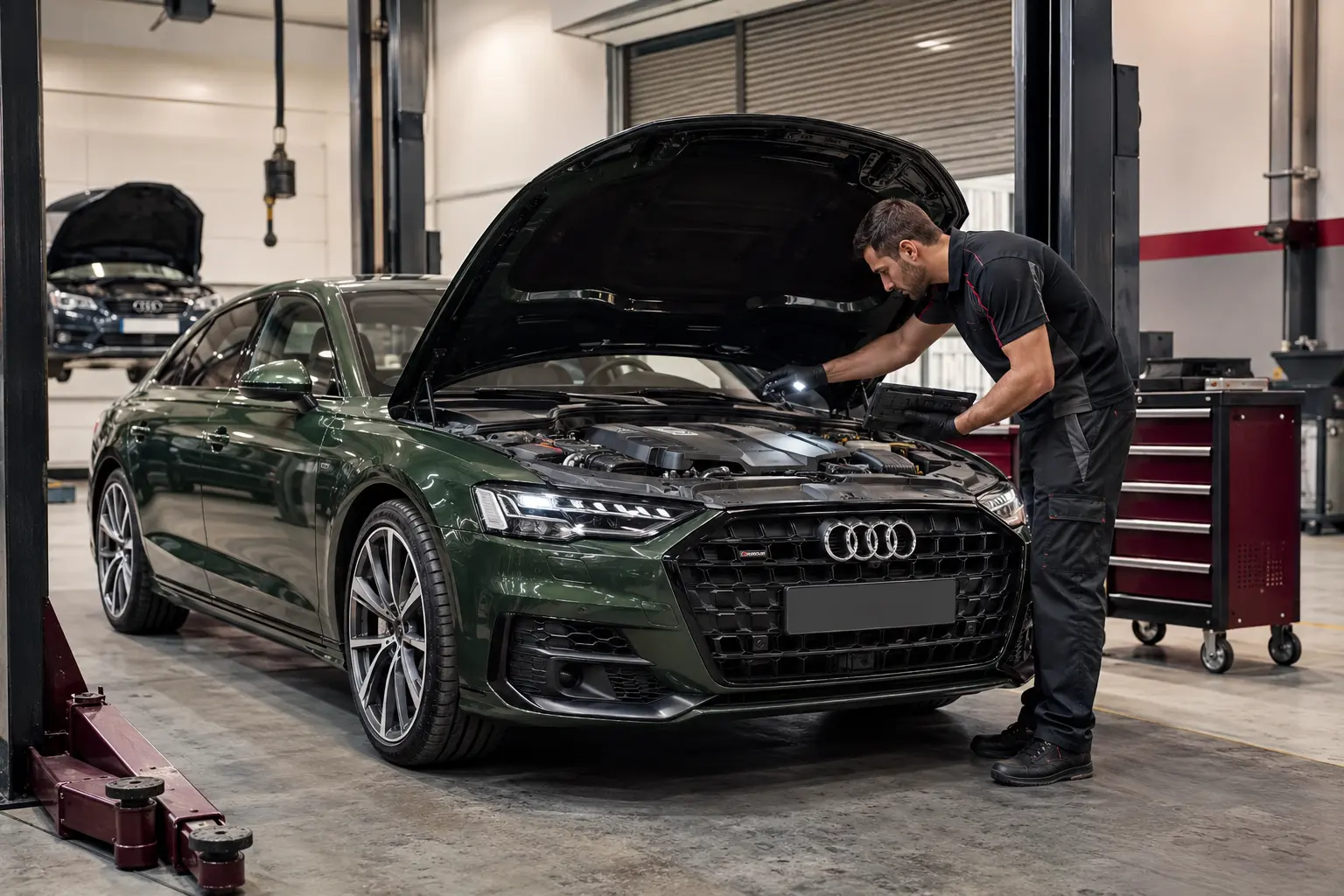
Inspection and approval are visible stages
The vehicle identity, observed condition and authorised repair route are recorded before work moves forward.

Independent workshop
What independent means
Audi Specialist Dubai is an independent workshop.
In practical terms, the repair conversation can include more than one suitable parts route where the exact vehicle and job allow it. The estimate should identify the selected route, the part brand or source available for that route, and the written terms that apply to the approved work.
Independence does not remove the need for vehicle-specific information. Model name alone is not enough for many parts or procedures. The year, VIN, engine or gearbox code, fitted equipment, previous repair history and current symptom can all change the correct starting point.
Customer protections
- A fault code alone is not treated as proof that an expensive module or part has failed.
- An estimate given from a message cannot cover faults that require inspection, testing or dismantling to confirm.
- An OE-supplier part is not described as the same product as an Audi Genuine part unless the exact evidence supports that statement.
- S, RS, R8 and e-tron capability is confirmed against the precise vehicle, task, equipment and safety requirement before booking.
- A verbal description of a warranty does not replace the terms written for the approved repair.
Workshop responsibility map
Who handles each stage
The map connects the customer request, assigned role, evidence produced, stop condition and approval point. Choose a work route to focus the eight stages on maintenance, mechanical, electrical or programming work.
Maintenance focus
Service history, mileage, time interval, fluid specification, fitted filters, visible condition and the approved service items.
Mechanical focus
Physical condition, measurements, leak or pressure evidence, repair access, parts condition and the closing mechanical check.
Electrical focus
Power, ground, wiring, signal, network behaviour and the conditions under which the electrical symptom appears.
Programming focus
Exact module task, compatible part, stable voltage, required access, completed coding or adaptation and the closing verification.
- 1Responsible roleService advisorAction and evidenceRecords the model, year, mileage, VIN when available, the driver complaint and any dashboard message.Customer input should distinguish what happened, when it happened and whether the vehicle can be driven safely.Stop or approval pointThe route is not assigned until the request and vehicle are identified clearly enough.
- 2Responsible roleService advisor and assigned technicianAction and evidenceRecords visible condition, warning indicators and immediate safety concerns before technical work begins.The intake record separates pre-existing condition from findings made later.Stop or approval pointUnsafe movement or a missing prerequisite changes the booking or recovery route.
- 3Responsible roleWorkshop assignmentAction and evidenceAssigns maintenance, mechanical, electrical or programming responsibility according to the complaint and initial checks.A job can cross routes, but each new route needs a reason.Stop or approval pointWork outside the agreed inspection or service scope returns to the approval step.
- 4Responsible roleAssigned technical roleAction and evidencePerforms the relevant physical checks, measurements, scan review or circuit tests.Evidence should match the recommendation. A scan result may guide testing but does not replace it.Stop or approval pointIf the cause is not supported, the technician should not move directly to replacement.
- 5Responsible roleTechnician and service advisorAction and evidenceTurns the findings into a repair, further-test or maintenance option that the customer can understand.Known limits, dismantling needs and parts alternatives belong with the recommendation.Stop or approval pointNo additional repair starts until the proposed scope can be identified.
- 6Responsible roleCustomer and service advisorAction and evidenceConfirms the authorised work, parts route, labour scope and written job-specific terms.Approval should be linked to a defined estimate or job card rather than an open instruction to repair anything found.Stop or approval pointA changed finding or price returns here before the scope expands.
- 7Responsible roleAssigned technician, electrician or programmerAction and evidenceCompletes only the approved task and records relevant parts, measurements, settings or repair steps.Another specialist may be assigned when the work crosses a technical boundary.Stop or approval pointUnexpected damage, access needs or incompatible parts stop progression until reviewed.
- 8Responsible roleTechnician and service advisorAction and evidenceCompletes checks appropriate to the job, explains the invoice and records the terms that apply after handover.Close-out may include a scan, measurement, leak check, road test, adaptation record or photographs when relevant.Stop or approval pointThe vehicle should not be handed over as complete when the agreed close-out check has not been satisfied.
The person assigned is confirmed with the job. The service advisor records that responsibility with the approved scope.
Role ownership
Where responsibility begins
Each job identifies who records the complaint, who performs the test, where approval is required and who completes the handover.
Service advisor
Owns the intake record and the customer-facing approval path.
- Receives
- Vehicle details, symptoms, warning messages, history and booking constraints.
- Produces
- A recorded complaint, estimate or approval reference, updates and handover explanation.
- Boundary
- Does not turn a message or fault code into a technical diagnosis.
Assigned technician
Owns the physical inspection and approved mechanical or maintenance work.
- Receives
- The recorded complaint, vehicle context and approved diagnostic or service scope.
- Produces
- Findings, measurements or observed condition appropriate to the work.
- Boundary
- Returns changed findings for customer approval before expanding the job.
Electrical route
Owns circuit evidence when the fault depends on power, ground, signal, wiring or network behaviour.
- Receives
- Symptom context, scan information and the vehicle condition under which the fault appears.
- Produces
- Relevant voltage, continuity, load, signal or wiring findings where the assigned test requires them.
- Boundary
- Does not label a module failed only because a communication or stored fault is present.
Programming route
Owns coding, adaptation or programming only after prerequisites and the exact task are confirmed.
- Receives
- A supported technical reason, correct component information and stable vehicle conditions.
- Produces
- A record of the assigned task and the close-out check that shows whether it completed as intended.
- Boundary
- Does not imply unrestricted access to manufacturer systems or authorised-dealer status.
Technical routes
How diagnosis is separated
Mechanical diagnosis, electrical fault tracing and programming solve different questions. Combining them without a clear boundary can turn a useful scan result into an unsupported replacement.
Mechanical diagnosis
The route begins with the driver’s symptom and the conditions that reproduce it. Physical inspection and measurements should then narrow the cause before external repair, internal repair, overhaul or replacement is discussed.
- Confirm the symptom and relevant operating condition.
- Inspect accessible causes and record condition.
- Use a measurement or test that can support or rule out the likely cause.
- Explain whether the next step is further diagnosis, targeted repair, dismantling or a major repair decision.
- Agree how the result will be checked after the work.
An overhaul or replacement decision needs more than a warning light, noise description or stored code. It needs evidence connected to the suspected internal fault.
Electrical and programming
Electrical testing asks whether the circuit, supply, ground, signal, wiring or connected unit behaves correctly. Programming begins only when the module task, compatibility and prerequisites are known.
- Read the full fault context rather than one isolated code.
- Check the power, ground, wiring or signal evidence relevant to the fault.
- Confirm whether the problem is electrical, component-related, configuration-related or still unproven.
- Repair the supported cause or define the programming task.
- Repeat the relevant check after repair, coding or adaptation.
Programming cannot repair a poor power supply, damaged wiring or an incompatible component. Those conditions must be addressed first.
For a deeper step-by-step fault-finding guide, use the Audi diagnostics page. The full workshop scope is organised on the Audi repair services page.
Workshop capability
Scope is vehicle specific
Booking scope is confirmed from the model, generation, powertrain, installed equipment and requested repair. High-voltage work is accepted only when the exact task, equipment and safety requirements can be supported.
| System | Typical starting point | Decision before work | Important boundary |
|---|---|---|---|
| Maintenance | Mileage, service history, time interval and current condition | Required items, fluid specification, filters and any additional findings | A service booking does not automatically approve repair of unrelated faults |
| Engine and cooling | Symptom, leak or pressure evidence, noise, temperature behaviour and measurements | External repair, further testing, internal inspection or major repair route | Internal damage should not be assumed from a scan result alone |
| Gearbox | Complaint conditions, fluid condition where relevant, scan data and mechanical checks | Service, targeted repair, overhaul, used unit or another supported route | Gearbox type and code must be confirmed before parts or replacement decisions |
| Brakes and suspension | Physical condition, measurements, wear, movement and road behaviour where safe | Repair scope, axle position, related hardware and parts route | Warning indication and visible wear need to be reconciled with inspection |
| Air conditioning | Output condition, pressures, leaks, electrical command and component operation | Leak repair, electrical work, component repair or recharge within a supported scope | Gas top-up alone does not identify why performance was lost |
| Electrical | Fault context, power, ground, circuit, signal and network behaviour | Wiring repair, component test, replacement or referral to programming | A communication code is not automatic proof of module failure |
| Programming | Exact module task, part compatibility, stable voltage and required access | Coding, adaptation, programming or responsible referral | Capability must be confirmed for the exact task before booking |
| S, RS, R8 and e-tron | Exact model, generation, powertrain, system and safety requirement | Accept, limit or refer the work according to confirmed capability | High-voltage work is never assumed from general Audi capability |
Parts choices
Know which route you approved
The estimate should name the proposed parts route, manufacturer or source, fitment basis and written terms.
Brand network route
The estimate should identify the Audi Genuine part and confirm fitment for the VIN or vehicle specification. Availability, price and written coverage can differ from other routes.
Named supplier option
A reputable supplier option should be shown by its actual manufacturer and part number where available. It should not be described as identical to the Audi Genuine part without exact evidence.
Suitable aftermarket
A value option still needs correct fitment and a clear brand. Suitability depends on the system, expected use, availability and the repair-specific terms written for that job.
Current workshop policy
The current policy allows Audi Genuine and, when requested and suitable for the repair, other branded parts routes. Fitment is checked from the VIN before parts are ordered.
If you want a particular route, ask for the actual brand, part number, fitted price and applicable written terms to appear on the estimate before ordering.
Estimate and approval
Changes require renewed approval
Some work can be estimated from the model, year, VIN and a clearly defined service. A fault, hidden condition or dismantling result may require inspection before the full repair scope is known.
Initial request
Record the vehicle and the service, symptom or warning message. Clarify whether the car can be driven safely.
Inspection scope
Define what can be checked without dismantling and what needs paid diagnosis, access or disassembly.
Written option
Identify labour, parts route, fluids, consumables, VAT and known limits that apply to the option.
Customer approval
Link the authorisation to a defined scope. Approval should not become permission for unrelated extra work.
Variation and invoice
If the finding changes, explain the reason and revised option before continuing. The final invoice should match approved work.
Approval rule When dismantling reveals a different fault, added damage or an incompatible part, the workshop explains the revised work and price before continuing.
Warranty and workmanship
Written job terms control
Coverage can differ with the repair, selected part route, supplier terms, mileage and the condition of connected systems.
The approved estimate or job card states the selected parts, repair scope and warranty terms for that job. Any duration, mileage limit, exclusions and claim steps must be written there.
A warranty assessment compares the returning symptom with the original repair, fitted part and written scope.
Closing evidence
How completed work is checked
- Scan recordUsed when stored faults, live values, coding or adaptations are relevant to the work.
- MeasurementsUsed when pressure, wear, voltage, temperature, leakage or another value supported the decision.
- PhotographsUseful for visible condition, dismantling findings, fitted parts or areas that will no longer be visible.
- Part identityBrand, part number and selected route where those details control fitment or written terms.
- Physical checkLeak, pressure, torque, movement, output or another check matched to the repair.
- Road verificationUsed only when safe, lawful and relevant to the reported symptom or completed work.
- Adaptation recordRelevant when an approved setting, basic setting, coding or programming task was completed.
- Invoice and termsRecords approved labour, parts and the repair-specific coverage supplied at handover.
The closing record includes only the evidence relevant to the complaint and approved repair.
Visiting the workshop
Send details before arrival
The workshop is at Warehouse 39, Al Quoz 4, Dubai, United Arab Emirates. Sending the vehicle details first helps the team decide whether you need a routine booking, diagnostic intake or a safer transport route.
If the vehicle has an oil-pressure warning, overheating, severe braking problem, major fluid loss, burning smell or another condition that may make driving unsafe, call or WhatsApp before moving it so the workshop can advise the correct intake or transport route.
Details to send
- Audi model and year
- Current mileage
- VIN when a parts or specification check is needed
- Service required or symptom in your own words
- Exact dashboard message or a clear photograph
- When the problem happens and whether it is happening now
- Whether the vehicle can be driven safely
Customer questions
Before you hand over
Confirm these operating, approval and capability details before handing over the vehicle.
Who operates the workshop?
AMF AUTO SERVICES LLC operates Audi Specialist Dubai under the public workshop name Audi Specialist Dubai.
Where is the workshop located?
The workshop address is Warehouse 39, Al Quoz 4, Dubai, United Arab Emirates. Use the map link on this page for directions.
Who will diagnose or repair my Audi?
The service advisor records the complaint and approval path. The workshop assigns the relevant technician, electrical route or programming route according to the job. The booking or job card identifies the person assigned and approved scope.
Can I choose Audi Genuine or another parts route?
The current parts policy allows Audi Genuine, OE-supplier or suitable aftermarket routes where available and appropriate. Ask for the actual brand, part number, fitted price and written terms before you approve the option.
Will I receive an estimate before work begins?
A defined service may be estimated from accurate vehicle details. Fault diagnosis, dismantling or hidden damage may need an inspection scope first. The repair option and parts route should be identified before the related work proceeds.
What happens if dismantling changes the scope?
The changed finding should be explained with the revised work and price. The job returns to the approval point before the additional scope continues.
What warranty applies to a repair?
The exact coverage depends on the approved repair, parts route and written terms. The estimate, job card and invoice control the scope. Ask the workshop to identify duration, mileage, exclusions and the claim process for your specific job.
Do you handle S, RS, R8 or e-tron models?
Capability must be confirmed for the exact model, generation, powertrain and job. High-voltage e-tron work depends on the precise task, equipment and safety requirements and should never be assumed from general Audi capability.
What should I send before booking?
Send the model, year, mileage, service or symptom, exact dashboard message, when the problem occurs and whether the vehicle can be driven safely. Include the VIN when a parts or specification check is needed.
Workshop author and Audi specialist
Abu Hashim
Abu Hashim is an Audi specialist in Dubai with four years of workshop experience involving TFSI and TDI engines, S tronic gearboxes and MMI electronics.
He writes the guides on audispecialist.ae to help Audi owners across the UAE understand what could be wrong, which checks are needed, what repairs may cost and when a replacement is unnecessary. His articles are designed to support an informed workshop conversation, not replace vehicle-specific diagnosis.
About the Workshop
Explore the workshop and service routes
These pages extend the decision path without replacing diagnosis or repeating the same service intent.