
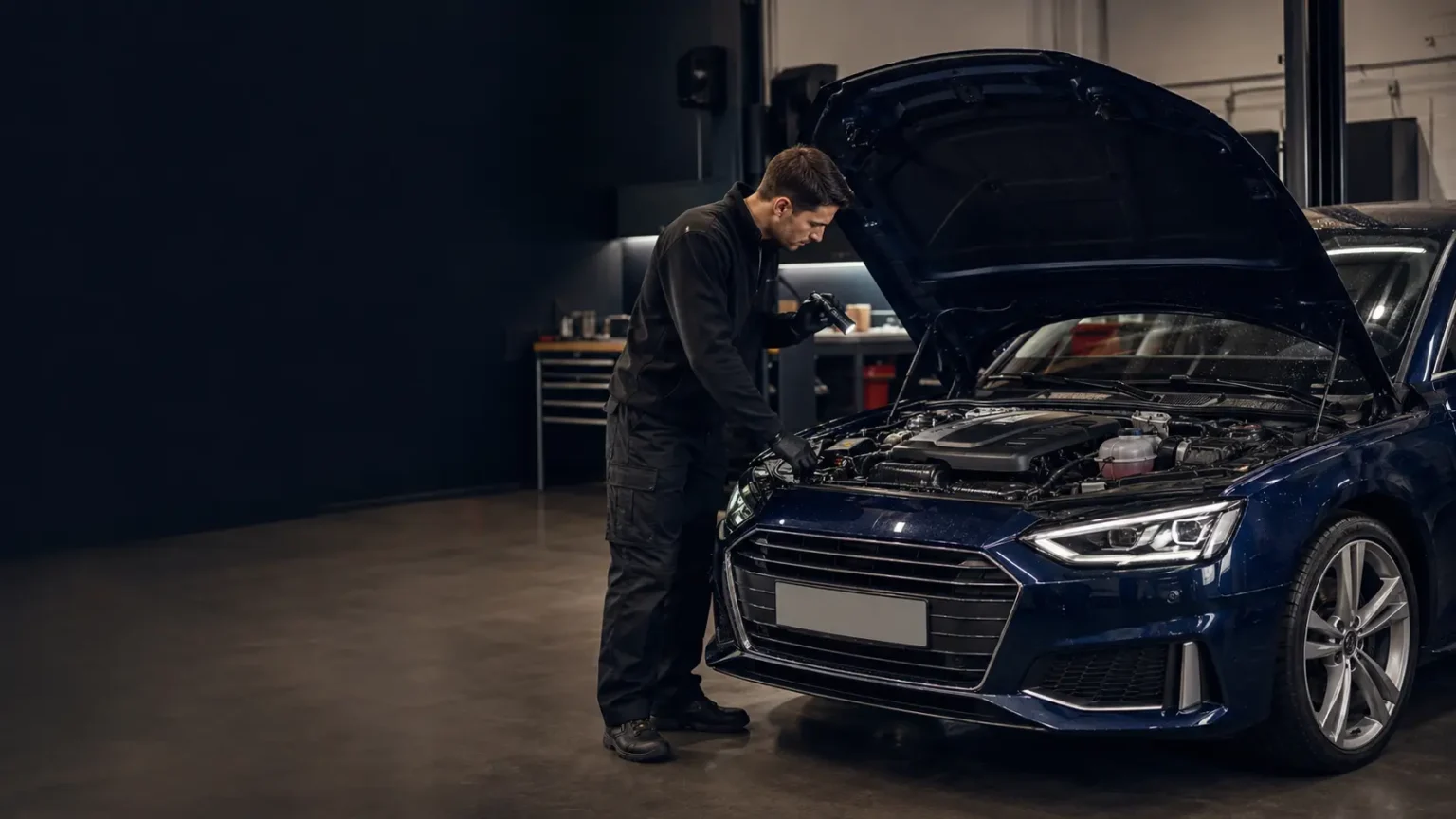
Cooling diagnosis in Al Quoz
Audi cooling system repair in Dubai
Audi cooling system repair in Dubai is a diagnostic service for coolant loss, overheating and temperature warnings involving containment, circulation, airflow, electrical control or the engine. We preserve useful evidence and select tests that separate those routes before quoting a repair. The Audi overheating guide explains the immediate safety decision and the observations worth preserving before arrival.
Safety triage
Choose the safe next step
A symptom can set the urgency without proving which part has failed. Use the observed condition, the warning behaviour and whether coolant is actively escaping. When the road position itself is unsafe, prioritise personal safety and local recovery support.
Active heat or severe warning
Steam, a red temperature warning, a rapidly rising temperature indication, heavy coolant loss, severe heat with power loss, knocking or an oil-pressure warning justify stopping as soon as it is safe. Switch off, move away from traffic when possible and contact the workshop or recovery support. Continuing to drive may turn a cooling-system problem into a wider engine concern.
Condition is uncertain
A recurring warning, a fresh puddle, repeated top-up need, an unknown fluid loss or a vehicle that has recently overheated should be assessed before another journey. Tell us whether the engine is cold, whether the warning is still active and whether the level appears to fall. If safety is uncertain, arrange recovery rather than testing the vehicle on the road.
Historic or minor evidence
A small dried trace found on a cold vehicle, an old warning that has not repeated or a mild odour without a temperature change may allow a planned inspection. Photograph the evidence before cleaning or topping up. Monitor only within the instructions for the specific vehicle, and do not treat repeated topping-up as a repair.
Hot-cap warning. A hot cooling system can retain pressure even after the engine is switched off. Never remove the expansion-tank or radiator cap while hot or pressurised. The correct waiting and checking procedure depends on the vehicle, its condition and the applicable owner information.
Cooling route navigator
Start with the symptom
Choose the observation that best matches the vehicle. The highlighted route is a useful starting area, not a remote diagnosis. All three branches remain visible because more than one route can overlap.
What did you observe
Select an observation to focus the route worth checking first.
Pressure and containment
This branch asks whether coolant is staying inside the intended circuit and whether the visible evidence identifies an active source rather than old staining or fluid from another system.
- Record first
- Where residue or fluid appears, whether the engine was hot or cold, how quickly the level changed and whether recent work disturbed the area.
- Workshop separation
- A cold visual inspection, identification of the fluid, inspection of the highest active source and a pressure test when appropriate may separate an external leak from a control or circulation concern.
- Decision after evidence
- Repair the verified source, widen access only when justified, or continue to another branch if containment remains supported.
Circulation and temperature control
This branch considers whether heat is being carried through the relevant circuit and regulated as intended. Pump design, thermostat arrangement, control method and the number of cooling circuits vary by vehicle.
- Record first
- When the temperature changes, whether cabin heat changes at the same time, whether the event follows a repair and whether the warning clears after cooling.
- Workshop separation
- Applicable temperature comparison, flow evidence, pump or control checks, scan-supported data and the correct fill or bleeding review can help distinguish circulation, regulation and trapped-air routes.
- Decision after evidence
- Confirm the component and access boundary, correct a filling issue where supported, or widen the investigation when circulation evidence does not explain the symptom.
Airflow and electrical control
This branch asks whether the radiator area can release heat to the passing air and whether the fans, supply, wiring, sensors and relevant control commands support that process.
- Record first
- Whether the temperature changes in traffic or at speed, whether a fan sound changed, whether front-end work was recent and whether the air-conditioning behaviour changed separately.
- Workshop separation
- Physical airflow inspection, fan actuation where applicable, supply and control testing, connector checks and scan evidence can separate obstruction, fan, wiring, sensor and command routes.
- Decision after evidence
- Restore the verified airflow or electrical path, keep AC repairs in their own scope, or return to circulation and engine checks if the fan route is supported.
Guidance only. The navigator cannot confirm a failed pump, thermostat, radiator, cap, fan, sensor or gasket. It shows why the first useful test changes with the symptom and operating condition.
Symptom evidence ledger
Record more than the warning
The exact observation helps, but it does not name the failed part. The workshop uses location, timing, temperature state, recent work and repeatability to decide what deserves testing.
Swipe or scroll the table sideways to compare every column.
| Observation | Safely record | Routes that can overlap | Workshop separation | What it does not prove | Urgency boundary |
|---|---|---|---|---|---|
| Audi coolant warning | Photograph the exact wording and colour, note engine temperature, outside condition and whether the warning stayed active. | Level, containment, sensor evidence, circulation or a previous filling issue. | Cold level and condition check, visible inspection, relevant stored data and further tests selected from that evidence. | A warning alone does not prove the water pump, thermostat or level sensor has failed. | Stop for red or severe temperature behaviour. Seek advice before driving when level loss is suspected. |
| Puddle or residue | Photograph the location before cleaning, note colour without using it as specification proof and check whether the vehicle was recently serviced. | Coolant, water, washer fluid, AC condensation or another vehicle fluid. | Identify the fluid, follow splash paths upward and find the highest active source before disturbing evidence. | The lowest wet point is not automatically the original leak point. | Rapid loss, steam or a temperature warning requires stopping. A dry historic trace can be scheduled soon. |
| Sweet or unusual odour | Note whether it is inside or outside, when the ventilation runs and whether any mist or residue is present. | External coolant trace, heater circuit, spilled fluid or an unrelated cabin odour. | Cold inspection, pressure testing when suitable and a separate cabin or AC route if evidence points away from engine cooling. | Odour alone does not establish a heater core or external leak. | Stop if odour accompanies steam, active overheating or impaired visibility. Otherwise arrange diagnosis. |
| Steam | Stop safely, switch off and observe from a safe distance. Record where it appeared only if that can be done without approaching danger. | Active coolant escape, severe heat or fluid contacting a hot surface. | Recovery intake, cold inspection and testing only after the vehicle is safe and the system has depressurised. | Steam location viewed from outside may not identify the failed connection or component. | Treat as a stop-driving condition. Never open the hot cap. |
| Heat rises in traffic | Note the exact gauge or warning behaviour, fan sound, AC use and whether the condition changes once the vehicle moves. | Airflow restriction, fan control, coolant circulation, sensor evidence or wider thermal load. | Cooling-pack inspection, fan and electrical checks, scan-supported comparison and circulation tests where justified. | The traffic pattern does not automatically prove a fan motor has failed. | Stop if temperature continues rising or a red warning appears. Do not recreate the event for testing. |
| Heat rises under load | Record speed, incline or load condition, warning wording and whether the temperature recovered after reducing load. | Containment, circulation, heat rejection, engine condition or a configuration-specific auxiliary circuit. | Leak evidence, temperature comparison, airflow and circulation checks, followed by engine tests only when supported. | The pattern does not by itself prove a blocked radiator or damaged engine. | Stop for continuing rise, severe warning, power loss, knocking or oil-pressure warning. |
| Cabin heat changes | Note whether airflow strength stayed normal, whether engine temperature changed and whether the symptom affected both sides of the cabin. | Coolant circulation, heater circuit, air in the system, climate-control airflow or an unrelated AC concern. | Compare engine and cabin behaviour, inspect coolant evidence and keep flap or refrigerant diagnosis in the AC scope. | Changing cabin heat does not alone diagnose a pump, thermostat or heater core. | Use engine warning behaviour to set urgency. Cabin comfort alone is not an overheating verdict. |
| Fan runs unexpectedly | Note whether the engine was hot, whether the vehicle had just stopped, how long the fan ran and whether a warning appeared. | Normal strategy, heat soak, sensor input, control request, wiring issue or a wider fault. | Check applicable operation, stored data, sensor plausibility, supply and command evidence before replacing a fan. | Fan noise or run-on does not automatically mean the fan or sensor is faulty. | Arrange diagnosis if new, persistent or linked to warnings. Stop if active overheating is present. |
| Repeated top-up need | Record frequency, amount if known, fluid used, invoice history and any trace that appears before topping up. | External loss, internal route, incorrect previous level, filling issue or an unverified observation. | Preserve residue, inspect cold, pressure test where suitable and widen to engine checks only if evidence supports it. | Repeated loss does not establish where the coolant went. | Rapid or accelerating loss needs urgent advice. Repeated top-up is not a safe long-term substitute for diagnosis. |
| No visible leak | Keep warning photos, note odour, exhaust appearance, misfire, heater change, recent work and whether undertrays were fitted. | Hidden external leak, heat-dependent leak, retained undertray fluid, internal route, sensor or filling concern. | Cold and heat-cycle inspection, pressure testing, undertray examination and engine tests only when the initial evidence requires them. | No puddle does not prove there is no external leak or that internal engine damage exists. | Use warning severity, loss rate and temperature behaviour to decide between recovery and planned inspection. |
Connected functions
How the cooling system works
The system contains coolant, moves it through the applicable circuits, controls when and where heat is exchanged, releases heat through the radiator area and reports relevant conditions to the vehicle. A change in any one function can create a similar warning to a problem elsewhere, which is why a symptom should lead to a test plan rather than a parts guess.
Containment depends on tanks, caps, hoses, connections, seals, radiators, housings and other configuration-specific joints. Circulation can involve mechanically driven or electrically controlled pumps, and some vehicles use more than one circuit. Temperature regulation may involve a thermostat or another control arrangement. Airflow depends on vehicle movement, the front cooling pack and fan operation. Sensors and control modules provide evidence, but their data must be compared with physical behaviour.
The heater circuit can also reflect coolant movement, while the air-conditioning circuit remains a separate repair scope even when the condenser sits near the radiator. Vehicle layout, engine, model year and powertrain determine which parts and procedures apply. No universal Audi coolant approval, fill quantity, pressure value or bleeding method should be selected from colour or model name alone.
Measured inspection
Diagnosis before replacement
No Audi receives every possible test. The sequence narrows as evidence becomes stronger, and each step should answer a defined question. If the result does not support a conclusion, the uncertainty stays visible in the estimate.
Document the cooling event
We start with the exact warning, the operating condition, recent work, any fluid added and whether the vehicle was driven after the event. A clear intake separates a current failure from an old stain, an intermittent warning or a filling concern.
Preserve cold evidence
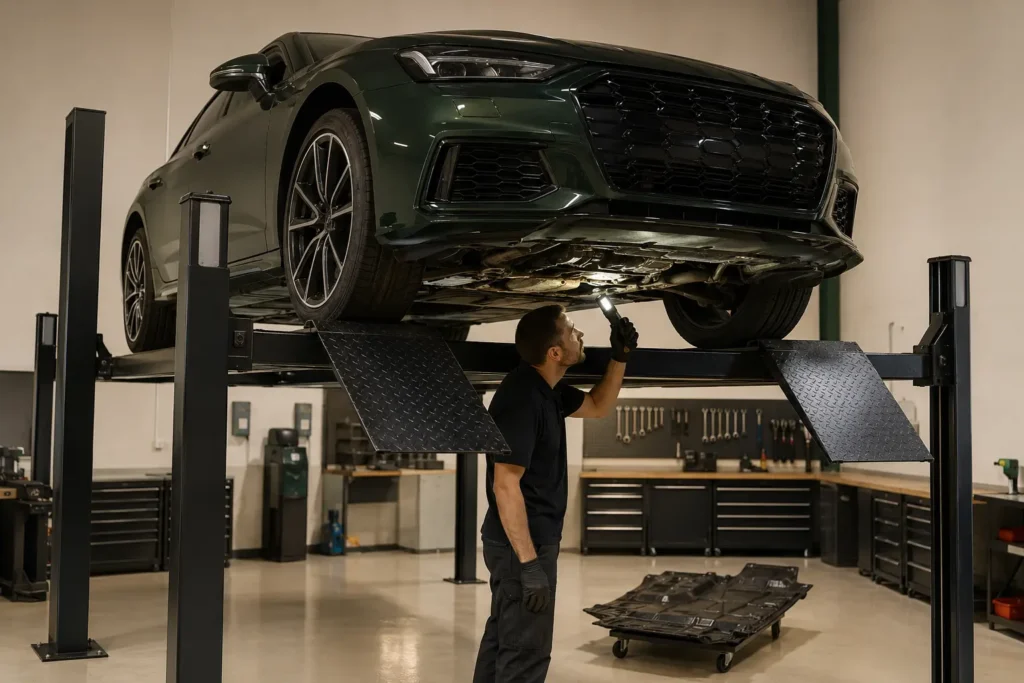
A cold visual inspection can reveal residue, splash direction, wet connections, tank condition, disturbed clips or undertray evidence before cleaning or topping-up changes the picture. The technician avoids declaring the lowest wet point to be the source.
Confirm level and fluid
Level and fluid condition are checked only through the applicable safe procedure. Colour is not used as proof of coolant approval. If the previous fluid is unknown or mixed, that uncertainty becomes part of the repair plan rather than a guess.
Select the useful test
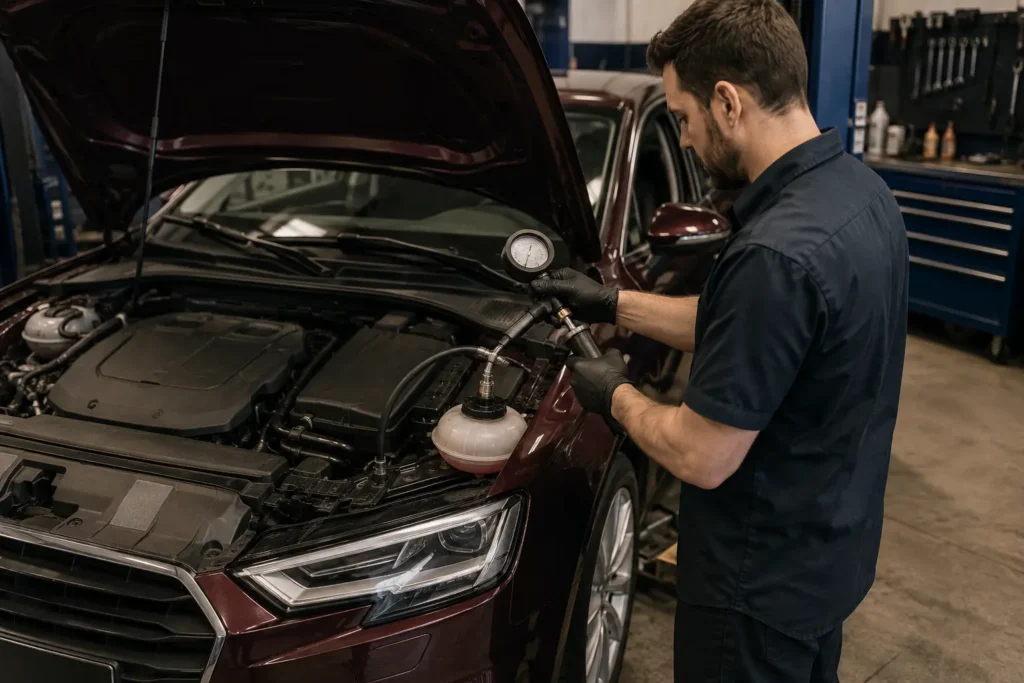
Pressure, scan, temperature, electrical or mechanical checks are chosen from the first evidence. A static pressure test may help one question, while a heat-dependent event, control issue or engine concern can require a different route.
Trace the active source
Leak diagnosis follows evidence upward and considers splash paths, airflow, undertrays and heat. The aim is to identify the highest active source or show that the visible trace does not yet support a repair decision.
Define the repair work
The estimate should distinguish the verified leaking or failed item from related access, seals, one-time-use hardware, coolant, electrical work and anything still unconfirmed. Approval is requested before the scope expands.
Use the correct filling procedure
After an authorised repair, refill, vacuum-fill or bleeding follows the vehicle-specific procedure and available technical information. The method cannot be assumed from another engine or from the appearance of the tank.
Recheck connected functions
Leakage, level, temperature behaviour, fan operation and relevant stored data are reviewed as applicable. A successful repair is more than the absence of a warning immediately after assembly.
Verify under useful conditions
A suitable heat cycle or road condition may be needed when safe and justified. The test should reflect the original complaint without deliberately recreating an unsafe overheating event or exceeding a cautious operating boundary.
Document the next action
The final record should state what was observed, what was tested, what the result supported, what was repaired and what monitoring remains. If an engine or electrical route is still open, that is explained rather than hidden inside a completed cooling repair.
Visible and hidden loss
Find the highest active source
A coolant trace can travel a long way before it becomes visible. Airflow can push it rearward, a belt or pulley can spread it, gravity can carry it across housings and an undertray can hold fluid until the car is parked. The first wet point seen from below may therefore be a collection point rather than the source.
Old staining also needs context. A dried deposit may remain after a previous repair or a small spill. Fresh coolant added during a top-up can wet the tank area. Condensation water and fluids from other vehicle systems can appear near the same parking position. The first useful task is to identify the fluid and preserve the pattern before it is wiped away.
A cold inspection may follow the tank, cap area, hose connections, flanges, radiator, visible joints and applicable pump or housing routes. These are inspection areas, not a catalogue of common failures. A cap concern needs evidence about sealing and pressure behaviour. A tank seam needs fresh activity or a supported test result. A wet hose connection should be traced above and around the joint before it is condemned.
Heat-dependent leaks can remain dry during a short cold check. Conversely, pressure testing can reveal a static leak without proving how the system behaves at temperature. The test plan may combine a suitable pressure check, careful inspection after a controlled heat cycle and review of undertrays or shielding. No owner should crawl under a hot, unstable or roadside vehicle to reproduce that process.
- Useful owner evidence
Photograph the residue location, the ground position and the exact warning before cleaning or topping up. - Useful workshop evidence
Record whether the trace is fresh, its highest supported source, the test condition and any access needed to confirm it. - Unhelpful shortcut
Replacing the lowest wet component without tracing splash paths can leave the original source unresolved.
Circulation and regulation
Test pump and thermostat concerns
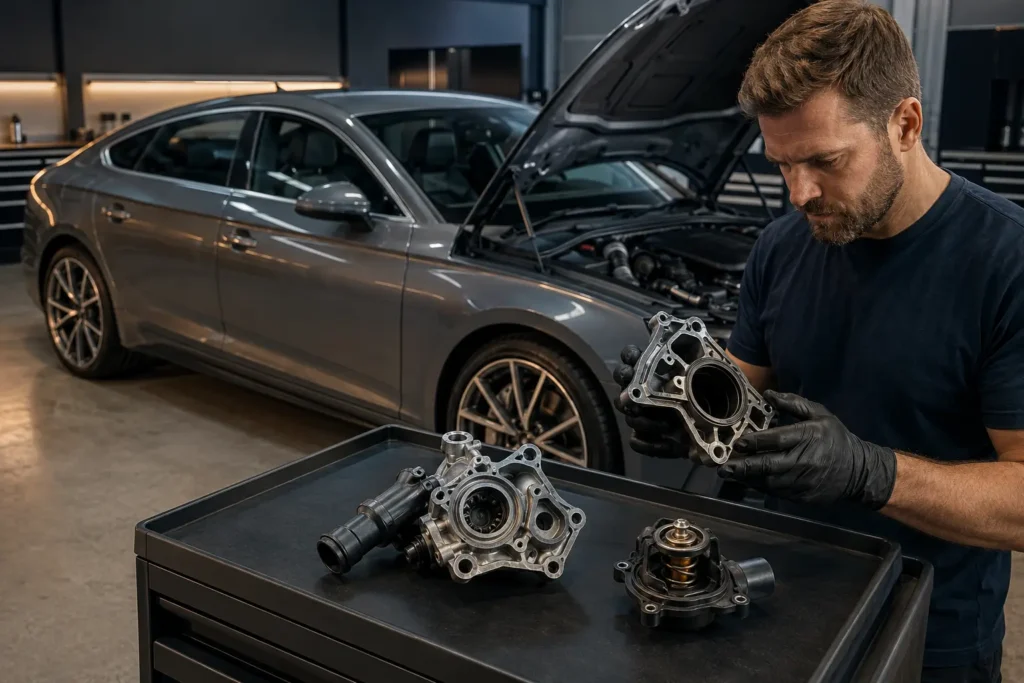
Owners often hear water pump or thermostat as the first explanation for coolant loss or overheating. Either component may be relevant on a particular vehicle, but the symptom still has to be connected to evidence. Leakage, circulation, temperature regulation and electrical control are different questions even when a component assembly places them close together.
Pump type and location vary. A mechanically driven pump, an electrically controlled pump and an auxiliary pump do not share one universal test. A stored fault entry may guide the investigation, but it does not prove that the pump itself has failed. The workshop may need to compare command, supply, physical operation, temperature behaviour, leakage and the condition of the connected circuit.
A thermostat or temperature-control concern also requires context. Slow warm-up, unexpected temperature movement, overheating or a stored code can overlap with sensors, circulation, filling, airflow and engine condition. The useful test asks whether the control behaviour matches the applicable vehicle information and whether the observed temperatures agree with the vehicle’s reported data.
After evidence supports a repair, the written scope should answer practical questions. Does the estimate include related seals and applicable hardware? Is access labour defined? Is the coolant route verified for the specific vehicle? What filling or bleeding procedure is included? Which post-repair temperature, leak and warning checks will be completed? If an electrical or adaptation step is required, is it inside the estimate or a separate approval?
A pump and thermostat should not be presented as an automatic pair. Sometimes access, technical information or a combined assembly changes the sensible scope; sometimes the evidence supports only one item. The decision belongs in the estimate with the reason stated. Parts compatibility, approval, availability, condition and warranty also need confirmation before genuine, supplier-branded or aftermarket language appears in a quotation.
Heat rejection
Separate radiator and airflow checks
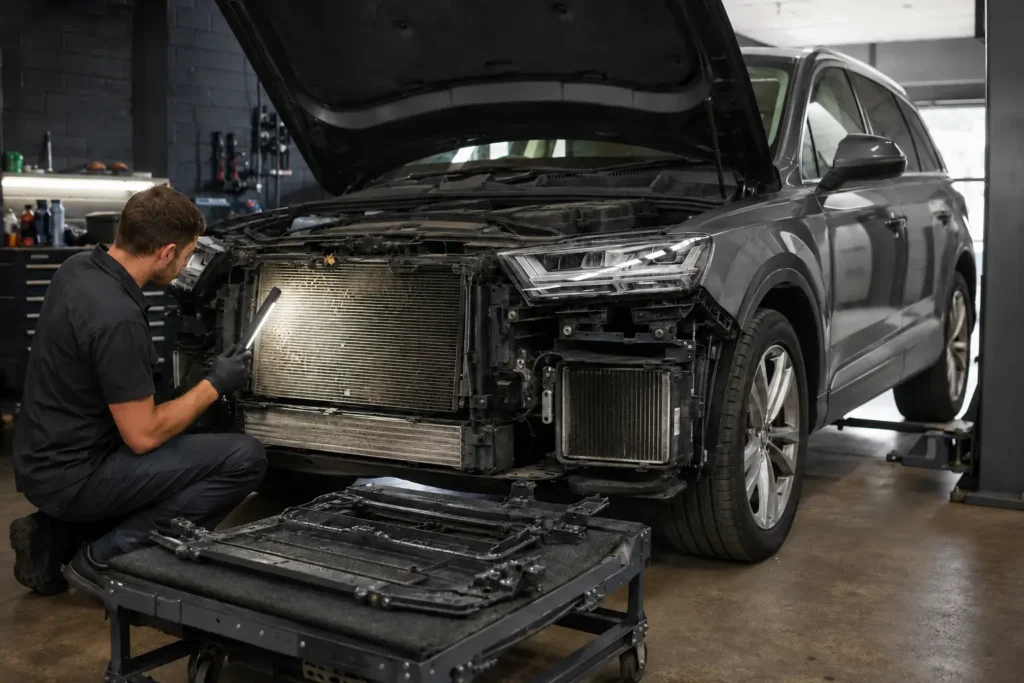
The radiator transfers heat from coolant to passing air, but it operates inside a front cooling pack with surrounding ducts, fans and, on many vehicles, the air-conditioning condenser. Visible damage, blocked fins, debris and poor sealing around the airflow path can affect heat rejection. That does not make every front-end temperature problem a radiator replacement.
Overheating in slow traffic can make fan and airflow testing a priority because vehicle speed is no longer supplying the same air movement. Overheating under sustained load can place greater emphasis on overall heat rejection, containment, circulation and engine condition. These patterns guide the order of tests, but neither pattern is a component verdict.
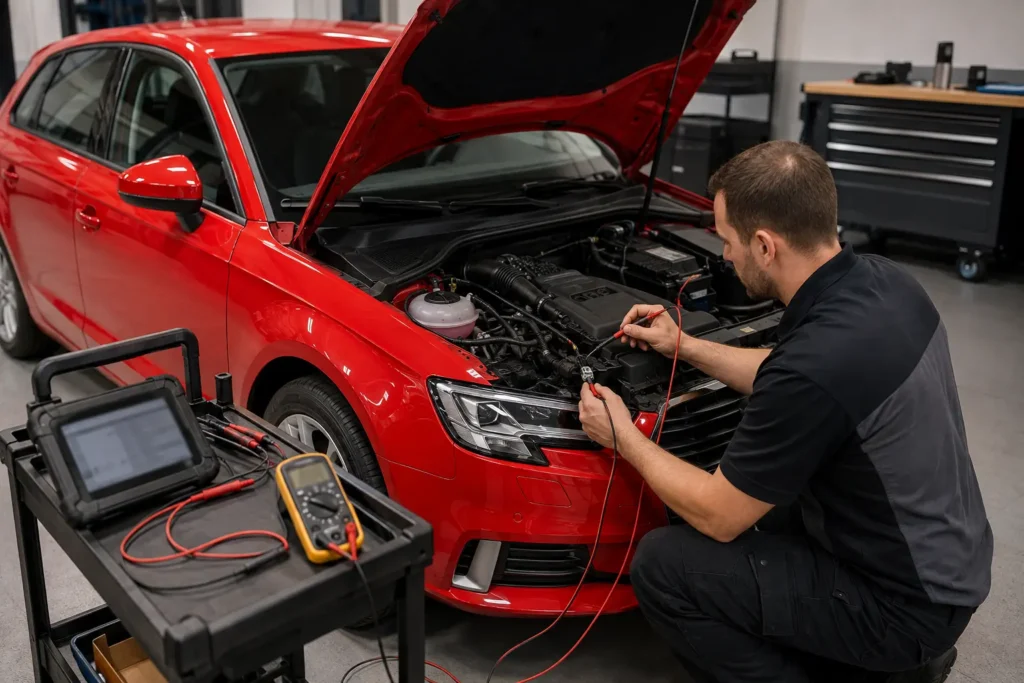
Fan operation also needs more than a sound check. A fan may be requested at different times for different reasons, and some systems use more than one fan or control stage. The workshop may compare a relevant command with supply, wiring, connector condition, sensor plausibility and physical operation. Scan data can support this work, but it cannot inspect a damaged connector, blocked cooling pack or weak electrical supply by itself.
The condenser and radiator may share the same incoming airflow, so an airflow concern can affect both cooling and cabin performance. The ownership boundary remains important. Refrigerant quantity, compressor operation, evaporator airflow and cabin temperature regulation belong to Audi AC Repair. This page keeps its focus on engine or applicable thermal-management coolant routes while recognising the physical overlap at the front of the vehicle.
After a repair, the verification should reflect the original complaint. That may include a controlled fan check, confirmation that the cooling pack is correctly assembled, comparison of relevant temperature information and a suitable heat cycle. The result should show that the verified route now behaves as intended, not merely that the warning is absent at idle for a few minutes.
Wider engine checks
Do not assume engine damage
Overheating or coolant loss can justify concern, but it does not automatically prove a head-gasket problem or internal engine damage. The investigation should widen only when the intake, initial inspection or test results support that route.
What supports a wider test
Continuing pressure behaviour, unexplained loss after external routes are checked, misfire, abnormal oil or coolant condition, combustion evidence, severe overheating history or a symptom that persists after a verified cooling repair may justify further work. The exact method depends on the evidence and engine configuration.
What may be compared
The workshop may inspect oil and coolant condition, look for relevant combustion evidence, compare compression or leakage where appropriate and assess continuing pressure or misfire. No single result provides certainty in every case, so findings should be combined rather than sold as a fear-based verdict.
What changes the repair
If evidence confirms a mechanical engine route, the repair decision moves beyond cooling-system ownership. A separate Audi engine repair assessment can define targeted repair, overhaul or replacement choices without hiding them inside a coolant-leak estimate.
Estimate logic
Turn findings into a clear estimate
A useful cooling-system estimate shows what the evidence established and what remains outside the approved work. It should be possible to compare two quotations without relying on a headline price that hides different parts, access, coolant or verification.
Repair the supported source
Name the leaking, failed or unsupported route and the test or inspection that led to it. If the result remains provisional until access, the estimate should say so before dismantling.
Define what access includes
List applicable seals, one-time-use hardware, coolant, access labour, electrical work and any related item whose condition can only be confirmed after access. State what requires additional approval.
Describe final verification
Explain the refill or bleeding route, leak recheck, temperature comparison, fan review, stored-data check and suitable heat-cycle or road verification that applies to the authorised repair.
Cost factors
Compare the complete estimate
A fabricated Dubai price range would not tell an owner what their Audi needs. Cost changes with the verified source, vehicle configuration, component access, coolant loss, connected damage, electrical diagnosis, required hardware, applicable fill procedure and the depth of final verification.
A simple external hose connection does not carry the same access as a hidden housing. A pressure test that finds an obvious source is different from an intermittent temperature problem requiring electrical and heat-cycle checks. A quote also changes when previous fluid is unknown, the cooling pack needs access or engine testing becomes justified.
For wider budgeting context, use the Audi Service Cost Guide, then request a vehicle-specific written estimate based on the inspected condition.
- Diagnostic boundary
What inspection or test is included and what remains outside it. - Parts route
Brand, compatibility, condition and approval status when verified. - Labour boundary
Access, dismantling, reassembly and any conditional work. - Fluid and consumables
Coolant route, seals, hardware and workshop materials. - VAT position
Whether the stated total includes VAT and any workshop charges. - Related work
Connected damage, electrical tasks or engine checks requiring approval. - Exclusions
Unconfirmed items, hidden damage and monitoring not included. - Warranty terms
Only the written, repair-specific terms that have been verified.
Evidence module
What the repair record should contain
No customer case is published here because an approved job card, complete readings, media and technician-reviewed sequence were not supplied for this page. A fictional model, code, pressure, temperature or outcome would make the page look specific while weakening the decision support. Instead, this module shows the evidence a real cooling-system investigation should retain.
- Reported condition
- The exact warning, loss pattern, operating condition, recent work and safe intake decision.
- Selected tests
- Which pressure, visual, temperature, scan, electrical or mechanical checks were chosen and what question each one answered.
- Recorded finding
- The observed source or unsupported route, including configuration, test condition and any uncertainty that remains.
- Authorised repair
- The item, access, seals, hardware, coolant, electrical work and exclusions approved by the customer.
- Closing verification
- Leak, level, temperature, fan, warning and road or heat-cycle checks that apply after the repair.
- Technical reviewer
- The technician who reviewed the finding and final record. This field remains pending until the real workshop evidence is assigned.
After the repair
Refill and verify the system
Repair completion depends on the correct fluid route and the applicable filling or bleeding procedure. An empty circuit, a partly drained circuit and a repair that opened only one branch may not receive the same process. The vehicle’s engine, powertrain, installed thermal-management equipment and current technical information decide what applies.
Coolant should not be identified from colour alone. Different products can share a colour, and similar-looking fluids may not share the same approval. When the existing fluid is unknown or mixed, the estimate should explain how that uncertainty will be handled. A universal top-up recipe or fill quantity would be unsafe and misleading.
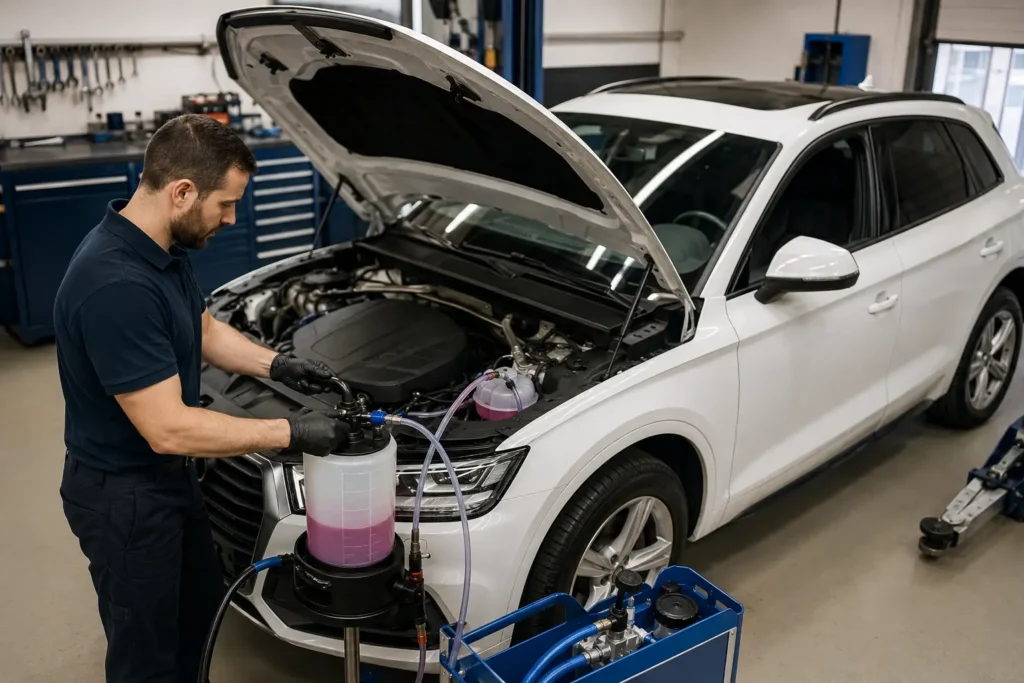
Vacuum-fill equipment can be useful for some configurations and repair states, but the tool itself does not prove that a system is free of every leak or pocket of air. The workshop still needs to check level, connected functions and the original complaint. Other configurations use a defined bleeding sequence or additional control steps. Those details belong to the vehicle-specific work record.
Final verification may combine a cold recheck, a controlled heat cycle, confirmation of fan behaviour, a review of relevant live or stored data and a suitable road condition when safe. The technician should also inspect the repair area after the system returns toward a cold state. A warning that stays off for a short idle period is not the only release criterion.
Owners should receive a clear monitoring instruction. That may cover a cold level recheck, any expected observation after service and the warning behaviour that requires stopping. It should never instruct the owner to open a hot system or repeatedly add unknown coolant while a leak remains unexplained.
Before contacting us
Send evidence we can use
A short, precise message helps the workshop decide whether to advise recovery, book a cold inspection or request more information. You do not need to name the failed part. The observed condition is more valuable than an online diagnosis.
- Audi model, year and engine
Include them if known. If you are unsure, say so rather than guessing. - Exact warning wording
Send a clear dashboard photograph or copy the message, including its colour and whether it remained active. - When behaviour changes
Note cold start, traffic, sustained speed, load, after parking or an intermittent event. - Steam, odour or residue
Describe what you saw and where, without approaching a hot or unsafe vehicle. - Recent coolant added
State what was used and how much if known. Keep the container or invoice if available. - Recent related work
Cooling, engine, battery or front-end work can change the first inspection route. - Current driving condition
Tell us whether the vehicle starts, whether a warning is active and whether it feels safe to move. - Useful photographs only
Remove personal documents, registration details and unnecessary identifiers before sending images.
Routine prevention also matters. Respond to recurring warnings, keep repair invoices, use only the verified fluid route and avoid repeated topping-up as a substitute for diagnosis. Service intervals and coolant requirements vary, so use the applicable vehicle information rather than a universal schedule. For planned care beyond this fault, see Audi Service and Maintenance.
Owner questions
Cooling-system repair questions
These answers set safe boundaries and explain what a test can establish. They do not replace the owner information or technical data for a specific vehicle.
If the exact warning is unclear, an Audi diagnostics assessment can combine the dashboard evidence with physical and electrical checks while this page retains cooling-system repair ownership.
Can I drive with a coolant warning?
It depends on the exact warning, temperature behaviour, coolant loss and whether the vehicle is in a safe position. A red temperature warning, steam, active overheating, rapid loss, severe heat with power loss, knocking or an oil-pressure warning means stop safely and contact the workshop or recovery support. Do not open the hot cap. A historic message or small dry trace may allow a planned inspection, but seek advice before driving when the level or warning severity is uncertain.
Why is coolant disappearing without a puddle?
A leak can occur only when hot or pressurised, evaporate from a warm surface, spread across an undertray or remain hidden behind shielding. Old staining can also confuse the picture. An internal route is possible in some circumstances, but no visible puddle does not prove engine damage. The workshop should begin with the loss history, a cold inspection and suitable containment checks, then widen the test only if the first evidence requires it.
Does overheating prove pump failure?
No. Overheating can overlap with coolant loss, circulation, temperature regulation, radiator airflow, fan control, sensor evidence, filling issues or engine condition. Pump design and control also vary. A workshop may compare leakage, physical operation, command or supply where applicable and relevant temperature behaviour. A fault entry or symptom can guide the route, but it should not be used as the sole reason to replace a pump.
Can a scan find a coolant leak?
A scan can show relevant stored faults, commands and live information, but it cannot see a split hose, dried residue, loose connection or blocked cooling pack. It also cannot identify every heat-dependent leak without physical evidence. Scan data is most useful when it answers a defined question and is compared with cold inspection, pressure behaviour, temperature evidence or electrical checks. A scan is one part of diagnosis, not a substitute for it.
Can I top up coolant myself?
Never open a hot or pressurised system. The correct fluid approval, safe checking method and level procedure depend on the vehicle. Coolant cannot be selected by colour alone, and mixing unknown products can complicate the repair. If the warning is active, the level is falling or the existing fluid is unknown, contact the workshop for advice. Repeated topping-up can hide the loss rate and should not replace diagnosis.
Why does temperature rise in traffic?
Slow traffic changes the airflow available at the cooling pack, so fan operation, airflow obstruction and electrical control can become useful test priorities. Circulation, coolant level, sensor information and wider thermal load can still overlap. The pattern does not prove a fan motor failure. Record whether the warning changes once the vehicle moves, whether the fan sound changed and whether air-conditioning use affected the event, then avoid deliberately recreating an unsafe rise.
Does coolant loss mean head-gasket damage?
No. External leaks, filling issues and configuration-specific cooling components can all cause loss. Internal engine checks become appropriate only when the history, initial inspection or test evidence supports them. The workshop may consider oil and coolant condition, combustion evidence, pressure behaviour, misfire, compression or leakage methods as applicable. No single test gives certainty in every engine, so the conclusion should combine evidence and avoid fear-based selling.
How is pressure testing used?
A suitable pressure test can help determine whether a cold system holds pressure and may make an external leak easier to locate. The applicable safe procedure, connection and limit depend on the vehicle and equipment, so a universal pressure value should not be published. A static test may not reproduce every heat-dependent problem and does not by itself prove circulation, fan control or engine condition. Its result should be recorded with the test condition.
What changes cooling repair cost?
Cost changes with the verified source, component access, vehicle configuration, related damage, required hardware, coolant route, electrical diagnosis, filling procedure and final verification. A useful written estimate states the diagnostic boundary, parts route, labour, fluids, VAT position, exclusions and verified warranty terms. A headline range without those details can make unlike scopes appear comparable. Send the model, symptom and warning evidence for a vehicle-specific estimate.
What to send us
Start with the observed condition
Send the Audi model and year, exact warning, when the temperature or loss appears, whether steam or active coolant loss is present, any recent work and whether the vehicle feels safe to move. The workshop can then advise whether to book a cold inspection, provide more evidence or arrange recovery.
Audi Cooling System Repair
Cooling and related repairs
These pages extend the decision path without replacing diagnosis or repeating the same service intent.