

12-volt testing, fitment and energy management
Audi Battery Replacement in Dubai
Audi battery replacement in Dubai should begin with a battery condition test, a charging check and the vehicle’s actual specification. We identify whether the fault belongs to the main 12-volt battery, an auxiliary battery, a connection, the charging system or an unwanted current draw before fitting parts.
Workshop diagnosis in Warehouse 39, Al Quoz 4. Main and auxiliary low-voltage batteries are covered. Key-fob cells, 48-volt components and high-voltage traction batteries follow different service routes.
Replacement becomes reasonable when the correct battery is fully charged for testing yet fails the applicable condition, conductance or load assessment, cannot provide stable cranking supply, has internal failure, or has unsafe physical damage. One flat start or one voltage reading does not prove that the battery has reached the end of its usable life.
Charge and test first. If it repeats, measure sleep-current behaviour before selling another battery. The Audi overnight battery-drain guide explains what parking and recent-change evidence to record.
Treat this as a charging-system or electrical-supply question until output and regulation are checked.
Verify specification, connections, registration where required, starting behaviour and stored low-voltage faults.
Symptom-led diagnosis
Choose the correct first test
A weak battery, discharged battery, charging fault, poor connection and starter problem can all produce a no-start complaint. Select the closest pattern to see what it changes.
Starting demand
Slow cranking is a circuit result
The battery must supply enough current through the positive cable, terminals, grounds and starter circuit. A laboured crank can come from low state of charge, reduced battery capacity, high resistance at a connection, an abnormal starter load or an engine that is mechanically difficult to turn. A single click can also be a supply or control-path issue.
Battery state of charge and state of health, cranking-voltage behaviour, cable voltage drop and the sound or speed of the crank.
Recharge and retest, clean or repair a connection, investigate the starter circuit, or fit the correctly specified battery.
Energy used while parked
A flat morning battery may still be serviceable
If the Audi starts after charging but becomes flat again after hours or days, the important questions are whether it was fully charged, whether the charging system replenished it, and whether the vehicle entered its normal sleep state. Normal standby loads, a module that remains awake, a light or latch signal, and aftermarket accessories can all change the pattern.
Charge history, resting period, current profile after shutdown, recent dash-camera or accessory work, and battery capacity after recharge.
Battery replacement only if it fails after proper charging, or a separate Audi electrical diagnosis for excessive draw.
Charging and power supply
The battery lamp is not a battery verdict
A red battery or electrical-system message while the engine is running usually demands a charging and supply check. Depending on the Audi architecture, the cause could involve alternator output, voltage regulation, the belt drive, cabling, battery sensing or a DC-DC converter. Replacing the 12-volt battery without correcting a charging fault can leave the car dependent on limited stored energy.
Charging behaviour under electrical load, control-module faults, voltage at the battery and generator path, and the exact dashboard message.
If steering assistance, lighting, cooling or multiple systems begin switching off, stop safely and arrange recovery rather than testing the remaining range.
Energy-management decision
Start-stop can be inhibited for many reasons
An unavailable start-stop function can reflect battery state of charge, battery temperature, climate demand, engine conditions, regeneration needs, steering input or another operating condition. It is useful context, but it is not a standalone battery-failure test. If the battery was recently changed, its specification and any applicable adaptation should be reviewed.
Battery technology and capacity, energy-management data, relevant faults and the conditions under which start-stop remains unavailable.
No repair, recharge and reassessment, correct battery registration, or diagnosis of another condition preventing the function.
Battery condition before replacement
Low charge is not lost capacity
Audi battery testing separates two questions that are often mixed together. A battery can be discharged because the Audi was parked for a long period, used mostly for short journeys, left with an electrical load, or supplied by a weak charging system. That describes its present state of charge. State of health asks a different question: how much useful capacity and starting performance remain after the battery has been prepared correctly for testing.
This distinction matters because a heavily discharged battery can produce a poor quick-test result before it is recharged, while an internally aged battery can show an acceptable surface voltage yet fall sharply when the starter demands current. The test method, battery technology, temperature and declared rating all affect interpretation. Useful data can include open-circuit voltage, internal resistance, conductance, calculated cold-cranking performance and reserve behaviour. Sulfation or other internal ageing may reduce usable capacity before the case shows visible damage.
\nLow-supply entries such as system voltage low, P0562, Terminal 30 or B+ voltage faults and multiple control-unit communication codes are clues, not automatic replacement instructions. They should be read with the battery test and the conditions under which the faults were stored.
How charged the battery is now. Charging history and recent use can change it.
How the battery’s usable capacity and starting ability compare with its intended condition.
How stable the supply remains when the starter and vehicle electronics place a real demand on it.
Security, terminal condition, venting, leakage, swelling, cracking and heat damage change the decision immediately.
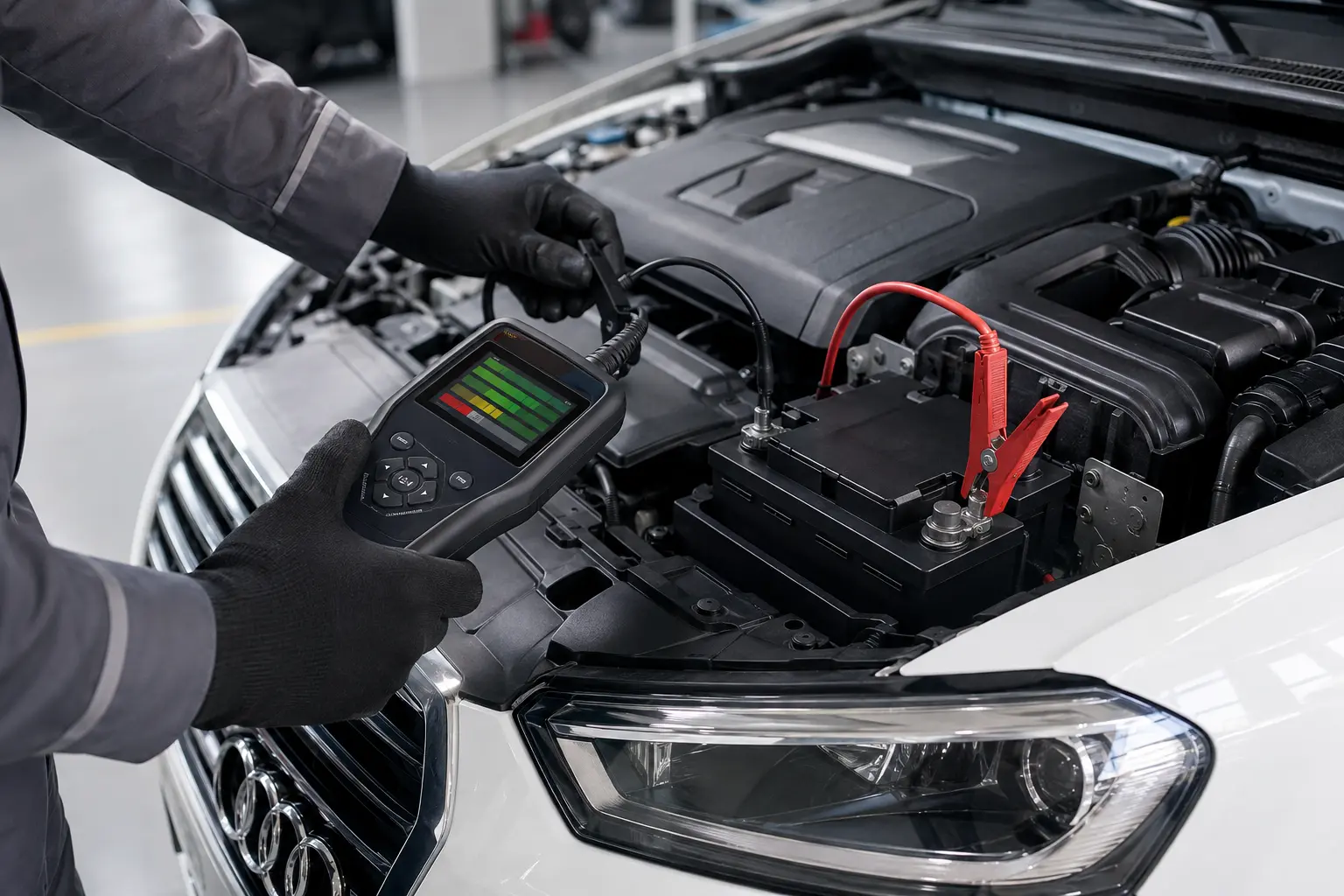
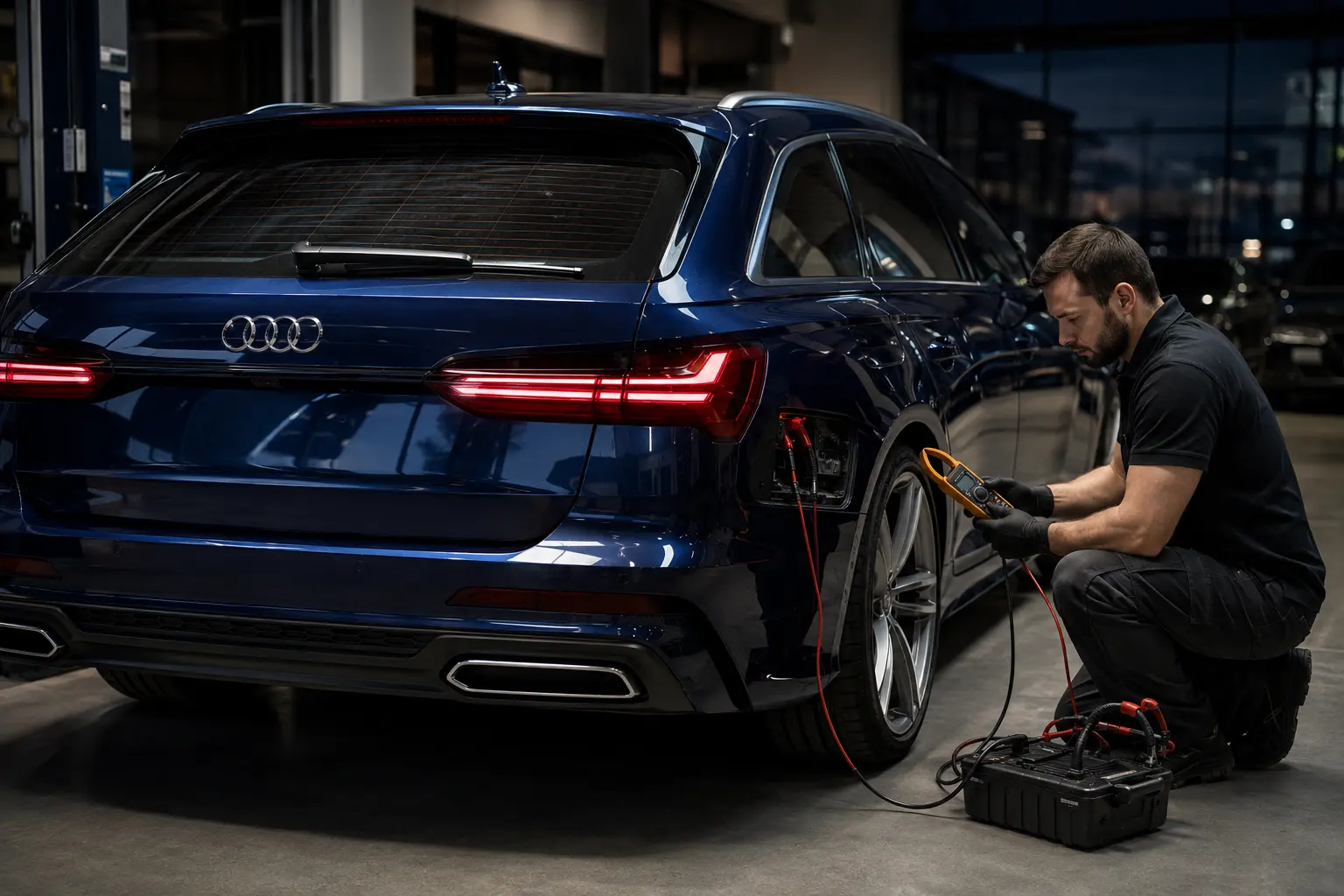
A measured route
Six checks before the estimate
- Identify the vehicle and installed battery
Use the VIN, model year, powertrain, build information and installed label to establish battery location, technology, capacity, starting rating, terminal layout and whether a second low-voltage battery is present.
- Record the complaint before clearing it
Photograph the dashboard message and note whether the Audi clicks, cranks slowly, cranks normally without starting, loses settings, becomes flat after parking, or shows a warning while running. Fault memory may contain low-voltage and communication history that is useful before disconnection.
- Inspect the physical current path
Check the case, hold-down, covers, terminal corrosion, cable condition, ground points and vent connection where used. A secure battery with clean low-resistance connections is part of the electrical system, not just an item placed in a tray.
- Assess charge and battery condition
Measure the present charge state and use an applicable conductance, capacity or load assessment. A deeply discharged serviceable battery may need controlled charging before a replacement decision can be made.
- Check cranking and charging behaviour
Observe supply during starting and charging under relevant conditions. The route may include cable voltage drop, alternator regulation, belt-drive condition or DC-DC operation depending on the actual powertrain.
- Investigate repeated discharge when supported
If the battery repeatedly becomes flat after parking, monitor the vehicle after its networks enter sleep. Current that is normal immediately after locking may be abnormal later, so one instant ammeter value is not a complete parasitic-draw diagnosis.
Exact fitment
Read the battery as a specification
An Audi-compatible battery is not defined by brand name or by whether it physically enters the tray. The replacement has to support the vehicle’s electrical demand and energy-management strategy while fitting and venting correctly.
Absorbent Glass Mat, Enhanced Flooded Battery and conventional flooded constructions have different operating characteristics. AGM and EFB are not generic quality tiers. They are battery technologies selected for particular duty cycles and charging strategies. Do not downgrade the installed technology simply because another case looks similar.
Capacity in amp-hours, the cold-cranking or EN starting rating, physical case dimensions, polarity, terminal position, hold-down profile and vent connection all belong to the fitment decision. The original part number, PR information, installed equipment and current supersession can be more useful than a model badge alone.
AGM, EFB or another specified construction. Match the required duty and charging strategy.
Amp-hour rating describes stored charge capacity. Do not choose it independently of the vehicle specification.
CCA or the applicable EN value helps define cold-start current performance under the stated test standard.
Length, width, height and lower fixing profile must suit the tray and restraint.
Positive and negative position, post type, cable reach and protective covers must align correctly.
Vent routing and any part number, serial, manufacturer or capacity data used for adaptation are checked before installation.
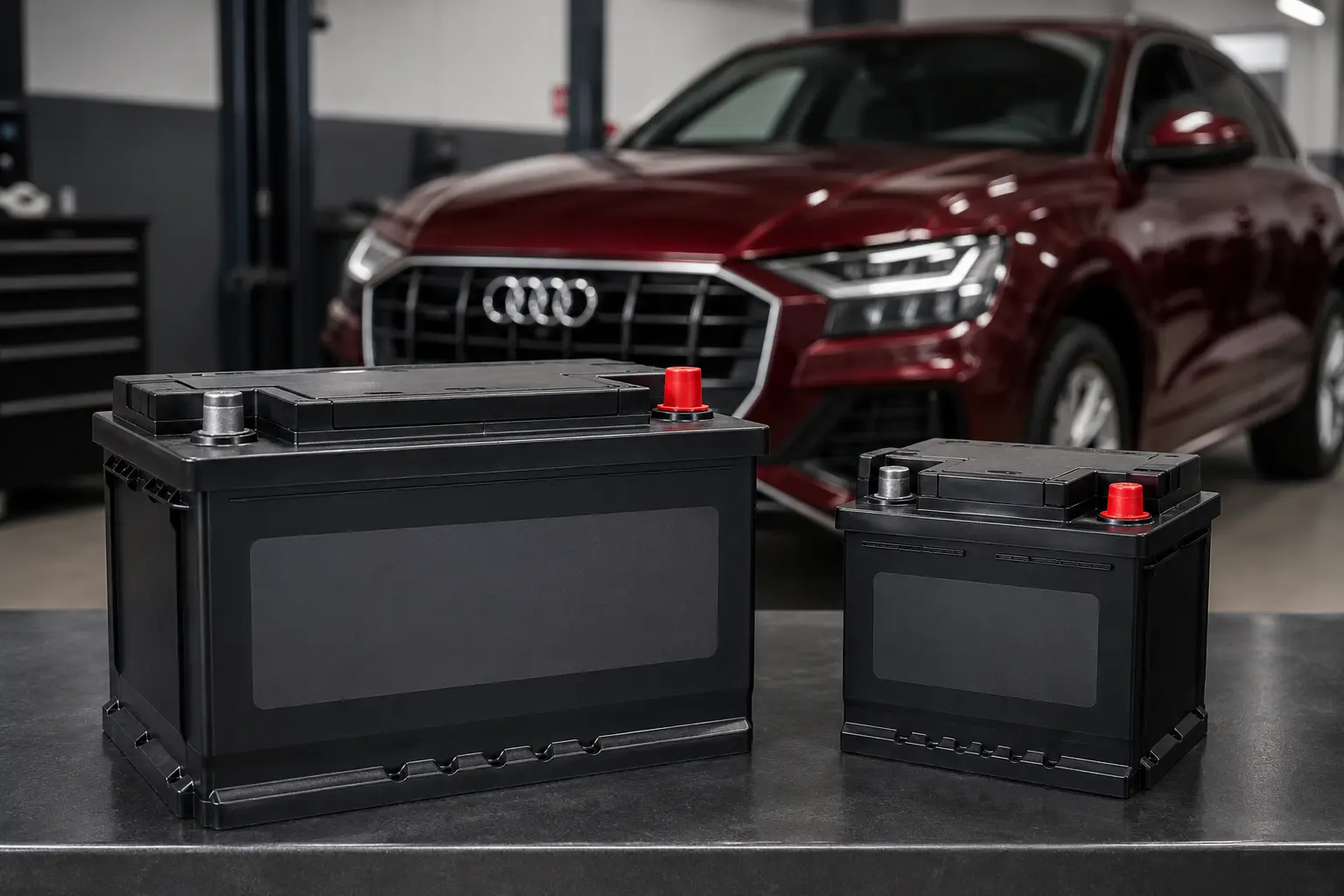
Battery names matter
Main and auxiliary are not interchangeable
The main low-voltage battery supports starting on combustion vehicles and supplies or stabilises the vehicle’s 12-volt network. Some Audi configurations also use a smaller auxiliary or support battery for a defined electrical function. A fault message that names an auxiliary battery should not automatically trigger replacement of the main battery, and a compact support battery should not be treated as a substitute for the starter battery.
The term auxiliary battery is also used loosely online. The correct meaning depends on the platform and equipment. We confirm the fitted architecture, battery location, part identification and relevant fault data before ordering. If both batteries are present, each can require its own test and replacement decision.
A key-fob coin cell is separate. It affects remote-key range or key warnings, not engine cranking capacity. A 48-volt mild-hybrid unit and a high-voltage e-tron traction battery are also separate systems with different isolation, diagnostic and safety requirements. This page covers main and auxiliary low-voltage vehicle batteries, not traction-battery replacement.
Keep the intent clean
Five battery terms that describe different jobs
Using the right system name makes the booking faster and prevents the wrong part from being priced.
Main 12-volt battery
Starting and vehicle-network support on combustion models, plus low-voltage system support on other powertrains.
Auxiliary battery
A separate low-voltage battery fitted only on relevant configurations for a defined support function.
Key-fob battery
A small replaceable cell for remote functions. It does not explain slow engine cranking or vehicle-wide low voltage.
48-volt battery
A separate higher-voltage subsystem. It is not an ordinary 12-volt battery replacement.
High-voltage traction battery
The energy store that drives an e-tron or plug-in hybrid. It requires a different safety-controlled service scope.
Alternator or DC-DC converter
Produces or transfers charging energy. A fault here can discharge a healthy low-voltage battery.
Starter motor and circuit
Uses battery current to crank a combustion engine. High current demand or circuit resistance can imitate battery weakness.
Parasitic or quiescent draw
Current used after shutdown. Diagnosis depends on how modules settle and whether the vehicle reaches its expected sleep state.
Battery energy management
What battery registration changes
Some Audi platforms use Battery Energy Management, often shortened to BEM, and store battery information so the energy-management system can distinguish a new battery from the aged unit it replaced. This is commonly called battery registration, adaptation or coding. The exact procedure depends on the control-unit architecture and diagnostic data available for the vehicle.
Depending on the platform, battery information may be handled through a battery-regulation control function or the J533 CAN gateway, with battery monitoring associated with components such as the J367 battery monitor. The data can include battery technology, rated capacity, manufacturer, part number or serial information. These terms should not be used as a promise that every Audi follows the same screen or channel.
In workshop language, Audi battery coding often means entering or adapting the replacement data rather than flashing control-unit software. Registration does not repair an unsuitable battery, poor terminal, charging fault or parasitic drain. It is the commissioning step after the physical battery and underlying system have been checked. Where the vehicle does not require or support the same adaptation route, we follow the procedure applicable to that VIN and installed equipment rather than forcing a generic coding step.
Record battery identity, relevant control data and fault memory. Use model-specific power-disconnection and support guidance.
Enter or adapt the new battery details only where the platform calls for it, then confirm acceptance.
Verify starting, charging, low-voltage faults and electrical functions. Coding success is not the entire closeout.

Dubai operating patterns
Heat, parking and short trips change the pattern
There is no responsible universal replacement age for every Audi battery in Dubai. Battery construction, location, vehicle specification, charging strategy, ambient heat, engine-bay temperature, trip length, parking duration and accessory use all influence the result. Calendar age is useful context, but it is not a substitute for testing.
Normal standby loads continue while the car is unused. A battery already below full charge has less reserve for a long parking period.
Starting demand can exceed the energy restored during brief trips, especially when climate control and other loads are high.
High temperature can accelerate battery ageing and makes swelling, venting, leakage or case damage important inspection findings.
Dash cameras, trackers, chargers, audio equipment, alarms and recent wiring work can change parked current or wake-up behaviour.
Avoid repeat replacement
When a new battery is only half the repair
The right battery cannot compensate for a fault that prevents charging, carries current through a poor connection or consumes energy while the car is parked.
Charging fault
An alternator, regulator, belt drive, cable or DC-DC problem can leave both the old and new battery undercharged. The battery warning appearing while the car is running makes this route more likely than a simple capacity complaint.
Parasitic drain
A module that stays awake, a latch input, light, communication fault or aftermarket accessory can discharge the vehicle after shutdown. The test may need time for network sleep and repeated observation of the current profile.
Starting or no-start fault
If the engine cranks at normal speed but does not fire, the battery has already done its starting-supply job. Fuel delivery, ignition, immobiliser, sensor or engine-management faults then need a different diagnostic route.
Battery choice
Match the battery before it reaches the car
We compare the removed battery, vehicle data and replacement specification before installation. A model such as Audi A4, A6, Q5 or Q7 can span several generations, engines, markets and equipment levels. The same badge does not guarantee the same battery position, technology or capacity.
The check includes physical dimensions, base hold-down, terminal orientation, cable reach, protective covers and vent routing. It also considers the declared Ah capacity, starting-current rating and whether the replacement technology matches the energy-management requirement. If the battery has been changed previously, the fitted unit is evidence but not automatically proof that it is correct.
Parts language should be explicit. Audi Genuine, an identified original-equipment supplier option and a named aftermarket battery are different purchasing decisions. The useful comparison is the exact manufacturer, part number, technology, ratings, date or supply information, warranty terms and installed scope, not vague labels such as premium or dealer quality.

Installed estimate
What changes Audi battery replacement cost
An exact installed price requires the VIN or registration details, the battery being replaced and the diagnostic scope. A price for only “an Audi battery” can omit the factors that decide the final job.
| Estimate factor | What should be identified | Why it changes the job | Question to ask |
|---|---|---|---|
| Battery unit | Manufacturer, part number, AGM or EFB technology, Ah capacity and starting rating. | Battery size, construction and electrical rating vary by model, equipment and powertrain. | Which exact battery is included in the quote? |
| Main or auxiliary | The failed circuit and whether one or two low-voltage batteries are involved. | A compact support battery and a main starter battery are different parts and often different access jobs. | Does the fault refer to the main battery, auxiliary battery or both? |
| Access and installation | Battery location, trim or seat access, hold-down, venting and power-support requirements. | Access time and reconnection procedures differ across platforms. | Does the installed price include access, secure mounting and vent connection? |
| Testing | Condition test, charge assessment, cranking supply, charging behaviour and connection check. | A confirmed failed battery differs from an intermittent no-start or repeat-discharge diagnosis. | What testing is included before replacement? |
| Registration | The applicable battery adaptation or energy-management procedure. | Some Audi control architectures require new battery data to be recorded, while others follow a different process. | Is registration required for this VIN and included if applicable? |
| Additional fault finding | Parasitic draw, starter circuit, alternator, DC-DC, wiring or control-module diagnosis. | These are separate causes and may require observation or access beyond a standard replacement. | What happens if the battery passes but the car still becomes flat? |
| Closeout and old unit | Post-installation checks, fault review, invoice detail, old-battery handling and stated warranty terms. | The customer should know what is verified and what paperwork or conditions apply. | What does the final handover include? |
For a quote, send the model, year, VIN, a photo of the installed battery label and the exact dashboard message. If the car is stranded, also explain whether it clicks, cranks slowly, cranks normally without starting, or lost power while driving. You can compare broader ownership variables in the Audi service cost guide.
Controlled replacement
What happens during the battery job
The physical swap is one step inside a larger electrical closeout.
- Confirm the scope
Identify main or auxiliary battery, complaint, vehicle configuration and any separate charging or drain diagnosis.
- Record useful data
Save the installed battery identity, dashboard messages, relevant faults and energy-management information before disconnection.
- Prepare the vehicle
Follow the applicable isolation, access and voltage-support method without using generic jump points or shortcuts.
- Remove and inspect
Release the hold-down and terminals correctly, protect surrounding components, and inspect cables, tray and vent route.
- Install and adapt
Fit the matched battery securely, reconnect protection and venting, then register or adapt it where the vehicle requires it.
- Retest and hand over
Confirm starting and charging, review remaining faults and functions, and document the fitted battery and agreed scope.
Post-installation verification
What should work when the job is complete
A successful start is necessary, but it does not close every battery complaint. The original symptom should be reconsidered after fitment. If the Audi previously became flat after parking, the replacement itself does not prove the parked-current problem is gone. If the charging warning appeared while driving, charging behaviour must be confirmed rather than inferred from the new battery.
Audi A3, S3 and RS3; A4, S4 and RS4; A5, S5 and RS5; A6, S6 and RS6; A7, S7 and RS7; A8 and S8; Q2; Q3 and RS Q3; Q5 and SQ5; Q7 and SQ7; Q8, SQ8 and RS Q8; TT, TTS and TT RS; R8; and e-tron families do not share one universal battery location or commissioning route.
Even within one model family, generation, engine, stop-start equipment, market specification and low-voltage architecture can change the correct part. Send the VIN rather than relying on the badge. Visit Audi models we service for model-specific repair routes.
Direct owner answers
Audi battery replacement questions
These answers define the first workshop route. The individual Audi still decides the specification and procedure.
Does every Audi battery need coding after replacement?
No single rule applies to every Audi. Some platforms use battery registration or adaptation so energy management knows the battery technology, capacity or new-battery identity. Others use a different procedure. The VIN, control architecture and installed equipment decide what is applicable.
What is Audi battery registration?
Battery registration is the diagnostic commissioning step that records replacement-battery information in the relevant energy-management system where supported. It may include technology, rated capacity, manufacturer, part number or serial data. It does not correct a charging fault, parasitic draw or wrong battery specification.
Can a weak Audi battery cause many warning lights?
Yes. Unstable low voltage can create communication and function faults across several control modules. Record the original messages before clearing anything. After the supply problem is corrected, faults that remain active need their own diagnosis rather than being dismissed as battery history.
Why is my Audi battery dead again after replacement?
Possible reasons include incomplete charging, an alternator or DC-DC fault, cable resistance, an unsuitable battery, missing adaptation where required, a module that does not sleep, or an accessory drawing current while parked. Recharge and test the battery, then follow the repeat-discharge pattern instead of fitting another unit automatically.
Is a jump-start proof that the battery has failed?
No. It proves only that the vehicle lacked enough usable starting supply at that moment. Low state of charge, reduced capacity, a poor connection, excessive starter demand, a charging fault or parked current draw can all lead to the same event.
Can I replace AGM with a normal flooded battery?
Do not downgrade the battery technology based on size alone. AGM, EFB and conventional flooded batteries have different duty and charging characteristics. Match the vehicle specification, ratings, case, polarity, hold-down and venting before installation.
What is the difference between main and auxiliary batteries?
The main 12-volt battery supplies starting and the principal low-voltage network on relevant models. An auxiliary battery is a second, often smaller unit assigned to a specific support function on some configurations. Each has a different part identification, circuit and test route.
Does this service include the Audi key battery?
No. The remote key uses a small coin cell and belongs to key-fob battery intent. It can cause reduced remote range or a key warning, but it does not normally cause slow engine cranking or vehicle-wide electrical shutdown.
Do you replace Audi e-tron high-voltage batteries?
This page is for main and auxiliary low-voltage vehicle batteries. The high-voltage traction battery that propels an e-tron or plug-in hybrid, and the 48-volt system on relevant models, require separate safety-controlled diagnosis and are not ordinary 12-volt replacements.
How much is Audi battery replacement in Dubai?
The installed cost depends on the exact battery technology, Ah and starting rating, physical size, access, main or auxiliary role, parts choice, testing and any applicable registration. Send the VIN and installed battery label for a defined quotation instead of relying on a model-only price.
Can I drive with the battery warning light on?
A warning while the engine is running may indicate that the car is not being charged correctly. If multiple systems start switching off, lighting becomes weak, steering assistance changes, the car overheats electrically, or there is burning smell, swelling or leakage, stop safely and request recovery advice. The remaining driving time cannot be judged from the lamp alone.
Can you replace an Audi battery at home or roadside?
This page describes workshop-based battery testing and replacement in Al Quoz. If the Audi is stranded, send the location, model, starting behaviour and dashboard message so the available recovery or fitting route can be confirmed. A repeat discharge, charging warning, auxiliary-battery fault or registration question may still need workshop diagnosis rather than a simple roadside swap.
What should I send before booking?
Send the Audi model, year, VIN, mileage, dashboard photo, a photo of the installed battery label, starting behaviour, how long the car was parked, recent jump-start or battery history, and any dash camera, tracker or electrical work. That information helps distinguish a straightforward replacement from a charging or parasitic-draw diagnosis.
Build a useful WhatsApp brief
Send the battery details in one message
Nothing is sent until you open WhatsApp. VIN and dashboard photos can be added there after the message is prepared.
Al Quoz workshop booking
Start with the battery label and symptom
Send the model, year, VIN, installed battery label and dashboard message. We can then separate a battery replacement from charging, parasitic-drain, starter and wider Audi electrical repair before the estimate is approved.
Need a different route? Browse all Audi services or use the contact and booking page.