
Audi Engine Repair in Dubai
Audi engine repair in Dubai is a diagnostic and mechanical service for warning lights, noise, smoke, overheating, oil or coolant loss, and performance changes. We confirm the fault and damage extent, then compare repair, overhaul and replacement routes before requesting approval.
- Diagnosis before route selection
- Written approval at each scope change
- Repair, overhaul and replacement compared

Does the engine need replacing
Usually, that question cannot be answered from one symptom. A misfire can come from ignition, fuelling, an intake leak, wiring or an internal sealing problem. Blue, white or dark exhaust smoke can narrow the investigation, but smoke colour alone does not identify a failed component. Repeated oil consumption may involve an external leak, crankcase ventilation, turbocharger sealing, valve guides, piston rings or more than one issue. An overheating event can damage the cylinder head or head gasket, but it can also begin with a thermostat, pump, hose, radiator or fan fault.
Before anyone recommends dismantling, rebuilding or replacing the engine, the evidence should locate the problem as far as reasonably possible. That normally means combining the complaint and repair history with a full scan, relevant live data, a physical inspection and selected mechanical tests. A single fault code, one low compression result or one borescope image is not a complete engine verdict.
The answer may be reassuringly local, such as an accessible leak or related system fault. It may support cylinder-head work while the lower engine remains serviceable. It may show that internal wear or damage makes an overhaul worth comparing with replacement. Sometimes the evidence is still incomplete, and the most responsible recommendation is another defined test rather than a larger repair.
The aim is not to save the original engine at any cost. It is to avoid condemning it without proof and to compare each realistic option on the same basis.
Stop the engine when
Some symptoms justify stopping the engine before further damage occurs. Others need prompt assessment but do not prove that immediate dismantling is required. Follow the exact dashboard instruction and the relevant Audi owner’s manual. For a red oil-pressure warning, severe overheating, steam, rapid fluid loss, seizure or a deep metallic knock, switch off safely and arrange recovery.
Stop safely and arrange recovery
Switch off when it is safe to do so if the car gives a red oil-pressure instruction, severe overheating or steam, rapid oil or coolant loss, a deep metallic knock, seizure, or an explicit instruction to stop the engine. A flashing warning with severe shaking or major power loss, a severe misfire or heavy smoke also belongs in the stop-and-recovery category. Continuing to run an engine without reliable lubrication, cooling or combustion control can turn a repairable fault into broader internal damage.
Do not restart after suspected water ingestion, severe oil loss, seizure or an explicit switch-off instruction. Restarting can repeat the damaging event before its cause has been checked. Do not open a hot or pressurised coolant reservoir. Escaping steam and coolant can cause serious burns. Let the car be recovered and inspected instead of trying to prove that it will run again.
Ask before driving
Arrange recovery if the engine has stalled while moving, or if steering or braking assistance has changed. For repeated stalling at startup or idle, a new mechanical noise, noticeable roughness or another symptom that has changed quickly but has not produced the stop conditions above, avoid an unnecessary journey and call with the exact message and symptoms. For repeated stalling, new mechanical noise, marked roughness or rapidly changing symptoms, avoid driving and arrange assessment or recovery.
Book the car promptly
A stable warning light, mild rough running, gradual oil use or a small visible leak still deserves investigation. Note when the symptom appears, check the levels only as the owner’s manual instructs and do not keep clearing codes or topping up a fast-moving loss without finding its cause. A developing fault is usually easier to assess when its history has not been erased.
Send evidence before arrival
The first useful message is not simply “engine problem”. Send the Audi model and year, approximate mileage and VIN if available. Include the exact warning message or a clear photograph, whether the engine cranks and starts, and whether the symptom appears cold, hot, at idle or under load.
Add recent repairs, available service history and any earlier reports or quotations. Tell us about an overheating, low-oil, coolant-loss, water-ingress or timing event, even if it happened before the current symptom. Disclose relevant tuning or mechanical modifications because they can change both the test plan and the parts specification.
- Model, year, mileage and VIN if available
- Exact warning message and symptom conditions
- Recent repair, oil-loss and overheating history
Describe the engine symptom
Share the model, year, mileage, warning message, symptoms and when they occur. We use these details to prepare the first workshop checks; repair begins only after the findings and scope are approved.
Test before taking apart
Engine diagnosis is a sequence, not a bundle of impressive-sounding tests. Each check should answer a question created by the evidence already available.
Identify the car and the event
Confirm the VIN, engine code or VIN-derived specification, service and repair history, symptom conditions and any oil-loss or overheating incident. Similar Audi models can use different engine configurations, parts and test specifications.
Inspect the basics in context
Check fluid level and condition, visible leaks, cooling behaviour, intake and breather connections, wiring, hoses, accessories and obvious mechanical condition. This can reveal a related fault before internal engine work is considered.
Read the control-system evidence
A complete scan should preserve fault codes, status, freeze-frame information and relevant live data. A code identifies a detected condition or circuit. It does not automatically identify the component to replace.
Rule out faults that imitate internal damage
Coils, plugs, injectors, intake leaks, crankcase ventilation, boost control, cooling faults, sensors, wiring and driven accessories can produce symptoms that owners reasonably describe as an engine problem.
Choose the mechanical checks
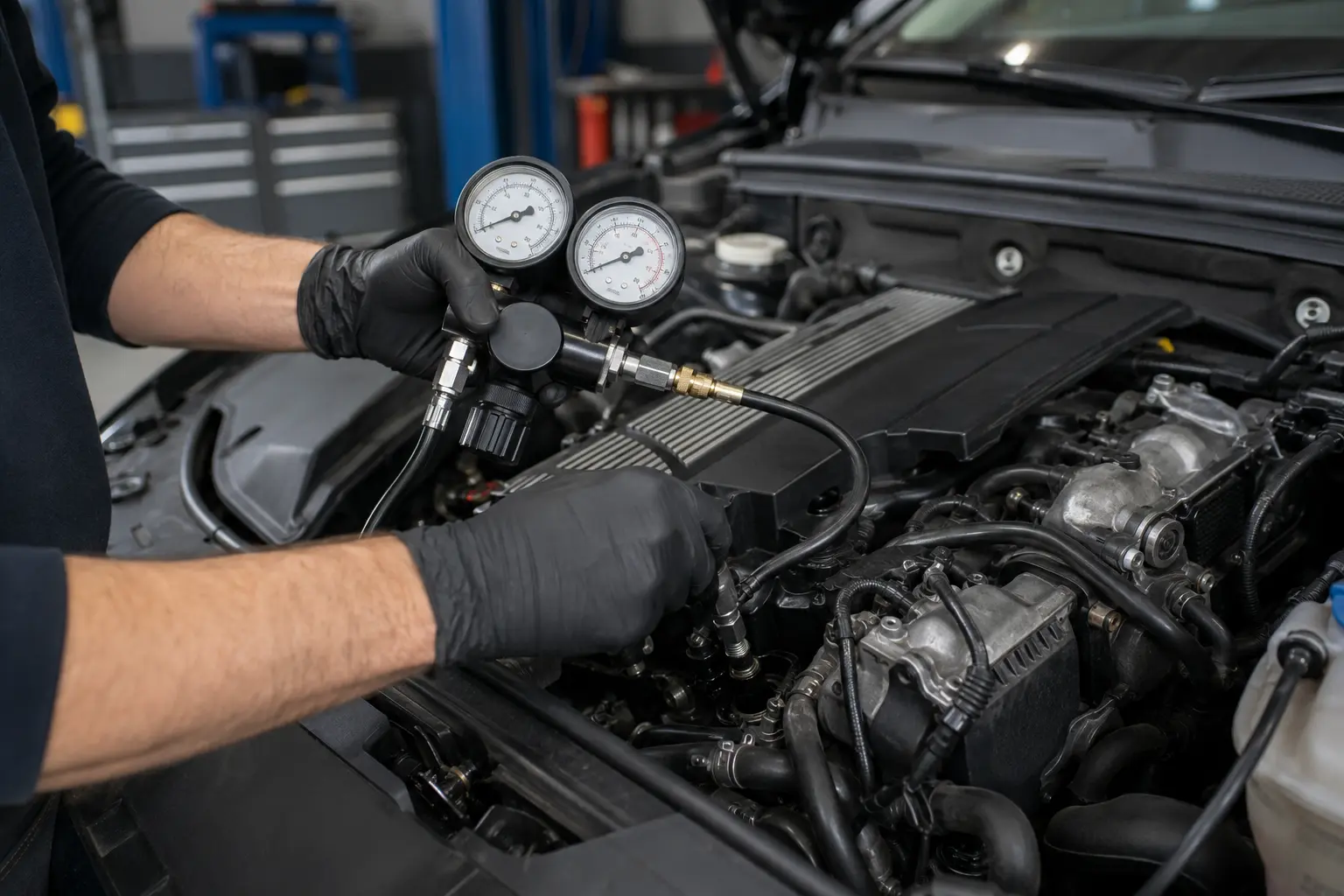
Compression testing can compare cylinder sealing when performed under controlled conditions. Cylinder leak-down testing can help show where pressure escapes. An oil-pressure test must use the correct oil condition, temperature and engine-speed specification. Cooling-system pressure testing can help locate loss. A borescope may reveal surface damage, deposits or fluid entry that needs to be interpreted with other findings. Timing correlation, crankcase pressure and oil or filter-debris checks may answer further questions.
Compare results with the exact engine specification
Compression, leak-down and oil-pressure results must be compared with the specification and test conditions for the exact engine. Test conditions and cylinder balance matter, and the limit must come from appropriate technical information for that engine code.
Interpretation matters as much as the tool. Read compression alongside cranking speed, battery condition, engine temperature and the spread between cylinders. Leak-down testing can show the path of lost pressure, but that result still needs the other findings. A borescope shows only surfaces within its view, not every bearing, oil passage or hidden sealing face.
The result should also agree with the symptom. A static test may not explain a fault that appears only hot or under load. Live data may show when it begins, while a repeat test can expose an inconsistent result or setup problem. One abnormal result should be checked before it supports a large repair. Each test should rule a route in, rule it out or identify the next smallest useful check.


Open the engine only with a reason
If non-invasive results support internal damage, the next approval can be a capped dismantling stage. The cap should state what will be removed, what will be measured and whether reassembly is included if the customer does not proceed.
Measure before finalising the build
Once internal parts are accessible, surface condition, clearances, distortion, cracks where relevant and machining feasibility affect the final scope. The estimate becomes more reliable after those findings are recorded.
External fault or internal damage
Symptoms can overlap. The estimate should not cross from an accessible related-system repair into internal engine work unless the evidence crosses with it.
Faults that can feel like engine failure
An engine-related symptom can begin outside the engine’s core assembly. Coils, plugs, injectors, intake leaks, crankcase ventilation, turbo or boost control, cooling components, oil-cooler or filter-housing leaks, sensors, accessories and mounts can all change how the engine runs, sounds or feels. Correcting one of these faults is different from rebuilding the engine. When the evidence points to ignition, fuelling, wiring, sensors or more than one vehicle system rather than confirmed mechanical engine damage, the broader Audi diagnostics service is the better route.
Findings that change the major route
Internal findings concern components such as valve sealing, the cylinder head, head gasket, pistons, rings, cylinder walls, bearings, crankshaft, lubrication passages or damage caused by a timing event. Cracking and distortion also have to be considered after certain overheating or mechanical failures.
Low compression may come from a valve, ring, cylinder or timing problem. Oil in the cooling system needs source confirmation because a heat exchanger can imitate a head-gasket concern. Smoke during one operating condition can have a different cause from smoke under load. A knock must be separated from accessory, combustion and internal rotating noises.
This split protects the decision. If evidence supports an external or related-system repair, the estimate should not quietly expand into an overhaul. If internal damage is confirmed, the next question is how much of the engine is affected and whether the existing core remains a sound basis for repair.
Low compression traced to valve timing, not worn rings
A 2015 Audi A4 arrived with low compression, a rough idle, weak acceleration and a brief timing-chain rattle. Worn piston rings had been suspected, and an engine overhaul was being considered.
Mohammad Sardar performed cylinder leak-down testing before the engine was opened. Leakage measured only 5–10%, showing that the pistons, rings and valves were still sealing properly. Mechanical timing inspection then showed incorrect camshaft-to-crankshaft alignment. A stretched timing chain and weakened tensioner had retarded the valve timing and created misleading low-compression readings.
Stretched timing chain and weakened tensioner, with the camshaft timing retarded against the crankshaft.
The timing chain, tensioner and guide rails were replaced, then the mechanical timing was reset and verified.
Quiet starting, smooth idle and normal power returned. An extended road test produced no recurring timing or misfire faults.
Compare the available routes
There is no automatic hierarchy in which a rebuild is always superior to a used engine, or a replacement is always quicker and safer. Compare total installed cost, evidence quality, vehicle condition, likely ownership period, parts availability, downtime, warranty boundaries and how much uncertainty you are willing to accept.
More diagnosis
Choose another defined test when the available findings conflict or do not locate the fault. The advantage is avoiding an unsupported repair. The downside is another assessment cost, but that cost should buy a stated answer rather than repeat an earlier scan. The price becomes firm when the test, access required and reporting scope are agreed.
Targeted repair
This suits an isolated external or local fault where relevant checks do not indicate wider internal damage. It preserves the original assembly and usually limits cost and dismantling. Its risk is overlooking a related cause, so the estimate should state the verification required after repair and any parts outside scope.
Cylinder-head or top-end repair
This route is considered when evidence places the defect above a serviceable lower engine. It may retain more of the original engine than a full rebuild. The final price normally depends on dismantling, crack or distortion checks, valve and surface condition, parts availability and permitted machining. A head-gasket label is not enough to fix the scope.
Overhaul or rebuild
A defensible overhaul means disassembly, cleaning, measurement, permitted machining, a named replacement-parts list, controlled reassembly and post-build checks. It may suit a valuable car with a rebuildable original core and a sensible parts route. Its uncertainties are discovered wear, component availability, machining limits and ancillary damage. Rebuilt does not mean every component is new.
Used replacement engine
This can make economic sense when the original core is damaged beyond a practical rebuild or when a documented donor offers a better total route. It is still an unreconditioned used assembly. Its engine code, source, evidence, included parts and warranty terms matter more than a low-mileage description. The fitted price is not firm until compatibility, supply terms and installation scope are confirmed.
Documented remanufactured engine
A remanufactured or exchange unit should come with a defined supplier standard, test record, component-replacement and machining policy, configuration and written warranty. A cleaned used engine is not remanufactured. This route can reduce some donor uncertainty, but only when the documents support the label.
New engine
A new short block, long block or complete assembly is considered only after a VIN and part-number check. “Complete” does not necessarily include the turbocharger, injectors, manifolds, wiring or accessories. Availability, logistics and total fitted cost often make this a rare choice rather than the default option.
Put every route on the same basis
Compare what is known, what remains uncertain, the installed total, expected downtime, warranty boundaries, the original failure cause and the evidence supplied at completion. A low component price and a fully defined installed scope are not equivalent quotations.
What sets the engine repair estimate
The first estimate covers the defined diagnostic stage. The repair estimate follows the confirmed route, whether that is an external repair, top-end work, an overhaul assessment or a replacement-engine installation.
The quote names the scan, mechanical tests or limited access needed to answer the next decision before dismantling expands.
The written scope identifies the parts basis, machine work, fluids, seals, ancillaries and verification included in the selected route.
If dismantling or supplier checks change the route, the revised finding, price and approval are recorded before additional work begins.
Every written estimate must state whether VAT is included and separate the engine or unit price from installation, fluids, ancillaries, coding or adaptations, machining and repairs to the original failure cause.
Evaluate a used engine
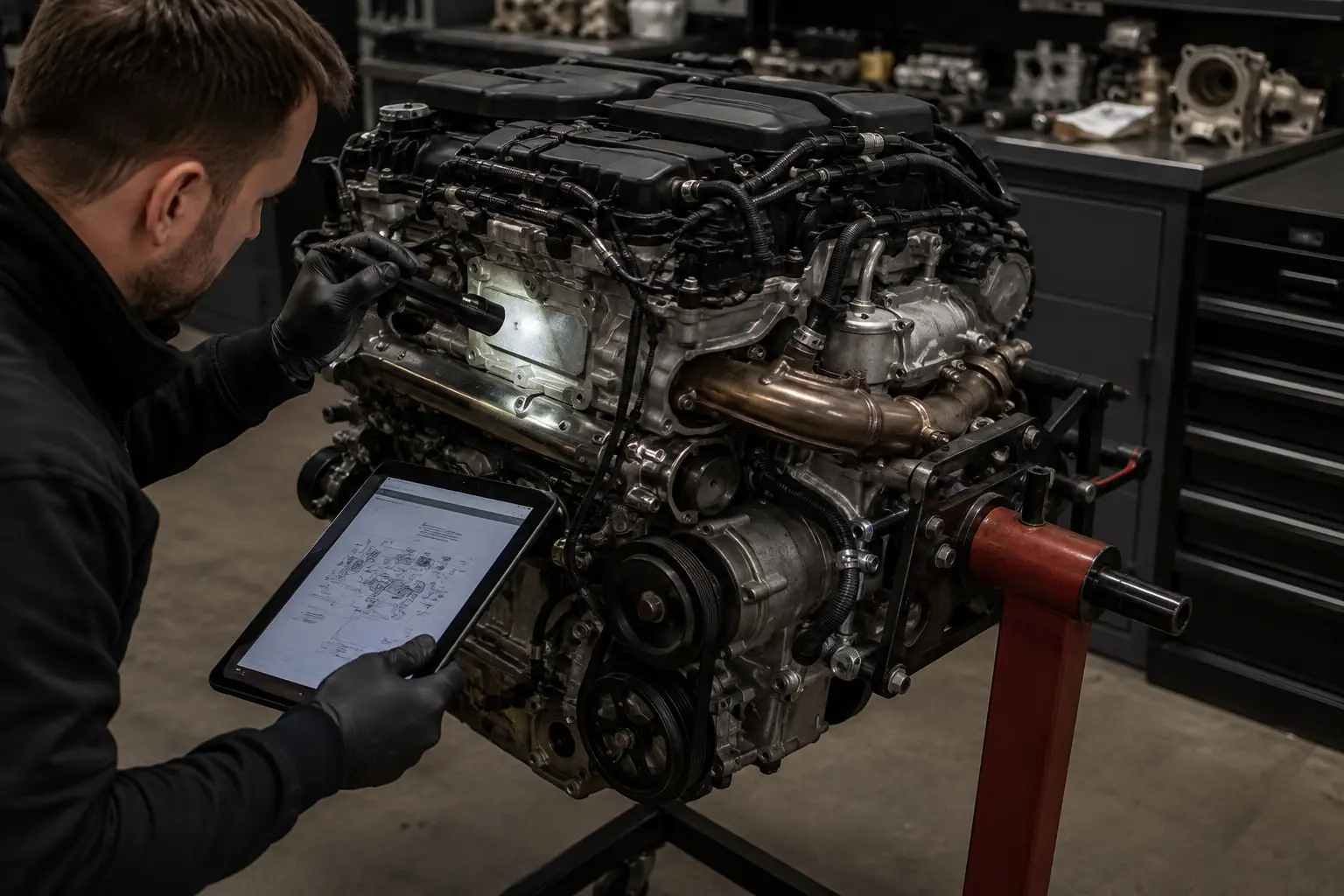
Do not buy a used engine on displacement alone. “Audi 2.0 TFSI” is not a sufficient compatibility check. The engine code, relevant part number or supersession and the vehicle application should be matched using the VIN and the exact configuration.
The proposed unit should have a supplier invoice and identifiable source. A claimed donor mileage, dashboard photograph or start-up video may add context, but none proves internal condition by itself. Ask what can be inspected before fitting: storage and transport condition, accident, fire or water exposure, crank rotation, fluid condition, sludge or metal, visible corrosion and internal surfaces through a borescope where access permits. Compression or leak-down results are useful only when the test method and conditions are recorded.
Control the procurement risk
Procurement creates risks before the engine reaches the workshop. The purchase record should identify the actual reserved engine by code, source, visible condition, included components and supplier terms. Confirm quote validity, when a deposit becomes committed, return transport responsibility and the remedy if the unit differs materially from its written description.
Get the contents in writing. The turbo, injectors, manifolds, sensors, wiring, pumps, starter, alternator and accessories may be included, excluded or present only for transfer. Their presence does not confirm their condition. The installation estimate should identify the seals, service items, mounts and fluids being renewed before the unit goes in.
Separate the warranties
Warranty wording needs equal care. Record the start date, time or mileage limit, covered components, exclusions and the party responsible for removal, refitting and labour if the unit fails. Do not accept “tested” without knowing who tested it, what was tested and what the result was.
A supplier warranty may cover only the donor assembly, not diagnosis, fluids, accessories, recovery, removal, refitting or consequential labour. It may impose installation, service-part, evidence and notification requirements. Obtain the written supplier terms before purchase and assign each risk and responsibility to the supplier, workshop or owner.
Some exchange arrangements require the original engine or a rebuildable core. The estimate should say whether the removed engine remains yours, must be returned or has an agreed disposal route. This matters if later inspection or parts recovery becomes necessary.
Correct the original cause
The original failure cause must also be corrected. A replacement engine does not solve a faulty cooling system, lubrication problem, contaminated intake, failed turbo, fuelling fault or another condition that damaged the first unit. Commissioning should address lubrication where the procedure requires it, oil pressure, cooling-system filling and bleeding, leak inspection, scanning, required settings or adaptations, a suitable road test and recheck. If the dashboard shows a red oil-can or low-pressure message, follow the Audi oil-pressure warning guide and stop the engine until the cause is assessed.
Approve a used unit only after its exact engine code, identity, condition evidence, included components and supplier terms have been checked. Any engine-number or registration requirement must also be confirmed from current UAE authority guidance for the particular replacement.
Define the overhaul scope
“Full overhaul” can describe very different jobs. A useful estimate replaces the label with a component and measurement schedule.


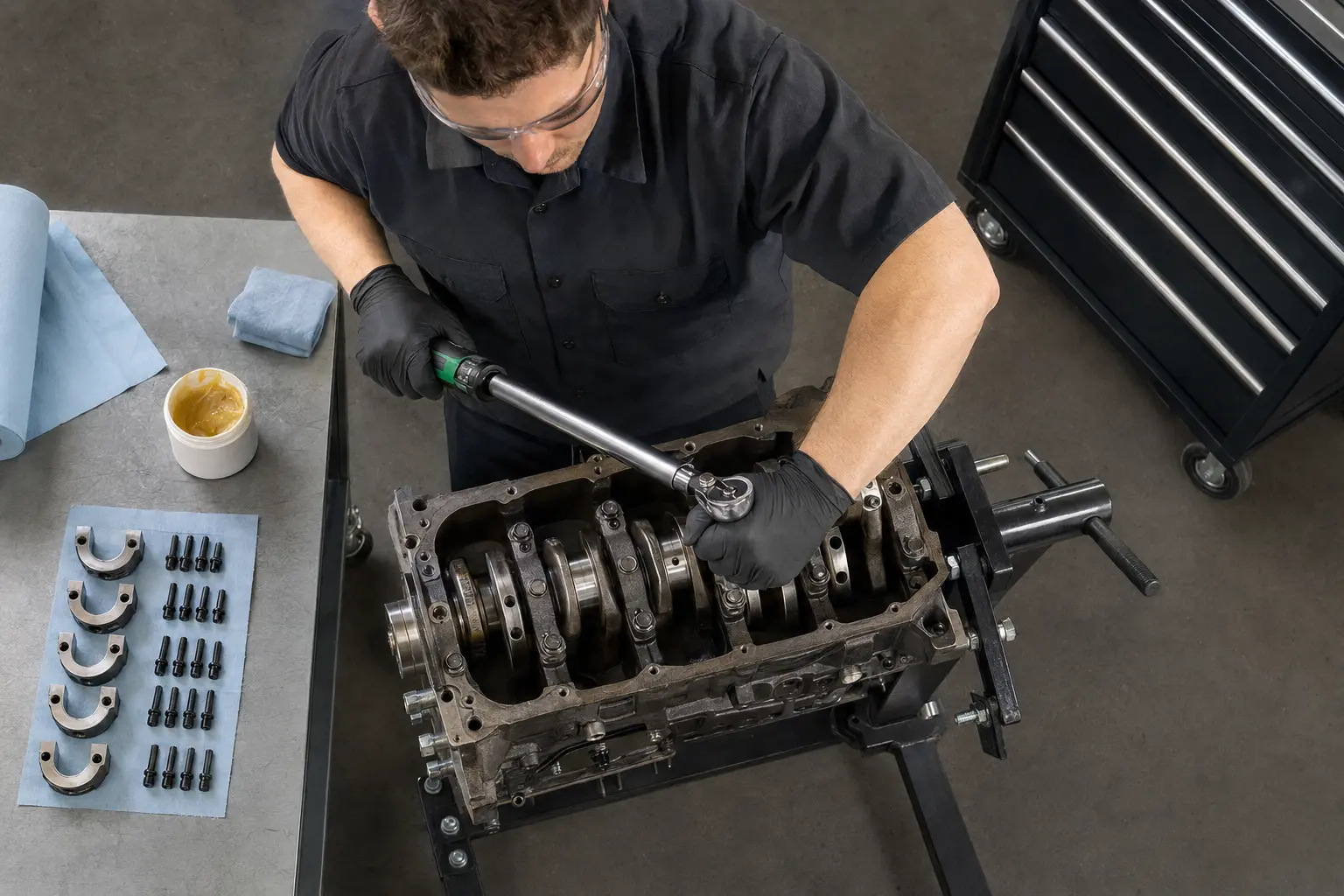
The core first has to be suitable. After disassembly and cleaning, the relevant checks may cover the cylinder head and block surfaces, cylinder condition, pistons, rings, connecting rods, crankshaft, bearings, oil passages and the damage that triggered dismantling. Crack or flatness checks and machine work depend on the component, material, engine specification and permitted repair method. Not every surface can be machined indefinitely, and not every damaged core is worth rebuilding.
The written scope should separate parts that will be new, reused after inspection, machined, remanufactured or supplied used. It should state whether timing parts, oil pump, cooling components, turbocharger, injectors, seals, mounts and other ancillaries are included. Machine-shop work and its records should be identified rather than hidden inside a general labour line.
The overhaul file should connect the original evidence with the completed work. Useful records include photographs as parts are exposed, measured components, the specification used for accept-or-reject decisions, and outsourced machine-shop findings. The parts list should identify parts and approved substitutions. If a component is reused, record the basis for reuse rather than allowing “checked” to stand without context.
Documentation prevents the scope changing silently. If the crankshaft, block, cylinder head or another major component is not repairable within specification, that finding should trigger a new decision. The owner can then compare a revised overhaul, another core or a replacement using the new evidence. Measurements matter because they explain the route, not because numbers alone prove quality.
Before approval, ask what findings could still change the estimate and what spending cap applies. After assembly, the job record should identify the initial lubrication or priming procedure where required, start-up checks, oil pressure and cooling verification, scan, leak inspection, road test and recheck. Follow the engine-specific run-in or first-service instruction supplied with the completed work. Do not rely on a universal break-in rule copied from another engine.
Mohammad’s decision is recorded against the individual job file, including measurements, parts disposition and completed verification.
Why a new engine is an exception
A factory-new engine can sound like the option with the least uncertainty, but the term needs definition. Audi parts may be supplied as a short block, long block or a more complete assembly. The quote must list the contents, part-number supersessions and the ancillaries that still need to be transferred or purchased.
Availability is VIN-specific. Lead time, import and logistics, warranty terms, fitting, coding or settings and related repairs all affect the installed total. For some cars, the cost can represent a large share of the vehicle’s value. A repairable original engine, a documented rebuild or a properly evaluated used unit may therefore be more defensible.
A new-engine route begins with a current VIN-linked supplier quotation showing availability, assembly contents, lead time and installed cost. The option can then be compared with repairing the original engine or fitting a documented replacement.
Approve work in stages
A large engine job should not move from a warning light to an open-ended invoice. Each approval should buy a defined answer or a defined repair, with an exit route before the next commitment.
Defined assessment
The first approval covers a defined assessment. It states the initial checks, reporting scope and the point at which further testing needs another decision.
Capped dismantling
If evidence supports internal inspection, the next approval is a capped teardown with the access and reporting scope written down. Before teardown, confirm reassembly, storage, collection and disposal costs if the core is uneconomic.
Measured or supplier-backed route
After measurement, or after a supplier identifies a replacement unit, you receive the route, parts basis, exclusions and estimate for approval. Before ordering an engine, machining or special-order parts, identify deposits, return terms and commitments that cannot be reversed. This preserves the choice between continuing and stopping.
Variation only when the evidence changes
Any later variation should explain what changed, show the supporting finding and obtain approval before the extra work begins. The final invoice should match the agreed route and record the important closing checks.
Evidence to confirm before approval
When Mohammad Sardar is assigned to a complex route, his review focuses on the point where evidence becomes a recommendation. It should identify the confirmed defect, unresolved risk, preferred route and what could still alter the estimate. A different condition found after dismantling returns the job to the approval gate.
- What finding supports this route?
- Which components and ancillaries are included?
- Are parts new, used, remanufactured or aftermarket?
- What measurements or supplier evidence will I receive?
- Which machining work is included?
- What caused the original failure and how will it be corrected?
- What does the warranty cover, exclude and require from me?
- Who pays the labour if a supplied unit fails?
- What scan, leak, pressure, road-test and recheck evidence closes the job?
Warning signs before a major engine job
Warning signs include replacement advice based only on a phone description or one code, an undocumented low-mileage claim, compatibility checked only by engine size, a “full rebuild” without measurements or a parts list, vague ancillary exclusions, no investigation of the original cause and warranty wording that does not separate parts from labour.
Protect the completed work by following the exact aftercare given for that engine and repair. Correct related cooling, timing, turbo, fuelling, crankcase-ventilation or maintenance faults rather than treating them as optional extras after damage. Keep the final estimate, parts list, supplier documents, machine records where supplied and verification results together. Those records help with future servicing, warranty questions and resale discussions.
Audi engine repair questions
Clear answers for the decisions that usually come before engine testing, repair, overhaul or replacement.
Does a misfire mean my Audi needs a new engine?
No. A misfire describes uneven combustion; it does not identify the cause. Coils, plugs, injectors, wiring, intake leaks and control faults can misfire without base-engine damage. Mechanical causes include valve sealing, compression, timing and cylinder damage. A full scan, relevant live data and selected mechanical checks should separate those paths before anyone recommends an overhaul or replacement.
Can an engine be repaired without removing it?
Yes, some external leaks, sensors, ignition components, crankcase-ventilation faults and accessible top-end work can be repaired with the engine installed. Other work needs removal for access, accurate measurement or safe assembly. The decision depends on the exact engine, failed area and wider damage. Ask whether removal is included and what discovery could change the scope.
Is a used engine safer than rebuilding mine?
Neither option is automatically safer. A used engine may reduce dismantling and machine work but brings uncertainty about its history, internal wear and included components. A rebuild keeps the known original core but depends on its condition, measurements, parts and workmanship. Compare the evidence, total installed price, warranty boundaries, downtime and vehicle value rather than the label.
How can I check used-engine mileage and condition?
Treat claimed mileage as one piece of supplier information, not proof of condition. Request source documents, the engine code, storage history, photographs and available test records. Inspect fluids, contamination, corrosion and internal surfaces where feasible. Record exactly what “tested” means. Even a good donor video cannot show every bearing, oil passage or sealing surface.
What does an engine overhaul include?
An overhaul scope is built from disassembly, cleaning, measured condition, permitted machining, a named parts schedule, controlled reassembly and post-build checks for that engine. The estimate must say what is new, reused or machined and whether timing, turbo, fuel, cooling and other ancillary components sit inside or outside the job.
Is a brand-new Audi engine available in Dubai?
It may be, but availability must be checked by VIN and current part number. The supplied item could be a short block, long block or more complete assembly, and lead time can change. The workshop confirms availability, assembly contents and lead time from a current VIN-linked supplier quotation.
Why can the estimate change after teardown?
Non-invasive tests can support opening the engine, but hidden surfaces and precise dimensions become available only after dismantling. Cracks, distortion, cylinder wear, crankshaft condition, damaged threads and earlier repairs may change the parts or machining required. A capped teardown and post-measurement approval prevent that uncertainty from becoming open-ended permission.
How long will the work take?
Diagnosis time depends on whether the symptom is present and which tests are justified. A repair then depends on access, parts supply, machine work, donor availability, authorisation and verification. The workshop can set the schedule after the diagnostic stage or the exact replacement unit is confirmed, with the remaining variables identified in the written plan.
Should I drive or arrange recovery?
Arrange recovery for a red oil-pressure instruction, severe overheating, steam, rapid fluid loss, deep metallic knocking, seizure or an instruction to stop the engine. Stop and recover the car for a severe misfire, heavy smoke, or a flashing warning with severe shaking or major power loss. Arrange recovery if the engine stalled while moving or steering or braking assistance changed. For other repeated stalling or a rapidly changing symptom, avoid an unnecessary journey and ask for advice. Follow the exact dashboard message and Audi owner’s manual, and arrange recovery when the symptom is severe or changing quickly.
Audi Engine Repair
Engine-related service routes
These pages extend the decision path without replacing diagnosis or repeating the same service intent.