
Independent Audi specialist · Al Quoz 4
Audi Q7 service and repair in Dubai
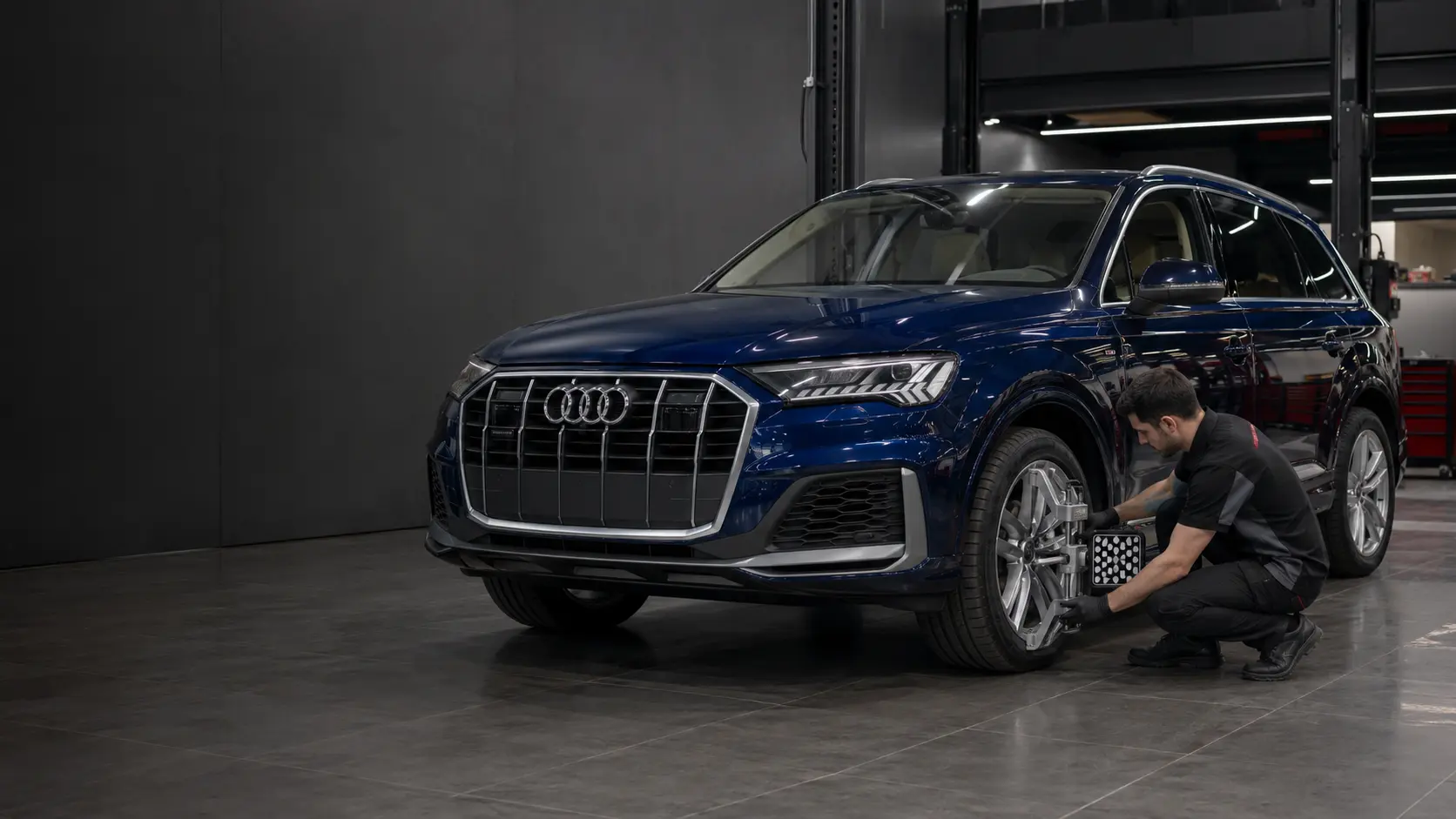
Audi Q7 service and repair in Dubai covers model-specific maintenance and diagnosis for engine, tiptronic, quattro, suspension, steering, brakes and electrical systems. We identify the generation, equipment and load-related symptom before proposing a repair.
Q7 three-deck load and ride map
Start with the occupied state
A large SUV can behave differently empty, fully occupied, heavily loaded or hot after sustained driving. The map below sorts the first evidence into three physical decks. It does not pretend to diagnose from a screen; each deck ends with a server-rendered workshop route.
Upper deck · seating and cabin
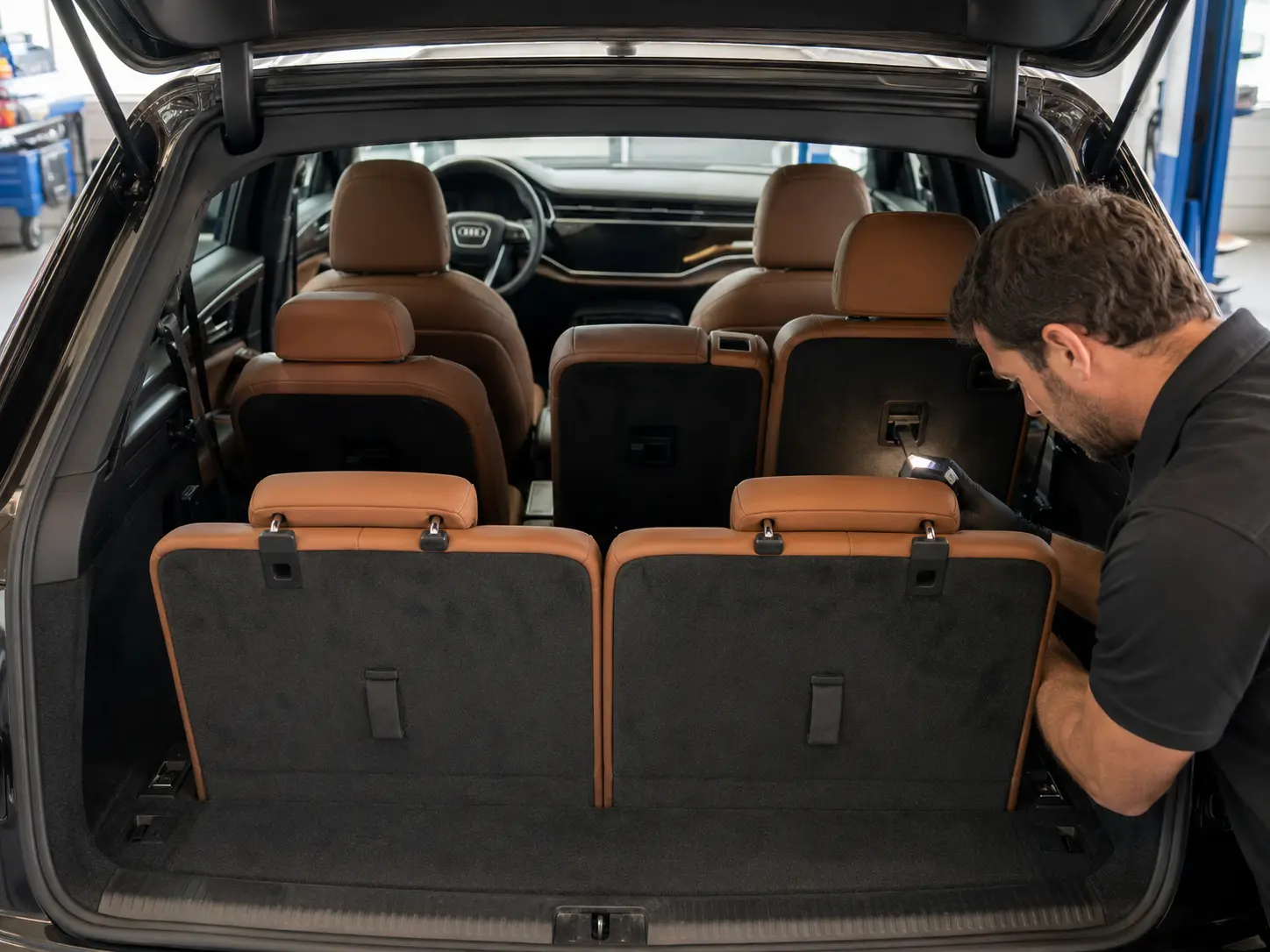
Record fitted seat count, occupied rows, luggage, seat or latch behaviour, climate zones, MMI, cameras and power supply. Do not assume every Q7 is a seven-seater.
Workshop result: identity, seat-function and electrical checks with any body, water-path or calibration boundary stated.
Middle deck · ride and braking
Measure four-corner height, tyre and brake condition, loaded joints and steering. Confirm adaptive air suspension, all-wheel steering, active roll stabilisation or other chassis equipment only where fitted.
Workshop result: corner comparison, leak or pressure route, brake measurements and alignment or calibration decision.
Lower deck · cooling and driveline
Identify engine, thermal loops, tiptronic code and quattro arrangement. Compare empty and loaded temperature, shift, vibration and acceleration behaviour.
Workshop result: pressure, temperature, scan and mechanical evidence before fluids, internal work or assembly options.
Baseline state
Useful for cold ride height, noise, steering and gearbox behaviour before passenger or luggage load changes the symptom.
Passenger state
Record rows in use and whether climate, seat latches, ride, braking or tyre contact changes with occupants.
Luggage state
Note cargo position and weight estimate. Never reproduce an unsafe overload merely to trigger a fault.
Thermal state
High ambient temperature, highway load and idling can expose marginal cooling, voltage or drivetrain conditions.
Generation and configuration
The Q7 name spans three generations
The first Q7 established the full-size Audi SUV line. The second generation introduced a different platform and later revisions changed lighting, assistance, powertrain and chassis equipment. Audi introduced the third-generation Q7 globally in June 2026. Local launch timing, engine choice and equipment must still be confirmed rather than inferred from a global announcement.
At the third-generation global launch, Audi described five seats as standard and six- or seven-seat layouts as options. That statement does not make every earlier Q7, imported vehicle or UAE-market car a seven-seater. Seat rails, latches, belts, airbags, control units and cargo-floor hardware follow the installed configuration.
Before work, record the VIN, generation, source market, engine, tiptronic code, quattro layout, seating, suspension, steering, brakes, wheels and tyres, 12V system and any fitted 48V, active roll stabilisation or Q7 TFSI e high-voltage equipment. S line is an equipment package; it is not automatically an SQ7.
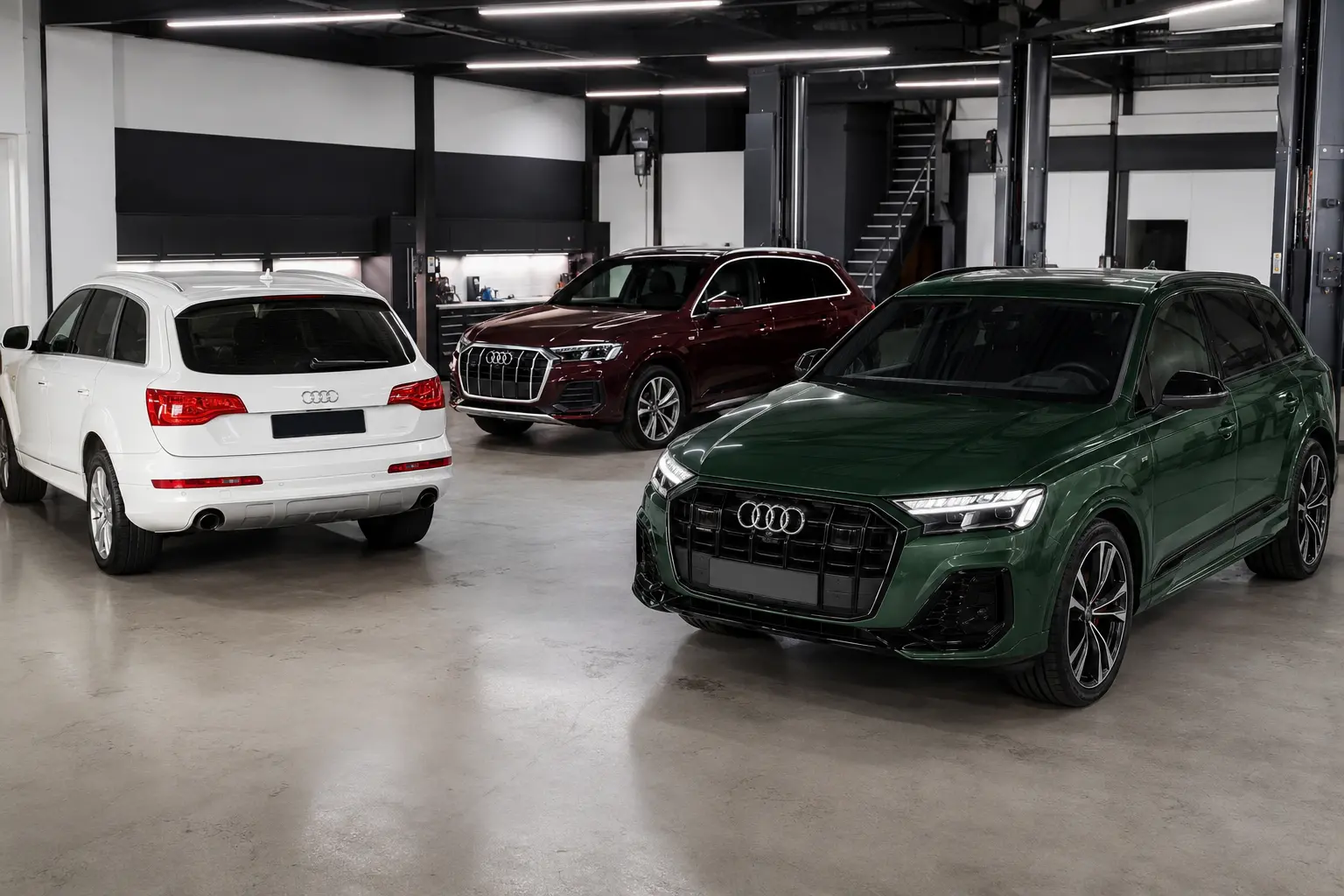
Age, previous repair, cooling condition, rubber parts, wiring and service history can outweigh a simple mileage judgement. Engine and gearbox identity remain essential.
Facelifts and equipment changes affect assistance, lighting, suspension and parts. Do not treat a revised body as one universal mechanical specification.
Newer architecture, seating choices and chassis options add identification and procedure boundaries. Global introduction does not prove immediate local availability.
Maintenance manifest
Service by engine, load and equipment
A Q7 service scope comes from VIN, time, mileage, history, source market and fitted systems. Dubai heat, dust and idling can change inspection attention, but they do not justify guessed fluids or universal replacement intervals.
Engine bayOil, filters and ignition
Confirm engine code, approved oil, capacity, filter and plugs where due. Record leaks, level and warnings separately from routine work.
Thermal loopsCoolant and climate
Identify engine, charge-air, cabin and Q7 TFSI e loops where present. Use correct coolant, controlled refill and a verified bleed.
Lower deckTiptronic and quattro
Use gearbox and driveline codes for fluid, pan, filter, temperature and level procedures. Service is not internal repair.
Middle deckQ7 brakes, tyres and load
Measure pads, discs, tyres, pressure and rolling circumference. Large wheels and brake packages require exact PR-code parts.
Ride systemsRide-height and steering systems
Confirm conventional, adaptive or air suspension and any all-wheel steering or active roll system before alignment or calibration.
Upper deckVoltage and cabin
Test 12V condition, fitted 48V or PHEV architecture, seats, climate, MMI, assistance and powered body systems.
Symptoms by load state
Record what changes when the Q7 is occupied
Stop and arrange recovery for red oil pressure, overheating or steam, smoke or burning smell, serious brake loss, heavy mechanical knock, loss of drive, unstable steering, a severely low corner or unsafe tyre clearance.
Load-aware evidence ladder
Diagnosis before a heavy parts list
The Q7’s size and equipment can create secondary faults across powertrain, chassis and cabin networks. A useful diagnosis preserves the original conditions, measures the actual vehicle and keeps unrelated maintenance separate.
Identify the built vehicle
VIN, generation, source market, engine, tiptronic, quattro, seats, suspension, steering, brakes and electrical architecture.
Record the load state
Empty, occupied, luggage, towing, cold, hot, idling, highway, braking, turning, shifting or changing ride height.
Stabilise supply
Test 12V condition and use support equipment where required before deep scanning, coding or programming.
Keep fault context
Freeze frames, counters, adaptations, height data, temperature, communication state and mileage remain attached to the symptom.
Perform the decisive test
Pressure, smoke, voltage drop, temperature, brake thickness, loaded movement, ride height or controlled road reproduction.
Separate the findings
Confirmed cause, contributor, overdue maintenance, unrelated recommendation and uncertainty are shown separately.
Approve the complete repair
Parts tier, labour, fluids, seals, programming, calibration, exclusions, VAT and variation terms are written.
Verify in the same state
Re-scan, remeasure and repeat the safe load or temperature condition that originally exposed the fault.
Lower deck · thermal
Cooling under real demand
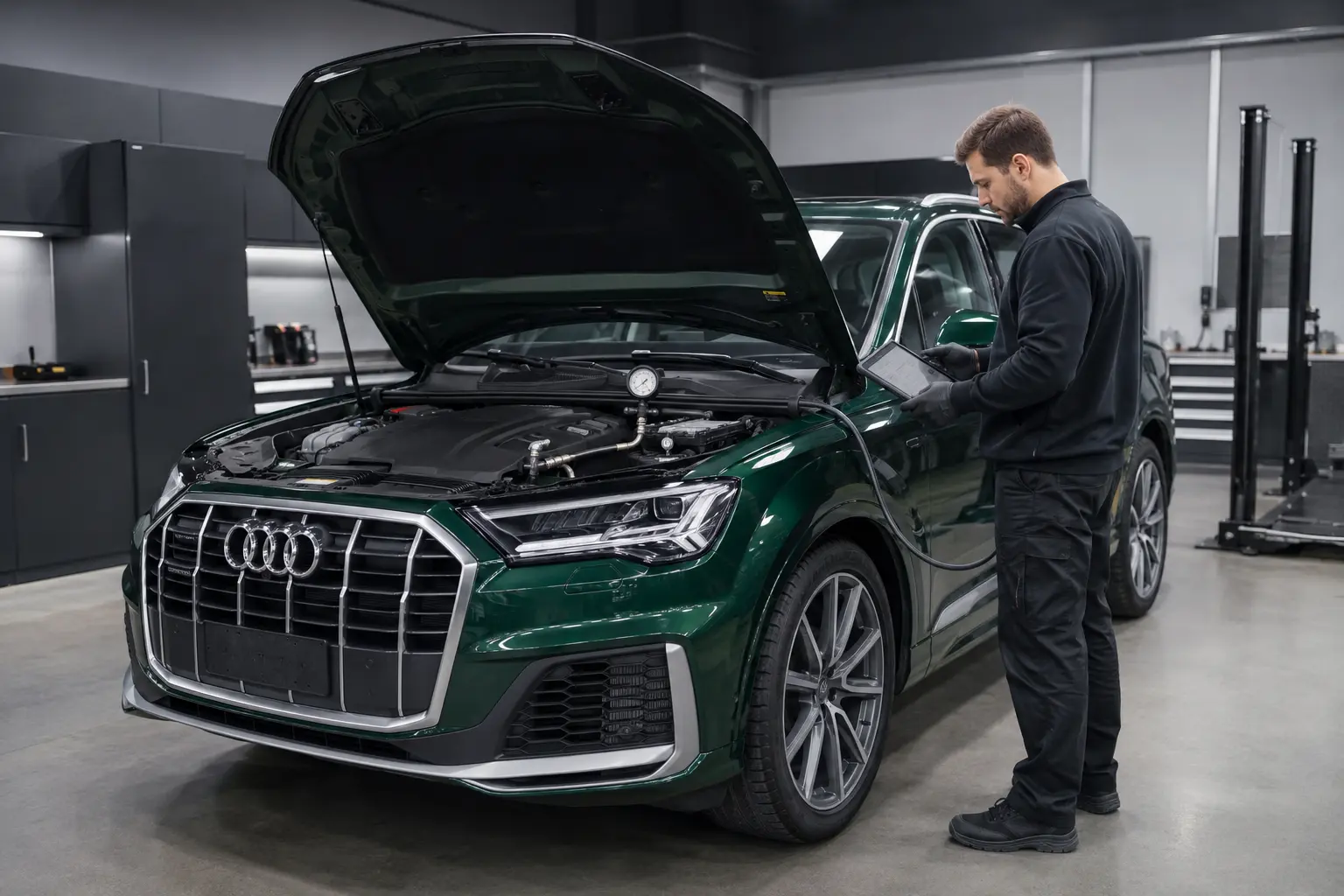
A small leak, restricted heat exchanger, weak pump, thermostat, fan-control problem or air pocket may appear only in heat or under sustained load. An undertray can hide evidence. Pressure-test the correct loop, compare commanded and measured temperatures and inspect at the relevant operating condition.
Q7 TFSI e adds plug-in-hybrid thermal decisions; it is not a battery-electric Q7. Identify the high-voltage boundary and accepted workshop scope before opening a related loop. Stop for rising temperature, steam or rapid coolant loss. The cooling-system page covers the deeper route.
Lower deck · driveline
Tiptronic and quattro identity
The exact tiptronic and quattro versions control fluid, pan or filter design, level procedure, adaptations and compatible parts. A vibration or delayed shift must be compared with mounts, shafts, joints, wheels, tyres and differential hardware.
Fluid service restores due maintenance on a serviceable unit; it cannot repair internal wear or a hydraulic control fault. Internal options must state repair scope, fluid, seals, programming, adaptation and closing test. See the gearbox repair route.
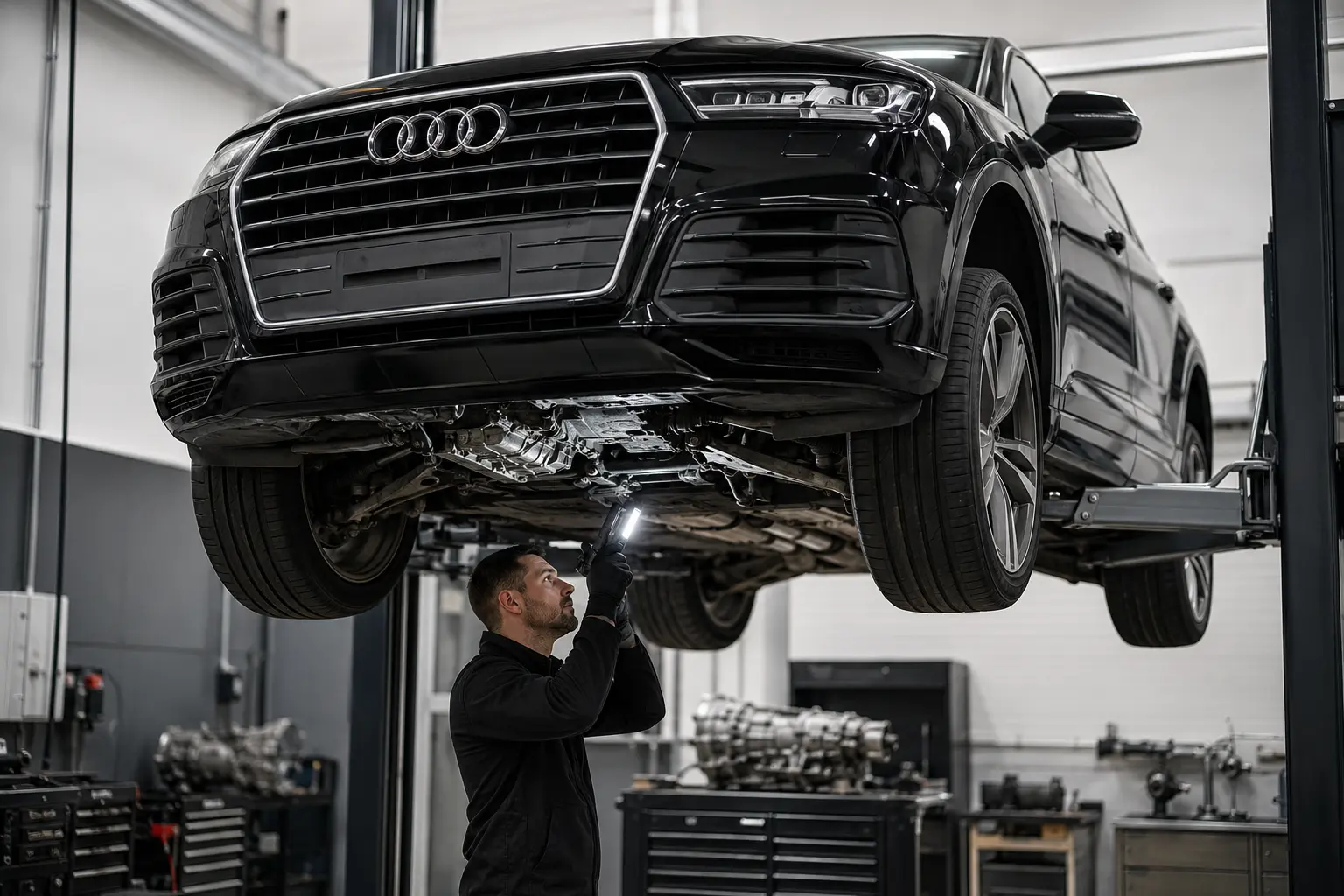
Middle deck · ride systems
Measure every corner before choosing a component
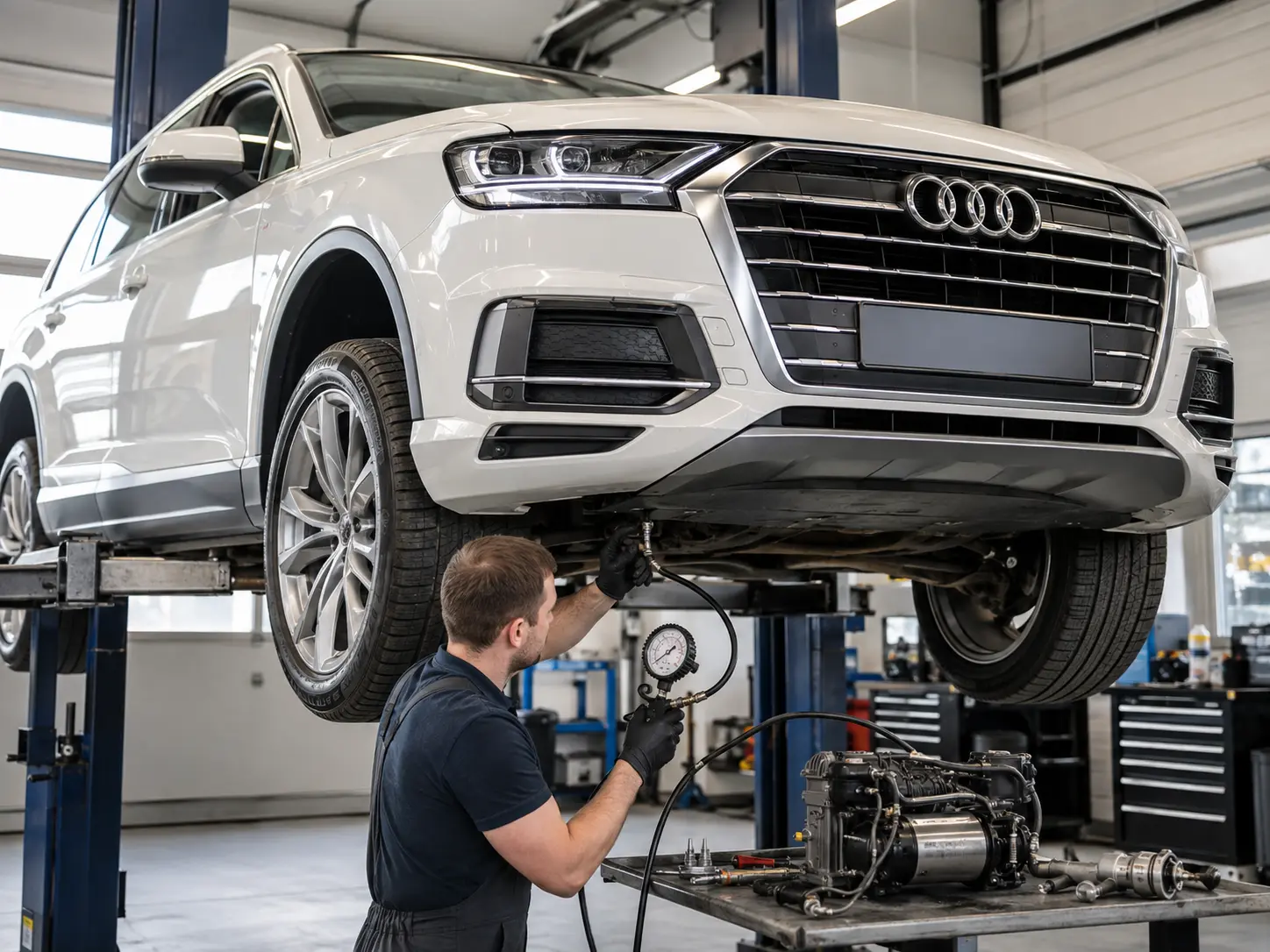
Air suspension is not fitted to every Q7, and a low corner does not automatically prove the air spring. Identity, height, leak and pressure evidence decide whether the route involves a strut, line, valve block, compressor, sensor, control supply or calibration.
Leak diagnosis
Record overnight drop and corner. Test air springs, struts, fittings, lines and the valve block at the condition that reveals the leak.
Pressure diagnosis
Check supply voltage, relay, compressor build, temperature and dryer or valve behaviour. Replacing only the compressor may leave the root cause.
Calibration check
Repair hardware first, then perform ride-height and related steering or assistance calibration where the exact procedure requires it.
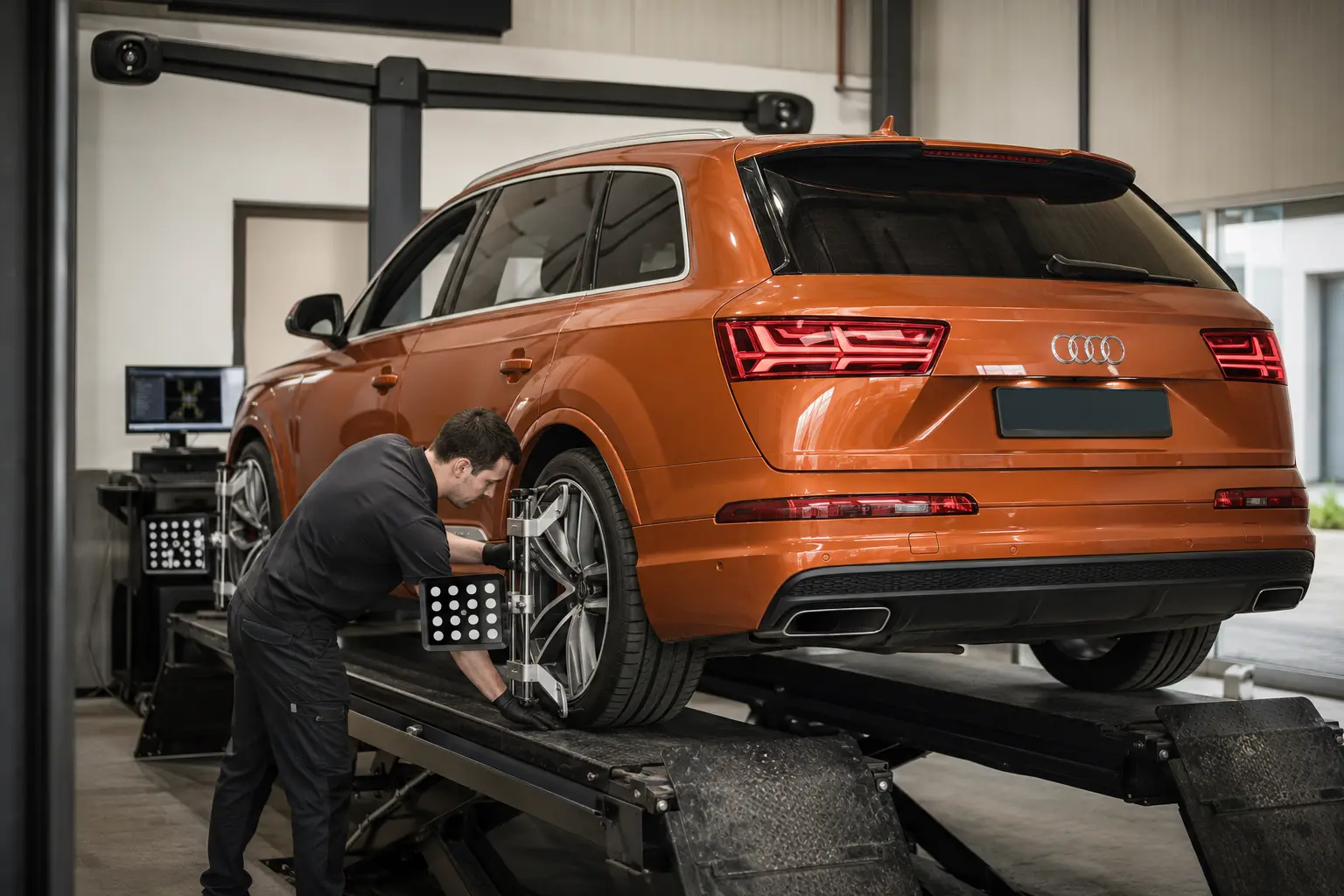
Steering, tyres and brakes
Alignment follows condition
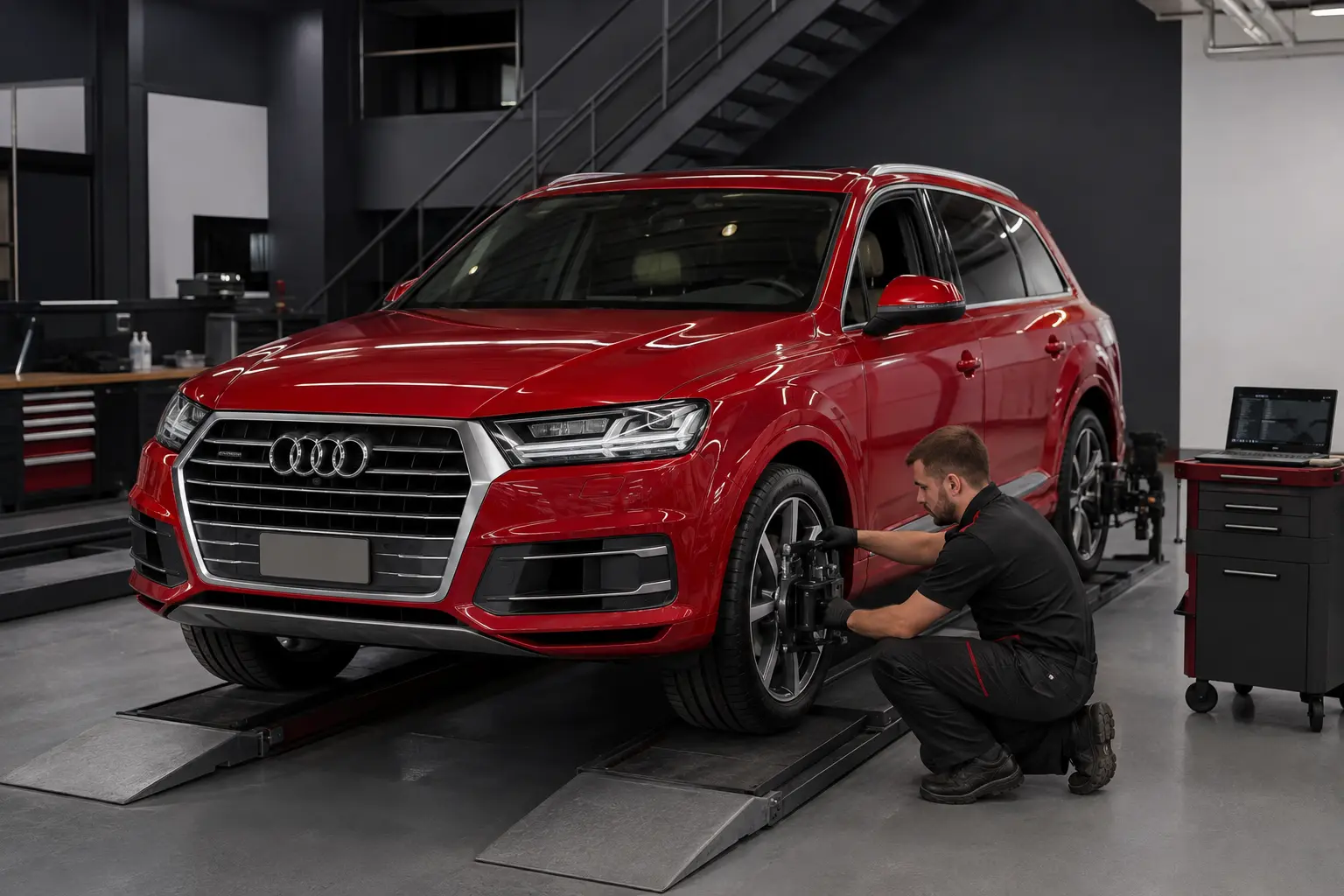
All-wheel steering is equipment-specific. So are adaptive damping and active roll stabilisation. Before alignment, measure ride height, inspect loaded joints, check tyre size, pressure, age, damage and rolling-circumference consistency and confirm whether steering or assistance calibration belongs in the closing procedure.
For brake vibration or pull, record speed, pedal pressure, heat and load. Measure pad and disc condition, check hub mounting, tyre and wheel run-out and suspension movement. A large Q7 brake package must be identified by PR code rather than wheel diameter or appearance.
After windscreen, bumper, grille, steering or suspension work, the fitted camera and radar systems decide whether calibration is required. It is not a generic add-on after every repair. The suspension page explains the chassis evidence route.
Upper deck · voltage and hybrid
Separate 12V, fitted 48V and Q7 TFSI e
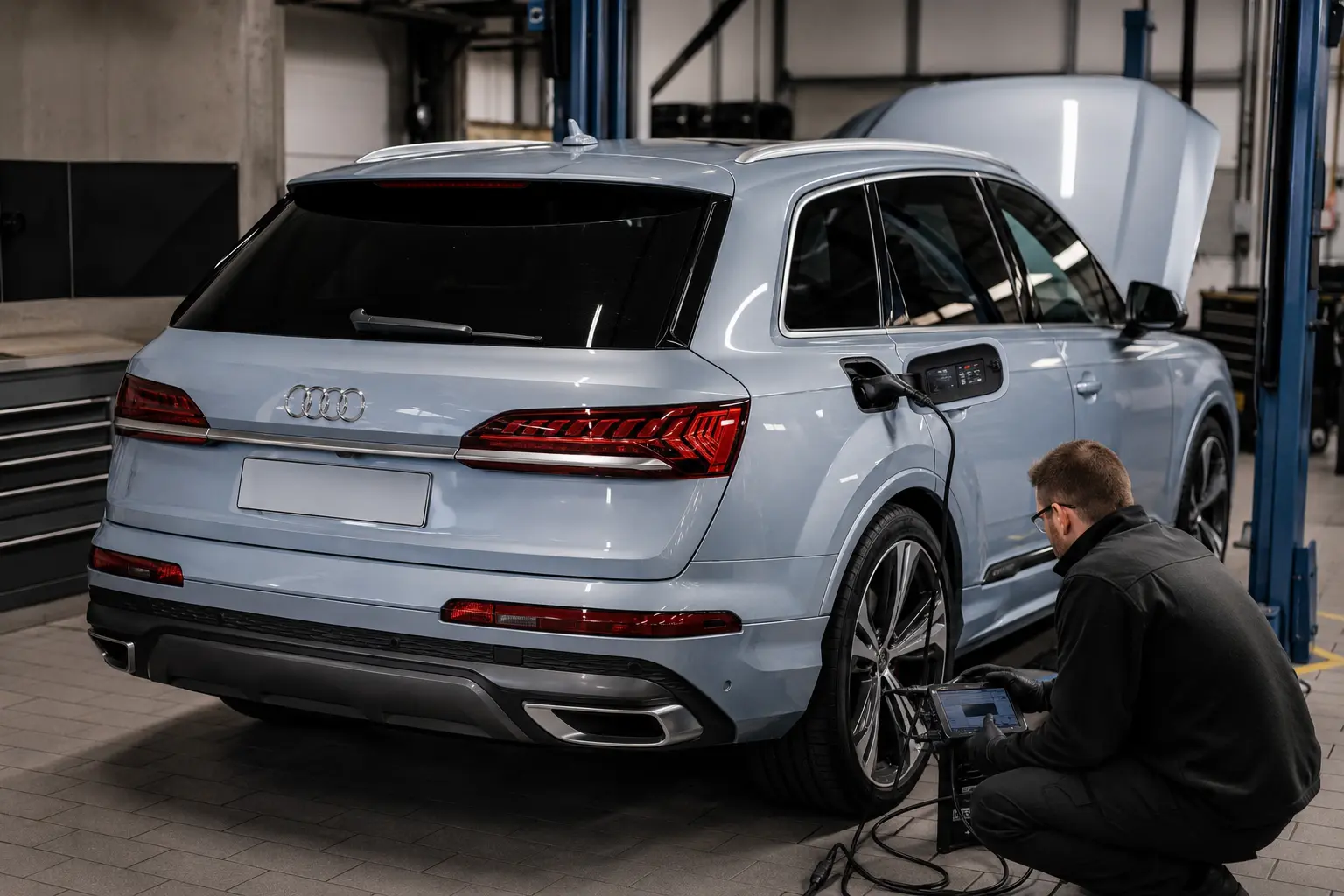
Start with the 12V battery, charging performance, grounds and stable support. A weak supply can create secondary faults across seats, MMI, cameras, tailgate, suspension, steering and powertrain controllers. Preserve context and then test the affected supply, signal, communication or component.
Some configurations add 48V mild-hybrid or chassis equipment. Q7 TFSI e adds plug-in charging, high-voltage systems, regenerative braking and extra thermal decisions. It remains a plug-in hybrid, not a battery-electric Q7. Identify the architecture and accepted high-voltage scope before booking or dismantling.
Seat, belt, airbag and latch work follows the actual five-, six- or seven-seat layout. Do not retrofit assumptions into an occupied safety system. The electrical repair page covers the wider voltage and network route.
Measured braking
Size and load change the decision
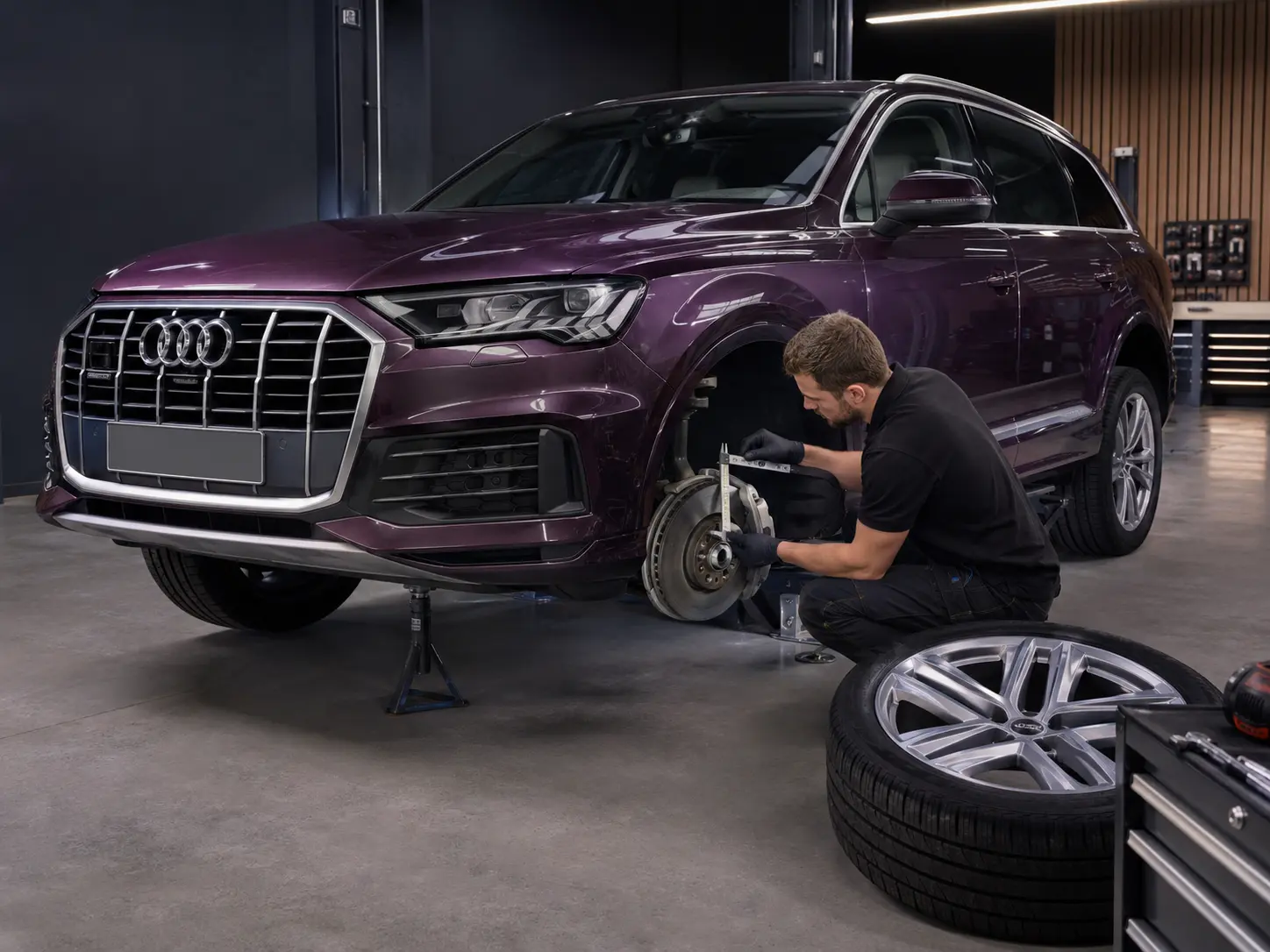
The Q7’s mass, passengers, luggage and wheel specification affect heat and stopping demand, but they do not replace measurement. Confirm the brake PR code, pad and disc dimensions, wear sensors, hydraulic condition and tyre grip before quoting friction parts.
A pedal pulse can involve disc thickness variation, hub condition, wheel fitment, suspension movement or tyre and road input. A warning may reflect wear, wiring or plausibility. Remove, clean and measure only as needed to separate the causes. New pads on unsuitable discs are not a complete repair.
After work, follow the fitted parking-brake and bedding procedure, check fluid and pedal condition and verify safely without claiming an unsafe high-speed test. Safety parts, friction materials, fluids and seals should be new and traceable.
Repair approval
Compare a complete Q7 repair
After the cause is supported, compare every option at installed, programmed, calibrated and verified cost. Large assemblies and high equipment levels can make a cheap component route expensive when essential work is omitted.
Track the condition
Use when measurements remain within limits. Record the interval, trigger for recheck and due maintenance separately.
Repair the confirmed fault
Use for a confirmed external component, line, wire, joint, latch, seal or leak while the assembly remains serviceable.
Repair inside the original unit
Define dismantling, renewed items, fluids, seals, programming and closing measurements. Keep unknown condition visible.
Rebuilt, used or new
State part number, source, compatibility, installation items and warranty. Avoid unknown-condition safety or service parts.
Q7 repair planning
Audi Q7 service and repair cost ranges
The Q7 ranges below were reviewed on 1 September 2026 for Dubai workshop planning. They are not fixed offers, and the written estimate shows UAE 5% VAT separately.
Generation, engine, tiptronic version, quattro layout, seating, suspension, steering, brake package, wheel size, fitted 48V or Q7 TFSI e equipment, parts tier and previous repair quality can change the total. Firm figures follow identity, inspection and any approved diagnostic or dismantling stage.
| Service or decision | Confirmed configuration | Tentative AED range | Included labour and tests | Main variables | Firm-quote stage | VAT status | Parts or fluid route | Estimate date |
|---|---|---|---|---|---|---|---|---|
| Initial Q7 scan and assessment | VIN, generation and concern supplied | AED 400 to 750 | Identity check, full-system scan and first physical inspection | Fault context, equipment and symptom complexity | After scan and first inspection | VAT excluded | Diagnosis only; no parts assumed | 1 September 2026 |
| Guided mechanical or electrical diagnosis | Conditions and affected deck recorded | AED 500 to 1,100 | First diagnostic block and one confirming measurement | Intermittent behaviour, access and network scope | After agreed diagnostic block | VAT excluded | Vehicle-specific tests and approved equipment | 1 September 2026 |
| Minor service | Engine, mileage and history confirmed | AED 850 to 1,650 | Approved oil, filter, scan, inspection and due basic filters | Oil capacity, engine family and due items | After VIN and schedule review | VAT excluded | New filters and approved fluids | 1 September 2026 |
| Major service | Exact engine and due items confirmed | AED 1,650 to 3,800 | Engine oil, filters, due ignition parts and fluids, scan and loaded-condition checks | Cylinder count, access and due fluids | After VIN and history review | VAT excluded | New vehicle-specific service parts | 1 September 2026 |
| Spark plugs | Petrol engine identified | AED 800 to 2,400 | Correct plug set, labour and post-work check | Cylinder count and engine packaging | After engine-code check | VAT excluded | New genuine or OE-quality plugs | 1 September 2026 |
| Brake fluid service | Fluid due and hydraulic system serviceable | AED 350 to 650 | Q7 brake-fluid service, bleed sequence and hydraulic checks | Brake package and fluid quantity | At booking confirmation | VAT excluded | New approved brake fluid | 1 September 2026 |
| Coolant service | Engine and thermal loops identified | AED 550 to 1,200 | Approved coolant, controlled refill and bleed checks | Loop count, capacity and PHEV configuration | After VIN and inspection | VAT excluded | Approved coolant and required seals | 1 September 2026 |
| Tiptronic service | Transmission code confirmed | AED 1,400 to 2,900 | Q7 gearbox-code fluid service, pan or filter items and level procedure | Gearbox code, oil quantity and pan design | After code and parts check | VAT excluded | Approved fluid and compatible service kit | 1 September 2026 |
| Quattro or differential fluid service | Exact driveline identified | AED 500 to 1,350 | Fluid and fill-level procedure for the identified differential | Front, centre, rear or sport differential | After drivetrain-code check | VAT excluded | Approved unit-specific fluid | 1 September 2026 |
| Cooling pressure and thermal check | Coolant loss or temperature concern present | AED 300 to 550 | Pressure test, visible inspection and live-temperature review | Hot-only leak, multiple loops and access | After first inspection | VAT excluded | Test only; repairs quoted after finding | 1 September 2026 |
| Q7 pump, thermostat or multi-loop cooling-control route | Leak or control fault confirmed | AED 1,800 to 5,500 | Component allowance, labour, coolant and bleed checks | Engine packaging, related housings and seals | After pressure and live-data tests | VAT excluded | New compatible components and seals | 1 September 2026 |
| Engine air-path or mechanical test route | EPC, boost, noise or condition concern recorded | AED 400 to 1,300 | Matched smoke, pressure, compression or mechanical test | Engine, access and remaining diagnostic question | After scan and test plan | VAT excluded | Test only; repair parts separate | 1 September 2026 |
| Tiptronic diagnosis | Shift or engagement conditions recorded | AED 500 to 1,100 | Scan, adaptations, fluid-state checks and safe road test | Cold or hot reproduction and transmission version | After first diagnostic block | VAT excluded | Diagnosis only; fluids or parts separate | 1 September 2026 |
| Valve-body or transmission control route | Hydraulic or control fault supported | AED 4,800 to 13,500 | Agreed repair route, fluid and adaptation allowance | Unit condition, parts source and internal wear | After diagnostic proof and approval | VAT excluded | New or verified rebuilt option stated | 1 September 2026 |
| Front brake pads | Brake PR code and disc state confirmed | AED 800 to 2,000 | Pads, fitting, cleaning, measurement and reset | Disc size, sensor and parts tier | After wheel and PR-code check | VAT excluded | New genuine or OE-supplier friction parts | 1 September 2026 |
| Front pads and discs | Brake package and measurements confirmed | AED 2,000 to 6,500 | Pads, discs, labour, measurement and post-check | Disc diameter, coating and performance package | After measurement and parts choice | VAT excluded | Matched new pads and discs | 1 September 2026 |
| Air-suspension diagnosis | Air suspension confirmed fitted | AED 500 to 1,100 | Scan, four-corner measurement, leak and pressure route | Intermittent drop, compressor state and access | After first diagnostic block | VAT excluded | Diagnosis only; no component assumed | 1 September 2026 |
| Air spring or strut per corner | Failed corner confirmed | AED 2,500 to 7,500 | One unit, labour and calibration allowance | Generation, axle, damper and parts route | After leak test and VIN check | VAT excluded | New, OE-supplier or warranted rebuilt option | 1 September 2026 |
| Air-suspension compressor | Compressor route confirmed | AED 2,500 to 6,500 | Compressor, labour and system verification allowance | Relay, dryer, valve block and root cause | After pressure and leak tests | VAT excluded | New or warranted compatible unit | 1 September 2026 |
| Air-suspension valve block | Valve block fault supported | AED 1,600 to 4,500 | Valve block route, labour and calibration checks | Contamination, line condition and parts source | After targeted air tests | VAT excluded | New or verified compatible unit | 1 September 2026 |
| Alignment and rear-steering check | Tyres, ride height and joints serviceable | AED 350 to 850 | Four-wheel measurement and fitted rear-steering review | All-wheel steering, seized hardware and calibration | After pre-alignment inspection | VAT excluded | No parts included | 1 September 2026 |
| 12V battery and registration | Battery specification and failure confirmed | AED 1,050 to 2,800 | Battery, fitting, registration and charging check | Capacity, chemistry, location and source | After battery test | VAT excluded | New correctly specified battery | 1 September 2026 |
| 48V or Q7 TFSI e diagnosis | Architecture and accepted scope confirmed | AED 750 to 1,900 | Voltage support, scan and first guided measurements | 48V equipment, charging, PHEV loops and safety scope | After system identification | VAT excluded | Diagnosis only; high-voltage parts separate | 1 September 2026 |
| Q7 pre-purchase inspection | Identity, access and inspection scope confirmed | AED 900 to 2,400 | Scan, road test, underbody, cabin, body and measured checks | Age, PHEV scope, equipment and report depth | Before inspection booking | VAT excluded | Inspection only; dismantling excluded | 1 September 2026 |
Read the Audi service cost guide when checking a Q7 estimate, then confirm which diagnostic stage, chassis or driveline work, fluids, VAT, exclusions and approval triggers are included.
Used Q7 inspection
Count the seats, identify the systems
Confirm VIN, generation, source market, Q7, S line or SQ7 identity, seating layout, engine, tiptronic code, quattro, suspension, steering, brakes, wheel and tyre specification and fitted voltage architecture. Match service invoices and part numbers to the actual vehicle.
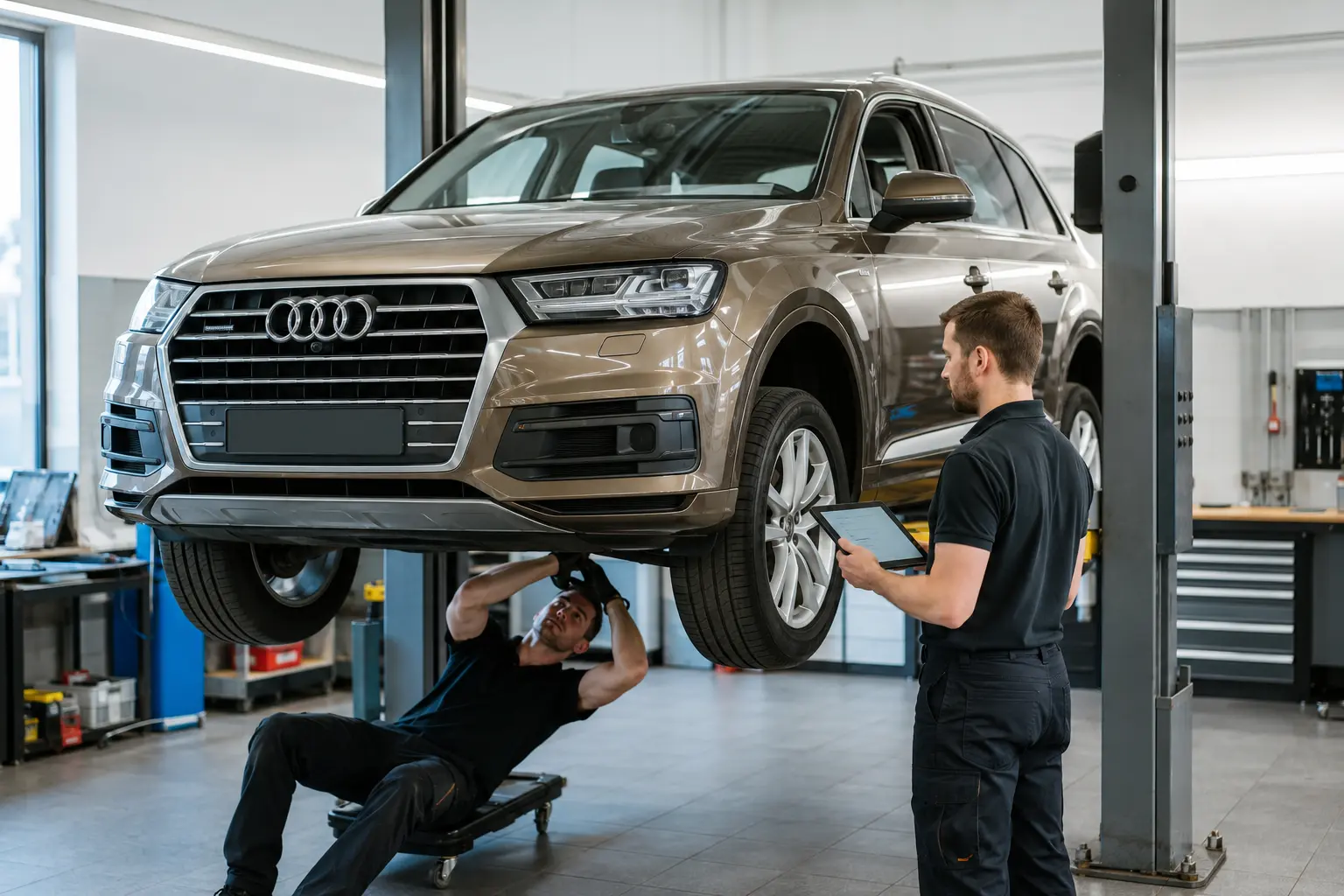
Start cold and retain full-system fault context. Test hot restart, acceleration, shifting, braking, turning and ride-height behaviour empty and at a safe agreed load where needed. Inspect cooling, oil and fluid leaks, mounts, shafts, underbody, loaded suspension joints, air-system condition where fitted, brake measurements and tyre consistency.
Operate every installed seat, latch, belt, climate zone, MMI display, camera, parking function, assistance system and powered tailgate. Inspect roof and body water paths, paint and structural evidence, windscreen, bumpers, lamps and calibration implications. For Q7 TFSI e, agree supported charging and battery-data checks without implying a capacity guarantee.
For a Q7, the report should distinguish safety work, overdue service, load- or suspension-related spending and faults that remain unconfirmed. See the pre-purchase inspection page for the full reporting route.
Worked diagnostic example
Rear corner low after an overnight park
This is a worked example, not a claimed customer job. An owner reports that one rear corner appears low in the morning but returns after the vehicle starts. A stored level-control condition is relevant, but it does not prove that the compressor or strut is the only failed part.
The technician records parking duration, temperature, load and which corner changes, then identifies the fitted suspension. Four-corner measurements confirm an asymmetric drop. Targeted leak checks compare the rear air spring or strut, line and fitting, while pressure build and temperature show whether the compressor has been overworked. Valve-block behaviour and supply voltage remain competing routes until measured.
The estimate separates the confirmed leak from any compressor damage or overdue maintenance. Closing verification leaves the Q7 in the same load and parking condition, checks the morning height, clears only resolved fault context and performs calibration if the exact repair procedure requires it.
Why the sequence matters
Replacing only the compressor could restore height briefly while the leak continues. Replacing only the lowest corner could miss a line, fitting or valve route. Load, time, height and pressure data protect the approval decision.
Q7 owner questions
Q7 questions before booking
Is every Audi Q7 a seven-seater?
No. Seating depends on generation, market and configuration. Audi’s global third-generation launch information describes five seats as standard with six- and seven-seat options; that does not make every older, imported or UAE vehicle a seven-seater. Inspect the actual seat system and VIN.
Does every Q7 have air suspension?
No. Suspension equipment varies. Some vehicles use conventional springs or adaptive damping, while others have adaptive air suspension. Identify the fitted chassis before interpreting a warning, measuring ride height or ordering a strut, compressor or valve block.
Does every Q7 have all-wheel steering?
No. It is equipment-specific. A steering or alignment plan must confirm whether the vehicle has a rear-steering system, then follow the applicable ride-height, alignment and calibration procedure.
What gearbox does an Audi Q7 use?
Many Q7 configurations use tiptronic, but the exact transmission version, source market and driveline still require code confirmation. Fluid approval, pan or filter design, fill method, adaptations and compatible replacement parts follow that identity.
Is a Q7 TFSI e fully electric?
No. Q7 TFSI e is a plug-in hybrid, not a battery-electric Q7. The petrol engine works with an electric drive, charge inlet, regenerative braking and shared cooling systems. The booking must identify the fitted high-voltage equipment.
Why does my Q7 sit low after parking overnight?
A leaking air spring or strut is one possibility, but line fittings, a valve block, height information, temperature, a control issue or previous work may contribute. Record which corner drops and how long it takes, then measure all corners and perform targeted leak and pressure tests.
Can a fault code tell me which Q7 suspension part to replace?
A code identifies a circuit or operating condition, not always the failed component. Four-corner height, pressure build, leak behaviour, supply voltage, temperature and physical inspection are needed before a parts decision.
Why can a Q7 overheat only with passengers or highway load?
Added load, ambient temperature and sustained engine demand may expose a marginal pump, fan, thermostat, coolant flow, heat exchanger or leak. Reproduce the condition safely, compare commanded and measured temperatures and pressure-test the relevant loops.
Can transmission fluid service fix a Q7 shift complaint?
It can restore due maintenance on a serviceable unit, but it cannot repair internal wear, bearings or hydraulic control faults. Record cold and hot behaviour and diagnose the exact tiptronic and driveline before promising an outcome.
What should be checked before buying a used Q7?
Confirm generation, source market, seating, engine, transmission, quattro, suspension, brakes, wheel and tyre specification and electrical architecture. Add full-system scanning, cold and hot road behaviour, cooling, underbody, body-repair, cabin, assistance and water-ingress checks.
When should a Q7 be recovered instead of driven?
Arrange recovery for red oil pressure, overheating or steam, smoke or burning smell, serious brake loss, heavy mechanical knock, loss of drive, unstable steering, a severely low corner, unsafe tyre clearance or an insecure seat or body system.
Send one load-aware Q7 brief
State the deck and occupied condition
Share the year, exact variant, mileage, seat and load state, warning or symptom and whether it happens cold, hot, braking, turning, shifting, changing ride height or charging. Before estimating Q7 work, the workshop must confirm the generation, load-related configuration and the first test for the reported condition.
Audi Q7 Service and Repair
Plan the next step for your Audi Q7
These pages extend the decision path without replacing diagnosis or repeating the same service intent.