
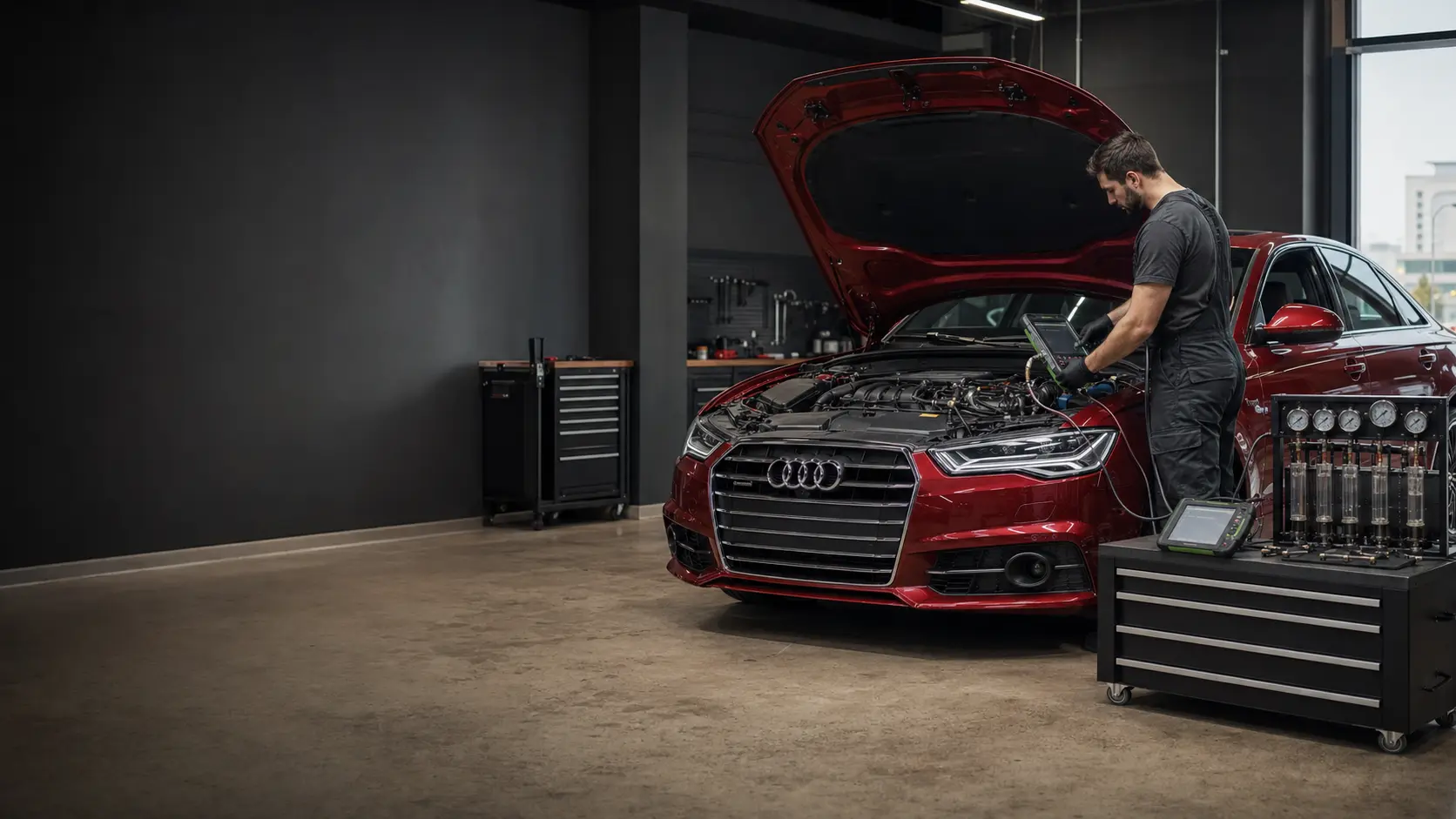
Audi fuel injector repair and replacement in Dubai
A misfire, difficult start or strong fuel smell does not automatically mean an injector has failed. We separate injector faults from ignition, air, pressure and compression problems, then explain whether the sensible route is a seal or wiring repair, cleaning and testing, one injector, or a matched set.
Fuel smell, a visible leak or severe shaking needs a different next step
If fuel is visible, the smell is strong, the engine is shaking heavily or the engine warning light is flashing, switch the engine off in a safe place. Do not keep restarting it to test the symptom. Call us to discuss inspection or recovery.
Symptoms that justify injector testing
Several faults can produce the same dashboard warning or driving complaint. The useful clue is when the symptom occurs and what the live data shows at that moment.
Rough idle or cylinder misfire
A weak, sticking or leaking injector can upset one cylinder. The same symptom can come from a coil, spark plug, intake leak, low compression or carbon accumulation.
Compare cylinders firstLong crank or difficult hot start
Fuel pressure that drains away after shutdown, an injector that leaks into a cylinder, or a pressure-control problem can lengthen cranking. Temperature and restart timing help narrow the test.
Check pressure retentionHesitation under load
An injector may deliver enough fuel at idle but fall behind under acceleration. Low supply pressure, a high-pressure pump issue or air-metering error can create a similar result.
Test under the fault conditionFuel smell or poor economy
A damaged seal, external leak, rich-running injector or incorrect pressure can raise consumption and create an odour. The source must be found before parts are chosen.
Treat leaks as urgentSmoke or uneven diesel running
Diesel injector correction values and return flow can reveal imbalance, but rail pressure, compression, air supply and contamination still need to be considered.
Use diesel-specific testsWarning light and stored codes
A cylinder-specific misfire or injector-circuit code is a starting point, not a parts order. Freeze-frame data shows speed, load and temperature when the control unit recorded it.
Read context, not just the code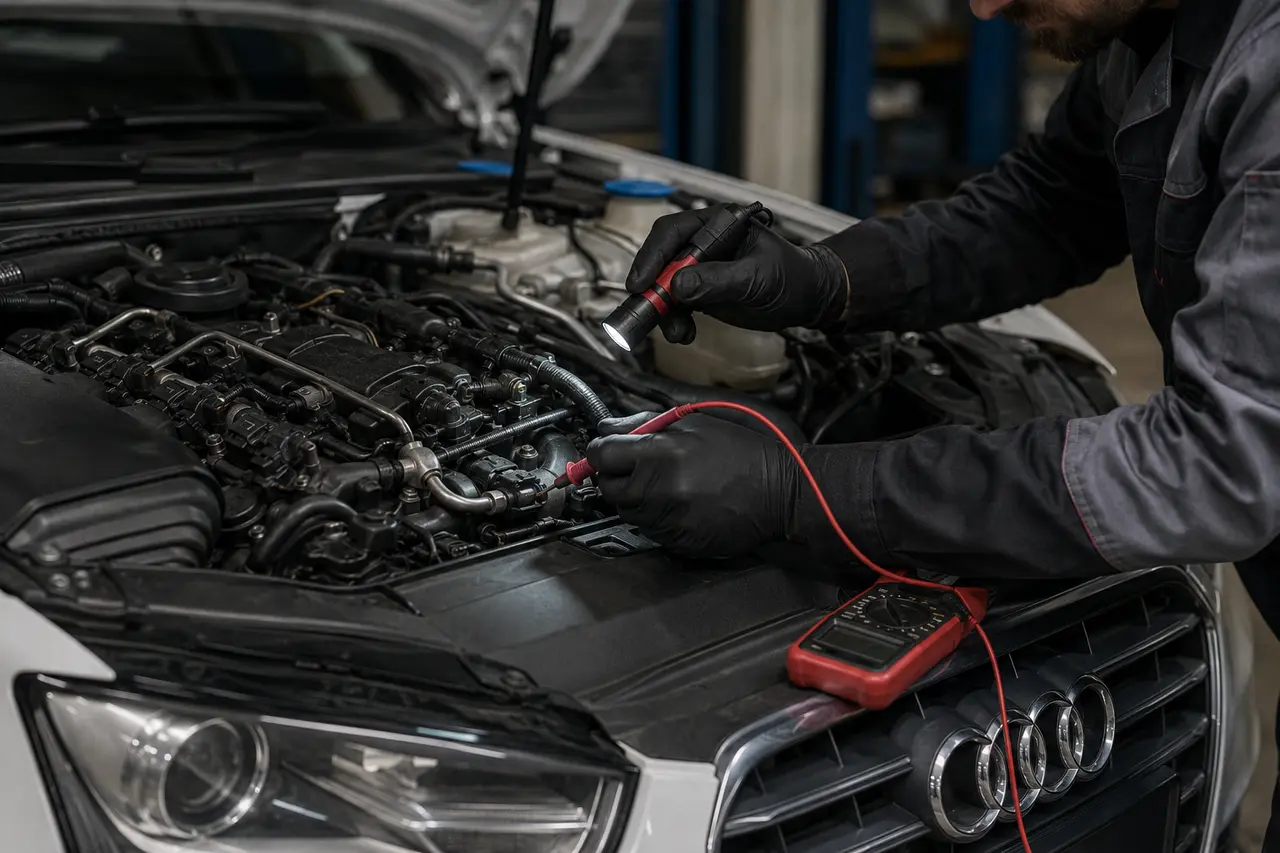
A circuit fault is not a failed injector
A loose terminal, oil or moisture in a connector, damaged insulation, excessive resistance or a poor control signal can stop a sound injector from operating correctly. We inspect the connector and nearby loom before recommending an injector.
- Visual and terminal-tension inspection
- Supply, ground and control-signal checks where applicable
- Harness continuity and voltage-drop testing
- Seal, rail and fuel-line inspection at the same access point
Which injector system is in your Audi
Model and year help, but the engine code or last six VIN characters let us identify the system and quote the correct test, seal kit and injector family.
Port fuel injection
Port injectors spray into the intake port at lower pressure. Depending on condition and construction, ultrasonic cleaning and flow comparison can be a practical route.
Access, rail seals and the number of cylinders influence the job more than the badge on the boot.
Petrol direct injection
Direct injectors work at much higher pressure and spray into the combustion chamber. Testing, removal, sealing and installation require the correct equipment and procedures.
Some replacements need adaptation or calibration data. Carbon on the intake valves is a separate issue and should not be sold as injector cleaning.
Common-rail diesel
Diesel diagnosis may include correction values, rail-pressure checks and return-flow comparison. A high return quantity can identify an injector that is bypassing more fuel than the others.
Fuel contamination or metal debris changes the repair plan because fitting one new injector without addressing the source can damage the replacement.
How we decide whether to clean, repair or replace
The order matters. Replacing the injector named in a fault code can leave the original cause untouched.
Identify the engine and injector family
We start with the exact Audi model, year and engine. The engine code or VIN confirms whether the car uses port injection, direct injection, a combined system or common-rail diesel, and which seals and installation procedures apply.
Scan every relevant control unit
Stored and pending fault codes are read with their freeze-frame data. Misfire counters, fuel trims, lambda response, injector correction values and commanded versus actual rail pressure provide more useful context than a code description alone.
Rule out the common lookalikes
Ignition faults, unmetered air, low supply pressure, high-pressure pump performance, compression loss and intake-valve carbon can mimic injector failure. The checks are chosen around the symptom rather than added automatically.
Inspect the fuel rail, seals and wiring
The technician checks for leakage, damaged connectors, pulled wiring, disturbed harness sections and signs of previous work. On direct-injection and diesel systems, correct depressurisation and cleanliness are essential before the rail is opened.
Compare delivery or return flow
Depending on the system, testing may include cylinder contribution, electrical waveform, balance testing, pressure retention, diesel return flow or off-car bench testing. The result should show whether one injector differs and by how much.
Check for contamination and upstream causes
Debris, water or incorrect fuel can affect more than one component. If contamination is present, the estimate may include tank, line and rail cleaning or further pump checks instead of treating one injector in isolation.
Agree the repair and verify the result
We explain the evidence, accessible repair options, parts basis and likely total before fitting parts. After the work, the engine is checked for leaks, codes, misfire counts, pressure behaviour and running quality under the conditions that exposed the fault.
What injector bench testing can show
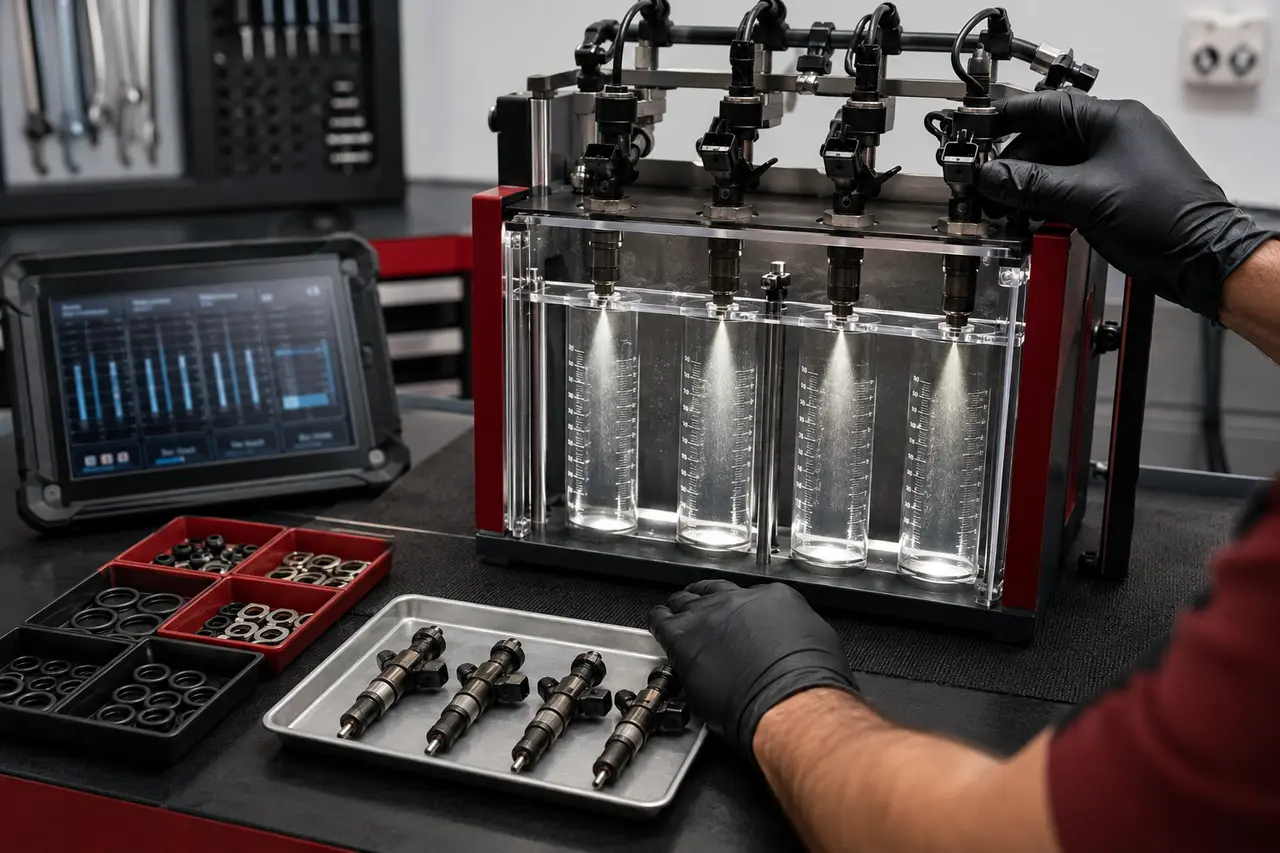
An off-car test can compare flow, spray pattern, leakage and electrical operation under controlled conditions. Cleaning is worthwhile only when the injector type can be serviced and the result improves to an acceptable, balanced condition.
A bench result can also justify replacement. If one unit leaks, remains badly imbalanced or has an electrical failure, repeated cleaning is not the useful route. The removed seals and retaining hardware are assessed separately because they are part of a leak-free installation.
The repair follows the fault
An injector enquiry does not always end with injector replacement. These are the routes an inspection can support.
No injector fault found
The evidence points to ignition, air, compression, fuel supply or another control issue.
- Report the confirmed direction
- Quote only the next useful test or repair
Seal, connector or harness repair
The injector itself tests correctly but its seal, terminal or local wiring is faulty.
- Repair the accessible cause
- Recheck leakage and operation
Cleaning and bench testing
Serviceable injectors are removed, cleaned, compared and refitted with suitable seals.
- Useful for recoverable deposits
- Before and after result guides the decision
Replace one injector
A single unit is confirmed faulty and the remaining injectors test acceptably.
- Parts choice matched to the engine
- Coding or adaptation completed if required
Replace a matched set
Several injectors are worn, the variance is excessive, or access makes repeated labour poor value.
- Four and six-cylinder scenarios differ
- The estimate states what the set includes
Contamination repair plan
Water, debris or pump wear has affected the rail or more than one injector.
- Find and remove the source
- Clean affected fuel-system sections before refitting
The work around the injector matters as much as the injector
Fuel injectors sit inside a system. Access, cleanliness, sealing, pressure control and post-repair checks determine whether the result lasts and whether the original complaint is actually resolved.
Record the fault while it is present
Intermittent misfires and hot-start complaints are easy to lose once the car cools or fault memory is cleared. We record the conditions that reproduce the problem, review freeze-frame data and compare relevant measurements before disturbing parts. If the engine runs smoothly at the workshop, the account of when the fault appears becomes part of the test plan.
On a petrol engine this may mean monitoring misfire counts and fuel trims during idle, restart or controlled load. On a diesel it may mean comparing correction values and rail pressure during cranking. The test is chosen to answer the complaint, not because every available measurement belongs on the invoice.
Protect the high-pressure system from dirt
Direct-injection petrol and common-rail diesel components work with small clearances. Dirt introduced while a line or rail is open can damage an injector or stop a new seal from seating correctly. The area is cleaned before opening, fuel pressure is released with the correct procedure, and exposed connections are protected.
Access can involve intake sections, wiring channels or other components above the rail. Their condition is noted during removal. A cracked hose, brittle connector or previous repair may explain part of the symptom and should not be hidden by installing injectors over it.
Use the correct seals and retaining method
Injector seals are not generic O-rings. Some petrol direct injectors use combustion-chamber sealing rings that need sizing tools. Diesel injectors may use seat washers and clamps with specific tightening procedures. Rails, pipes, bolts or clips can also be single-use depending on the engine.
The parts line on the estimate should therefore cover more than the injector body. It should identify the seals, retainers and hardware needed for a safe refit, plus any coding or adaptation required by that engine-management system.
Check the cause, the repair and the surrounding system
A dry visual check is followed by a running leak inspection and the measurements relevant to the original fault. If the complaint was a cold misfire, an immediate warm idle is not enough evidence. If it was a hot restart problem, the engine needs an appropriate heat cycle and restart check.
Fault memory is scanned again after the road test. New codes, pressure deviation, fuel-trim movement or a remaining cylinder imbalance can expose a second issue that was masked by the first. The purpose is to hand the car back with a documented result, not simply with the warning light cleared.

Return flow is one part of diesel diagnosis
Return-flow bottles compare how much fuel each injector sends back to the system. One injector returning substantially more than its neighbours may prevent the rail from reaching the pressure needed for starting or stable running.
The test is interpreted alongside rail pressure, correction values, cranking speed, fuel quality and mechanical condition. A diesel injector can also fail through poor spray, leakage or an electrical fault, so the result must match the symptom.
Audi fuel injector repair and replacement prices
These tentative ranges include 5% VAT and are current for September 2026. The engine, injector number, access, parts route and test result determine the estimate for your car.
| Service | Tentative price | What changes the range |
|---|---|---|
| Initial scan and injector assessment | AED 315–525 | Fault history, engine access and available live data |
| Extended fuel-system diagnosis | AED 525–945 | Intermittent faults, road testing and pressure checks |
| Injector circuit or harness diagnosis | AED 315–735 | Connector condition, loom access and signal testing |
| Petrol injector balance or contribution test | AED 420–735 | Engine layout and test access |
| Diesel injector return-flow test | AED 525–840 | Cylinder count and access |
| Bench test for a set of injectors | AED 630–1,260 | Injector type, quantity and removal status |
| Port injector ultrasonic cleaning | AED 630–1,050 | Number of injectors and seal requirements |
| Direct injector cleaning and testing | AED 945–1,785 | High-pressure type, quantity and serviceability |
| Injector seal repair | AED 420–1,050 | Seal type, leakage and removal access |
| Injector connector repair | AED 315–840 | Terminal damage and loom section required |
| Replace one port injector | AED 735–1,470 | Part brand, engine and access |
| Replace four port injectors | AED 2,100–4,200 | Parts route and rail hardware |
| Replace one direct injector | AED 1,050–2,310 | Injector version, seals and adaptation |
| Replace four direct injectors | AED 3,990–7,875 | Genuine or OE-quality parts and access |
| Replace six direct injectors | AED 5,775–11,550 | Engine layout, parts route and hardware |
| Replace one diesel injector | AED 1,575–3,465 | New or approved remanufactured part and coding |
| Replace four diesel injectors | AED 5,775–11,550 | Part route, coding and contamination work |
| Injector coding or adaptation | AED 315–630 | Control-unit procedure and injector data |
| Fuel rail and line cleaning | AED 735–1,575 | Extent and type of contamination |
| High-pressure pump diagnosis | AED 420–840 | Mechanical pressure tests and access |
| Compression or leak-down test | AED 525–1,260 | Cylinder count and engine access |
| Dubai recovery when the car should not be driven | AED 315–630 | Pickup location, destination and vehicle condition |
How the estimate changes after testing
These are illustrative combinations based on the ranges above. They show the logic of an estimate, not a diagnosis for a vehicle we have not inspected.
Four-cylinder TFSI with one confirmed direct injector fault
Misfire data follows one cylinder, ignition and compression checks are acceptable, and the injector remains out of balance. A one-injector route may be sensible if the other three test consistently.
- Likely scope
- Extended diagnosis, one direct injector, seals and adaptation
- Planning range
- AED 1,890–3,885
- Decision point
- Condition and balance of the remaining injectors
Port-injected engine with uneven flow but no electrical failure
The set is serviceable, no unit leaks and flow improves after ultrasonic cleaning. Cleaning can restore a balanced set without buying four injectors.
- Likely scope
- Assessment, removal, ultrasonic cleaning, bench comparison and seals
- Planning range
- AED 1,365–2,100
- Decision point
- Acceptable after-clean flow and spray consistency
V6 direct-injection engine with several weak injectors
More than one injector shows poor balance and the labour to access the rail is substantial. A six-injector set may reduce the risk of repeating the same access work soon.
- Likely scope
- Diagnosis, six injectors, seals, hardware and adaptation
- Planning range
- AED 6,615–13,125
- Decision point
- Parts basis and whether contamination is present
Diesel with one injector showing excessive return flow
One bottle fills markedly faster, commanded and actual rail pressure support the finding, and fuel inspection shows no wider contamination. One replacement can be considered.
- Likely scope
- Return-flow test, one diesel injector and coding
- Planning range
- AED 2,415–4,935
- Decision point
- New versus suitable remanufactured part
Misfire caused by low compression, not an injector
The misfire remains on the same cylinder after electrical and fuel checks, while compression and leak-down results reveal a mechanical problem. Buying an injector would not correct it.
- Likely scope
- Extended diagnosis plus compression or leak-down test
- Planning range
- AED 1,050–2,205
- Next page
- Audi engine repair diagnosis
Choose the injector repair from the engine and test result
The estimate should identify the parts basis and the small installation items that are easy to overlook.
Useful when the exact factory part and Audi packaging are preferred or when alternatives are unsuitable.
A compatible injector from an established original-equipment supply route may offer a different price point.
A properly tested remanufactured option may suit some diesel systems. Test documentation and warranty terms matter.
Sealing rings, retainers, single-use lines or bolts, calibration data and adaptation are included where the procedure requires them.
Four details make an early price more useful
Model year is not always enough
The same Audi model can use more than one engine or injector generation. The engine code or last six VIN characters reduces the risk of quoting the wrong part, seal kit or labour route. It also helps establish whether calibration data or adaptation is expected after fitting.
Cold, hot, idle and load faults need different tests
A symptom that appears only after an overnight cold soak may need a different booking plan from one that occurs on a hot restart or during motorway acceleration. Describe the timing rather than only saying that the engine runs rough.
New, OE-quality and remanufactured are not interchangeable
Availability and suitability vary by engine. A remanufactured diesel injector may be considered when it has the correct test and calibration information. A tested used part is considered only when its history and condition make sense for the repair, not as an automatic low-price substitute.
Contamination can turn one part into a system repair
Water, incorrect fuel or pump debris can affect the tank, lines, rail and several injectors. In that situation, the lowest one-injector estimate is not the relevant comparison. The quote needs to remove the source, clean affected sections and protect the replacement parts.
Verification should repeat the conditions that exposed the fault
Clearing a code is not the finish. The repaired area and the measured symptom are checked again.
Build your injector enquiry
The preview is created on this page before WhatsApp opens. Add the model, year and main symptom first. A warning-light photo or a short video of the engine running can help us plan the initial check.
Audi fuel injector FAQs
Does a misfire code prove the injector is faulty?
No. A cylinder-specific misfire code identifies where combustion became uneven. Spark plugs, ignition coils, air leaks, compression loss, fuel pressure and carbon accumulation can cause the same result. Injector testing should follow the evidence.
Can an Audi fuel injector be cleaned instead of replaced?
Sometimes. Cleaning is useful when the injector type is serviceable and deposits are affecting flow or spray. Bench testing should show whether it improved and whether the set is balanced. Electrical failure, leakage or severe wear usually points to replacement.
Should I replace one injector or the full set?
One injector can be sensible when one unit is clearly faulty and the others test consistently. A set may make more sense when several are weak, the balance is poor or access labour would be repeated. We compare both routes when the result supports them.
What is the difference between port and direct injectors?
Port injectors spray fuel into the intake port at relatively low pressure. Direct injectors spray into the combustion chamber at much higher pressure. Their testing, sealing, removal and parts costs differ.
How are diesel injectors tested?
Testing can include control-unit correction values, commanded and actual rail pressure, electrical checks and return-flow comparison. Off-car specialist testing may be needed to assess spray and leakage in more detail.
Can I drive with a faulty injector?
That depends on the symptom. Do not continue driving with visible fuel, a strong raw-fuel smell, severe shaking or a flashing engine warning light. A mild stable symptom still deserves prompt diagnosis because unburned fuel can affect other components.
Why does the car struggle to start when hot?
Possible causes include pressure bleeding down, an injector leaking into a cylinder, incorrect rail-pressure control, heat-related electrical faults or a different starting-system issue. A pressure-retention check and live data during the hot restart help separate them.
Does injector replacement require coding?
Some injectors and control systems require calibration values, coding or adaptation; others do not. The procedure depends on the exact engine and injector. Any required step should be part of the quoted installation.
Are injector seals replaced during the job?
Seals disturbed during removal are normally renewed with the correct installation tools and procedure. Some engines also use retaining hardware, lines or bolts that should not be reused. The estimate should state what is included.
Is intake carbon cleaning the same as injector cleaning?
No. Injector cleaning addresses the component that meters and sprays fuel. Intake carbon cleaning addresses deposits on the intake tract or valves, especially on some direct-injection engines. Diagnosis should identify which area is causing the symptom.
Could the fuel pump cause injector-like symptoms?
Yes. Low supply pressure or weak high-pressure delivery can affect every injector and cause long cranking, hesitation or lean running. Pressure should be checked before a full injector set is condemned.
What details help with an initial estimate?
Send the Audi model and year, engine or last six VIN characters, the main symptom, when it happens, any warning or code, recent fuel-system or ignition work, and whether there is a leak, strong smell or severe shaking.
How long does injector diagnosis take?
A visible connector fault may be found quickly, while an intermittent pressure or hot-start complaint can require repeated testing. Removal for bench work adds time. We can explain the planned diagnostic stage once we know the engine and symptom.
What if contamination is found in the fuel system?
The source and extent must be addressed before fitting clean or new components. The plan may include inspecting the tank, pump, lines and rail, cleaning affected sections and testing more than one injector.
Do you work on all Audi petrol and diesel models?
We handle a broad range of Audi petrol and diesel systems, but parts, tools and procedures depend on the engine. Send the model, year and engine or VIN detail so compatibility can be checked before booking.
Get the injector fault identified before choosing parts
Call for immediate guidance, or build a WhatsApp message with the model, year and conditions that trigger the problem.