
Audi collision and body repair
Audi Body Shop and Accident Repair in Dubai
Audi accident repair starts by separating visible paint or panel damage from hidden mounting, structural, steering, restraint and sensor effects. The inspection defines what can be repaired, what must be replaced, and which paint, parts and verification steps belong in the approved scope.
A photograph can narrow the route. It cannot show every hidden bracket, reinforcement, wiring connector or sensor mount. A final estimate follows access, material and vehicle checks.
After an Audi accident
Decide whether the Audi should move
A minor-looking impact can affect a wheel, closure, cooling part, restraint or sensor mount. Use the physical behaviour, not paint damage alone, to decide whether the Audi should move.
Stop and recover
Wheel contact or displacement, changed steering or braking, a leak, smoke, exposed wiring, unstable windshield glass, deployed airbag, loose part or unsafe closure needs a recovery conversation.
Book prompt inspection
Changed gaps, a moved bumper, wheel-area impact, damaged lamp, sensor warning, failed lock, window, camera or parking sensor needs checking before cosmetic work.
Plan cosmetic work
A stable scuff, chip or dent may suit a cosmetic booking only when there is no loose part, warning, leak, closure, wheel, lighting or visibility concern.
Audi accident damage assessment
Separate cosmetic, functional and structural damage
Minor Audi accident damage may be limited to a scuff, dent, cracked bumper or broken lamp mounting. A heavier front, rear, side or wheel-area impact can also move reinforcement, inner panels, closures, suspension points or sensor mounts. Separating cosmetic, functional and structural damage sets the right inspection before a paint or parts quote is approved.
Cosmetic damage changes appearance without changing the shape, attachment or operation of nearby systems. Even here, scratch depth and remaining coating decide whether correction, a local repair or refinishing is suitable. Polishing cannot replace colour coat or corrosion protection that has been cut through. After the repaired finish has cured and been inspected, a separate Audi paint-protection plan can be considered without confusing protection with repair.
Functional damage changes fit or operation. A bumper corner may stay attached yet move a sensor holder. A door may close but sit high against the seal. A lamp can illuminate while its mounting foot is cracked. These faults need an estimate that includes the hidden attachment, not only the visible surface.
Safety-related damage concerns stable control, structure, closures, restraint components, sharp edges, fluids, visibility or high-voltage areas. It is not diagnosed from a photograph. The useful remote decision is whether to arrange recovery and what must be exposed or measured before repair begins.
Surface evidence
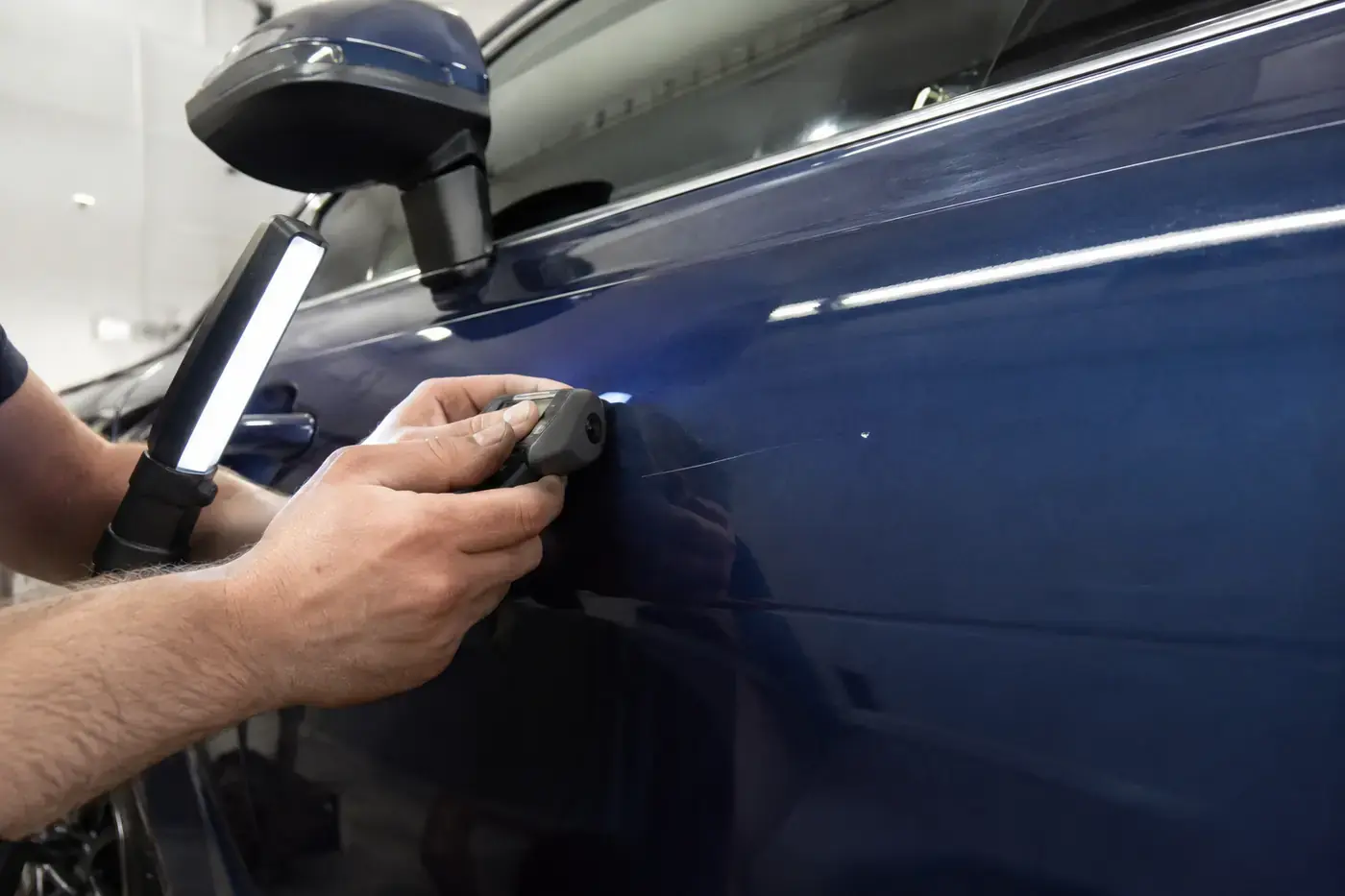
Transfer, clear-coat marking, chips and scratches are examined for depth, area, panel material and previous repair. The smallest sound process may preserve more original finish.
Fit and function
Dent shape, panel gaps, clips, brackets, locks, lamps, glass, trim, wheel clearance and fitted sensors decide whether the scope extends beyond paint.
Safety and geometry
Wheel position, openings, rails, pillars, floors, restraint warnings, cooling parts and EV or PHEV high-voltage zones can require a wider measured route.
Least invasive sound route
Move up the method scale only when needed
The method follows the damaged layer
Paint transfer and a shallow clear-coat mark may respond to controlled cleaning and correction. A chip, limited scuff or small defect may suit a local paint process, but metallic, pearl, panel-edge and highly visible positions can make a spot edge conspicuous.
Paintless dent repair is considered when the finish is intact, the metal is not excessively stretched and access, reinforcement, edges and previous filler do not defeat controlled reshaping. Broken paint, a hard crease or an inaccessible double skin can move the work to conventional repair.
Conventional panel work restores shape before primer and colour. Replacement becomes more defensible when metal is torn or severely stretched, a casting is cracked, a safety-related mounting is unreliable, sound attachment points are unavailable or repair cost and repeat risk exceed the value of a suitable part.
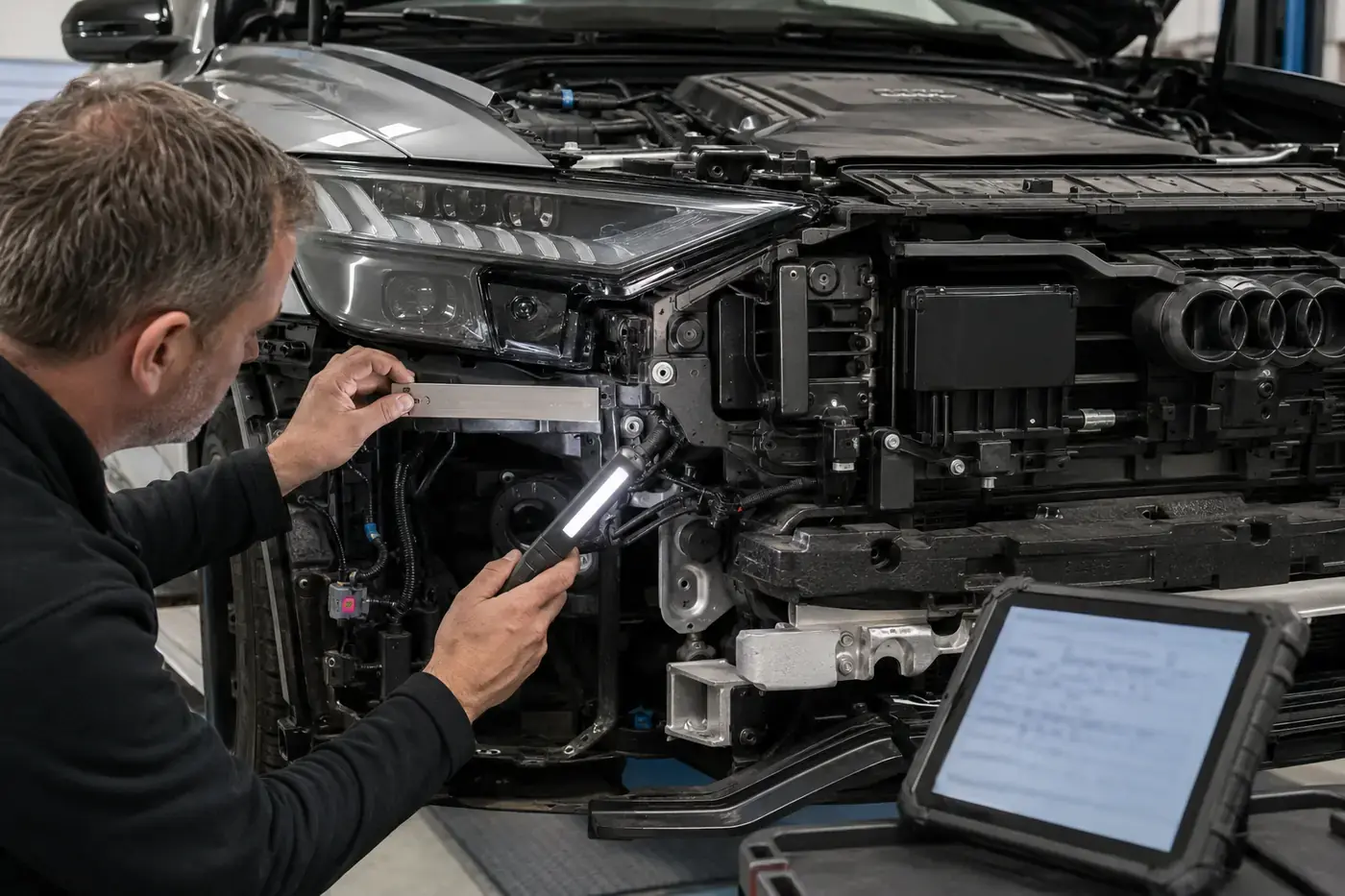
Accident repair adds measurement, controlled access and system checks. A photograph helps plan this route, but dismantling is what exposes absorbers, reinforcements, inner panels, wiring, cooling parts, sensor brackets and prior repairs.
Observed damage to first decision
What should be checked before approval
| Damage finding | Likely route | Check before approval | Do not assume |
|---|---|---|---|
| Paint transfer or shallow clear-coat mark | Correction or limited surface treatment | Scratch depth, remaining coating, panel temperature and previous refinishing | Every visible line needs paint |
| Small dent with intact paint | PDR assessment | Access, crease, stretch, edge, reinforcement, material and prior filler | Every intact dent is suitable for PDR |
| Deformed panel with paint damage | Conventional repair and refinish | Material, shape, corrosion protection, joining points and repair economics | Filler can replace correct metal work |
| Cracked bumper cover | Plastic repair or replacement | Plastic type, tabs, brackets, sensors, absorber, reinforcement and paint restrictions | The cover is the complete bumper system |
| Torn or severely stretched panel | Replacement or wider repair plan | Attachment, safety function, material route, adjacent structure and available part | A lower labour quote restores integrity |
| Misaligned gap after impact | Measure before cosmetic work | Hinge, latch, mounting point, opening, seal and deeper geometry | Adjustment alone is the repair |
| Wheel-area impact | Mechanical and geometry inspection | Wheel, tyre, hub, steering, suspension, subframe, attachment and clearance | A straight-looking wheel is safe |
| Sensor-mounted bumper damage | Body repair plus electronic verification | Bracket position, fault records, repair restrictions, aiming and calibration need | A clean dashboard proves alignment |
| Hidden damage behind trim | Controlled dismantling and variation | Inner panel, wiring, reinforcement, clips, seals and water paths | The first photo price is final |
Preserve paint when viable
PDR depends on shape and access
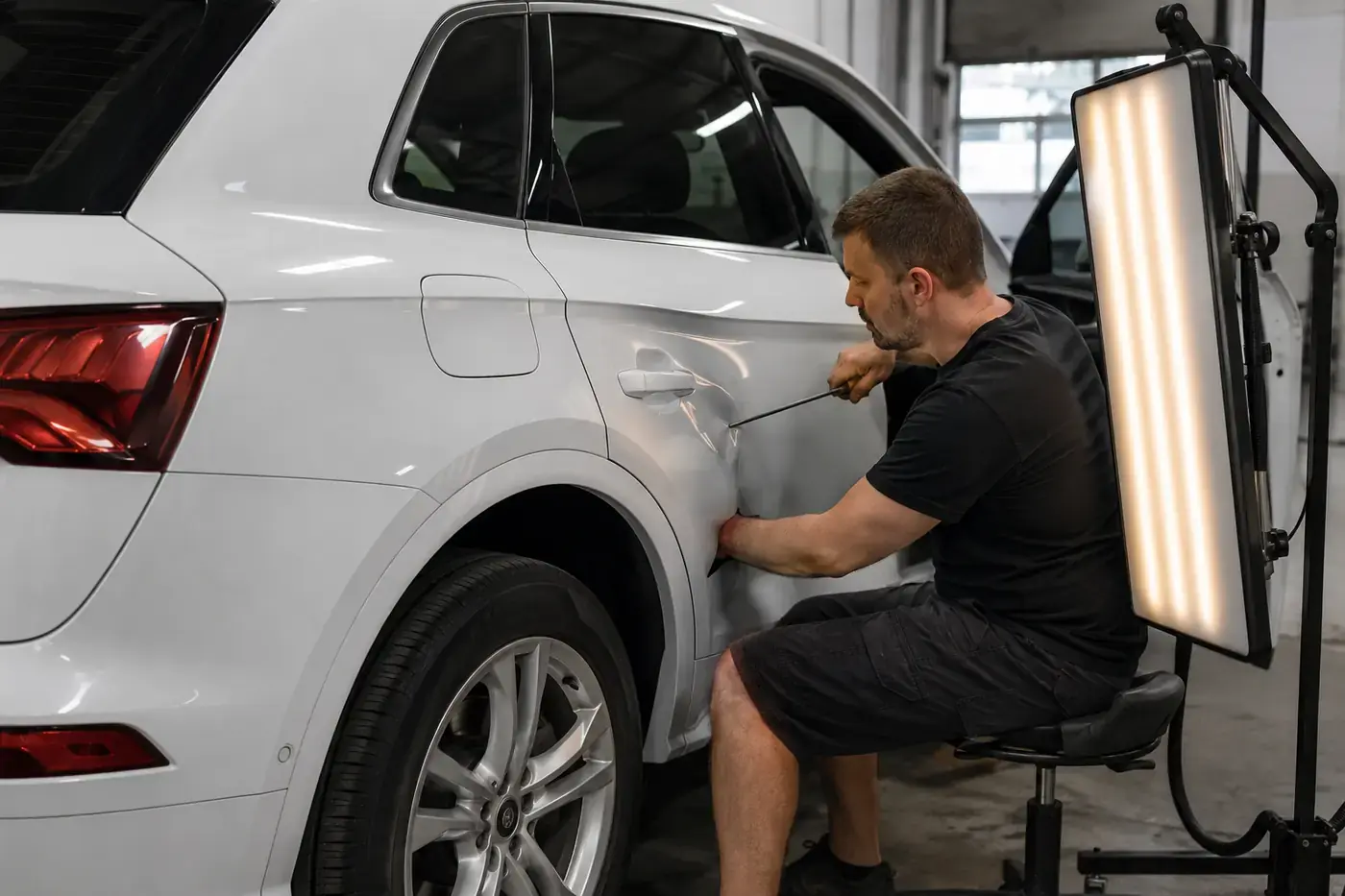
Paintless dent repair is a method choice, not a promise attached to the word dent. It is useful when the original finish can flex and the metal can be moved without hiding a split coating, stretched crown or earlier repair.
A broad shallow depression in an accessible part of a door can be more controllable than a small sharp strike on a reinforced body line. A panel edge, double skin, intrusion beam or bonded reinforcement may block tool access. Glue-pull access can help on some surfaces, but coating condition and previous paint still matter.
Reflection lighting reveals highs, lows and tension around the dent. The assessment also checks cracked clear coat, colour fracture and displaced seam sealer. If the metal has stretched, the finish is broken or the panel contains filler, conventional shaping and refinishing may produce the more durable result.
- Paint remains intact and stable
- Metal is not excessively stretched
- Crease and crown are controllable
- Edge and reinforcement permit access
- Previous filler does not undermine work
- Material is identified before work
The skin is one layer
A bumper quote needs the hidden stack
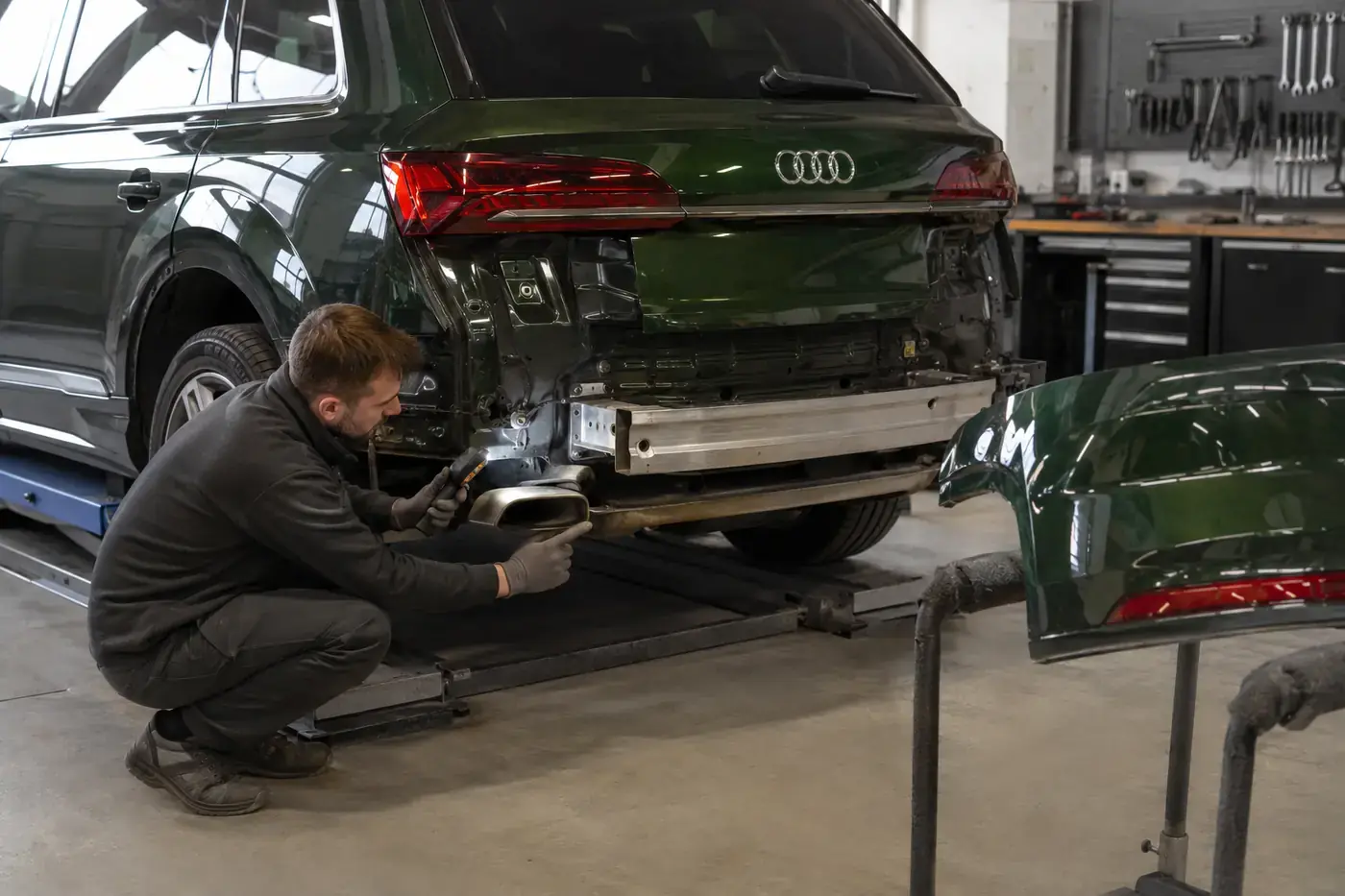
A surface scuff can be a refinishing job. A displaced or cracked cover can involve attachment tabs, side guides, grille pieces, sensor holders, an energy absorber, reinforcement, wiring and lamp mounts.
Heat reshaping or plastic repair is considered only after the material, deformation, crack position and sensor zone are understood. A repair at a mounting point must restore dependable fit. Missing plastic, torn corners, repeated repairs or a distorted sensor area can make replacement more predictable.
Parking sensors can still click or display normally while a holder points them incorrectly. Radar and camera requirements vary by vehicle and fitted equipment. Paint thickness, filler, bracket position and removal can affect what must be checked, aimed or calibrated, so the exact repair information controls the route.
Colour is a system result
Paint code starts the match
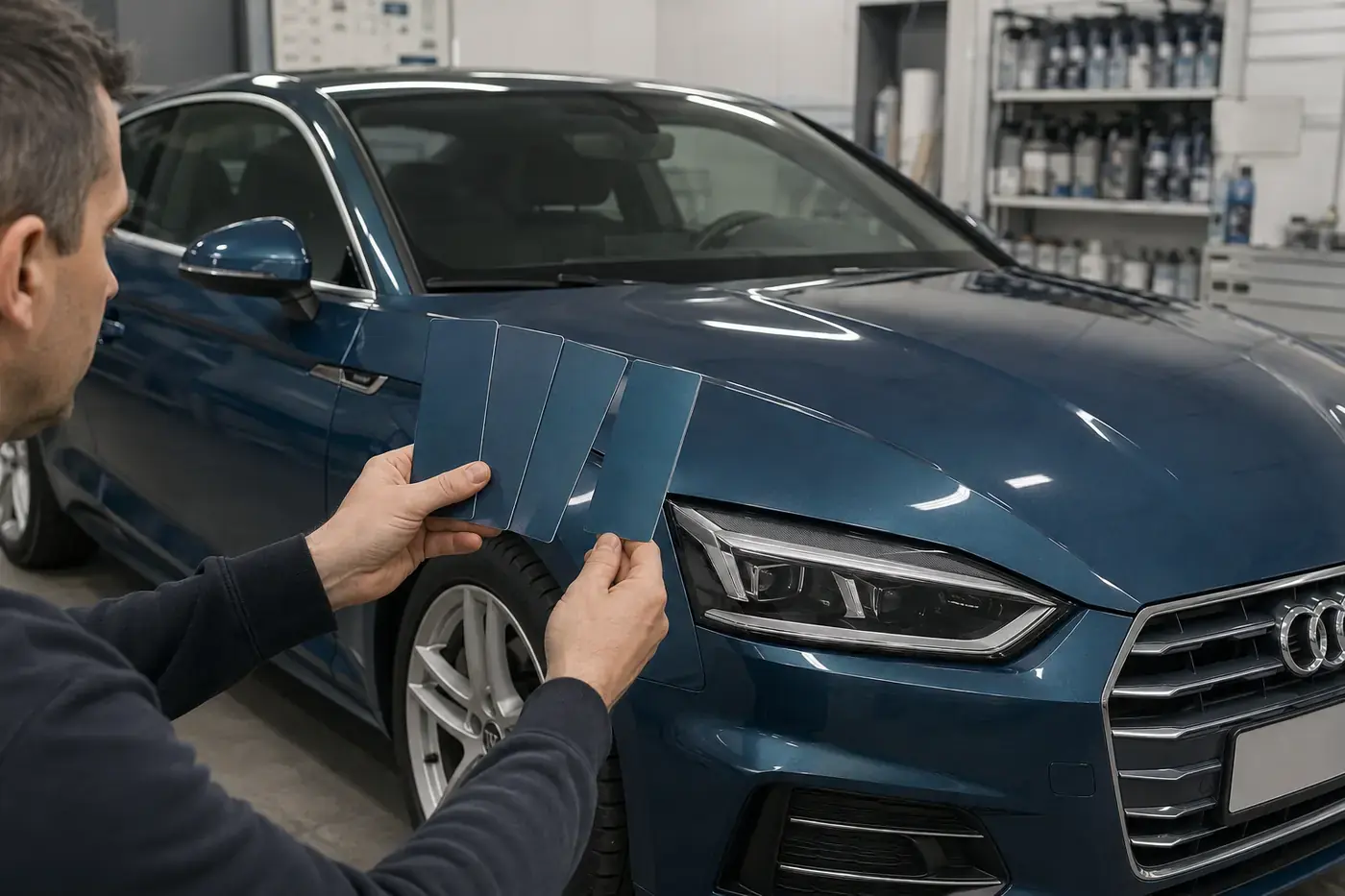
The Audi paint code identifies a formula family. It does not account by itself for ageing, previous repair, panel orientation, application texture, metallic flake or pearl effect on the vehicle in front of the technician.
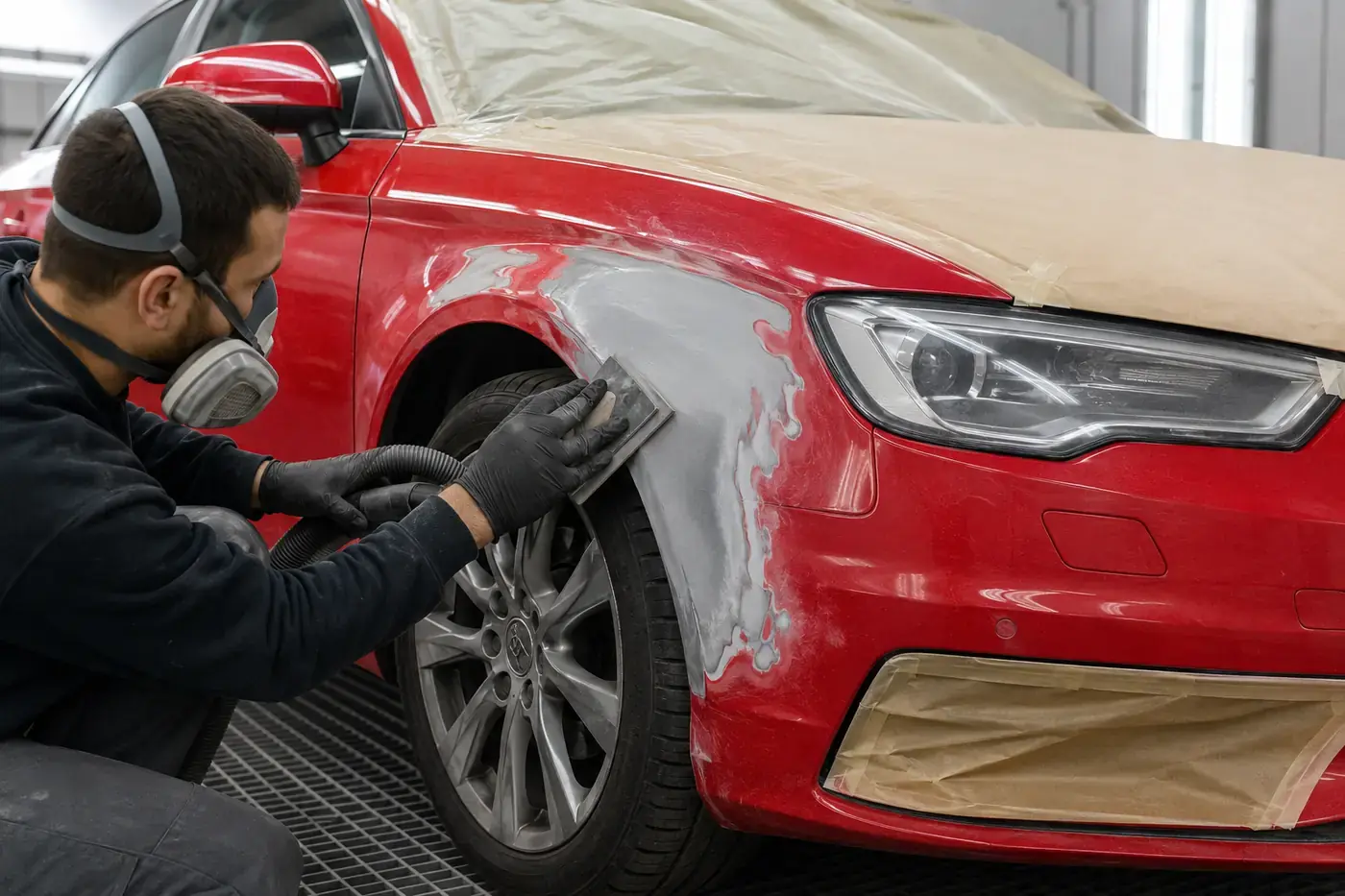
Cleaning and substrate assessment come first. Steel, aluminium, plastic, composite and a previously filled surface do not share the same preparation. Bare areas need the specified protection. Plastics can require adhesion treatment. Primer, sealer, base colour and clear coat must be compatible and applied as one refinishing system.
Solid colours can still vary with film build and earlier work. Metallic colour changes with flake orientation and viewing angle. Pearl or multi-stage finishes add another effect layer and can make a local edge more visible. Matte and special finishes require a separate acceptance check because gloss adjustment and local correction are restricted.
A spray-out comparison or digital colour tool may support the choice only when that capability is available for the job. The sample is compared against the vehicle under more than one practical lighting condition. Blending can be appropriate when a repaired edge would otherwise remain visible, but painting every adjacent panel is not automatic.
Audi accident repair sequence
The estimate develops as hidden damage is exposed
An Audi accident repair estimate begins with visible damage and the reported impact. Controlled access can reveal broken brackets, absorbers, wiring, reinforcement or inner-panel movement. Any supplementary approval should name the new finding, its repair method and its effect on the total.
Receive and make safe
Record keys, condition, loose parts, leaks, warnings and whether movement, isolation or confirmed recovery is appropriate.
Identify and inspect
Confirm VIN, equipment and paint code. Photograph gaps, closures, lamps, wheels and affected systems. Scan when impact or warnings justify it.
Expose and compare
Remove only what is needed to reveal brackets, absorbers, reinforcement, wiring, inner panels and attachment points. Compare sound repair with replacement.
Approve the scope
Define labour, parts tier, clips, paint, blends, scanning, alignment, aiming, calibration, VAT and known exclusions before work proceeds.
Repair in sequence
Complete material repair, joining, protection, sealing and refinishing in the correct order. Do not paint over unresolved fit or geometry.
Reassemble correctly
Use the specified clips, seals, fasteners and parts. Restore affected coding, aiming, alignment or calibration only where required.
Verify function and finish
Check gaps, closures, water paths, lights, sensors, warnings, wheel clearance, paint finish and road behaviour within the approved scope.
Record the handover
Provide the final repair scope, approved variations, verification performed and practical care advice for the refinished area.
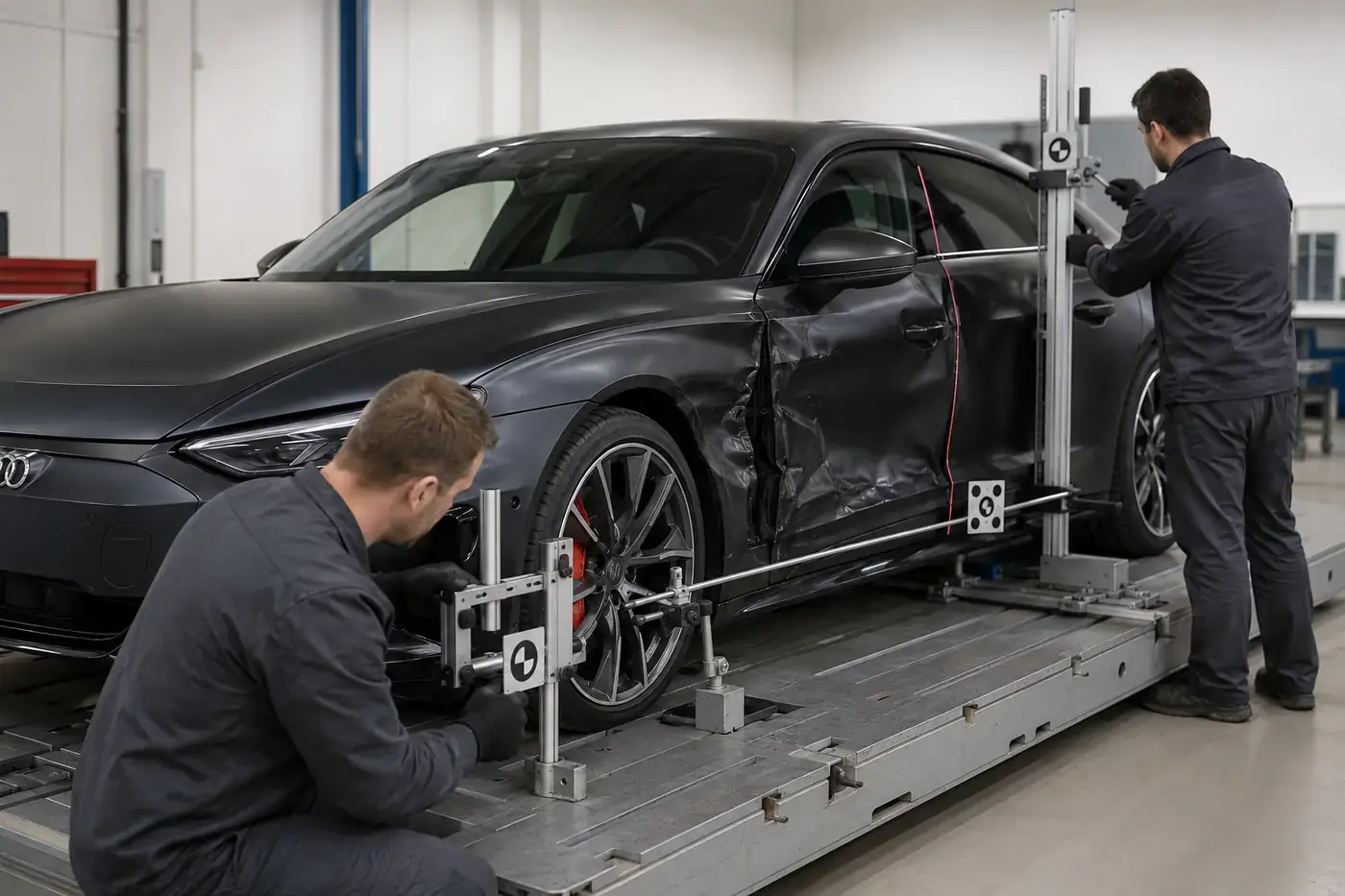
Preserve or replace
Repairability is more than appearance
Keeping the original part can preserve factory joints and avoid unnecessary replacement. It is the better route only when shape, strength, mounting, corrosion protection and finish can be restored and verified.
Repair the original
Favour repair when material behaviour is understood, deformation is controllable, sound attachment remains, protection can be restored and the finished panel or plastic component can hold the required fit and function.
- Limited deformation or repairable plastic damage
- Dependable mounting and sensor positions
- Accessible protection and sealing work
- Lower disturbance of original joints
- Repair economics remain reasonable
Replace the component
Favour replacement when tearing, severe stretch, structural cracking, inaccessible damage, failed safety-related mounting or unreliable economics makes a repaired part the weaker decision.
- Torn metal or missing plastic
- Cracked casting or reinforcement
- Compromised attachment or closure function
- Repair restriction near fitted sensor zones
- Sound compatible part provides lower repeat risk
Conventional steel, high-strength steel, aluminium, plastic, composites and bonded glass apertures need different decisions. Material identification comes before heating, pulling, welding or adhesive work. Aluminium can require separated tools and contamination control. The live workshop capability has not yet confirmed major aluminium structural work or a particular bench, welding system, spray booth or measurement platform, so those services are accepted only after the actual delivery route is stated in writing.
Previous repair also matters. Filler, corrosion, thick paint, disturbed seams and changed panel gaps can limit PDR, change sanding and colour decisions, or reveal that the new damage crosses an earlier repair. A paint-depth reading is comparative evidence, not proof that work is good or bad.
Collision overlap only
Mounting can matter as much as wiring
A clean dashboard does not prove that a lamp, parking sensor, camera or radar remains in its specified position. Impact energy and component removal can change the verification route even when a device still communicates.
Parking sensors and holders, front or rear radar where fitted, cameras, headlamp mounts, door electronics, restraint warnings and wiring are considered only where the damaged area involves them. The installed equipment, repair restriction, fault record, geometry change and parts removed decide whether scanning, aiming or calibration is required.
A wheel-area hit can cross into tyre, hub, steering, suspension, subframe and alignment work. A front impact can affect the condenser, radiator, fans and cooling supports. Larger wiring or module damage routes to Audi electrical repair; a collision warning that needs broader system testing routes to Audi diagnostics. Suspension movement is assessed through Audi suspension repair.
On an electric or plug-in hybrid Audi, underbody, charging-port and battery-area damage changes the safety plan. No customer should touch, move or push a damaged high-voltage part. The vehicle identity and damaged zone are reviewed before transport or dismantling is accepted.
Tentative planning prices
Compare complete scopes in AED
These consumer planning ranges were checked on 2 September 2026 against the supplied workshop starting bands and current Dubai market listings. They include 5% VAT, ordinary labour and the stated materials. They are not fixed quotes. A VIN-linked written estimate and the damage found after access override the webpage.
Every row states the assumed route. “Before part cost” means the replacement component is excluded. Genuine, verified supplier, aftermarket and used items are never blended into one unnamed parts price. Matte or special finishes, major corrosion, prior poor repair, hidden impact damage and insurer-directed changes require a separate scope.
| Repair route | Tentative AED range | Included assumption | Main variables |
|---|---|---|---|
| Photo-based initial routing | RoutingAED 0 to 250 | Photo review only when accepted by current workshop policy; no dismantling, scan, parts or final estimate. | Image quality, urgency review and whether a physical inspection is needed. Zero cost is not promised until confirmed. |
| Physical body-damage assessment | DiagnosisAED 250 to 600 | Visible inspection, gaps, closures and written first scope. No parts, paint, dismantling or structural measurement. | Number of areas, lift access, material and installed equipment. |
| Scan after collision warnings | DiagnosisAED 250 to 550 | Relevant module scan and fault record. Repairs, aiming and calibration excluded. | Vehicle systems, warning count, communication state and post-repair comparison. |
| Paint-depth and previous-repair inspection | InspectionAED 150 to 400 | Comparative readings and finish review on accessible panels. No dismantling or guarantee of repair history. | Panel materials, vehicle size, access and required documentation. |
| Light paint transfer or clear-coat correction | ServiceAED 250 to 700 | One local area, correction materials and ordinary labour. No colour coat, panel paint or parts. | Scratch depth, remaining coating, area and previous finish. |
| Small chip or localised paint repair | ServiceAED 400 to 1,000 | One small defect, ordinary solid or standard metallic materials. Full panel and blending excluded. | Substrate exposure, position, colour effect, edge and corrosion. |
| Small uncomplicated PDR dent | ServiceAED 300 to 750 | One accessible intact-paint dent and ordinary labour. Trim removal and paint excluded. | Depth, body line, edge, reinforcement, access and previous filler. |
| Medium or creased PDR repair | ServiceAED 700 to 1,800 | One qualifying dent with more controlled reshaping. Paint and replacement parts excluded. | Stretch, crown, access, material and finish stability. |
| Multiple-dent or hail-style repair | ServiceAED 1,500 to 5,000+ | Defined group of PDR-suitable dents. Paint, glass, trim replacement and non-PDR panels excluded. | Panel count, dent count, roof access and trim removal. |
| Bumper scuff preparation and refinish | InstalledAED 700 to 1,600 | Existing cover, ordinary preparation, compatible materials and refinish. Sensors, crack repair and cover removal may be extra. | Colour, paint area, existing damage, trim and sensor zone. |
| Bumper crack or plastic repair with paint | InstalledAED 1,000 to 2,800 | Repairable cover, ordinary removal, plastic repair and refinish. Reinforcement, sensor and hidden brackets excluded unless named. | Plastic type, crack position, missing material, tabs and colour. |
| Bumper cover replacement, paint and fitting | InstalledAED 2,500 to 10,000+ | One compatible new or approved used cover as stated, ordinary paint and fitting. Sensors, reinforcement and calibration only if itemised. | Genuine or alternative part, trim version, colour, brackets, stock and fitted equipment. |
| Single ordinary panel refinish | InstalledAED 900 to 1,900 | One sound panel, standard solid or metallic materials and ordinary preparation. Metal repair and blending excluded. | Panel size, damage, prior paint, colour and edges. |
| Metallic or pearl panel with blending | InstalledAED 1,400 to 3,500 | One repaired or refinished panel plus defined adjacent blend area. Parts and major panel repair excluded. | Effect layer, panel orientation, blend count and previous colour variation. |
| Fender repair and paint | InstalledAED 1,000 to 2,700 | Repairable existing fender, ordinary shaping, materials and refinish. Replacement part, blends and liners excluded. | Material, wheel-arch damage, mounts, access and colour. |
| Door dent repair and paint | InstalledAED 1,200 to 3,200 | Repairable door skin, ordinary trim access and one-panel refinish. Intrusion structure, glass, lock and blending excluded. | Edge, body line, door electronics, material and colour. |
| Bonnet repair and paint | InstalledAED 1,500 to 3,800 | Repairable existing bonnet, ordinary shaping and refinish. Hinges, latch, insulation and replacement part excluded. | Aluminium or steel, double skin, distortion, colour and latch geometry. |
| Quarter-panel repair and paint | InstalledAED 1,800 to 4,500 | Defined repairable area, ordinary metal work and refinish. Inner structure, glass, multi-panel blends and replacement excluded. | Access, material, wheel housing, bonded areas and colour. |
| Panel replacement labour and refinish before part | Part excludedAED 1,500 to 4,500 | Ordinary removal, installation preparation and paint labour. Panel, clips, seals, blends and structural work excluded. | Bolt-on or welded part, material, joining, protection and access. |
| Panel-gap, hinge or latch adjustment | ServiceAED 350 to 1,300 | Adjustment of sound existing parts after geometry check. Replacement hinges, latch, structure and paint excluded. | Opening damage, access, seized fasteners and underlying movement. |
| Headlamp mounting or bracket repair | InstalledAED 500 to 1,800 | Repairable accessible mount and ordinary fit verification. Lamp unit, coding and aiming beyond basic check excluded. | Mount type, lamp technology, water damage, alignment and part availability. |
| Chassis or structural measurement | MeasurementAED 600 to 1,800 | Defined geometry or opening measurement where capability is confirmed. Pulling and parts excluded. | Datum access, set-up, affected area and measurement provider. |
| Structural pulling or controlled accident repair | RepairAED 3,000 to 15,000+ | Defined measured labour scope only when capability and method are confirmed. Parts, paint and calibration separately itemised. | Material, damage path, joints, bench route, access and verification. |
| Wheel alignment after impact | ServiceAED 250 to 650 | Measurement and permitted adjustment on a mechanically sound vehicle. Bent parts and calibration excluded. | Suspension damage, seized adjusters, wheel size and fitted systems. |
| Parking-sensor holder, setup or verification | InstalledAED 400 to 1,500 | Defined holder or sensor route and ordinary body/electronic verification. Bumper paint and radar work excluded. | Part source, sensor condition, wiring, access and fault records. |
| Camera or radar calibration where required | CalibrationAED 1,000 to 3,500+ | One confirmed static or dynamic route through an available provider. Body correction and component replacement excluded. | Equipment fitted, prerequisites, targets, alignment, environment and provider. |
| Cooling-pack or AC-condenser collision route | InstalledAED 1,500 to 12,000+ | Defined damaged cooling parts, ordinary access and relevant verification. Exact parts tier and refrigerant work stated in quote. | Radiator, condenser, fans, supports, leaks, refrigerant and model. |
| Full-body repaint in original colour family | InstalledAED 9,000 to 25,000+ | Original colour family, agreed preparation and standard refinish system. Major corrosion, accident repair, special finishes and parts excluded. | Vehicle size, strip level, prior paint, panel repair, material and finish. |
| Major accident repair with parts and systems | InstalledAED 10,000 to 50,000+ | Only a planning band. Written scope must separate parts, body, paint, mechanical, electrical, restraint and calibration work. | Hidden damage, parts tier, structure, safety systems, insurer approval and availability. |
Worked estimate example
Paint transfer without repainting
A stable door mark is cleaned and measured. If the colour coat remains and controlled correction is sufficient, planning is AED 250 to 700 including VAT. A cut-through coating changes this to a local or panel paint scope.
Worked estimate example
Intact-paint dent
An accessible shallow door dent with no edge or previous filler may plan at AED 300 to 750 including VAT. A sharp crease, reinforcement or cracked finish can move the same visual area to AED 1,200 to 3,200 for conventional repair and paint.
Worked estimate example
Sensor-equipped cracked bumper
A repairable crack with paint may plan at AED 1,000 to 2,800 including VAT. Replacement can plan at AED 2,500 to 10,000+ once the exact cover, brackets, sensors, reinforcement, paint and required electronic verification are named.
Worked estimate example
Front or wheel-area impact
Begin with physical inspection, relevant scan and geometry checks, typically AED 750 to 2,950 combined including VAT depending on scope. Dismantling may then reveal cooling, suspension, inner-panel or sensor work that needs a documented supplementary estimate.
Two quotes differ when one covers only the visible outer panel and another includes materials, blends, clips, brackets, sensor work and VAT. They can also assume different parts tiers or different repair-versus-replacement routes. Compare each named inclusion before comparing the total.
Part route in writing
Choose traceability with the price
The estimate should identify the exact component, condition and warranty boundary. A bumper cover or panel may arrive unpainted, and clips, brackets, seals or single-use fasteners may be separate items.
Repair original
Often preserves original joints and avoids unnecessary replacement when sound shape, mounting, protection and finish can be restored.
Audi Genuine new
VIN-linked and normally highest cost. Paint, trim, brackets and availability still need confirmation.
Quality alternative
Accept only with exact fit, suitable material, certification where relevant, correct mounting and traceable source. Do not label it OEM without proof.
Used original
Potentially suitable for a sound non-safety part after part number, variant, prior repair, corrosion, storage, brackets, paint and sensor compatibility are checked.
Customer supplied
Condition, fit, missing items, colour, return rights and repeat-labour or warranty boundaries must be accepted before booking.
Used airbags, seatbelt pretensioners, damaged structural parts and uncertain safety components are not presented as budget choices. If a used bumper cover, door, fender or trim is accepted, the estimate should still include inspection, refinishing, attachments and the risk that hidden damage appears after stripping.
Accident scope and insurance
Confirm the accident repair route before approval
Your booking should identify who completes each accident-repair stage. The Audi workshop can receive the enquiry and route relevant diagnostic, electrical and suspension checks. PDR, paint, major structural work, insurance-estimate handling and vehicle-specific calibration must be confirmed for the individual job before the vehicle is accepted.
The written scope will state whether body, paint, structural, insurance, scan, alignment, calibration and recovery work is handled directly, coordinated through a suitable provider or not offered for that job. This keeps the estimate useful without implying equipment, insurer relationships or in-house calibration capability that has not been confirmed.
Insurance approval follows the damage evidence
When insurance-estimate support is available, photographs, a damage and parts schedule and a supplementary estimate can document scope. Insurer acceptance, excess, depreciation, betterment, parts authorisation and repair method still depend on the policy and insurer decision.
This page does not claim approved-repairer status, cashless repair, direct billing, guaranteed approval, a courtesy car or a specific insurer relationship. Do not approve dismantling until the estimate explains how hidden damage will be reported and who may authorise a variation.
Ask these approval questions
- Which parts are repaired and which are replaced?
- Which panels are painted, and where is blending allowed?
- Which part tier, clips, brackets, seals and fasteners are included?
- What measurement, scan, alignment, aiming or calibration is included?
- What may change after dismantling, and who approves it?
- Is 5% VAT included in every total?
Close the approved job
Quality control extends past paint gloss
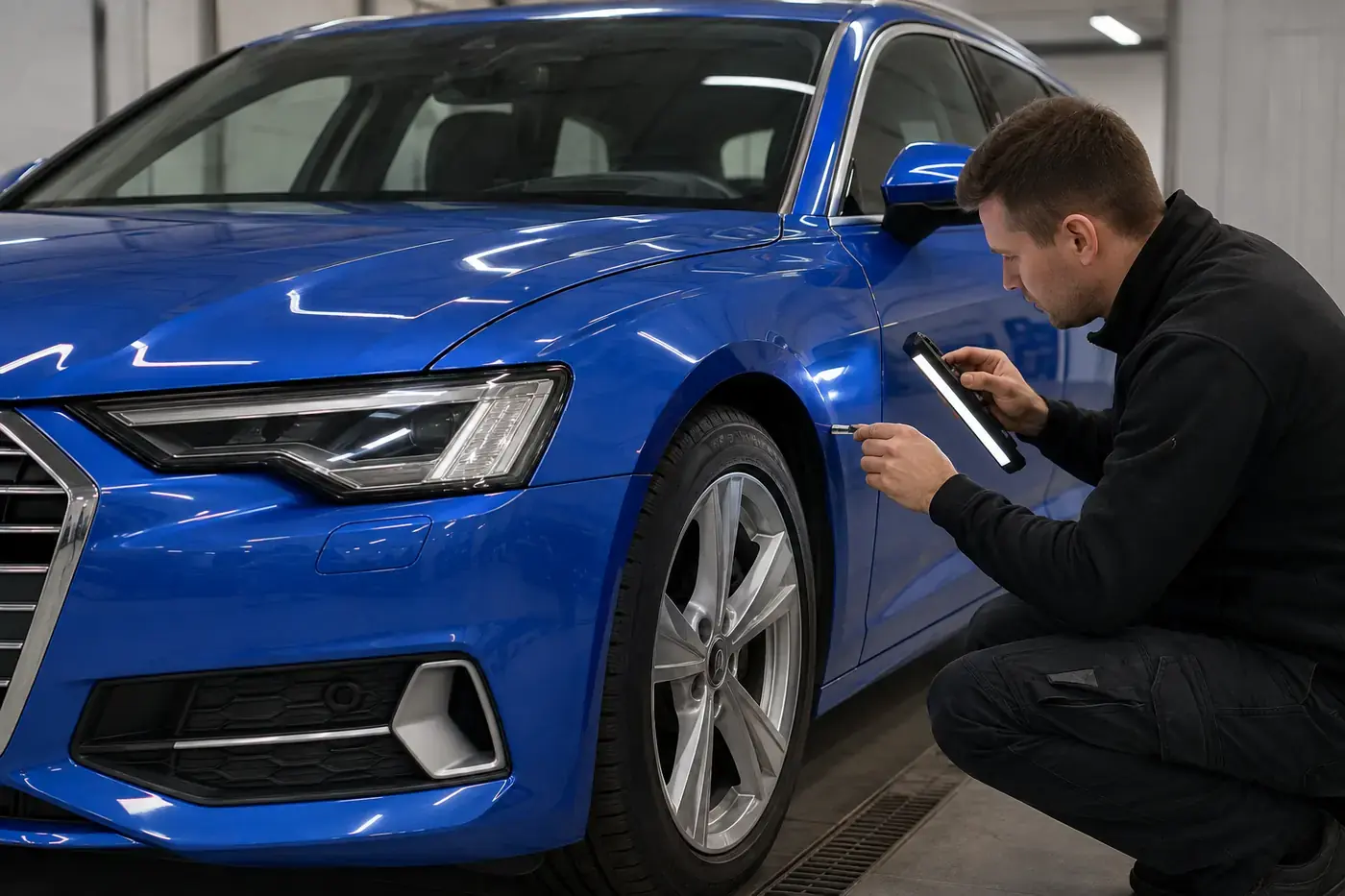
The return check follows what was repaired and disturbed. It cannot promise factory-new condition on every vehicle, but it can verify the agreed fit, finish, protection and functions before handover.
Shape and fit
Review surface shape, panel gaps, hinges, latches, doors, bonnet, tailgate, glass, locks, windows, mirrors, trims, liners and undertrays.
Protection and water
Check disturbed seams, corrosion protection, seals, drainage and water paths. A leak or water test is used where the repaired area requires it.
Colour and finish
Assess colour, metallic or pearl orientation, gloss, texture, edges, cleanliness and blend transitions in more than one practical light when possible.
Systems and drive
Verify lamps, parking sensors, cameras, warnings, wheel clearance, alignment-related behaviour, noise, vibration and road behaviour where required.
Audi accident and body repair questions
Answers before approving accident repairs
Can you estimate Audi accident damage from photos?
Photos can identify the affected areas, likely method and urgency. The final estimate still depends on material, paint depth, mounting damage, installed equipment and anything revealed after controlled access.
How much does Audi accident repair cost in Dubai?
Planning ranges start around AED 250 to 700 for light correction, AED 300 to 1,800 for qualifying PDR, AED 700 to 3,500 for many bumper or panel paint routes, and rise above AED 10,000 when parts, structure or several systems are involved. The ledger includes 5% VAT and states its assumptions.
How much does it cost to paint one Audi panel?
A single ordinary panel refinish is tentatively AED 900 to 1,900 including VAT. Metallic or pearl work with a defined blend can be AED 1,400 to 3,500. Panel repair, parts, several blend panels and special finishes change the scope.
Is PDR suitable for every dent?
No. Paint condition, stretch, crease, body line, edge, reinforcement, access, panel material and previous filler decide suitability. Broken paint or distorted metal may need conventional repair and refinishing.
When should bumper damage stay inside a wider accident-repair assessment?
A bumper-only route is suitable when the damage is confined to the cover, its mountings, adjacent trim and fitted equipment. A wider body-shop assessment is needed when the impact also affects neighbouring panels, reinforcement, lamps, cooling parts, wheel clearance, closures, structure or restraint and sensor mountings. For damage limited to the cover itself, use the Audi bumper-repair service.
Is repairing the original panel better than replacing it?
It can preserve original joints and reduce disturbance when shape, mounting, protection and finish are soundly restorable. Replacement is better when tearing, severe stretch, structural cracking or unreliable attachment defeats a durable repair.
Should I choose Genuine, aftermarket or used body parts?
Choose by exact fit, material, mounting, traceability, condition and complete installed cost. Genuine is normally highest cost. A quality alternative needs proof of suitability. A used original non-safety part needs careful inspection, refinishing and a written warranty boundary.
Why can an estimate change after dismantling?
Bumper covers, liners and trims conceal brackets, absorbers, wiring, reinforcements, inner panels, clips and prior repair. A controlled supplementary estimate should identify the new finding and obtain approval before added work.
Will the new paint match the existing colour?
The process aims for an acceptable consistent match, not an unconditional invisible result. Code, formula variant, existing fade, prior paint, panel orientation, metallic or pearl behaviour, texture and blend strategy all influence the outcome.
Can I drive after a minor accident?
Do not decide from appearance alone. Stop and arrange a recovery conversation when steering, braking, wheel position, closures, glass, fluids, loose parts, sharp edges, airbags, high-voltage areas or visibility may be affected.
When can accident damage require scanning, aiming or calibration?
It depends on the equipment and what moved or was removed. Bumper sensors and radar brackets, windshield cameras, steering-angle data, ride-height inputs, lamps and other driver-assistance components can require scanning, aiming, basic settings or calibration when the vehicle procedure calls for it. The estimate should state the trigger and whether the work is included, coordinated or still subject to inspection.
Do you handle insurance estimates?
Availability must be confirmed for the specific booking. No approved-repairer, cashless, direct-billing or insurer relationship is claimed here. Policy terms and insurer decisions control excess, parts, repair method and approval.
How long does body and paint repair take?
Timing depends on inspection, dismantling, material, paint stages, parts supply, curing, insurer decisions and calibration or mechanical work. A conditional programme can be given after the scope and parts route are known.
What is checked before the Audi is returned?
The approved scope closes with relevant checks of shape, gaps, closures, seals, trims, corrosion protection, colour, texture, lamps, sensors, warnings, wheel clearance, scan or calibration records and road behaviour.
Start the accident assessment
Send clear photos before moving the Audi
Include the Audi model and year, impact area, driving condition, warning messages, closure problems and affected sensors or lights. The first response can then distinguish a cosmetic booking from controlled dismantling, measured accident inspection or recovery.