
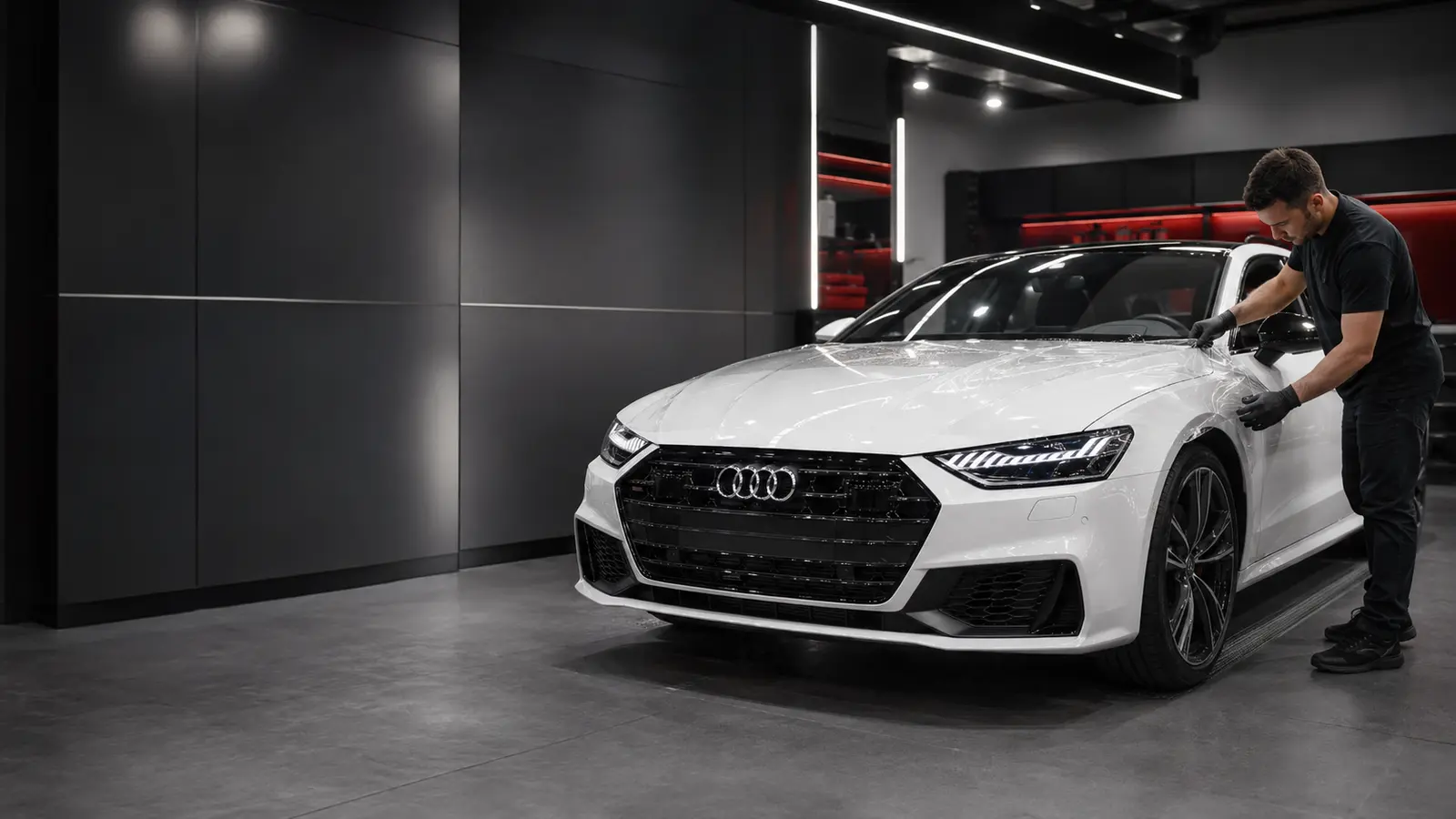
Audi Paint Protection in Dubai
Audi paint protection starts with the paint that is already on the car. Paint protection film is the main route for physical chip and light-abrasion resistance; ceramic coating improves chemical resistance, washing and gloss but does not stop stone chips. Sealant is a shorter-term surface option, while paint correction removes a controlled amount of clear coat to reduce suitable defects before protection. We inspect first, then match the layer and coverage to the finish, condition and use.
PPF, ceramic coating, sealant or correction?
Choose paint protection film when impact-prone panels need a sacrificial physical layer. Choose ceramic coating when easier cleaning, water behaviour, gloss and resistance to ordinary environmental contamination are the priorities. A sealant suits a lower-cost, shorter-duration maintenance route. Paint correction is preparation, not protection: it can reduce suitable swirls and defects in a gloss clear coat before PPF or coating, but it cannot restore missing paint or safely remove every mark.
The existing surface decides what can happen next. Chips, peeling clear coat, active corrosion, poor repainting, lifting edges and body damage are not hidden or stabilised reliably by a transparent film or coating. Matte and satin finishes also need compatible products and different correction rules. Inspection separates contamination that can be removed from defects that require polishing, repainting or body repair. A cracked or displaced cover belongs to Audi bumper repair before protection is installed.
Build a useful paint-protection enquiry
Send the model, year, paint finish, panels you want protected and any repaint or damage history you know. Clear stationary photos in direct and reflected light can help plan an inspection, but film adhesion and correction scope still need an in-person surface check.
Each layer solves a different problem
Protection should be specified by the threat, finish and maintenance plan. No single product hides body damage, prevents every scratch and eliminates washing.
Condition decides whether protection can start
Transparent protection preserves what is beneath it. Inspection identifies contamination, correctable finish defects, paint failure and previous repairs before materials are ordered or fitted.
New gloss paint with light transport marks
Wash, decontaminate and inspect under controlled lighting. A light correction may be enough before PPF or coating, but avoid polishing simply because the car is new.
Measure before polishingStone chips on the front end
Film can protect against future impacts but remains transparent over existing chips. Touch-up or repaint decisions should be made before installation.
Protection will not hide chipsPanel was repainted recently
Confirm the paint system, cure status, adhesion quality and body-shop guidance. Film applied too soon or removed later can present a higher risk on an unstable repaint.
Repaint history mattersMatte or satin factory finish
Use film and coating designed for that finish. Ordinary polishing can create permanent glossy patches, so correction options are much narrower.
No gloss polishingDeep scratch catches a fingernail
A coating will not fill it and correction may not remove it safely. The panel may need touch-up, refinishing or acceptance of the visible defect before protection.
Depth sets the boundaryOld film has yellowed or lifted
Assess film age, adhesive, edges and paint condition. Removal is a separate controlled task; the surface is inspected again before new protection is approved.
Remove and reassess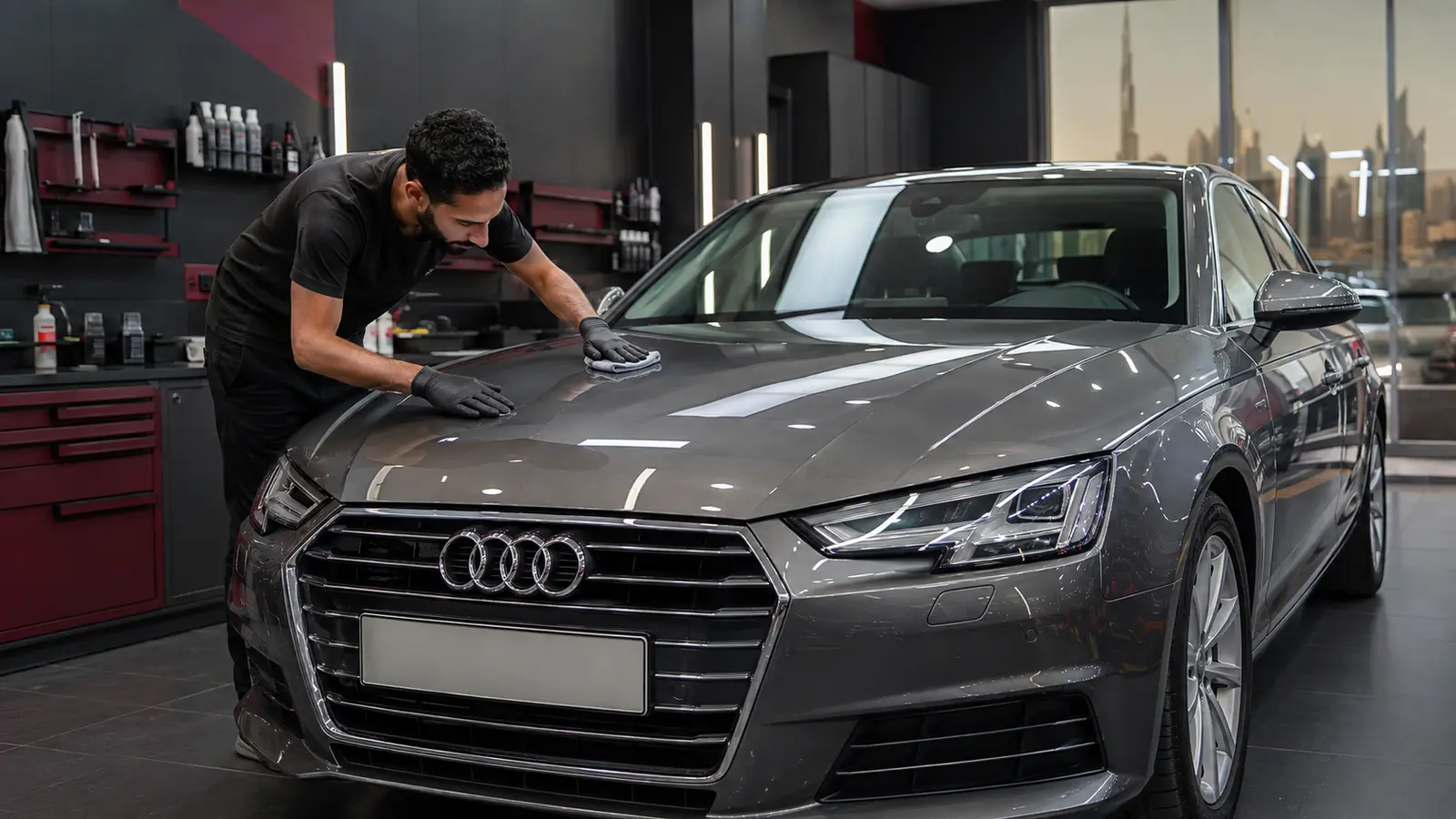
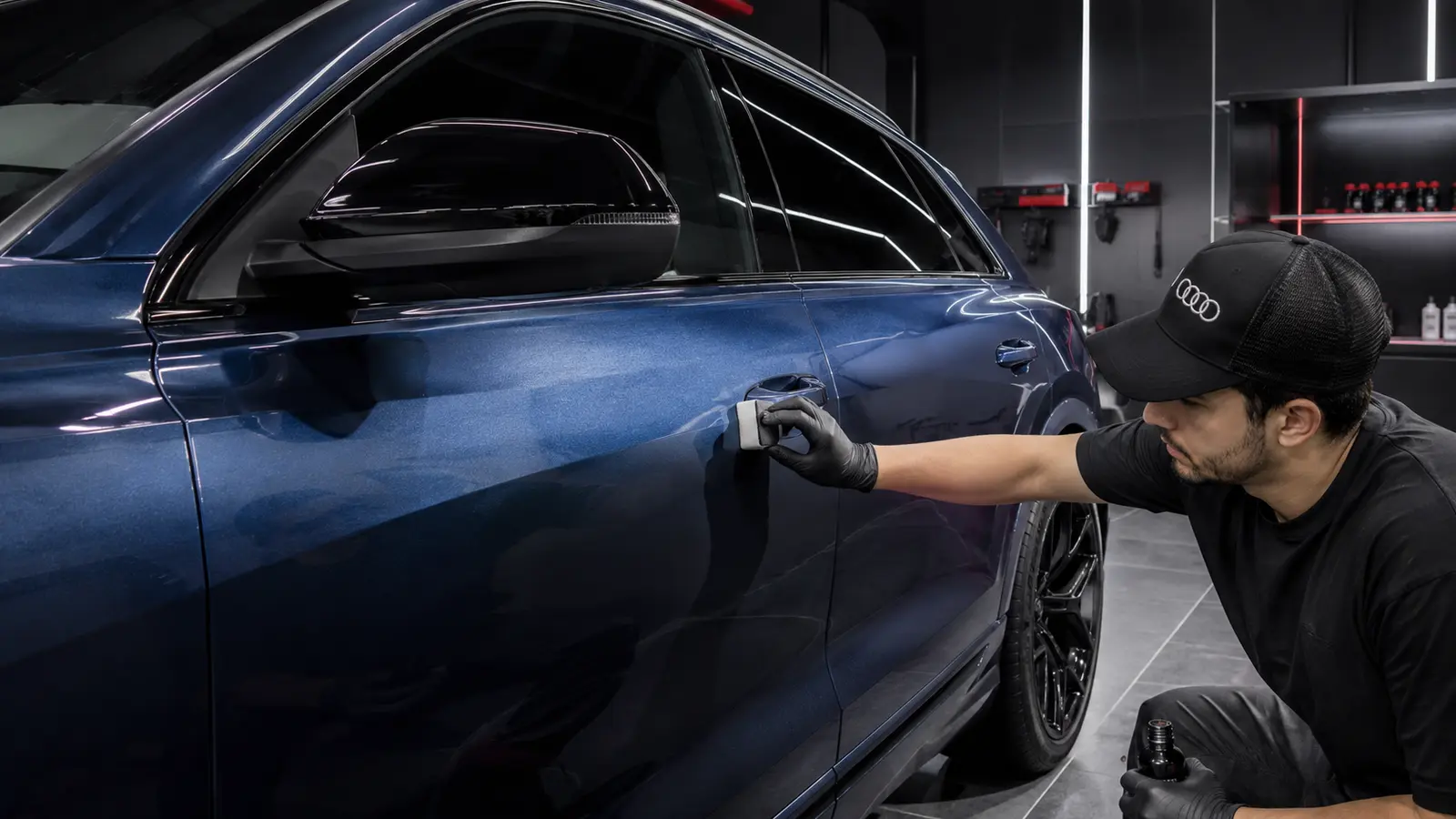
Preparation is determined panel by panel
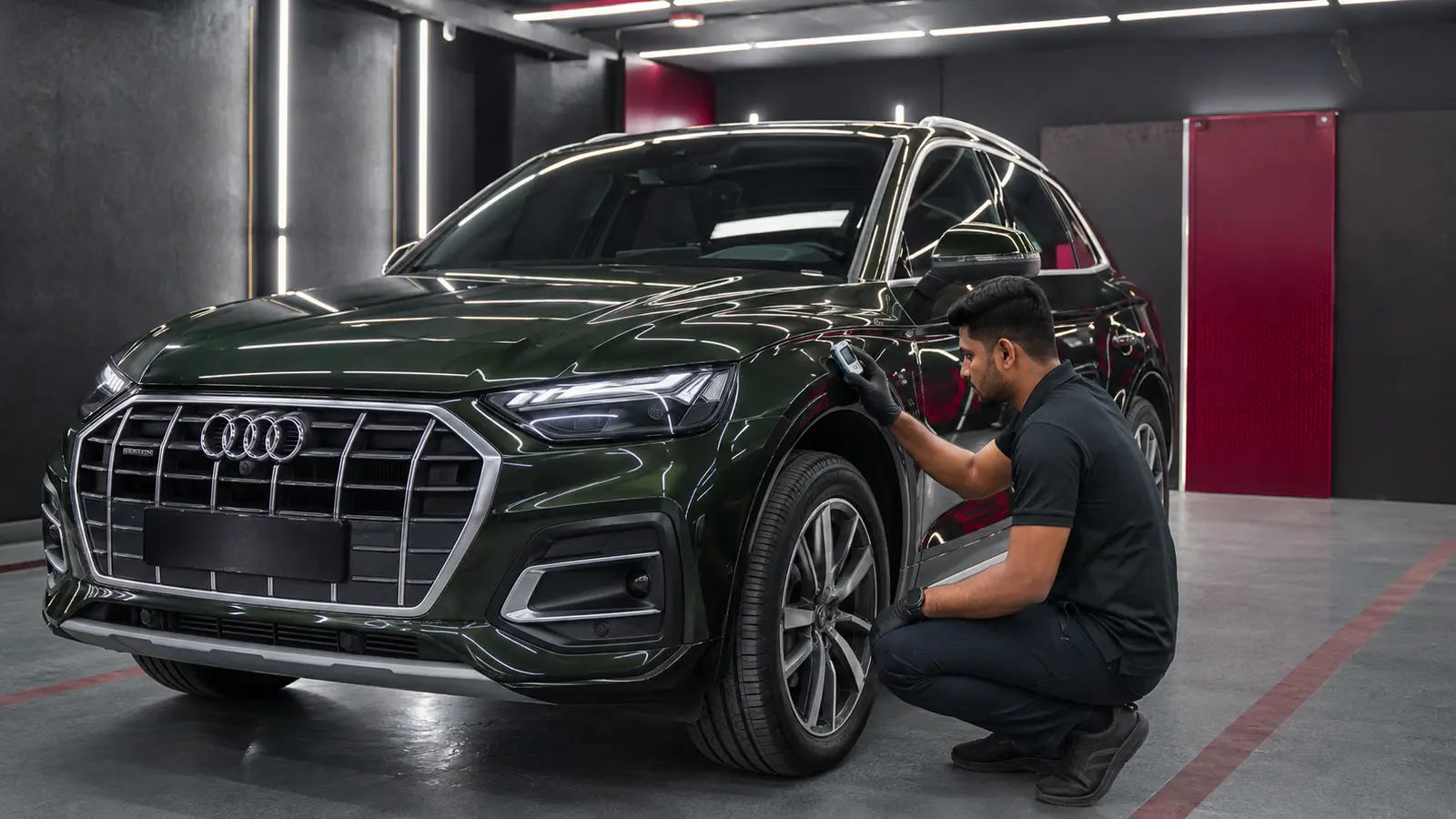
The car is washed and chemically decontaminated before close inspection because traffic film, bonded particles and old wax can hide the true finish. Controlled lighting reveals swirls, sanding marks, water spotting, chips and repaint texture. A paint-depth gauge can provide useful comparison data on suitable panels, but it does not identify every repair material or prove that a repaint is stable.
The preparation plan should name which defects will remain. On gloss paint, a test area helps set a correction level that improves the finish without chasing deep marks or removing unnecessary clear coat. Matte surfaces need finish-specific cleaning and no ordinary abrasive correction. Chips, dents, corrosion, peeling clear coat or poor body repairs are routed for repair before transparent protection.
- Record chips, scratches, dents and repainted panels.
- Remove bonded contamination before judging correction.
- Use controlled lighting and a test area on gloss paint.
- Confirm matte, satin, gloss or wrapped surface compatibility.
- Agree in writing which visible defects will remain.
Choose the protection route from the threat
Start with where and how the Audi is used, then decide on physical coverage, appearance and maintenance. Product lifespan claims are secondary to preparation, installation quality and aftercare.
Define the exposure
Identify motorway use, construction-area dust, tight parking, outdoor storage, frequent washing and the panels that receive most impacts or handling.
Inspect the substrate
Record paint finish, repaint history, chips, clear-coat condition, contamination and existing film or coating. Resolve unstable surfaces first.
Map the layer and coverage
Select sealant, coating, partial PPF, full-body PPF or a compatible combination. Name every included panel and any excluded trim or edge.
Approve preparation and aftercare
Agree correction limits, disassembly, edge treatment, cure time, first wash and future maintenance before work begins.
Use a coverage-zone map before comparing prices
Front packages are not standardised. One may include only the bumper and part of the bonnet; another may cover the complete bonnet, full wings, mirror caps and vulnerable lighting surfaces where suitable. The estimate should list each zone. Partial bonnet and wing lines can remain visible, while full-panel coverage moves the termination toward panel edges.
Wrapped edges can reduce visible film lines when panel shape, access and paint condition allow it. They may require limited component removal, additional time and an agreed boundary around badges, sensors, vents and complex curves. Some edges must remain exposed for reliable installation or service access. The installer should explain this before work, not after the car is collected.
Body repair and repainting are separate services. If inspection finds dents, missing paint, unstable clear coat or corrosion, protection pauses until the substrate is suitable. This page owns the protective-layer decision; broader service routing remains available through Audi repair services without pretending that film or coating repairs damaged bodywork.
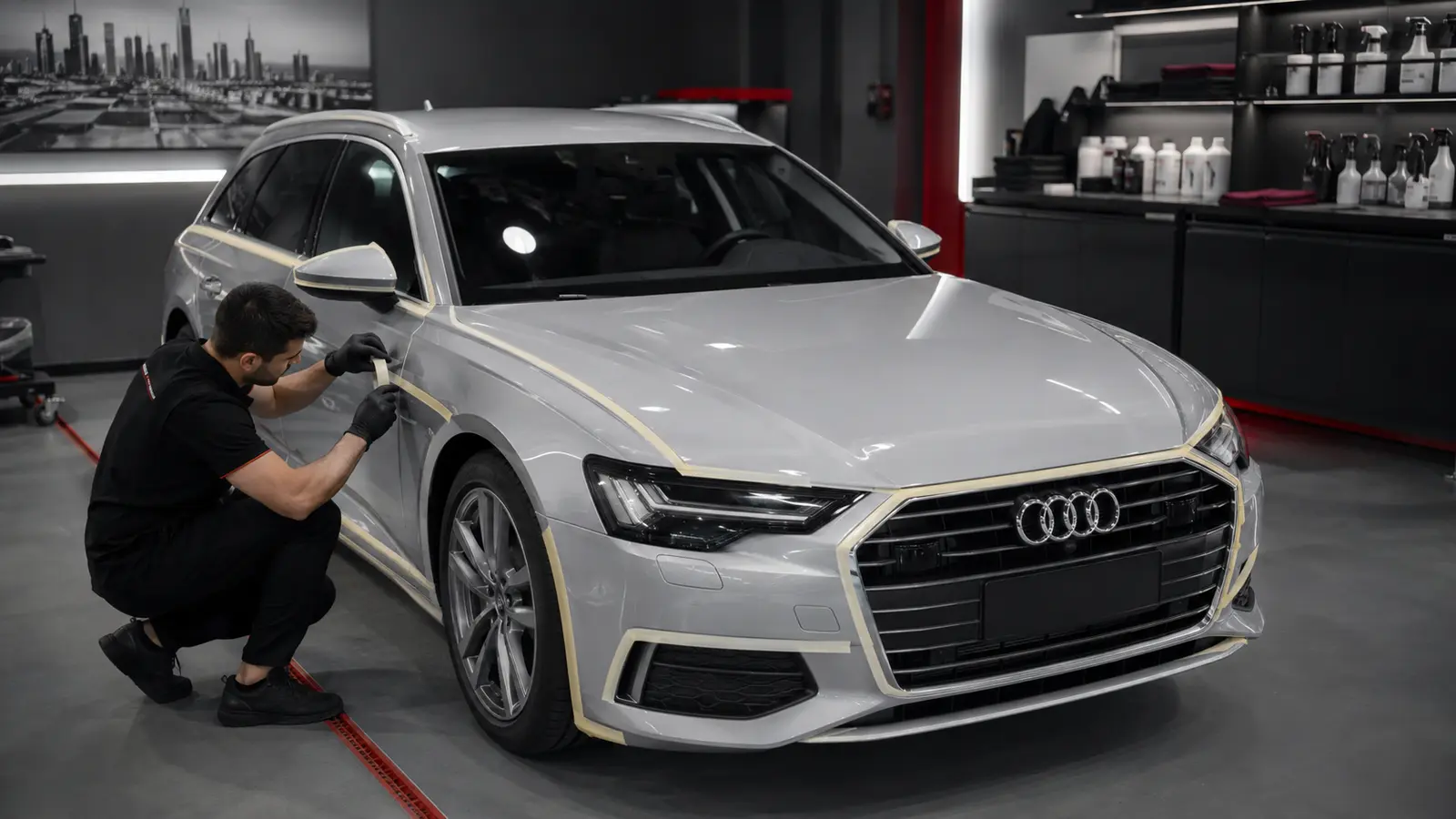
Four protection scopes that can be quoted clearly
Every route includes different materials, labour and maintenance. The written scope should be specific enough that two quotations can be compared panel by panel.
Sealant maintenance route
For a lower-cost, renewable surface layer after suitable cleaning and preparation.
- Shorter-term protection than a coating
- Simple scheduled renewal
- No meaningful stone-chip barrier
Ceramic coating route
For easier cleaning, water behaviour and gloss or finish maintenance using a product compatible with the surface.
- Preparation and cure included
- Named number of layers where relevant
- Maintenance wash guidance supplied
Impact-zone PPF route
For physical film on the panels most exposed to chips and light abrasion.
- Coverage zones drawn and listed
- Edge treatment agreed
- Existing defects recorded first
Full-body PPF route
For broader physical coverage across painted panels with finish-specific film.
- Panel-by-panel coverage schedule
- Disassembly limits stated
- Removal and long-term maintenance discussed
Compare protection options on the same criteria
The useful question is what the product protects against, how the current paint must be prepared and what maintenance remains afterward.
| Route | Works best when | Main limitation | Verification needed |
|---|---|---|---|
| Paint correction | Suitable defects in gloss clear coat before protection | Removes a controlled amount of clear coat; cannot replace missing paint or fix body damage | Paint condition, depth context, test area and agreed finish target |
| Sealant | Shorter-term gloss, water behaviour and routine surface protection | Less durable and less chemically resistant than many cured coatings; no chip protection | Surface preparation, product and renewal interval |
| Ceramic coating | Chemical resistance, easier cleaning and gloss or compatible matte maintenance | Does not prevent stone chips or deep scratches | Product compatibility, prep, cure and maintenance method |
| Partial PPF | Physical protection for selected impact zones at lower cost than full coverage | Uncovered panels remain exposed; transition lines may be visible | Exact panels, full or partial coverage and edge treatment |
| Full-body PPF | Broader sacrificial physical layer and optional gloss or matte appearance route | Higher cost, more seams/edges and eventual removal considerations | Film type, panel map, disassembly, edges, warranty and aftercare |
PPF and ceramic-coating brands seen in the Dubai market
Local installers advertise several international protection systems, but brand recognition alone does not establish authenticity, installer approval, coverage or warranty. Compare the named product line, surface preparation, panel map, edge treatment, cure plan and written warranty issuer.
Paint protection film brands to compare
The ranges below illustrate how one manufacturer can offer different finishes, top coats and protection levels. Confirm the exact film rather than accepting a quotation that says only “premium PPF.”
| Brand | Example film lines | Useful quotation check |
|---|---|---|
| XPEL | ULTIMATE PLUS, STEALTH | Gloss or satin finish, exact series, coverage, installer status and warranty registration |
| STEK | DYNOshield, DYNOmatte, DYNOmight | Finish, thickness or impact priority, hydrophobic top coat and written warranty |
| SunTek | Ultra, Reaction, Ultra Matte, Defense | Film line, finish, top-coat behaviour, included panels and edge method |
| LLumar | Valor, Platinum Gloss, Platinum Matte | Regional product availability, finish, installer route and warranty terms |
| 3M | Scotchgard Paint Protection Film Pro Series 200 | Gloss or matte product, authorised supply/installation and registered warranty |
Ceramic coating brands customers may encounter
Professional and consumer-facing ranges can differ within the same brand. The estimate should identify the exact coating, surfaces, layers where relevant, preparation and cure requirements.
| Brand | Example coating family | Useful quotation check |
|---|---|---|
| Gtechniq | Crystal Serum Ultra or Light | Exact product, accredited-installer requirement where applicable, preparation and aftercare |
| Ceramic Pro | ION or 9H systems | Authorised package, included layers/surfaces, warranty issuer and maintenance obligations |
| GYEON | Q² Mohs EVO and professional ranges | Exact product, application route, layer plan, cure precautions and maintenance |
| CARPRO | CQUARTZ Professional, Finest or Skin | Paint or PPF-specific use, installer status, preparation and written coverage |
Tentative Audi paint-protection prices in Dubai
These ranges include 5% VAT and are planning figures for a vehicle in serviceable condition. Vehicle size, paint finish, contamination, correction hours, repaint history, film or coating product, panel complexity, edge treatment, disassembly and old-material removal can change the quotation. Every written estimate should name the product and exact coverage.
| Service scope | Tentative AED | What changes the range |
|---|---|---|
| Paint-condition inspection and test area | AED 210–420 | Vehicle size, finish type and depth of defect review |
| Wash and chemical decontamination preparation | AED 315–630 | Body size, bonded contamination and existing protection |
| Single-stage gloss paint correction | AED 840–1,680 | Paint hardness, vehicle size and defect target |
| Multi-stage gloss paint correction | AED 1,680–3,675 | Defect depth, paint condition, safe correction limit and labour |
| Paint sealant application | AED 420–840 | Preparation, body size and product system |
| Ceramic coating, entry surface package | AED 1,260–2,310 | Preparation, product, layers and cure requirements |
| Ceramic coating, premium body package | AED 2,310–4,725 | Correction, coating system, body size and included surfaces |
| Front bumper PPF | AED 1,575–2,625 | Bumper complexity, film, sensors, edges and grille openings |
| Full bonnet PPF | AED 1,575–2,835 | Bonnet size, edge wrapping and paint preparation |
| Mirror-cap PPF pair | AED 525–945 | Mirror shape, film pattern and edge access |
| Headlamp protection film pair, where suitable | AED 525–1,050 | Lamp shape, film compatibility and pattern |
| Partial-front PPF package | AED 2,625–4,725 | Included bumper, bonnet section, wing sections and mirrors |
| Full-front PPF package | AED 5,250–8,400 | Complete bonnet/wings, bumper, mirrors, edges and film tier |
| Full-body gloss PPF | AED 15,750–26,250 | Vehicle size, film tier, disassembly, edges and complexity |
| Full-body matte or satin PPF | AED 17,850–29,400 | Finish conversion, body size, film, seams and panel complexity |
Worked quote examples
These calculations compare different protection choices against assumed paint conditions and coverage areas. They are illustrative totals with 5% VAT included, not quotations for a vehicle we have not inspected.
Sealant after decontamination
Hypothetical gloss Audi with no correction requested.
- Wash and decontamination
- AED 420
- Paint sealant
- AED 525
- Total
- AED 945
Ceramic coating with light correction
Hypothetical medium saloon with light swirls.
- Preparation
- AED 525
- Single-stage correction
- AED 1,050
- Ceramic coating
- AED 1,785
- Total
- AED 3,360
Full-front PPF package
Hypothetical SUV with serviceable factory gloss paint.
- Preparation and inspection
- AED 525
- Full-front PPF
- AED 6,300
- Compatible film-topper application
- AED 630
- Total
- AED 7,455
Old front film replacement
Hypothetical coupe requiring controlled old-film removal before new coverage.
- Old-film removal
- AED 1,260
- Adhesive cleanup and preparation
- AED 735
- New full-front PPF
- AED 6,825
- Total
- AED 8,820
What happens from paint inspection to cure
The sequence protects the substrate and makes the approved coverage visible before installation starts.
Record the requested outcome
Clarify chip protection, easier washing, gloss, matte conversion, selected panels and the customer’s maintenance expectations.
Inspect in controlled light
Document chips, scratches, clear-coat failure, repaint texture, dents, existing film and surfaces that may need a separate repair.
Wash and decontaminate
Remove traffic film, iron contamination, tar and suitable bonded material so the actual finish and adhesion surface can be judged.
Approve correction boundaries
Use a test area on gloss paint where correction is proposed. State defects that cannot or should not be removed safely.
Map panels, seams and edges
List the exact PPF zones, partial or full panels, edge treatment, badge and sensor boundaries, and any agreed limited disassembly.
Install the chosen layer
Apply film or coating in a controlled clean area using the product-specific preparation, application and initial cure process.
Inspect after settling or cure
Check PPF alignment, edges, contamination and stretch areas, or verify coating uniformity and high spots under suitable lighting.
Explain the first days and future care
Provide the first-wash timing, cure precautions, approved cleaning route, inspection schedule and process for reporting an edge or finish concern.
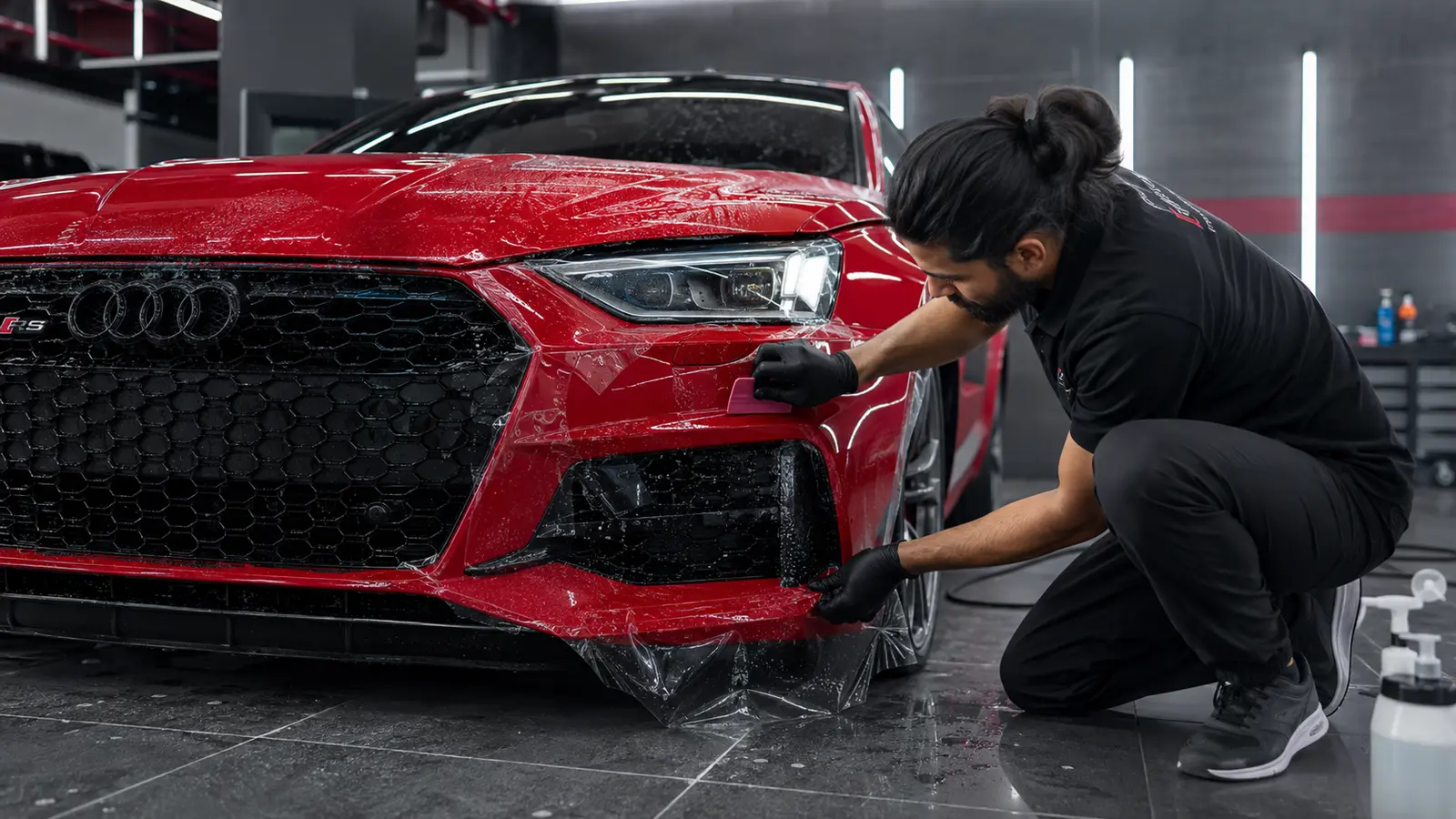
Film, coating and finish compatibility
PPF varies by thickness, top-coat behaviour, gloss or matte finish, adhesive system, pattern support and written warranty. A product should be identified by manufacturer and line, not sold as anonymous “premium film.” Warranty scope can depend on authorised installation, registration, maintenance and exclusions, so the written issuer and terms matter.
Ceramic coatings also differ in chemistry, layer system, compatible surfaces and cure. More layers are not automatically better; preparation and uniform application matter more than a large layer count. Matte paint, matte PPF, gloss PPF, trim, glass and wheels may each need different products. The estimate should state which surfaces are included and which are excluded.
What should be visible at handover
The finished surface is reviewed under appropriate lighting after the product’s initial setting or cure stage. The handover should also preserve a record of existing defects, included panels and the aftercare route.
Included panels, seams, pattern terminations and deliberately exposed areas match the approved map.
Film alignment, edges and contamination or coating uniformity are checked under suitable light.
Removed trim is refitted and affected sensors, cameras, lamps or handles are checked where relevant.
Cure time, first wash, cleaning products, inspection point and warranty documentation are explained.

Audi paint-protection questions
Choose protection around the paint condition, finish and areas you want covered. Preparation, product compatibility and the agreed coverage map determine the final work.
Which PPF and ceramic coating brands can I compare?
Dubai customers commonly encounter PPF from XPEL, STEK, SunTek, LLumar and 3M, and coating systems from Gtechniq, Ceramic Pro, GYEON and CARPRO. Availability and installer authorisation must be confirmed for the exact product. Ask for a written product name, coverage map, preparation scope, warranty issuer and aftercare plan.
Is PPF better than ceramic coating?
They solve different problems. PPF is a physical sacrificial film for covered areas; ceramic coating mainly supports chemical resistance, gloss and easier cleaning. They can be combined when the products are compatible.
Will ceramic coating stop stone chips?
No. It is far too thin to act like paint protection film against normal stone impacts. Choose PPF for physical chip resistance on the panels that need it.
Does PPF hide existing scratches and chips?
Transparent film may change how very light marks look, but it does not repair missing paint, deep scratches, dents or poor repainting. Existing defects should be recorded and addressed first where appropriate.
Should paint correction be done before PPF?
Only to the level the paint condition and agreed finish justify. Gloss paint may benefit from controlled correction; matte paint must not receive ordinary gloss-polishing correction.
Can PPF be applied over repainted panels?
Sometimes, after the paint has cured and its adhesion and finish are suitable. Repaint history raises installation and future-removal considerations that should be discussed before approval.
Can matte Audi paint be protected?
Yes, with matte-compatible PPF or coating. Product choice and installation must preserve the intended low-gloss finish, and ordinary polishing should be avoided.
What is included in a full-front PPF package?
The term is not universal. Our written scope should list the bumper, complete or partial bonnet, wings, mirror caps and any other included zones, along with edge treatment.
Are PPF edges always wrapped?
No. Panel geometry, access, sensors, trim, paint condition and reliable adhesion can require exposed or pattern-cut edges. The planned edge treatment should be agreed panel by panel.
Can PPF be installed over ceramic coating?
Existing coating can interfere with film adhesion and may need removal from installation areas. If both are planned, the sequence and product compatibility should be set before work begins.
How soon can the car be washed afterward?
The correct interval depends on the film or coating product, workshop conditions and cure stage. Follow the written handover instruction rather than a universal number of days.
Will PPF or coating prevent every scratch?
No. Film can absorb some light abrasion and impacts on covered panels, while coating can reduce contamination adhesion. Sharp objects, heavy contact and poor washing can still mark the surface.
Can old PPF be removed safely?
Controlled removal often succeeds, but risk depends on film age, adhesive, heat history and whether the paint is factory or repainted. Inspect and document the substrate before removal.
What maintenance does protected paint need?
Regular gentle washing remains necessary. Avoid harsh chemicals, aggressive brushes and unapproved polishing. Follow product-specific guidance for decontamination, toppers and inspection.
Are the prices on this page final quotes?
No. They are tentative planning ranges including 5% VAT. Paint condition, vehicle size, exact product, correction, panel coverage, edges, disassembly and removal work determine the written quotation.
What should I send for an initial estimate?
Send the Audi model and year, gloss or matte finish, preferred coverage, known repaint history, existing film or coating and clear stationary photos of chips, scratches or affected panels.
Choose the layer after the paint is inspected
Call to discuss full-body, matte or repainted vehicles. For a first written direction, prepare the model, year, finish, required coverage and photos of existing defects so the inspection and material options can be planned.