
Electrical diagnosis, repair and supported programming
Audi Electrical Repair in Dubai
Audi electrical repair in Dubai is a diagnostic service that traces faults through battery voltage, charging, grounds, wiring, water ingress, network communication and control-unit configuration. We test the affected circuit before recommending a module, coding operation or software procedure.
Independent Audi specialist in Al Quoz. Programming availability is confirmed from the vehicle, module identity, lawful access, power condition and required calibration route.
Quick WhatsApp request
Two details are enough
Tell us the Audi model and what is wrong. Add one short note only if it helps. Warning, scan and part-label photos can be attached after WhatsApp opens.
The page does not diagnose the fault or store these answers. You review the message in WhatsApp before choosing whether to send it.
Tell us what happened
Only the first two fields are required.
Choose the safe next action
Electrical fault urgency
A page cannot confirm whether the car is safe to drive. Use the symptom boundary below, then call if the situation is unclear.
Stop and call
Smoke, a burning smell, visible damaged wiring, sparks, a hot or hissing battery, severe steering or braking loss, a red high-voltage warning, or a no-start in an unsafe location needs a direct call and may need recovery. Do not keep cycling the ignition, charging the car or touching damaged cables.
Drive only with normal control
If normal steering, braking, lighting and drive remain available but warning messages have appeared, book promptly and stop if control changes, temperature rises or the warning becomes red. Multiple warnings can share a voltage or network cause, but that must be tested.
Book a planned check
An intermittent drain, one comfort function, a post-repair adaptation or a planned module setup can usually begin with a booked diagnostic visit. Bring the recent-work history, scan report and original module where relevant.
Electrical Signal Bench
Follow power before programming
A healthy control unit still cannot communicate without the correct supply, ground and network path. The investigation moves through the system in an order that keeps programming from becoming a guess.
A fault code identifies where the system noticed a problem. It may point to a circuit, implausible value, missing message or function. The technician still has to determine whether the cause is supply, wiring, a related component, the control unit, configuration or the conditions under which the test ran.

Measured diagnostic order
How the fault is narrowed
Confirm the complaint
The technician records what the driver saw, when it happens and what changed immediately before the fault. An intermittent event after rain needs a different first route from a fixed fault after module replacement.
Stabilise the electrical supply
Battery condition, system voltage and safe support are checked before deep scanning or programming. A weak supply can create misleading events and can interrupt a control-unit write.
Read the complete vehicle
The full scan and communication topology show which modules respond, which messages are missing and how the events line up in time. One screenshot rarely gives enough context.
Test power and ground
Fuses, high-current links, grounds and voltage drop are checked under a relevant load. Continuity alone can miss a connection that passes a tiny test current but fails in operation.
Inspect the physical path
Wiring, terminals, connector tension, water paths, heat damage, previous splices and repair access are inspected before condemning a module.
Test the network and function
The technician checks the affected CAN, LIN or other platform network, then compares sensor input, actuator response and control-unit behaviour with the symptom.
Confirm identity and compatibility
Part number, suffix, installed equipment, software level and protection status are reviewed before a replacement or software route is quoted.
Choose the actual operation
The result may be wiring repair, original-module repair, replacement, coding, adaptation, parameterisation, programming, initialisation or calibration. Those operations are not interchangeable.
Close the job
A post-repair scan, relevant measurement and function check are used to confirm what changed. Clearing the stored fault without reproducing or testing the cause is not a close-out.
Starting, charging and energy management
Low voltage changes the whole picture
A battery can start the car once and still be unstable during diagnosis or programming. The charging system, cable path, grounds and battery-management data need to agree.
Battery testing is read in context. The useful record includes battery type and capacity, state of charge, measured condition, how the car has been used, starter demand and charging behaviour under relevant conditions. Alternator output at one engine speed does not reveal every regulator, communication or connection problem. Voltage-drop testing across the positive and ground paths can expose resistance that an unloaded continuity check misses.
Where the Audi requires it, a correctly specified replacement battery is registered or adapted so the energy-management system has the right capacity, technology and replacement information. Registration does not make an incorrect battery suitable and does not repair a failing alternator, poor ground or damaged battery monitor.
Several apparently unrelated warnings after a flat battery or jump start can share a supply event. The responsible route is to stabilise voltage, retain the full scan context, check what lost communication or learned limits, then perform only the supported initialisations or adaptations that the car actually needs.
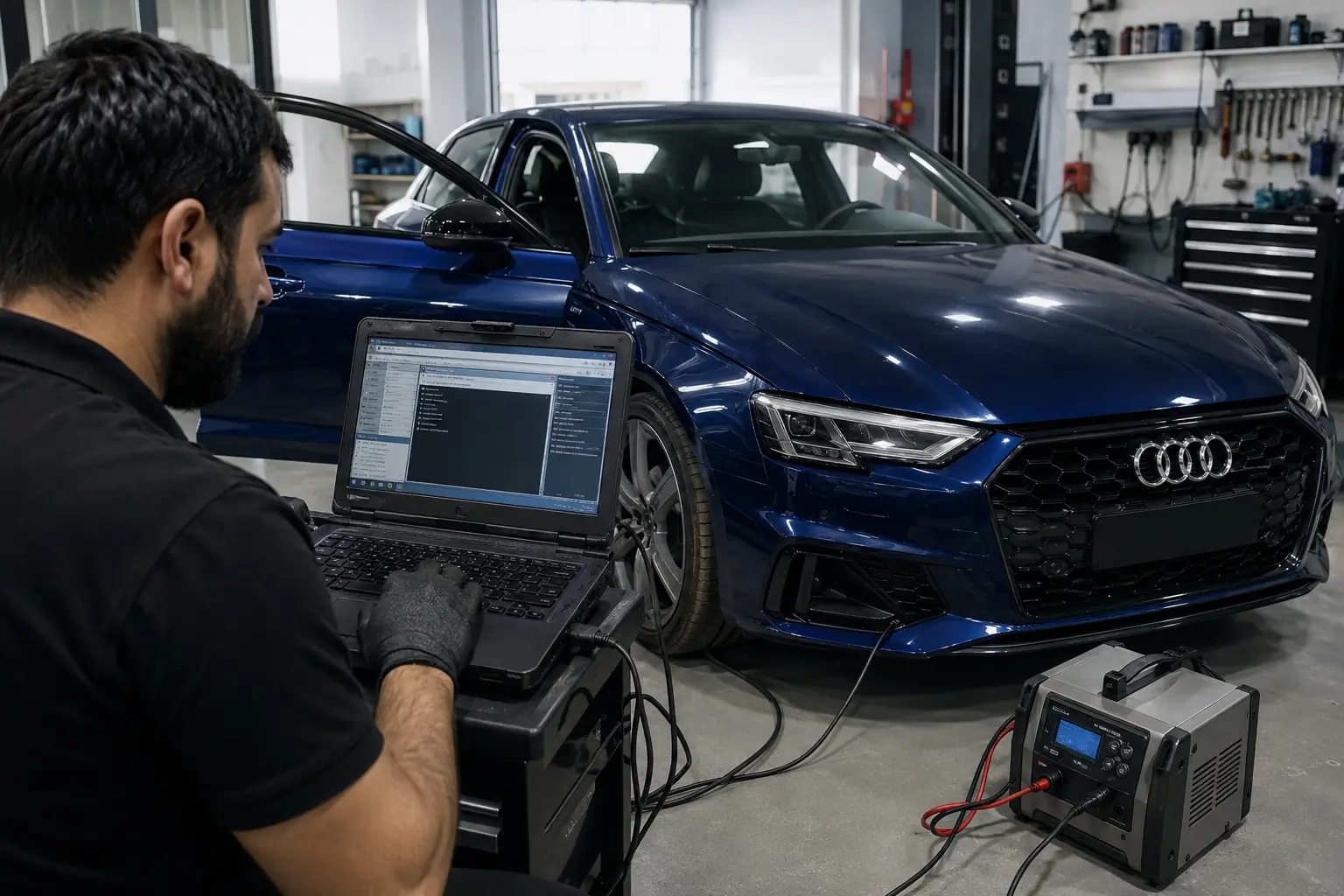
Programming needs stable support. A module write is not started simply because the laptop can connect. The vehicle supply, communication path, module identity, access route and recovery boundary are checked first.
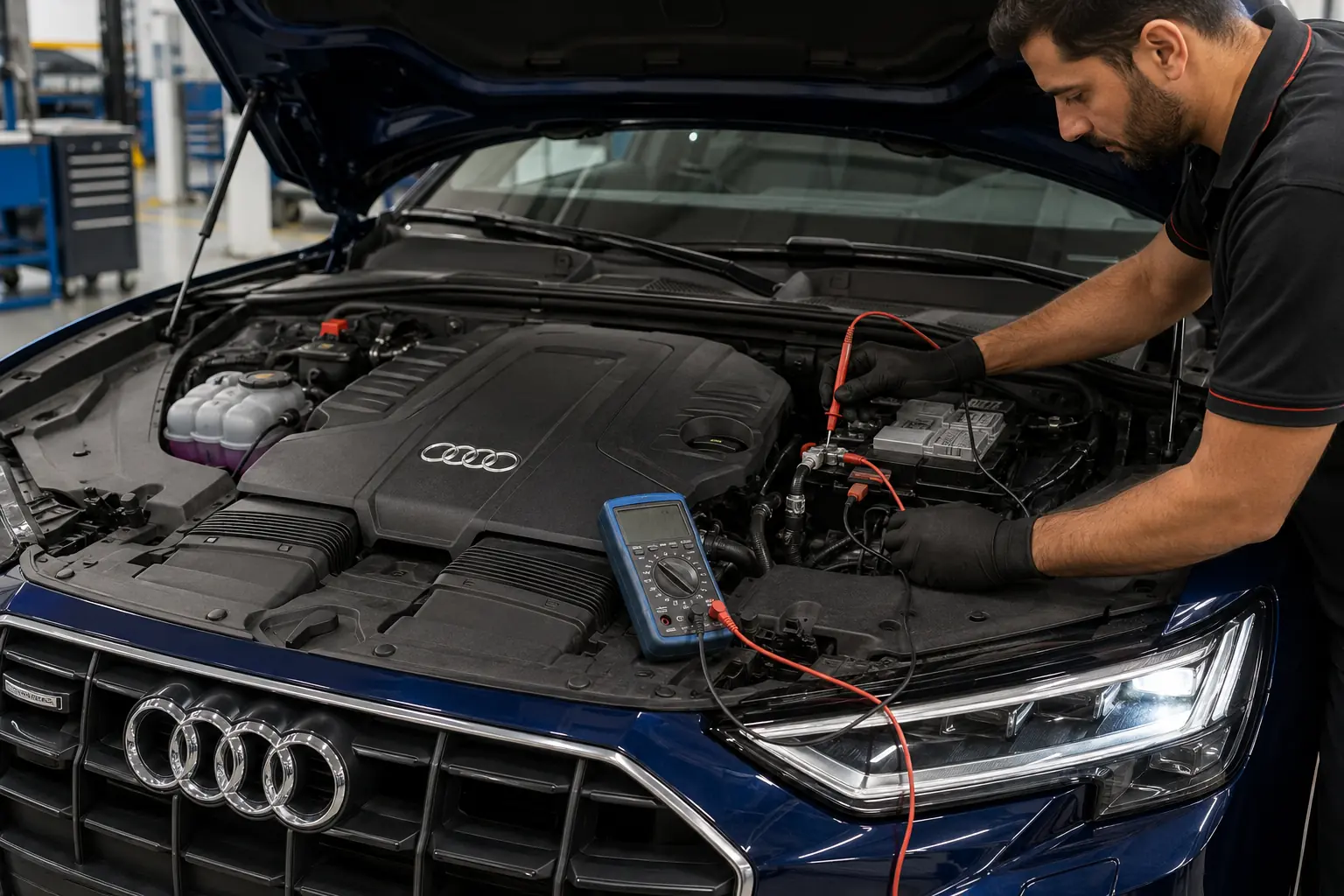
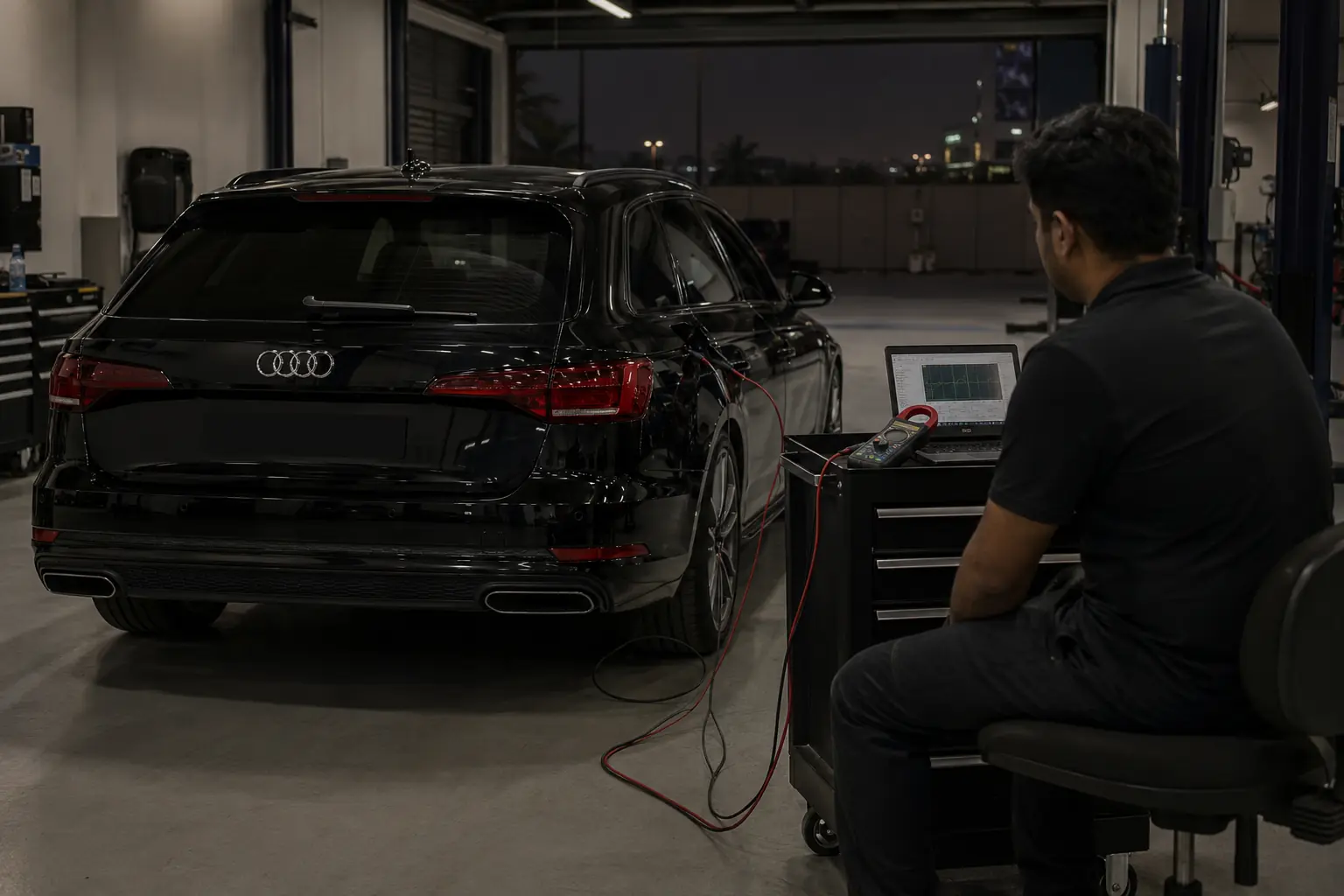
Battery drain investigation
One current reading is not enough
An Audi does not enter sleep the moment the ignition is switched off. Modules finish tasks, networks settle and some systems wake again when a latch, key, tracker, accessory or fault triggers them. Use the Audi overnight battery-drain guide to record the parking pattern and recent changes before testing.
The test starts by checking whether the battery and charging system can support a meaningful drain investigation. The technician then records the test conditions, keeps the vehicle in the correct closed or simulated-closed state and monitors current over the period required by the exact vehicle procedure. A universal sleep-current number is not applied to every platform.
Common routes include an intermittent control unit, a door or boot latch that reports the wrong state, a dash camera or tracker wired to the wrong supply, a convenience or infotainment module that keeps the network awake, and water intrusion around a connector or control unit. Pulling fuses without a plan can wake networks repeatedly and disguise the sequence, so the isolation method matters.
The quote normally begins with a defined diagnostic time block. If the drain is intermittent or the affected branch needs access, the workshop should explain the next monitored block before continuing. Replacing the battery alone may temporarily hide the symptom while leaving the wake event unchanged.
Wiring, connectors and distribution
Repair the path, then recheck it
A coding change cannot repair a loose terminal, corroded splice, overheated fuse contact or ground path that drops voltage under load.
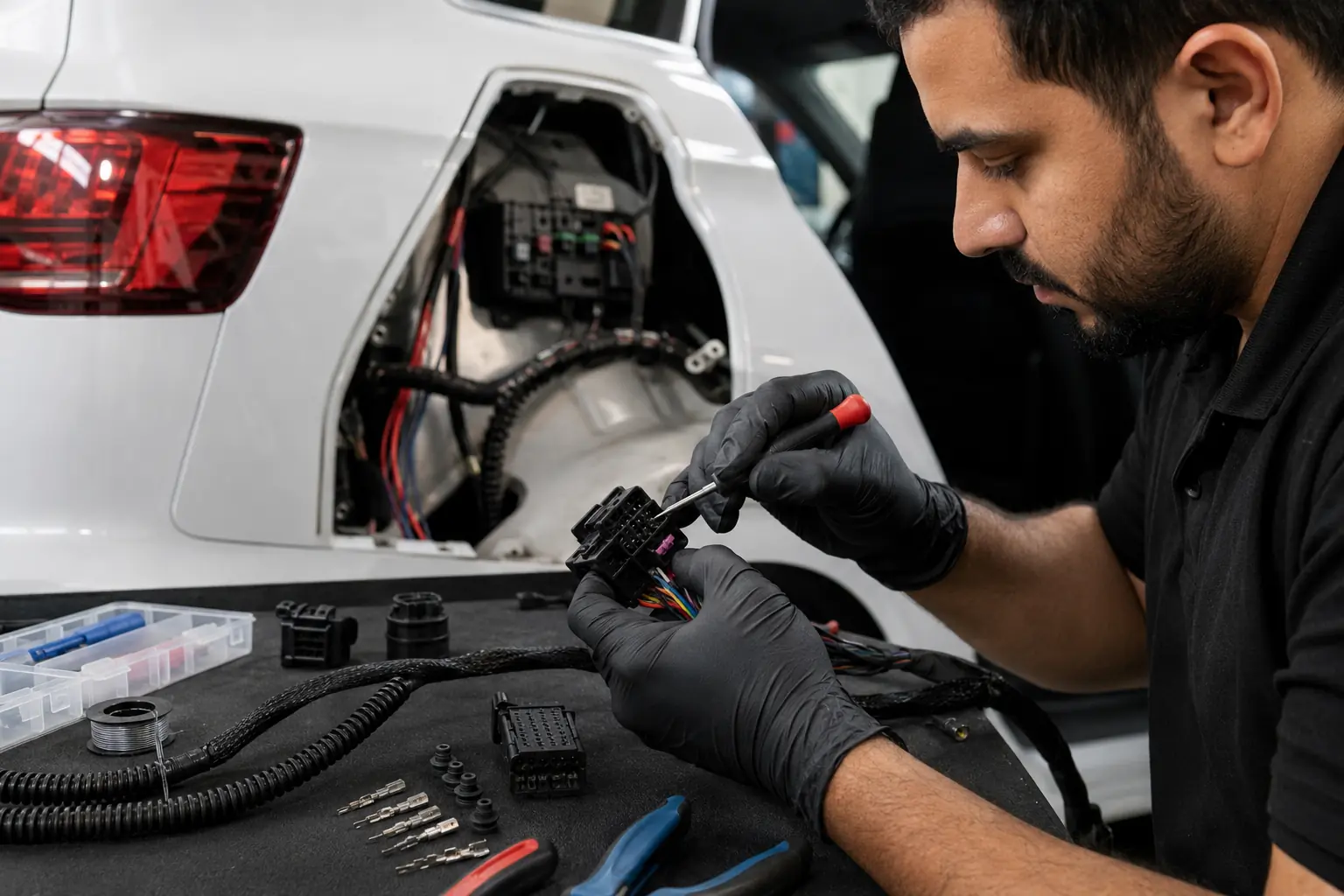
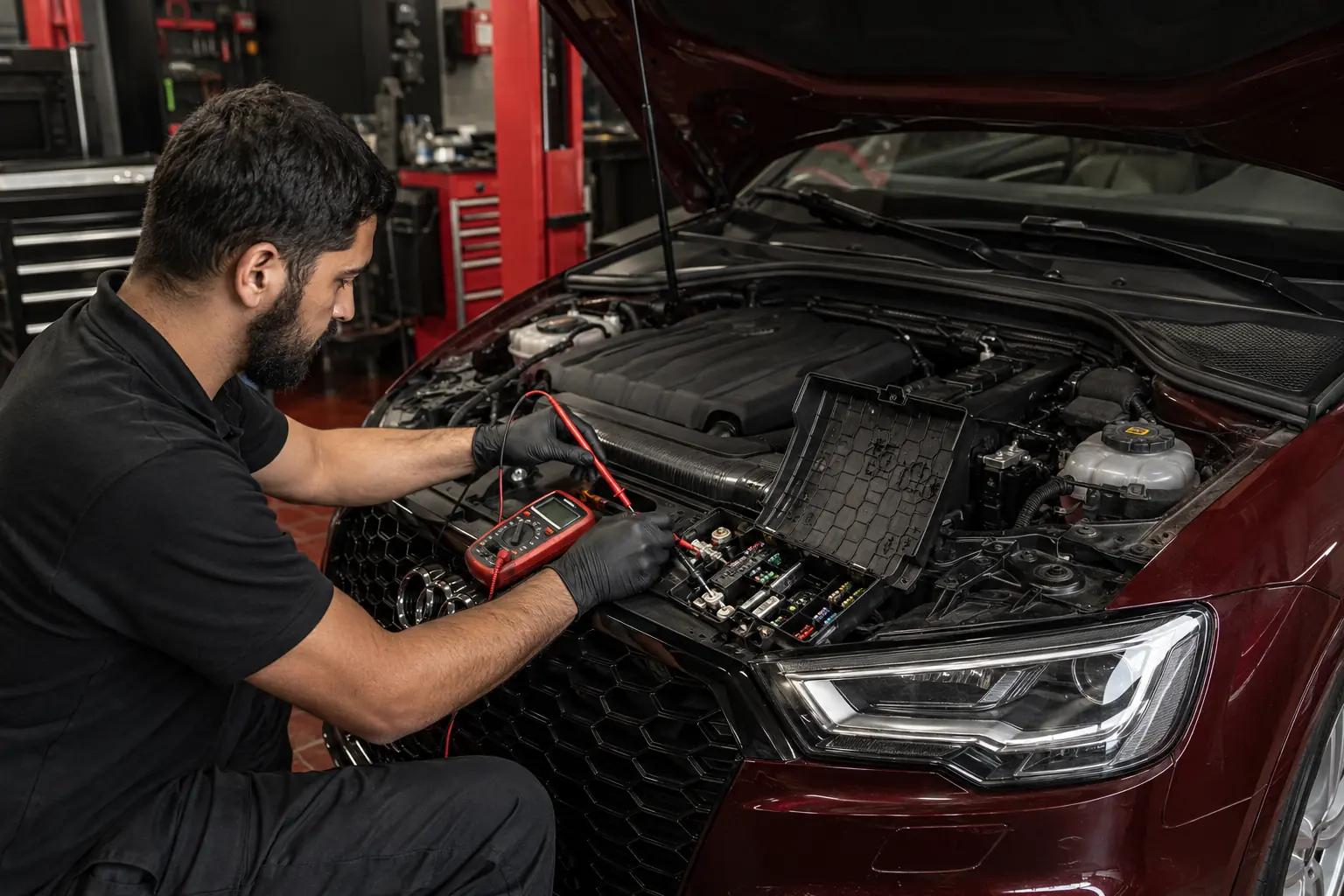
A proper electrical repair has a before and after test. The workshop records the damaged area, repairs the conductor or terminal with the correct method, restores insulation and routing, then repeats the load, voltage-drop or communication check that exposed the fault.
Wiring and terminals
Useful checks include load testing, voltage drop, continuity used in context, terminal tension, pin condition, corrosion, heat damage, broken insulation, previous splices and water migration along the harness. A neat-looking splice is not enough if its resistance rises under load or its sealing allows moisture back into the circuit.
Fuses, relays and grounds
A fuse may be intact while its holder or supply point overheats. Relays, distribution blocks, high-current links and grounds are tested for the fault condition. A higher-rated fuse is never a solution, and repeated fuse replacement without finding the overload risks further damage.
Vehicle communication
Why several modules go offline
Audi platforms can use CAN and LIN, with FlexRay, MOST or Automotive Ethernet on particular generations and systems. The exact network is identified from the vehicle rather than assumed from the badge.
One missing supply, ground fault, shorted network branch or gateway problem can make several modules appear unavailable. The scan topology helps show which part of the car is missing, but the technician still checks electrical conditions at the affected branch. Replacing the first module named in a communication code can waste both the part and the programming cost.
The gateway installation list is reviewed when a module has been replaced or a supported retrofit has changed the vehicle configuration. Original coding and adaptation data are backed up when the original control unit still communicates. If it does not, the replacement route depends more heavily on exact identity, supported datasets, vehicle configuration and lawful access.
Network diagnosis ends with the physical or configuration cause, not simply with communication restored for one scan. The affected functions are checked, remaining events are reviewed and the customer is told which faults belong to the completed work and which need a separate route.
Use the correct operation
What programming actually means
Customers often use one word for several different procedures. The distinction matters because a configuration change, software write and physical repair solve different problems.
| Term | What happens | What should be recorded |
|---|---|---|
| Diagnosis | Tests supply, ground, communication, fault context, hardware and software state before a route is chosen. | Finding, relevant measurement and recommended next step. |
| Coding | Configures a control unit for the vehicle and the equipment that is actually installed. | Original or reference coding, accepted coding and function check. |
| Adaptation | Sets or relearns a stored value, component relationship, operating limit or service value. | Channel or function, accepted status and related check. |
| Basic settings | Runs a prescribed relearn, initialisation or controlled actuator routine after its physical conditions are met. | Routine status, conditions and post-check. |
| Parameterisation | Loads the correct vehicle-specific dataset or configuration where the module and supported route require it. | Dataset identity, completion status and resulting function. |
| Programming or flashing | Writes approved control-unit software or firmware while the vehicle has stable support and communication. | Original and target software, completion status and post-scan. |
| Calibration | Aligns a measured system such as a camera, radar, steering or suspension sensor after fitment, geometry and environment checks. | Required physical conditions, result and measurements. |
| Component matching | Pairs an eligible replacement component with the vehicle where lawful and technically supported. | Ownership and part evidence, matching or protection status and function check. |
| Initialisation | Restores learned limits after a battery, module, motor or mechanism has been disconnected or replaced. | Initialised limits and operating confirmation. |
| Hardware repair | Repairs wiring, terminals, supply, ground or an eligible original module fault. | Physical repair evidence and the repeated electrical test. |
Clearing a code is not one of these repairs. A coding change cannot restore a corroded terminal, a software update cannot compensate for low programming voltage, and a calibration cannot correct bent hardware or poor wheel alignment.
Named workshop scope
Audi programming and coding we carry out
The operation is confirmed only after the model, year, VIN, module identity, installed equipment, physical repair state, power condition and lawful access route have been checked. The list below is a capability index, not a promise that every item is available on every Audi.
Diagnosis and configuration
The starting group for identifying the vehicle, control units and current configuration. Platform or online-system names are not published as capabilities without current confirmation.
- Full-vehicle control-unit scan
- Gateway installation-list verification
- Transport-mode deactivation where a prescribed procedure requires it
- Control-unit identification and software-level comparison
- Original coding and adaptation backup where readable
- Supported short coding and long coding
- Adaptation-channel setup
- Guided basic settings
- Vehicle-specific parameterisation or dataset installation
- Replacement-control-unit commissioning
- Supported factory-configuration restoration
- Software-version management and approved update
- Control-unit firmware programming or flashing
- Post-programming scan and functional close-out
Battery and energy management
Registration follows correct battery selection and electrical testing. It does not repair a weak battery, charging fault, wrong capacity or voltage drop.
- Battery registration after replacement where required
- Battery Energy Management or BEM adaptation
- Supported capacity, technology and manufacturer data entry
- Battery-monitor control-unit adaptation
- Intelligent battery-sensor setup where fitted
- Energy-management diagnosis and configuration check
- Alternator or voltage-regulator communication diagnosis
- Start-stop diagnosis and prescribed post-repair adaptation
- 48-volt energy-system commissioning only after the separate competence and isolation route is confirmed
Engine control and emissions service functions
Software and adaptations follow lawful physical repair. The workshop does not suppress emissions faults or misrepresent an unrepaired component.
- Supported ECU software programming
- ECU replacement coding, configuration and lawful matching
- Throttle-body adaptation
- Accelerator and throttle basic settings where applicable
- Injector calibration-code entry for supported applications
- Prescribed fuel-system component adaptation
- Turbocharger actuator basic settings
- Intake-manifold runner or actuator basic settings
- EGR adaptation after lawful physical repair
- DPF replacement or service adaptation after condition verification
- SCR and AdBlue component adaptation after repair
- NOx-sensor replacement adaptation where prescribed
- Thermal-management pump, valve or thermostat basic settings
- Supported engine-mount or active-mount setup
Transmission and driveline
Adaptation cannot repair clutch wear, hydraulic leakage, internal damage, incorrect fluid condition or the wrong mechatronic part number.
- Supported TCU programming
- S tronic and DSG mechatronic coding
- Mechatronic parameterisation where supported
- Clutch adaptation and basic settings
- Gear-selector module coding or adaptation
- Transmission replacement-module commissioning
- Tiptronic adaptation on supported platforms
- Multitronic adaptation on applicable legacy vehicles
- quattro or all-wheel-drive control coding and basic settings
- Applicable Haldex-type coupling adaptation
- Sport differential or rear differential configuration
- Transfer-case adaptation on supported Audi SUV platforms
Braking, steering and chassis
Tyre pressure, ride height, alignment, load condition, level floor and the completed physical repair are checked where the calibration procedure requires them.
- ABS and ESC control-unit coding
- ABS and ESC basic settings after eligible repair
- Brake-pressure, yaw-rate and acceleration-sensor calibration
- Electronic parking-brake service mode
- Electronic parking-brake coding and basic settings
- Steering-angle sensor calibration
- Electromechanical power-steering module coding
- Steering-rack end-stop or centre-position adaptation
- Dynamic-steering basic settings where fitted
- Air-suspension ride-height calibration
- Suspension control-module coding or parameterisation
- Adaptive-damping control setup
- Rear-wheel-steering calibration where supported
- Direct TPMS sensor identification and relearn
- Indirect TPMS reset and control configuration
- Wheel-speed or chassis-sensor initialisation where prescribed
Driver assistance and parking
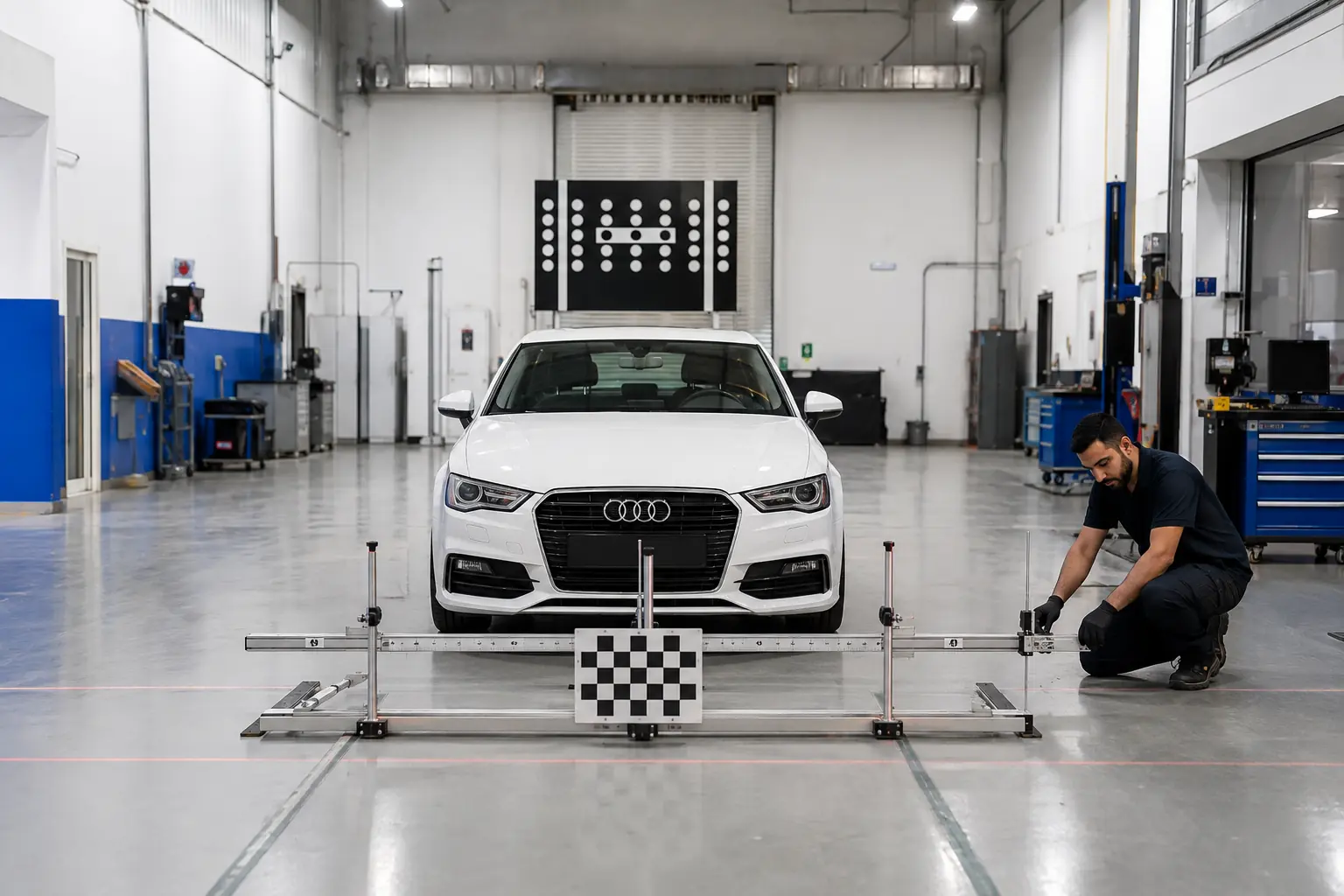
Calibration is accepted only when the required targets, measurement equipment, workshop space and physical vehicle conditions are available for that system.
- Adaptive cruise-control radar coding and supported calibration
- Front driver-assistance camera coding and calibration
- Lane-assist control setup
- Side-assist or blind-spot radar setup
- Front-corner radar setup where fitted
- Licensed, region-compatible traffic-sign-recognition configuration
- Parking-sensor control-unit coding
- Parking-assist module setup
- Reversing-camera coding and calibration
- Surround-view camera calibration
- Night-vision control setup where supported
- Head-up-display setup or calibration
- Central driver-assistance controller or zFAS commissioning
- Laser-scanner calibration where supported
- Driver-monitoring camera calibration where applicable
Body, comfort and access
Key and anti-theft work requires recorded customer instruction plus proof of identity and vehicle ownership or authorised possession. No security-bypass method is published or offered.
- Central electrics or body-control-module coding
- Gateway coding and installed-module list configuration
- Door-control-module coding
- Window-regulator initialisation and learned limits
- Sunroof and panoramic-roof initialisation
- Powered boot or tailgate basic settings
- Seat-control and memory-seat coding
- Approved seat-occupancy calibration where applicable
- Mirror and comfort-system configuration
- Rain and light sensor calibration
- Wiper and humidity-sensor adaptation
- Alarm, siren and central-locking module coding
- Remote-control synchronisation and adaptation
- Eligible new, additional or replacement-key programming
- All-keys relearn where the authorised procedure requires it
- All-keys-lost eligibility assessment with enhanced ownership checks
- KESSY or keyless-entry matching
- Access and start-authorisation commissioning
- Supported immobiliser integration after eligible component repair
- Towbar and trailer-control-module coding
- Auxiliary-heater or parking-heater setup
- Convertible-roof basic settings on supported models
- Compatible convenience-feature configuration
Lighting systems
The physical fitment, ride height and aim are checked first. Coding that creates glare, disables a mandatory light or hides a warning is excluded.
- Headlamp control-module coding
- LED headlamp replacement-module setup
- Matrix LED coding and basic settings where fitted
- Headlamp range and level-control calibration
- Rear-light control-module configuration
- Legal supported daytime-running-light configuration
- Ambient-lighting control coding where fitted
- Replacement-lighting-module parameterisation
Climate and thermal management
Refrigerant, coolant, air-distribution hardware and software configuration are diagnosed separately. Programming does not repair a leak, blocked condenser, damaged motor or air pocket.
- Climate-control or Climatronic module coding
- HVAC flap-motor basic settings
- Air-distribution actuator adaptation
- AC compressor or control-valve electrical diagnosis and supported settings
- Auxiliary-heater control coding
- Heated-seat or ventilation-control setup
- Cooling-pump and coolant-valve basic settings
- Supported conventional, hybrid and electric thermal-management programming
Infotainment and instruments
Software, maps and feature entitlements must be licensed and compatible. Mileage alteration, pirated activation and identity concealment are refused.
- MMI head-unit coding and parameterisation
- Approved MMI firmware or software update
- Navigation-data update from licensed compatible sources
- Legitimate FEC or SWaP entitlement recovery for an existing valid licence
- Bluetooth, telephone and media-interface coding
- Audio amplifier and sound-system module coding
- Radio or tuner setup with lawful code recovery
- Supported Virtual Cockpit or cluster replacement setup
- Instrument-cluster coding after approved replacement
- Display, language, unit and legal market configuration
- Reversing-camera and parking-display integration
- USB, media-port and connectivity setup
- Emergency-call and telematics adaptation
- myAudi and key-user setup when backend and account eligibility permit it
Safety and restraints
Physical safety repairs must be documented first. Airbag bypasses, resistor tricks, crash-data concealment and warning suppression are not accepted.
- Replacement airbag control-unit coding after documented physical repair
- Crash-sensor configuration after approved replacement
- Approved occupant-detection or seat-occupancy calibration
- Seat-belt, buckle and restraint basic settings where prescribed
- Restraint-network diagnosis and post-repair scan
Hybrid and e-tron systems
Twelve-volt, 48-volt, plug-in-hybrid and high-voltage work remain separate. High-voltage operations proceed only after current training, isolation, insulated equipment and supported access are confirmed.
- Supported high-voltage battery-management programming
- Prescribed high-voltage battery module and serial-number commissioning
- Hybrid drive-control configuration
- Power-electronics or inverter programming
- On-board charger coding
- DC-to-DC converter setup
- Charge-port and charging-control coding
- Electric-drive thermal-management programming and settings
- High-voltage coolant-pump and valve basic settings
- Battery-management adaptation after approved component repair
- Electric-machine or resolver basic settings where prescribed
Replacement modules and protection
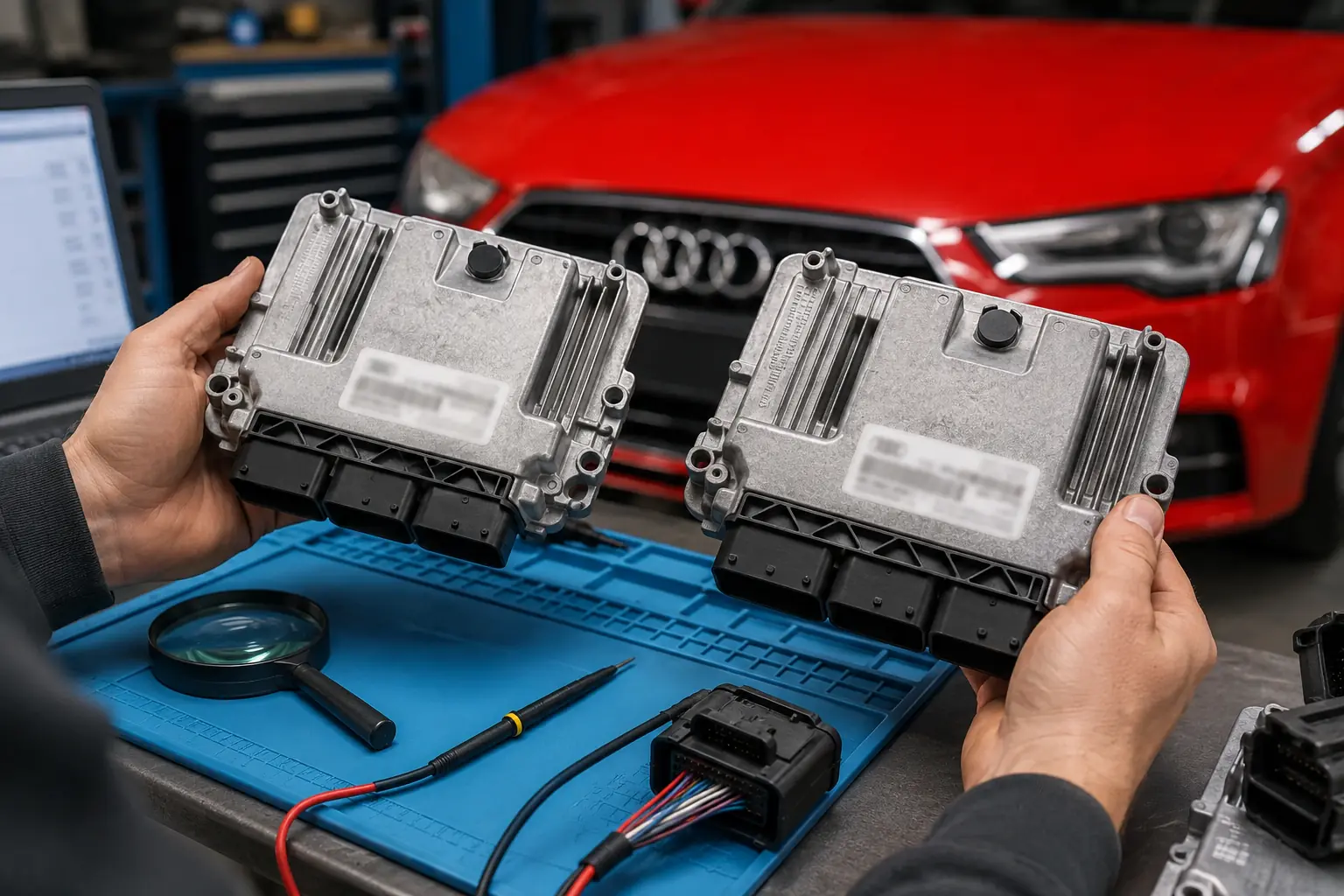
A used original module is evaluated, not promised. One-time data, donor history, software level, exact suffix, component protection and immobiliser identity can prevent reuse.
- Compatible new replacement-module coding
- Used original module eligibility evaluation
- Lawful configuration transfer from the original module
- Approved data transfer or cloning that preserves identity and legal boundaries
- VIN or vehicle-identity setup only through the supported lawful procedure
- Component Protection diagnosis and supported matching or removal
- SFD-protected authorisation only where a current licensed route is confirmed
- Immobiliser-related matching with ownership verification
- Post-installation parameterisation, basic settings and calibration
Service functions and supported retrofits
Many requests called programming are actually a service function, relearn or coding change. They follow completed work and cannot be used to conceal missing service or hardware.
- Oil-service and inspection-service reset after completed work
- Fixed or flexible service-interval adaptation
- Electronic parking-brake pad-change mode
- Direct or indirect TPMS reset and relearn
- Guided DPF regeneration after diagnosis when conditions permit
- Fuel-system priming or bleeding after approved repair
- AdBlue refill recognition or prescribed SCR service routine
- Actuator output tests and guided function checks
- Digital service-history entry only with authorised access and accurate records
- Compatible genuine-equipment retrofit coding
- Gateway installation-list update after approved retrofit
- Supported locking, mirror, lighting, window and convenience preferences
- Parking display or reversing-camera configuration after compatible installation
- Audi smartphone interface, Apple CarPlay or Android Auto activation through a legitimate compatible entitlement route
Excluded requests include odometer alteration, immobiliser defeat, anonymous key work, airbag or emissions warning suppression, DPF or AdBlue delete, pirated firmware or feature files, unsafe performance maps, safety-system disabling, illegal lighting and coding that pretends missing hardware is installed.
Complete installed route
Repair, replace or programme
The lowest purchase price is not always the lowest fitted cost. Diagnosis, access, data transfer, coding, protection, calibration and an incompatible unit can change the result.
Repair wiring or supply
Use this route when a measured supply, ground, signal, connector or harness fault prevents correct operation.
- Evidence
- Voltage drop, load test, continuity in context, connector or wiring finding.
- Main uncertainty
- Hidden damage, water migration and access time.
- Quote must state
- Repair area, labour basis, materials and repeated test.
Repair the original module
An eligible specialist repair may preserve the original identity and reduce configuration work.
- Evidence
- Module diagnosis, repair-provider scope and written terms.
- Main uncertainty
- Internal damage may be broader than the initial symptom.
- Quote must state
- Who repairs it, what is tested and warranty boundaries.
Fit a used original module
A compatible-looking used part still needs exact identity, donor and security review.
- Evidence
- Part number, suffix, software, donor status and return terms.
- Main uncertainty
- Locked data, protection, unknown history and limited warranty.
- Quote must state
- Part condition, supported setup path and who carries incompatibility risk.
Fit a named independent replacement
This route exists only when a reputable exact application is catalogued for the function.
- Evidence
- Brand, catalogue fitment, specification and supplier terms.
- Main uncertainty
- Quality, coding support and function coverage vary by maker.
- Quote must state
- Brand, part identity and every setup requirement.
Fit Audi Genuine or named OE-supplier
The exact VIN application, supersession, source and availability are confirmed before order.
- Evidence
- Verified part number and supply route.
- Main uncertainty
- Lead time, cost and protected online functions.
- Quote must state
- Supply, coding, parameterisation and calibration scope.
Code, adapt or update existing hardware
The current hardware must pass its physical and electrical preconditions before a software operation begins.
- Evidence
- Pre-scan, identity, supply plan, supported procedure and backup.
- Main uncertainty
- The routine may expose an underlying hardware fault or fail its prerequisites.
- Quote must state
- Operation, access fee, recovery boundary and post-check.
Protected and high-energy systems
Extra checks before access
Security-related matching and high-voltage work have their own authorisation and safety gates. Ordinary low-voltage diagnosis does not remove them.
Keys, KESSY and protection
Key, immobiliser, start-authorisation and Component Protection work requires proof of identity, proof of ownership or authorised possession, all available working keys, clear original and replacement part evidence and a recorded customer instruction.
A marketplace key or used security module may already contain locked or one-time data. The workshop first decides whether a lawful supported matching route exists. Security defeat, undocumented access and methods that could help bypass vehicle protection are refused.
12-volt, 48-volt and high voltage
A 12-volt supply fault can disrupt communication on a hybrid or electric Audi, so low-voltage condition still matters. A 48-volt belt-starter system, plug-in hybrid or e-tron high-voltage circuit introduces different isolation, training and insulated-equipment requirements.
High-voltage module programming or commissioning is confirmed only after the exact system, current technician competence, safe isolation procedure, equipment and supported access have been checked. No low-voltage service claim is used as authority for high-voltage work.
Transparent quotation route
Electrical and programming prices
A teaser coding price can be misleading when the vehicle first needs diagnosis, stable support, licensed access, a compatible module, parameterisation or calibration. The current publishable price status is shown below without inventing a range.
Every item currently requires an inspection and VIN-based quote. The written estimate should separate diagnosis, labour, parts, coding, calibration, online or licensed access and recovery after a failed precondition. It should also state whether the UAE standard 5 percent VAT is included or added. See the Federal Tax Authority VAT information.
| Work | Current price status | Firm quote gate | Scope to confirm |
|---|---|---|---|
| Initial electrical diagnosis | Inspection and VIN quote required | Symptom, recent event, scan context and first test route | Time block, measurements and additional diagnostic approval |
| Battery and charging-system test | Inspection and VIN quote required | Battery type, condition, access and charging behaviour | Test only or test with replacement and registration |
| Battery replacement and registration | Inspection and VIN quote required | VIN, battery capacity, technology, brand and fitment | Battery, labour, BEM data entry and VAT treatment |
| Parasitic-drain investigation | First time block quoted after intake | Battery passes, vehicle sleep procedure and accessory history | Monitoring period, additional hour and access approval |
| Wiring or connector repair | Inspection and access quote required | Confirmed damaged area, terminal type and harness access | Materials, labour basis, sealing and repeated load test |
| Fuse, relay or distribution diagnosis | Inspection and VIN quote required | Circuit, fault condition and access to links or grounds | Diagnosis separate from replacement parts |
| Starter or alternator diagnosis | Inspection and VIN quote required | Battery passes, load condition and cable voltage drop | Diagnosis, removal access, part route and programming if any |
| CAN or vehicle-network diagnosis | Diagnostic time block quoted | Full scan, missing topology and affected network branch | Access, wiring tests and further isolation approval |
| Control-unit coding or adaptation | Inspection and VIN quote required | Exact module, supported procedure and hardware condition | Pre-scan, backup, operation and post-check |
| Basic settings or initialisation | Inspection and VIN quote required | Physical repair completed and prerequisites pass | Routine only or diagnosis if the routine fails |
| Replacement-module commissioning | Part and VIN quote required | New or used status, exact identity, protection and original data | Coding, dataset, matching, calibration and failure allocation |
| Software programming or flashing | Module-specific quote required | Current and target software, approved source, stable power and access | Online fee, backup, programming labour and recovery boundary |
| Parameterisation or dataset installation | Module-specific quote required | Compatible hardware, correct dataset and licensed route | Dataset, access fee, configuration and function check |
| ECU or TCU replacement setup | Part and VIN quote required | Module identity, lawful matching, mechanical condition and software | Supply, coding, adaptation and post-repair testing |
| ABS, steering or parking-brake setup | Inspection and VIN quote required | Physical repair, sensor state, alignment and supported routine | Coding, basic settings, calibration and road or static check |
| Air-suspension calibration | Inspection and VIN quote required | Leak and hardware condition, ride height, tyres, alignment and level floor | Diagnosis separate from calibration when a fault remains |
| Headlamp or Matrix LED setup | Part and VIN quote required | Correct module, fitment, ride height, aim and supported parameters | Coding, parameterisation, basic settings and aim check |
| MMI or infotainment coding and update | Identity and entitlement quote required | Hardware, software, licence, region and current function | Licensed files, access, programming and recovery boundary |
| Camera, parking or ADAS calibration | System-specific quote required | Correct hardware, physical repair, alignment, targets and workspace | Setup, calibration, external provider if used and result |
| Key, KESSY or immobiliser matching | Ownership and eligibility quote required | Identity, vehicle documents, available keys and part status | Key supply, lawful access, matching and all-keys procedure |
| Component Protection supported route | Module-specific quote required | Ownership, exact module, supported access and vehicle communication | Diagnosis, matching route, online fee and function check |
| Used-module evaluation and setup | Evaluation quoted before setup | Labels, donor status, original unit, software and return terms | Evaluation, coding path and outcome if incompatible |
| Module repair or data transfer | Bench and module quote required | Eligible fault, original communication and repair-provider scope | External repair where used, transfer, setup and warranty boundary |
| 48-volt, hybrid or high-voltage work | System and safety quote required | Exact system, competence, isolation, equipment and supported access | Low-voltage diagnosis separate from high-voltage labour |
A firm written price is possible after the workshop knows the exact vehicle, failure path, part route and supported programming or calibration steps. If a precondition fails, the workshop should stop and explain the diagnostic or recovery cost before continuing. For broader planning, see the Audi service cost guide.
What changes the estimate
Access and uncertainty cost time
Diagnostic time increases when the fault is intermittent, water has travelled through a harness, the affected branch sits behind trim or several previous repairs have changed the wiring. The workshop should quote the first controlled test block, report what it established and request approval before opening a broader route.
Module work changes with the exact part number, suffix, software generation, original-module communication and new, repaired or used condition. A readable original unit may allow a backup or configuration comparison. A dead original and an undocumented used replacement remove that advantage and raise compatibility risk.
Programming cost can include stable battery support, backup, licensed or online access, the actual write, parameterisation, basic settings, calibration and the post-scan. If an interrupted or weak module needs recovery, that is a different scope from the planned operation and must be approved.
Supplier availability and return terms matter. A used control unit with no return option can cost less at purchase but expose the customer to the full loss if locked data or the wrong suffix prevents setup. A written estimate should say who supplies the part, who carries incompatibility risk and which warranty applies to the part, programming and labour.
For 48-volt, hybrid and high-voltage work, safe isolation and technician competence are part of the route. A low-voltage diagnostic price should not be presented as the complete price for high-voltage access or commissioning.
Workshop case
2018 Q7 gateway replacement
A confirmed Audi Specialist job involved the J533 data bus diagnostic interface on a 2018 Audi Q7 3.0 TFSI. The decisive work included gateway replacement and coding, with programmer Sergei handling the supported Component Protection step.
Security procedure, account access and protected values are intentionally not published.
Why the module was not treated as plug-and-play
The gateway sits at the centre of vehicle communication and the installed-module record. A replacement therefore has to be assessed against the exact vehicle and its control-unit population. Matching connectors alone cannot establish the correct suffix, software, configuration or protection status.
The responsible sequence was to treat electrical supply and communication as programming preconditions, confirm the replacement identity, preserve original information where available, complete the supported coding and Component Protection route, then use a whole-vehicle scan and function check for close-out. The protected step was handled by Sergei because it was a programming and security-access operation, not an ordinary code clear.
This case is useful because it separates three jobs customers often combine under one word: replacing the physical gateway, configuring it for the Q7 and completing the supported protection process. If any one of those routes is unavailable for a proposed used or replacement unit, fitting it first does not create compatibility.
Protect the diagnosis
What to keep before the visit
The original module, part label, scan and recent-work history can save time. Discarding them early can remove a useful comparison source.
- 01Keep the original control unit
Do not return or discard it until compatibility, data-transfer and core-return requirements are understood. If it still communicates, its identity and configuration may guide the replacement route.
- 02Photograph every part label
Capture the full label before installation, including the suffix and supplier packaging. Redact security values before sending the image publicly.
- 03Bring the complete scan
A complete report preserves network and timing context. One selected code can hide the supply or communication event that explains several warnings.
- 04Record battery and jump-start events
Note when the battery went flat, what was fitted and whether the vehicle was jump-started. Use the correct vehicle procedure rather than unverified cable methods.
- 05Stop the water source
Drying a connector without fixing the leak allows corrosion and wake events to return. Tell the technician about rain, washing, windscreen or body work.
- 06Document accessories
Trackers, cameras, audio, lighting and charging accessories can alter wake behaviour and circuit load. Bring the installer details and wiring route if available.
For a broader symptom-led investigation that is not mainly electrical or programming work, use the Audi diagnostics page. Routine battery checks and scheduled inspection items can also be discussed through Audi service and maintenance.

Customer questions
Electrical repair questions
The useful answer usually depends on the exact vehicle, fault path and module. These answers show the condition that changes the route.
How much does Audi electrical diagnosis cost in Dubai?
The current publishable route is an inspection and VIN-based quote, not an invented teaser fee. The price depends on whether the first work is a battery and charging test, a defined parasitic-drain time block, wiring access, network diagnosis or module evaluation. Ask for the time block, included tests, VAT treatment and approval point for additional diagnosis in writing.
Can you programme and code Audi control modules?
Yes, the workshop carries out the named coding, adaptation, parameterisation, basic-setting, calibration and supported programming work listed on this page. The exact operation still depends on the model, year, VIN, module hardware and software, installed equipment, original-module status, lawful access, stable power and required calibration conditions. Send both module labels and the full scan before ordering a replacement.
What is the difference between coding, adaptation and programming?
Coding configures the control unit for the vehicle and installed equipment. Adaptation sets or relearns stored values and component relationships. Programming or flashing writes control-unit software or firmware. A vehicle may need one, several or none of them after a repair, so the workshop identifies the technical reason before choosing the operation.
Can a used Audi module be programmed to my car?
Sometimes, but never from the connector shape alone. Exact part number and suffix, software generation, donor history, locked or one-time data, Component Protection, immobiliser identity, return terms and the condition of the original unit can decide whether reuse is possible. The used module should be evaluated before it is described as a low-cost solution.
Do you register a replacement Audi battery?
Battery registration or BEM adaptation is carried out where the exact Audi requires it and the installed battery has the correct type and capacity. Registration does not correct an unsuitable battery, poor charging output, cable voltage drop or a damaged battery monitor. Send the old and new battery labels so the specification can be checked.
Can low battery voltage cause several warning lights?
Yes, one low-voltage or jump-start event can affect several control units and store communication or plausibility faults. That does not prove every warning shares the same cause. The responsible next step is to stabilise the supply, retain the complete scan and test the systems whose warnings remain or return.
Can you programme Audi keys and KESSY?
Eligible key, KESSY and start-authorisation work is assessed through a lawful supported route. The customer must provide identity, proof of ownership or authorised possession, all available working keys and clear part information. Used keys and security modules may contain locked data, so compatibility is checked before a promise is made.
What is Component Protection?
Component Protection is a vehicle security and component-matching control that can restrict functions when a protected replacement unit is installed. A compatible part can still require a supported lawful matching or removal route. The page explains the decision boundary but does not publish protected procedures, credentials or security values.
Can you update Audi MMI software?
Supported MMI updates can be carried out when the hardware, current software, target version, region and licensed source are compatible. An update is not started as a general attempt to repair every screen, amplifier, communication or storage fault. Pirated firmware, maps and feature licences are excluded.
Can coding fix an airbag, ABS or engine warning?
Coding can complete an eligible replacement or restore the correct configuration, but it cannot repair a deployed restraint, broken wire, failed sensor, hydraulic problem, emissions fault or internal engine defect. The physical and electrical cause is repaired first. Airbag bypasses, emissions defeat and warning suppression are refused.
Can you programme an Audi after a module replacement?
Yes, where the replacement is compatible and a supported commissioning route exists. The workshop checks the original and replacement identities, readable backup, vehicle configuration, protection status, stable power and required coding, dataset, basic settings or calibration. Send the label before fitting a used unit whenever possible.
Do you work on Audi 48-volt, hybrid and e-tron electrical systems?
The workshop first separates the 12-volt, 48-volt, plug-in-hybrid and high-voltage route. A 12-volt fault may affect communication on any of them, but high-voltage access and programming require separate training, isolation, insulated equipment and supported procedures. Availability is confirmed for the exact system before the job is accepted.
Send the fault details
Review your electrical request
Include the Audi model and year, symptom, what changed before it started, scan code, original-module status and a clear part-label photo. The workshop can then confirm the first diagnostic route, ownership or compatibility evidence and when a firm quotation is possible.
Workshop scenes on this page are generated illustrations, not records of customer jobs.
Audi Electrical Repair
Electrical, warning and model routes
These pages extend the decision path without replacing diagnosis or repeating the same service intent.