
Pressure warning diagnosis
Audi TPMS sensor replacement in Dubai
An Audi tyre-pressure warning does not automatically mean a sensor must be replaced. We identify whether the car uses direct pressure sensors or indirect wheel-speed monitoring, confirm actual tyre pressure, condition and leaks, activate or scan the system, and replace or programme only the failed compatible part.

Measure all four tyres when cold and inspect for a puncture or damaged valve. A visibly low, cut or overheating tyre needs physical attention before any reset is attempted.
WhatsApp enquiry builder
Show us the warning and wheel history
The message updates on this page so you can review every detail before WhatsApp opens. Nothing is sent automatically.
After WhatsApp opens, attach a dashboard photo and any sensor or wheel invoice you have.
Direct or indirect
Identify how your Audi monitors pressure
The correct diagnostic and replacement route starts with the system type, not the dashboard symbol alone.
Direct TPMS sensors
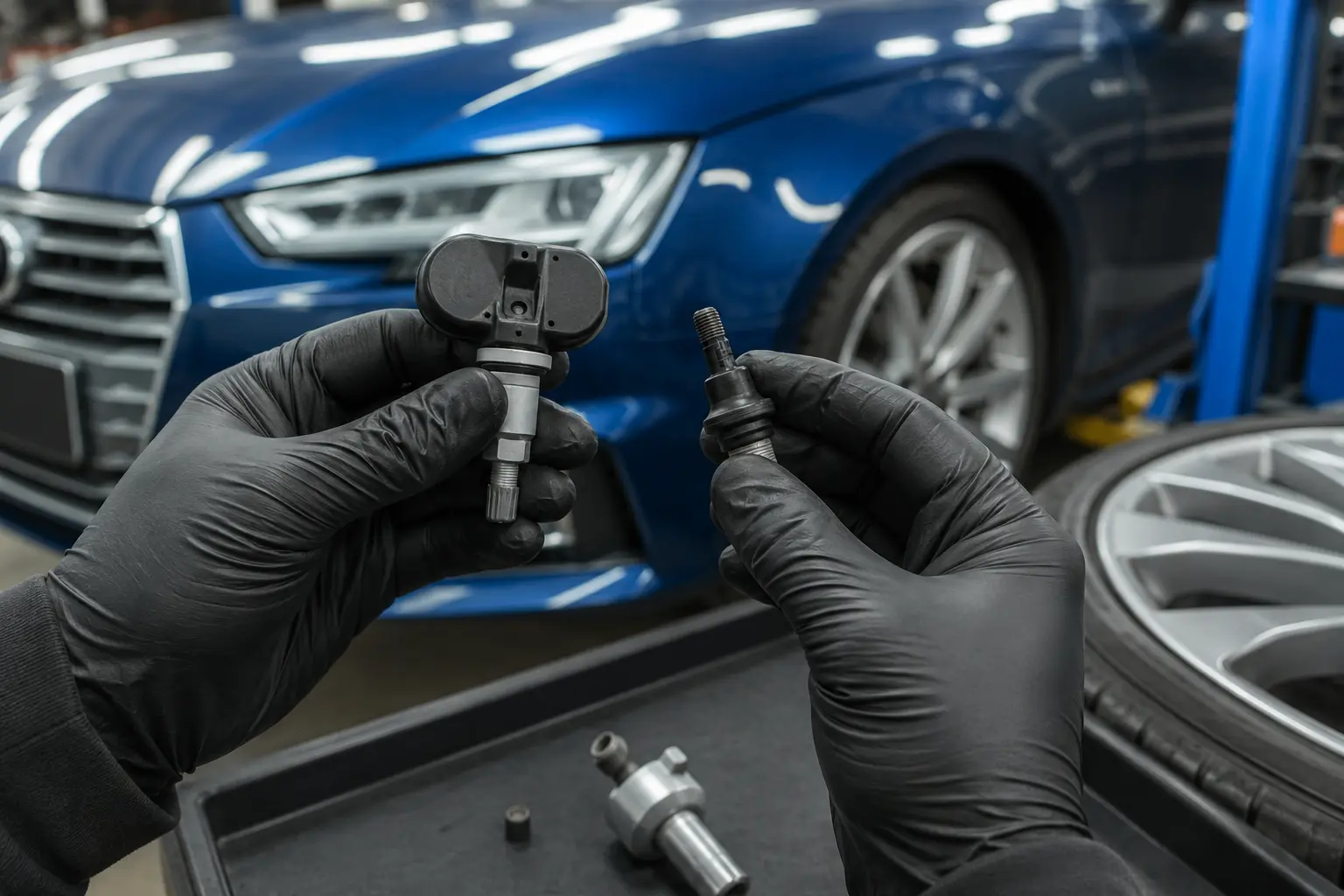
A battery-powered sensor is fitted at each monitored wheel, usually as part of the valve assembly. It transmits pressure, temperature, identity and status information to the vehicle. A weak internal battery, damaged valve, incompatible frequency or protocol, broken housing, missing sensor, failed receiver path or incomplete relearn can set a warning.
- Individual pressure values may appear in the vehicle display
- A handheld activation tool can test sensor response
- Replacement must match vehicle generation and market specification
- Valve seals and service hardware should be renewed correctly
Indirect wheel-speed monitoring
No pressure transmitter is fitted inside the wheel. The vehicle uses ABS wheel-speed information and other calculated behaviour to detect a tyre whose rolling characteristics have changed. A pressure correction normally needs a reset or store procedure, but an ABS sensor, tone-ring, wheel-bearing, tyre-size or calibration issue can prevent correct monitoring.
- Tyre pressure is still measured manually
- There may be no sensor to replace at the valve
- All tyres should match the approved size and sensible wear pattern
- Wheel-speed faults belong to an ABS diagnostic route
Warning-cause matrix
Match the symptom to the next check
Tyre visibly low
Do not reset the system to dismiss the lamp. Inspect for a puncture, cut, damaged rim or valve and confirm the tyre can be handled safely.
One pressure value missing
On a direct system, activate that wheel sensor and check its identity, status, battery indication and compatibility with the vehicle.
Warning after tyre work
Check whether a sensor was damaged, omitted or replaced with the wrong type, whether the valve leaks and whether the relearn was completed.
All pressures are correct
Confirm the readings cold, then identify the system and scan stored faults. A pressure reset alone will not fix a dead sensor or ABS input fault.
Warning flashes first
A flashing lamp or system-unavailable message often indicates a monitoring-system fault rather than simply low pressure. The exact vehicle message matters.
Warning returns later
Look for a slow leak, temperature-related pressure change, marginal sensor battery, intermittent receiver path or a reset carried out at the wrong pressure.
Diagnosis before replacement
Prove the sensor is the failed part
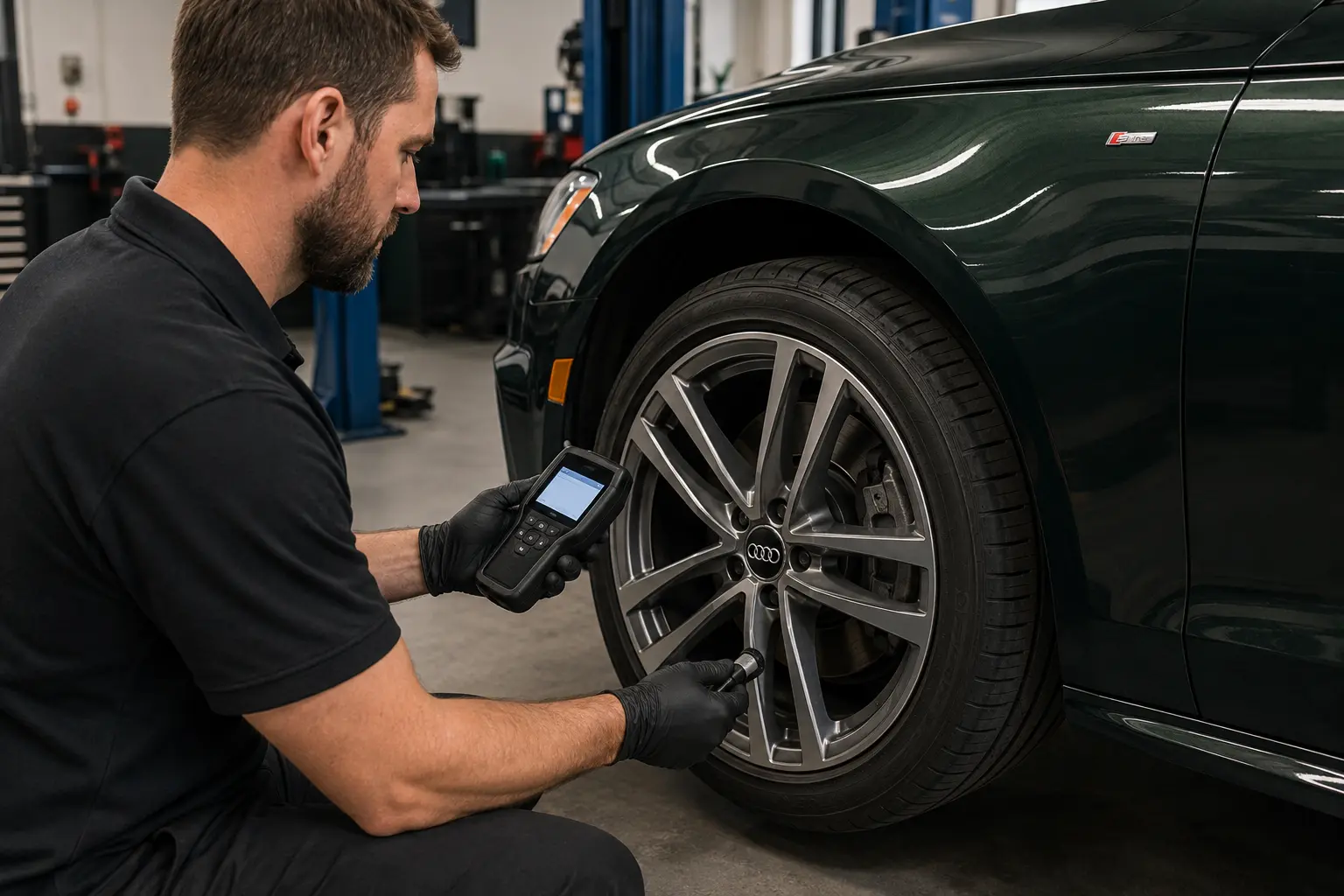
A correct diagnosis begins with cold tyre pressures and a physical inspection. If the vehicle uses direct sensors, each wheel is activated and compared with the vehicle data. A sensor that responds to a handheld tool may still be incompatible with the car, registered to the wrong wheel position or failing intermittently. A sensor that does not respond may have a depleted battery, damaged housing or incorrect activation method for that generation.
We scan relevant control units, record identities and look for receiver, antenna, gateway, ABS and communication faults. On indirect systems, live wheel-speed data and tyre circumference matter more than valve hardware. Replacement is recommended only when the test route supports it.
- Cold pressure and leak source checked first
- Direct sensor identities and responses compared
- Frequency, protocol and part compatibility verified
- ABS wheel-speed faults kept separate from sensor sales
Replacement workflow
From warning to verified wheel position
The sequence protects the wheel, avoids an incompatible sensor and confirms the vehicle actually accepts the repair.
Inspect and identify
Record model, year, wheel size, warning behaviour, actual pressures and whether the system is direct or indirect.
Activate and scan
Read available sensor identities and status, then check control-unit faults and wheel-speed inputs where relevant.
Match the part
Confirm frequency, protocol, valve type, approved replacement option and whether pre-programming is required.
Fit and seal
Remove the tyre carefully, install correct seals and hardware, torque the valve and rebalance when necessary.
Relearn and verify
Complete the vehicle-specific learning or reset route, confirm each position and recheck for leaks and warning return.

Lookalike faults
When a new sensor will not help
A nail, bead leak, cracked rim or damaged valve can reduce pressure while the sensor works correctly. Temperature changes can expose a marginally low cold setting. An indirect system can react to mismatched tyre sizes, large tread-depth differences or an incomplete reset. ABS wheel-speed sensor, tone-ring and wheel-bearing faults can disable indirect monitoring.
On a direct system, the vehicle may fail to recognise a physically functional sensor because its protocol, frequency or programming is wrong. A receiver, antenna, wiring, power-supply or gateway issue can affect several sensors at once. Replacing all four transmitters will not repair a missing receiver path.
Broader network or power faults can be assessed through Audi electrical diagnosis. The Audi repair services hub helps route brake, wheel, suspension and electrical symptoms without turning this page into a general tyre or ABS service.


Tentative Dubai pricing
TPMS price ledger
These are planning ranges, not quotations. Unless marked included, amounts are before 5% UAE VAT. Audi model, system type, sensor protocol, valve design, wheel condition, tyre access, parts tier, number of sensors, programming method and associated ABS or receiver faults affect the total.
| Assessment or work | Tentative range | Assumption and scope |
|---|---|---|
| Initial TPMS scan and warning check | AED 250–450 | One vehicle, accessible diagnostic system and standard fault confirmation |
| Cold pressure and visible leak inspection | AED 100–250 | Four tyres checked without tyre removal or rim repair |
| Individual direct-sensor activation test | AED 150–300 | All fitted wheels accessible to a compatible activation tool |
| Tyre removal and refit per wheel | AED 80–150 | Normal tyre and wheel with no run-flat or damage complication |
| Wheel balance after sensor work | AED 60–120 | Standard balance on one wheel; weights and wheel condition affect price |
| Quality compatible sensor supply | AED 180–350 each | Correct frequency and protocol available for the exact Audi |
| Genuine or OE sensor supply | AED 350–650 each | Part only, subject to VIN, supersession and availability |
| Programmable sensor supply and setup | AED 250–500 each | Compatible blank sensor, programming and identity preparation |
| Metal valve service kit | AED 80–180 | Seal, core, nut or cap as applicable; sensor body excluded |
| Rubber snap-in valve replacement | AED 70–150 | Compatible valve stem fitted to a reusable sensor body |
| Sensor fitment labour per wheel | AED 120–220 | Tyre demount, correct torque, leak check and refit |
| Vehicle relearn or position learning | AED 150–350 | Supported standard relearn after compatible sensors are installed |
| Four compatible sensors package | AED 700–1,600 | Parts only or basic programmed set depending on brand and protocol |
| Four genuine or OE sensors | AED 1,400–2,600 | Parts only; model and valve specification create variation |
| ABS wheel-speed diagnosis | AED 350–750 | Scan, live data and focused electrical checks for one reported concern |
| Wheel-speed sensor replacement | AED 350–900 | Part and ordinary labour; seized hardware or bearing faults excluded |
| Receiver or antenna diagnosis | AED 350–700 | Power, communication and focused receiver-path checks |
| Receiver or control module supply | AED 900–2,500+ | Part only; exact equipment, coding and availability vary widely |
Example 1 One dead sensor
Diagnosis AED 250 + compatible sensor AED 250 + fitment AED 120 + relearn AED 150 = AED 770. VAT AED 38.50. Example total AED 808.50.
Example 2 Leaking valve seal
Inspection AED 150 + service kit AED 60 + tyre removal and labour AED 120 = AED 330. VAT AED 16.50. Example total AED 346.50.
Example 3 Four sensors
Diagnosis AED 300 + sensor set AED 1,000 + labour AED 400 + relearn AED 200 = AED 1,900. VAT AED 95. Example total AED 1,995.
Example 4 Wheel-speed lookalike
Diagnosis AED 400 + ABS sensor AED 650 + labour AED 250 + reset and test AED 150 = AED 1,450. VAT AED 72.50. Example total AED 1,522.50.
The four examples are hypothetical arithmetic examples, not customer jobs. A written estimate should state sensor tier, quantity, labour, programming, VAT and any tyre, wheel, ABS or receiver exclusion.
Parts and material choices
Compatibility matters more than appearance
Two sensors that fit the same valve hole can communicate differently. We compare the exact system requirement before recommending a part tier.
Genuine and recognised OE supply
A genuine Audi boxed sensor or a recognised original-equipment sensor can be the clearest route when VIN specification and supply are confirmed. It may cost more but can simplify identification. OE status should be based on the actual part and manufacturer, not a vague sales label.
Even a genuine part may require the correct valve hardware, torque, programming or relearn. Old nuts, seals and valve cores should not be reused merely to reduce the parts line.
Quality programmable alternatives
A reputable programmable sensor can provide a practical alternative when its frequency, protocol, firmware coverage, valve type and programming equipment support the vehicle. The workshop should document the chosen part rather than describe every aftermarket sensor as equivalent.
Very cheap unknown sensors can create short battery life, unreliable transmission, poor valve hardware or future compatibility problems. A saving has value only when the vehicle recognises the sensor consistently.
Pressure and replacement planning
Account for heat, age and repeat labour
Dubai conditions make correct cold-pressure measurement important. Tyre temperature rises quickly after driving, so a warm reading should not be compared casually with the cold value on the vehicle placard.
Set the baseline correctly
We record pressure before changing it, inspect tyre size and condition, then set the vehicle to the applicable cold-pressure specification. A tyre filled when hot can later appear low after cooling. A slow bead, valve-core or puncture leak may take time to reveal itself, so a warning that returns after several hours needs leak diagnosis rather than another reset.
Pressure recommendations can vary with load, wheel and tyre package. The value molded on the tyre sidewall is not the normal vehicle setting. The vehicle label and approved tyre information provide the correct starting point. After adjustment, an indirect system must store the new reference only when the tyres are known to be correct.
Plan one sensor or a set
A single failed sensor can be replaced by itself. When all four original sensors are of similar age, we also explain the labour consequence of returning for another tyre demount if another sealed battery fails soon. This is a planning comparison, not a reason to replace responsive sensors automatically.
The estimate should show sensor quantity, part tier, valve hardware, tyre removal, balance, programming and relearn separately enough to understand the choice. If the wheel is corroded, cracked or previously repaired, rim work remains outside a sensor-only quotation. Customer-supplied sensors are checked for compatibility, but an unknown product can add diagnostic time and may not have useful return support.
Estimate and handover boundaries
Confirm what was learned and fitted
A proper handover records which wheel or system caused the warning, the sensor identity where available, the chosen replacement type, renewed valve hardware, pressure setting and the relearn method. If the warning came from an ABS or receiver fault, the customer should receive that diagnosis rather than a bill for unnecessary transmitters.
Direct sensors may need a short drive before the vehicle displays stable values. Indirect systems need normal driving to compare wheel behaviour after the correct reference is stored. A warning that remains immediately after fitment is investigated before handover. A warning that returns later may indicate another ageing sensor, a new pressure loss or an intermittent receiver path.
We do not describe a reset as a repair when the physical cause is unknown. Final verification is intended to show that pressure is correct, the fitted sensor responds, the vehicle accepts it and no relevant fault remains active at the time of release.
Frequently asked questions
Audi TPMS questions
Does every Audi have a sensor inside each wheel?
No. Some Audi models use direct battery-powered sensors inside the wheels, while others use indirect monitoring calculated from ABS wheel-speed information. The model year, market and equipment must be identified before parts are ordered.
Can I drive with the TPMS warning on?
Check the tyres immediately. If a tyre is visibly low, damaged, hot or losing pressure, do not continue normally. If pressures are correct and the warning indicates a system fault, arrange diagnosis because monitoring may be unavailable.
Why did the warning appear after new tyres?
A sensor may have been damaged, a valve may leak, a wheel may lack the correct sensor, a replacement may be incompatible or the relearn may be incomplete. On indirect systems, pressure storage or tyre-size differences can matter.
Can you replace only one Audi TPMS sensor?
Yes, when testing confirms one failed direct sensor and the remaining sensors are compatible and responsive. If all sensors are the same age, the customer may compare one-sensor repair with planned replacement of an ageing set.
How long do TPMS sensor batteries last?
Battery life varies with sensor design, age, temperature, transmission frequency and driving pattern. The battery is normally sealed into the sensor, so a depleted battery usually means replacing that sensor rather than opening it.
Can a TPMS sensor battery be changed?
Most direct sensors are sealed and are not designed for a reliable battery-only service. Replacing the complete compatible sensor protects sealing and transmission performance.
Does a new sensor need programming?
Some sensors arrive with the required protocol, while programmable sensors need vehicle-specific preparation. The car may also need a relearn, position-learning drive or diagnostic procedure after installation.
Why does the warning return after a reset?
A reset cannot repair a slow leak, dead sensor, wrong protocol, damaged valve, receiver fault or ABS wheel-speed problem. It may also have been stored with incorrect pressures. The returning warning should be diagnosed rather than repeatedly dismissed.
Can a damaged valve be replaced without changing the sensor?
Sometimes. Selected sensors accept a correct replacement rubber or metal valve and service kit. Corrosion, broken housing, incompatible hardware or a depleted sensor battery may make complete replacement more sensible.
Will universal TPMS sensors work on every Audi?
No single sensor should be assumed to cover every Audi. A programmable range may support many vehicles, but frequency, protocol, firmware, valve type and tool coverage must match the exact application.
Can an ABS fault trigger a tyre-pressure warning?
Yes, particularly on indirect systems that use wheel-speed information. An ABS sensor, tone ring, wheel bearing, wiring or control fault can disable or distort tyre-pressure monitoring.
Do wheel positions need to be relearned after rotation?
It depends on the system. Some vehicles identify wheel positions automatically after driving, while others need a specific learning process. We verify the method for the vehicle rather than applying one universal reset.
Should all four sensors be replaced together?
Not automatically. One confirmed failure can be repaired individually. When sensors are the same age and several batteries are weak, a four-sensor plan may reduce repeated tyre removal, but the choice should be explained with parts and labour totals.
What should I send before booking?
Send the Audi model and year, a dashboard photo, the cold pressures, which wheel is indicated, what tyre or wheel work was recently done, and any part number or scan code available.
Complete the repair
Set pressure, learn the sensor and verify
Final checks include valve sealing, correct cold pressure, sensor response or indirect-system reset, stored fault review and confirmation that the dashboard accepts the repair. Use the enquiry builder for a focused first assessment or visit the contact and workshop page for directions.