
Audi Tyre Replacement in Dubai
Audi tyre replacement should begin with the exact factory-approved size, load index, speed rating and construction fitted to the car. We inspect tread, age, puncture position, sidewalls and wear across the axle, then explain whether one tyre can be repaired, a matched pair is sensible or the vehicle needs a full set. Mounting, balancing, pressure and TPMS checks form part of a complete fitment plan.
Which tyre does your Audi actually need?
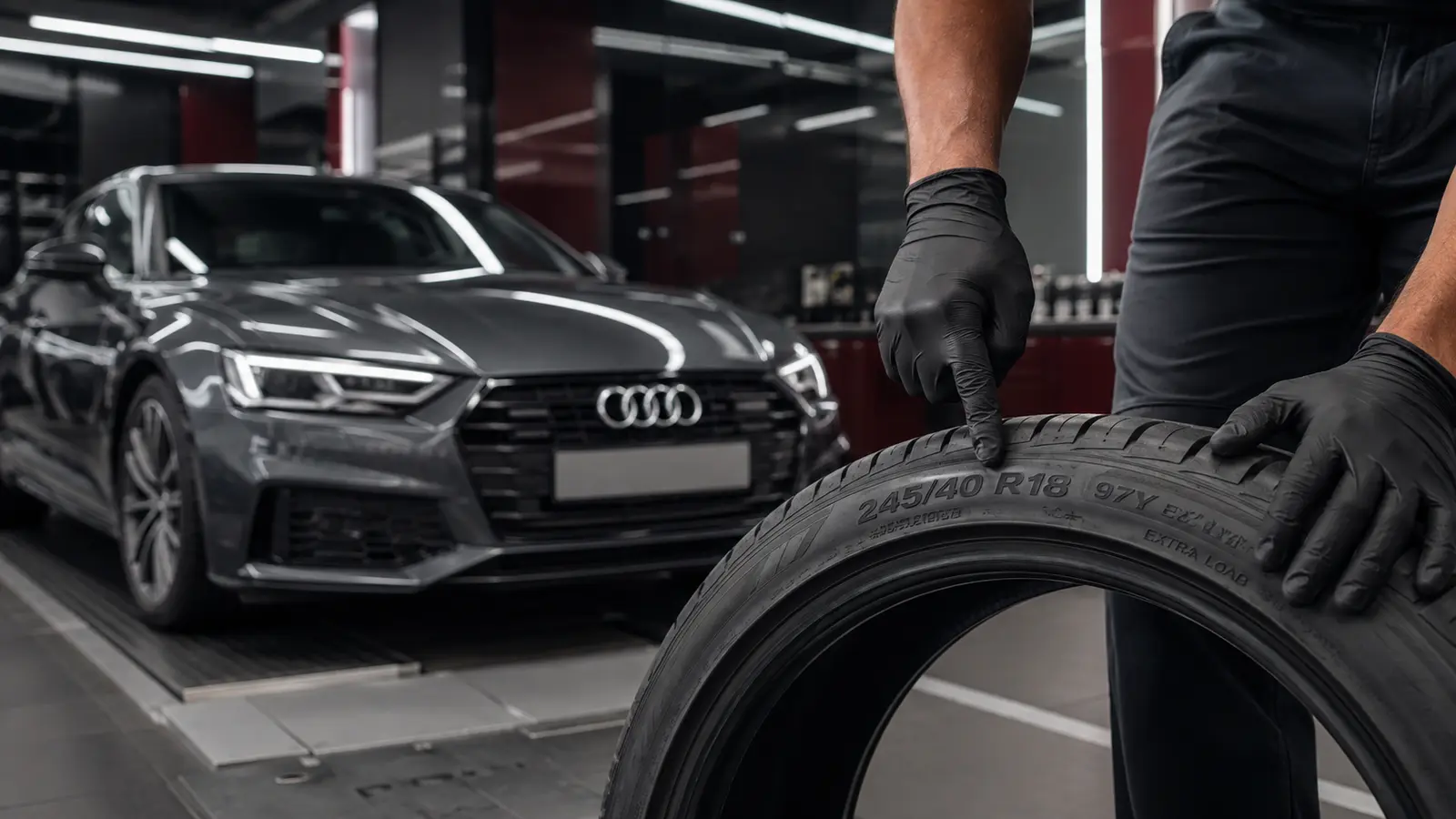
The correct tyre is not chosen from wheel diameter alone. The sidewall code records width, aspect ratio, construction, rim diameter, load index and speed rating. The vehicle label, handbook data, VIN-linked specification and currently fitted wheel package help confirm which combination belongs on the car. Approved alternatives may exist, but their rolling circumference, load capacity, clearance and front-to-rear relationship must remain suitable for that specific Audi.
Condition matters just as much as the code. A small puncture in the central tread area may be repairable after the tyre is removed and inspected internally. Damage at the shoulder or sidewall, exposed cords, impact swelling, deep cracking, serious under-inflation damage or an unsuitable previous repair normally changes the decision to replacement. The remaining tyre on the same axle is then measured so the pair can be assessed together.
Build a tyre enquiry that can be checked
Send the model, year, current sidewall code and the problem you can see or feel. A clear stationary photo of the full sidewall and damaged area may help us prepare, but a repair decision still requires removal and internal inspection.
Read the tyre code from left to right
A code such as 255/45 R20 101W describes several separate limits. Each part must be interpreted with the Audi specification and wheel package, not copied from a tyre that may already be incorrect.
Replace, repair or investigate another cause?
The visible symptom sets the first safety decision. It does not always identify the complete cause, so tread condition, pressure history, wheel condition, suspension and alignment evidence may need to be separated.
Small object in central tread
Remove the tyre and inspect the inner liner, injury angle and extent of any run-flat damage. A professional internal repair may be possible when the injury is within the repairable zone and all other limits are met.
Internal inspection requiredShoulder cut or sidewall puncture
The shoulder flexes and the sidewall carries structural loads. Damage in these areas is normally a replacement decision rather than a plug or patch decision.
Replace, do not patchBulge after a pothole impact
A bulge can indicate internal cord damage even if pressure appears stable. Stop driving and inspect the tyre and wheel; the tyre normally requires replacement.
Urgent safety issueCracks or age concern
Date is one factor, but storage, heat cycles, pressure history and visible condition matter. Deep cracking, hardening or structural deterioration can justify replacement before the legal tread limit.
Assess condition, not date aloneInside edge wearing quickly
Low pressure, alignment, worn suspension, wheel damage or driving pattern may be involved. Replacing the tyre without finding the wear cause can shorten the new tyre life.
Diagnose wear patternSteering vibration at speed
Imbalance is common, but bent wheels, tyre radial-force variation, incorrect seating, wear or suspension looseness can feel similar. Inspect before repeatedly adding weights.
Separate tyre from chassis
A puncture is judged from both sides of the tyre
A screw in the tread does not automatically mean repair, and a tyre that still holds air is not automatically undamaged. The tyre is removed from the wheel so the inner liner can be checked for abrasion, creasing, heat damage, secondary injuries and evidence that it was driven at very low pressure. The injury location and angle are measured before a repair method is selected.
Temporary external plugs and sealant can obscure the original injury. Tell the technician what was used and how far the vehicle travelled afterward. A safe repair must restore the air-retaining liner and fill the injury channel using a suitable professional method. If the structural area is compromised, replacement is the responsible route.
- Confirm the puncture sits within the repairable tread area.
- Inspect the inner liner for heat, abrasion and creasing.
- Check for multiple or overlapping previous repairs.
- Record any sealant or temporary plug already used.
- Leak-test and balance the assembly after approved repair.
Use this replace-or-repair decision map
The route depends on injury position, structural condition, pressure-loss history and the condition of the other tyre on the axle. A visual check from outside is only the first screen.
Make the vehicle safe
Treat rapid deflation, a bulge, exposed cords, sidewall damage or heavy vibration as a stop-driving concern. Arrange recovery if continued use could worsen the tyre or wheel.
Identify and remove
Confirm the tyre specification, note any sealant and remove the assembly. Demount the tyre when a puncture or internal damage is suspected.
Inspect the complete tyre
Measure tread, locate the injury, inspect sidewalls and inner liner, and compare age and wear across the axle. Check the wheel seating surfaces and valve.
Choose and verify
Repair only when all limits are satisfied. Otherwise select a compatible replacement, balance it, set pressure, check TPMS status and confirm the final wheel-bolt procedure.
Why uneven wear and vibration need a wider check
Uneven wear is evidence, not a diagnosis. Feathering, one-sided wear, cupping and central or shoulder wear can point toward different combinations of pressure, alignment, worn dampers or joints, wheel shape and driving conditions. We measure the pattern and inspect the assembly before deciding whether tyre replacement alone is enough.
A balancing machine identifies mass imbalance in the wheel-and-tyre assembly. It cannot correct a bent rim, a tyre with excessive runout, an incorrectly seated bead or looseness in the suspension. If the car pulls or the tread shows a geometric wear pattern, wheel alignment may be recommended as a separate scope after the relevant suspension and tyre condition are suitable.
Tyre Pressure Monitoring System behaviour varies by Audi. Some configurations infer pressure loss through wheel-speed data; others use pressure sensors. A warning can follow genuine pressure loss, incorrect pressure, a relearn requirement or a sensor/system fault. This tyre page covers pressure setting and the fitment implications. Separate sensor diagnosis or replacement belongs to the appropriate diagnostic route. Chassis looseness or ride concerns can be assessed through Audi suspension repair when the evidence points beyond the tyres.
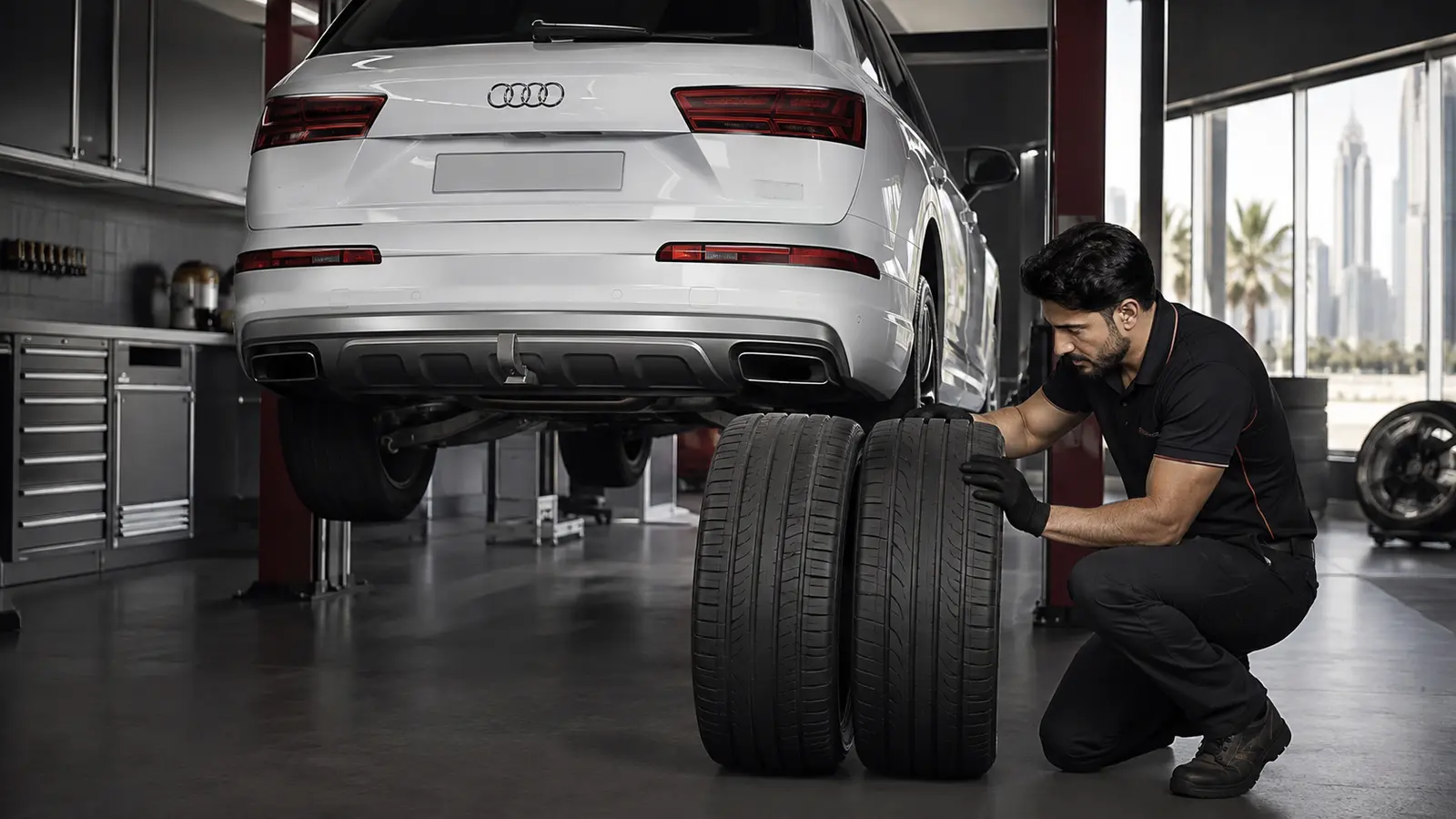
Four tyre routes with different trade-offs
The best option is the one that meets the verified specification and the customer’s actual use. Brand name alone does not settle wet grip, noise, comfort, durability or construction.
Approved puncture repair
For a limited, repairable tread injury on an otherwise serviceable tyre.
- Tyre removed and inspected internally
- Professional combination repair where suitable
- Leak check and rebalancing included
One matched replacement
For isolated damage when the opposite tyre remains a close match in specification, construction and usable tread.
- Confirm axle compatibility
- Match performance category
- Measure the remaining partner tyre
Axle-pair replacement
For large wear differences, discontinued tyre lines or when two matching tyres give the more consistent axle response.
- Install matching specifications
- Position according to tyre guidance
- Balance both assemblies
Complete set
For end-of-life wear, widespread age or cracking, or a deliberate change of tyre line across the car.
- Verify all four sizes and ratings
- Respect staggered fitments where present
- Set pressures and complete TPMS procedure
Compare tyre tiers by use case, not slogans
Within every tier, check the actual model of tyre, current label information, availability and suitability for the Audi. A premium name does not excuse an incorrect load rating or size.
| Route | Works best when | Main limitation | Verification needed |
|---|---|---|---|
| Premium touring | Daily commuting, motorway use, refinement and balanced wet/dry behaviour | Usually higher purchase price; characteristics vary by product line | Exact size, ratings, construction and current product data |
| Performance / ultra-high-performance | S or RS-style use, larger wheels and stronger steering or dry-grip priorities | May trade comfort, noise or wear for response; not every fitment suits every model | Vehicle approval, temperature/use pattern and axle matching |
| Mid-range touring | Budget-conscious daily use where a well-specified, established product meets the requirement | Refinement, wear and wet performance vary more between models | Independent product data and exact rating match |
| Run-flat construction | Vehicles and wheel packages designed to use run-flat capability where continued mobility is a priority | Firmer ride, availability and repair limits can differ | Vehicle suitability, pressure monitoring and matching construction |
| All-season or specialist pattern | A specific mixed-weather, terrain or mobility need supported by the vehicle and region of use | Can compromise the behaviour prioritised by a summer-road tyre | Real operating conditions and approved fitment |
Tyre brands commonly compared in the Dubai market
Dubai sellers list many established tyre manufacturers. Compare the exact product line and Audi fitment—not the sidewall badge alone. Availability changes by size and specification, so the quotation should identify the precise tyre offered.
Brand families customers may encounter
These are comparison examples, not a claim that every size is stocked. Check current availability for the vehicle.
| Brand | Example families | What to verify for the Audi |
|---|---|---|
| Michelin | Pilot Sport, Primacy | Size, ratings, current data and applicable Audi OE marking |
| Pirelli | P Zero, Cinturato, Scorpion | Vehicle purpose, construction and axle matching |
| Continental | SportContact, PremiumContact, EcoContact | Generation, load capacity, wet grip and noise |
| Bridgestone | Potenza, Turanza, Alenza | Vehicle purpose and run-flat or standard construction |
| Goodyear | Eagle F1, EfficientGrip | Variant, ratings and same-axle compatibility |
| Dunlop | Sport Maxx | Generation, size, ratings and construction |
| Yokohama | ADVAN, BluEarth | Intended use, exact specification and product data |
| Hankook | Ventus, iON | Conventional or EV-focused line and load capacity |
| Nexen | N’Fera, N’Blue | Pattern, label data, construction and axle pairing |
| Kumho | Ecsta, Crugen | Vehicle purpose and complete sidewall specification |
Tentative Audi tyre prices in Dubai
These planning ranges include 5% VAT and assume workshop access during normal hours. Tyre brand, product line, size, load and speed ratings, run-flat construction, wheel diameter, availability and existing damage can materially change the final quotation. A written estimate should name the exact tyre and whether mounting, valve, balancing, disposal and TPMS procedures are included.
| Service scope | Tentative AED | What changes the range |
|---|---|---|
| Puncture inspection with tyre removal | AED 105–210 | Injury location, wheel size, sealant cleanup and internal condition |
| Professional repair of eligible tread puncture | AED 160–315 | Repair method, demounting, valve and rebalancing requirement |
| Valve replacement during tyre service | AED 55–135 | Standard valve, metal valve or TPMS-related hardware |
| Wheel balancing, one wheel | AED 55–105 | Wheel diameter, weight type and residue removal |
| Wheel balancing, four wheels | AED 210–420 | Wheel size, correction needed and existing weight cleanup |
| Standard tyre, 17-inch, each fitted | AED 420–840 | Brand line, ratings, availability and valve scope |
| Standard tyre, 18-inch, each fitted | AED 525–1,050 | Width, load rating, premium tier and availability |
| Standard tyre, 19-inch, each fitted | AED 735–1,470 | Low-profile specification, brand and approved fitment |
| Standard tyre, 20-inch, each fitted | AED 945–1,995 | SUV/performance specification, load index and brand |
| Standard tyre, 21-inch, each fitted | AED 1,260–2,625 | Large-size availability and performance specification |
| Standard tyre, 22-inch, each fitted | AED 1,575–3,150 | Rare size, load capacity, brand and order timing |
| Run-flat tyre, 18–19 inch, each fitted | AED 840–1,785 | Exact run-flat line, load/speed rating and stock |
| Run-flat tyre, 20–21 inch, each fitted | AED 1,260–2,835 | Size, reinforced construction, vehicle fitment and stock |
| Two matched 18-inch tyres fitted | AED 1,050–2,100 | Product tier, valves, balancing and disposal |
| Two matched 20-inch tyres fitted | AED 1,890–3,990 | SUV/performance tyre line and availability |
| Four matched 18-inch tyres fitted | AED 2,100–4,200 | Product line, balancing, valves and disposal |
| Four matched 20-inch tyres fitted | AED 3,780–7,980 | Load/speed specification, brand and availability |
| TPMS relearn or basic reset after fitment | AED 105–315 | System type and whether a separate sensor fault exists |
Worked quote examples
The calculations below show how a repairable puncture, one replacement tyre or an axle pair can produce very different totals. They do not price an unseen car, and each total includes 5% VAT.
Eligible central-tread puncture
Hypothetical 18-inch tyre that passes internal inspection.
- Removal and inspection
- AED 105
- Combination repair
- AED 105
- Balance and refit
- AED 63
- Total
- AED 273
One damaged 19-inch tyre
Hypothetical matched single replacement with the opposite tyre still suitable.
- Specified tyre
- AED 945
- Mounting and balancing
- AED 105
- Valve and disposal
- AED 42
- Total
- AED 1,092
Matched 20-inch axle pair
Hypothetical pair after shoulder damage and excessive tread difference.
- Two specified tyres
- AED 2,520
- Mounting and balancing
- AED 210
- Valves and disposal
- AED 84
- Total
- AED 2,814
Four 18-inch touring tyres
Hypothetical planned set replacement on matching wheels.
- Four tyres
- AED 2,940
- Mounting and balancing
- AED 336
- Valves and disposal
- AED 126
- Total
- AED 3,402
What happens from tyre check to handover
The process keeps safety decisions separate from sales choices and records the specification fitted to the car.
Confirm the vehicle and complaint
Record model, year, VIN where available, fitted wheel package, warning message, pressure-loss history and any impact or temporary repair.
Inspect all four tyres and wheels
Read the sidewall codes, measure tread, note date and condition, compare wear across each axle, and check for sidewall, bead and rim concerns.
Demount when repairability is in question
Inspect the inner liner and injury path. Do not approve a puncture repair from the outside alone.
Present the compatible routes
Name the exact proposed tyre, rating, construction and quantity. Explain why one, two or four tyres are recommended and state the estimate inclusions.
Mount without avoidable wheel damage
Use suitable tyre-changing equipment and protection, replace relevant consumables, seat the bead correctly and set the initial pressure.
Balance and refit
Correct mass imbalance, clean the mating surfaces as needed and follow the correct wheel-bolt tightening procedure.
Complete pressure and TPMS checks
Set cold pressures to the relevant vehicle/load guidance, perform the applicable reset or relearn and investigate any warning that remains.
Handover the measurements
Record the fitted specification, pressures and any separate alignment, wheel or suspension recommendation.
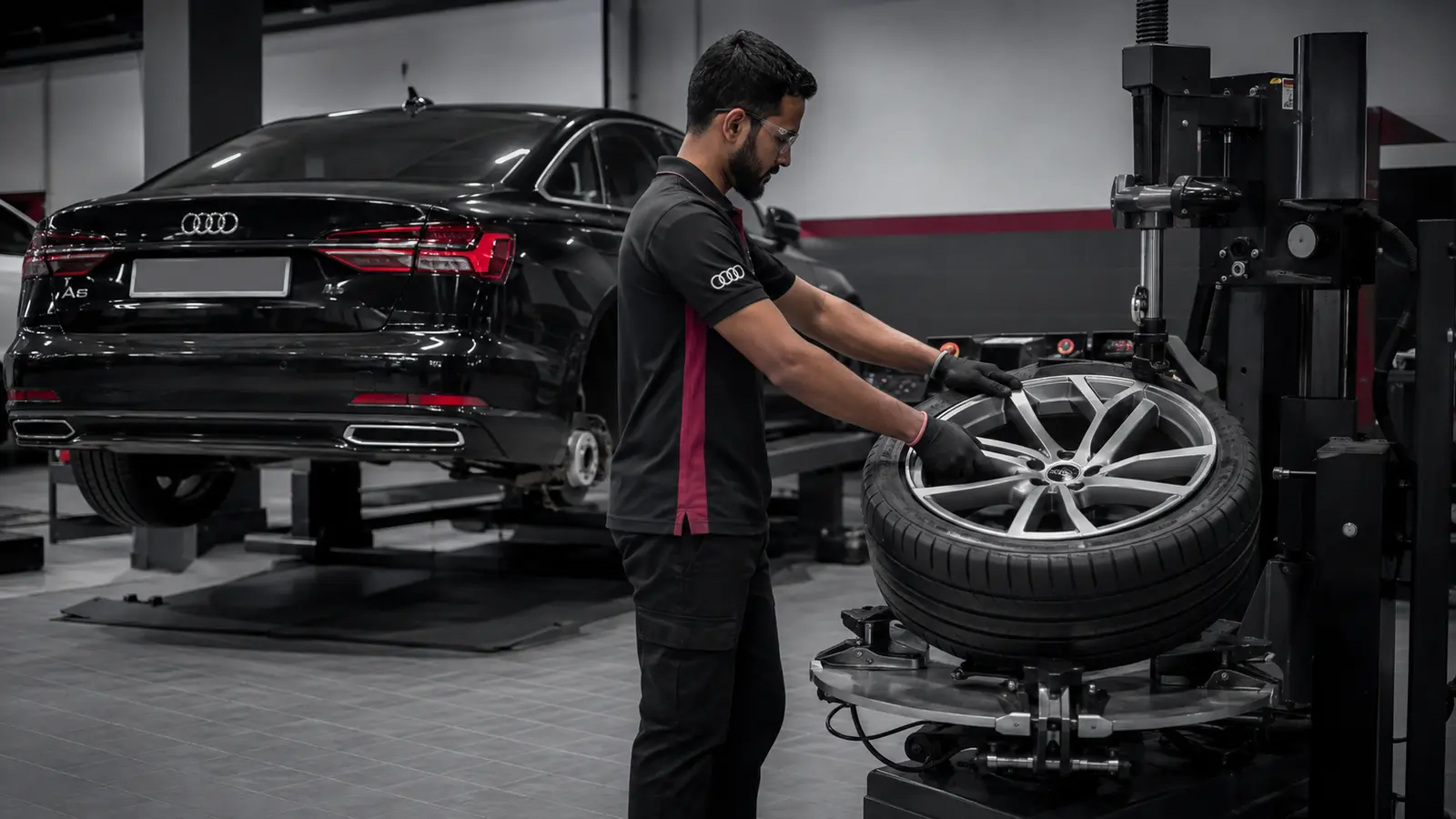
Tyre construction, matching and availability
Standard, run-flat and self-sealing tyres are not interchangeable labels for the same product. Their construction, repair rules, ride behaviour and mobility features differ. The Audi’s approved fitment and pressure-monitoring arrangement set the starting point. If a customer wants to change construction, the complete vehicle configuration and use should be reviewed rather than changing one tyre in isolation.
Staggered wheel packages may use different front and rear sizes while still requiring a planned rolling-circumference relationship. Directional tyres have a rotation direction; asymmetric tyres have inside and outside faces. These details are checked during installation. When the exact product line is unavailable, the estimate should explain the proposed alternative and the implications for axle matching rather than quietly mixing unlike tyres.
What should be checked before the car leaves
Handover should show that the selected tyre is compatible, the assembly is secure and the pressure-monitoring state is understood. A new tyre does not erase an unresolved alignment, wheel or suspension cause.
Size, load index, speed rating and construction match the approved route.
Bead seating, valve condition, balance weights and visible wheel condition checked.
Wheel bolts tightened correctly and tyres oriented or positioned as required.
Cold pressures set, TPMS procedure completed and remaining warnings explained.
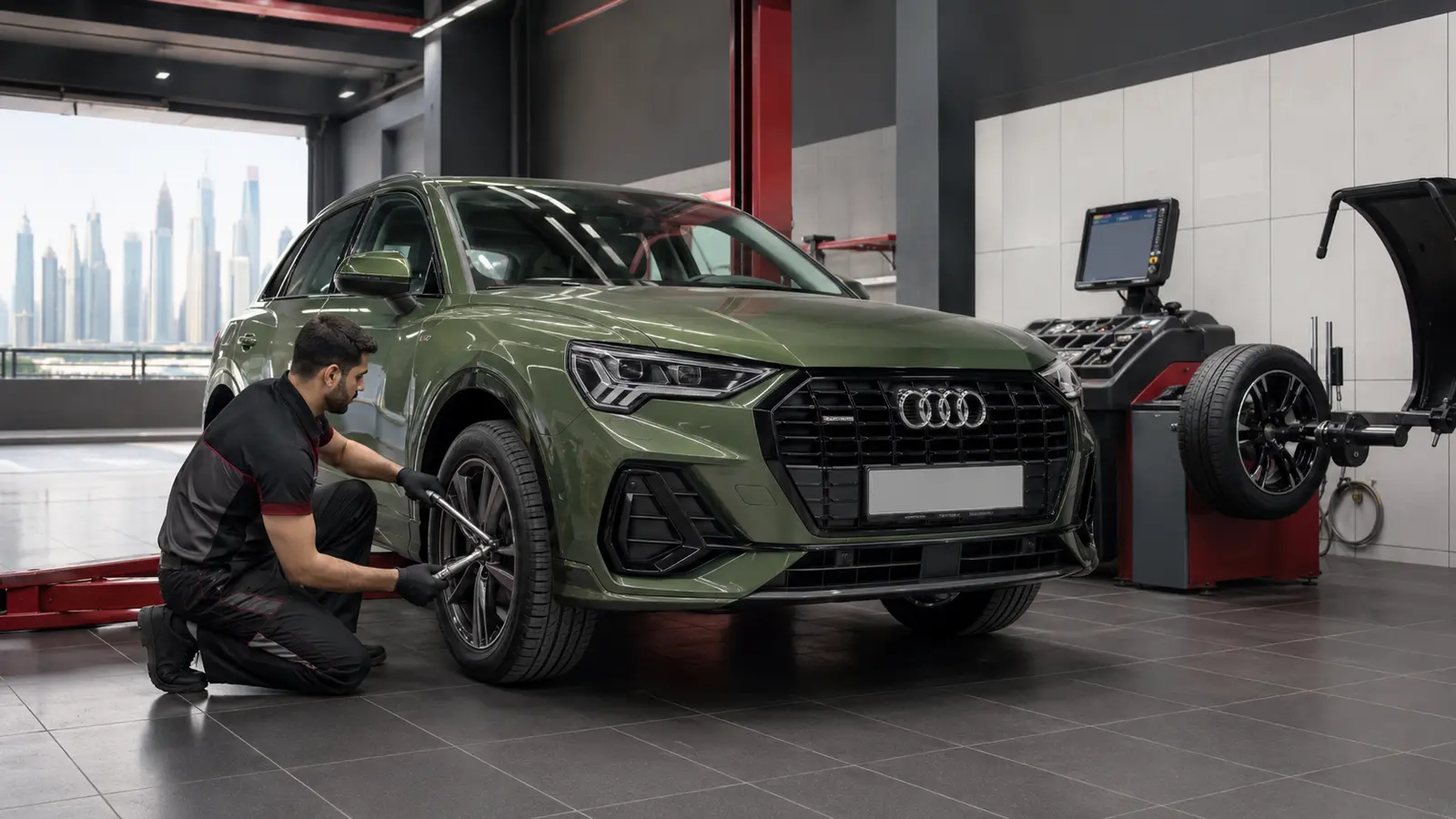
Audi tyre replacement questions
Tyre decisions depend on the damage location, internal condition, exact size and remaining tread across the axle. Inspection comes before repair or replacement advice.
Which tyre brands can you quote for an Audi?
Dubai buyers commonly compare Michelin, Pirelli, Continental, Bridgestone, Goodyear, Dunlop, Yokohama, Hankook, Nexen and Kumho. The shortlist depends on size, ratings, construction, Audi specification and current stock. The quote should name the precise product line.
Can an Audi tyre puncture be repaired?
Sometimes. The tyre must be removed and inspected. A limited injury in the repairable central tread area may qualify; shoulder, sidewall, structural or run-flat damage can require replacement.
Do I need to replace two tyres if only one is damaged?
Not automatically. We compare the other tyre on the axle for specification, construction, product line, age and remaining tread. A close match may allow one replacement; a large difference may favour a pair.
Do quattro Audis need four new tyres at once?
Not in every case. The complete set must remain within the relevant specification and acceptable rolling-circumference relationship. Measurements and the model-specific guidance decide whether one, two or four tyres are suitable.
Can I fit a different tyre size?
Only after confirming an approved or technically suitable alternative for the exact vehicle and wheel package. Clearance, load capacity, rolling circumference, speed rating and front-to-rear relationship all matter.
What do 255/45 R20 101W markings mean?
They describe nominal width, profile ratio, radial construction, rim diameter, load index and speed symbol. The full code still needs to be checked against the vehicle specification.
Is a higher load or speed rating always better?
A higher capability is not a universal upgrade. The tyre must be compatible with the wheel, vehicle, construction requirement and intended use; ride and handling characteristics can also change.
Can I mix run-flat and standard tyres?
Mixing constructions across the same vehicle can create inconsistent behaviour and may conflict with the approved setup. Review the full set and vehicle specification before changing construction.
How old is too old for an Audi tyre?
There is no useful decision from age alone. Read the date code, then assess cracking, hardening, storage, pressure history, damage and manufacturer guidance. Condition can justify earlier replacement.
Why is the inside edge worn more than the outside?
Possible contributors include alignment, pressure, suspension condition, wheel shape and use. The wear pattern should be measured before fitting a new tyre so the underlying cause is not missed.
Will balancing stop every steering vibration?
No. Balancing corrects mass imbalance. Bent wheels, tyre runout, poor seating and suspension looseness can produce similar vibration and need separate diagnosis.
Does tyre replacement include wheel alignment?
Not unless it is listed in the estimate. Alignment is a separate measured service and should follow any necessary tyre, wheel or suspension correction.
What happens to the TPMS after tyre replacement?
Pressures are set and the applicable reset or relearn is completed. If a warning remains because of a sensor or system fault, that diagnosis is a separate scope.
Can a sidewall bulge be repaired?
No practical tyre repair restores damaged sidewall cords. Stop driving, inspect the wheel as well, and replace the damaged tyre with a compatible unit.
Are the prices on this page final quotes?
No. They are tentative planning ranges including 5% VAT. The exact tyre specification, current availability, quantity, condition and included labour determine the written quotation.
What should I send for an initial tyre quote?
Send the Audi model, year or VIN, the complete sidewall code, quantity needed, construction if known, current tread or damage description, and clear stationary photos where safe.
Send the sidewall code before choosing a tyre
Call first if the tyre is losing pressure quickly, bulged or visibly damaged. For planned replacement, prepare the model, year, VIN and complete tyre code so availability and a compatible fitted estimate can be checked.