
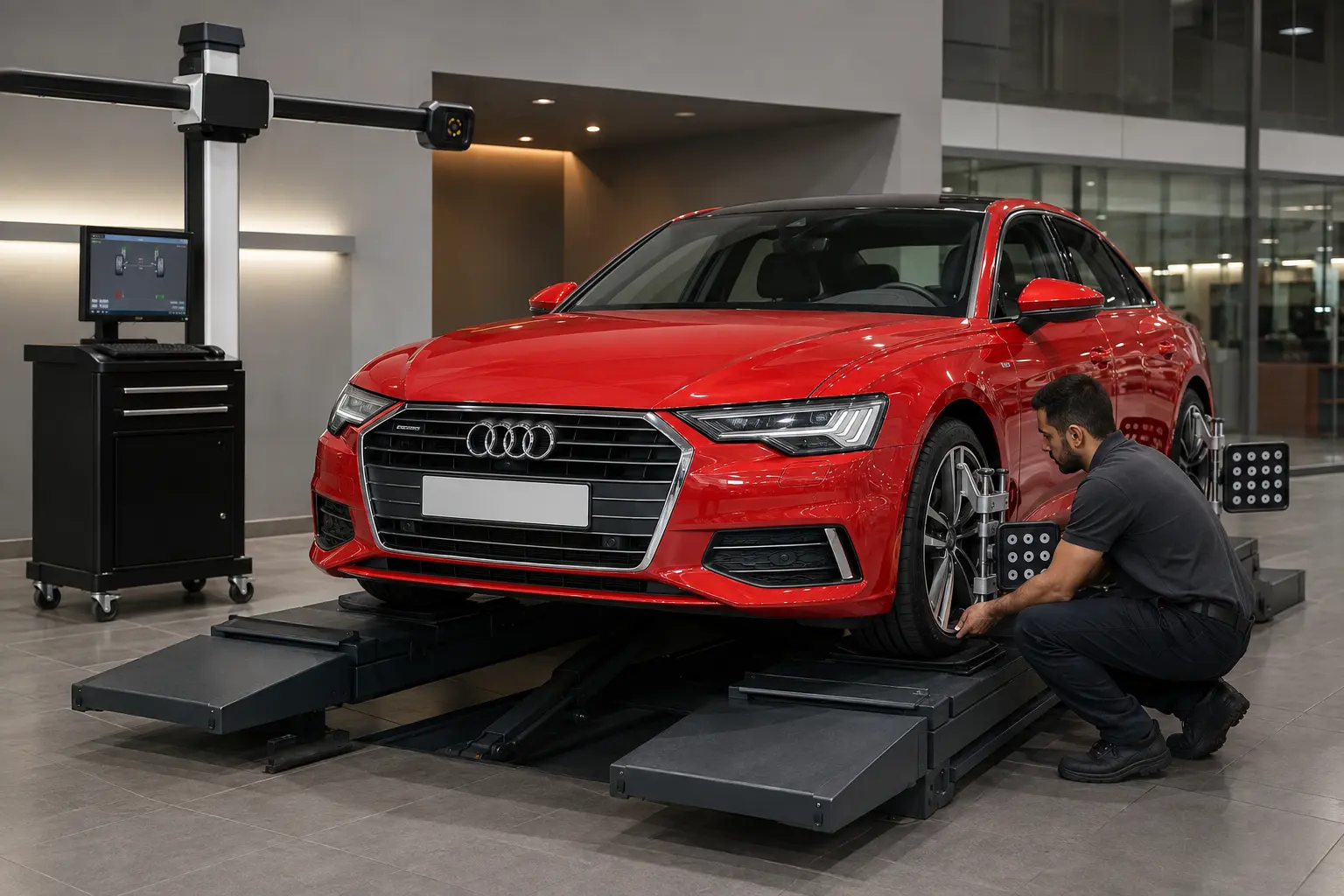
Audi Wheel Alignment in Dubai
Accurate wheel alignment starts by finding out why an Audi pulls, wears tyres or leaves its steering wheel off-centre. We measure the geometry, inspect the parts that hold it, and explain what can be adjusted before turning any bolt.
A straight steering wheel is an outcome, not the diagnosis
Audi wheel alignment in Dubai is often requested after a kerb strike, pothole impact, suspension repair, tyre replacement or the discovery of uneven tread. Those are sensible triggers, but the symptom does not prove that an adjustment is the answer. A tyre with unequal pressure can make the car drift. A tyre with internal construction variation can create a persistent pull even when geometry is within range. An out-of-balance wheel normally produces speed-related vibration rather than a constant drift. A bent rim can add runout. Worn control-arm bushes, ball joints or tie rods can allow the measured angles to move as the car rolls.
Road camber matters too. Many Dubai roads are crowned or fall toward drainage, so a vehicle may gently follow the slope. A useful check compares behaviour on more than one suitable road surface and considers tyre condition, rather than promising a perfectly neutral feel on every lane. Steering-rack play can also leave a vague centre without being an alignment error.
Our process therefore begins with pressures, wheel and tyre condition, ride height, suspension play and steering free play. If the platform is mechanically stable, the geometry reading becomes meaningful. If it is not, we show which repair must come first and why aligning the car prematurely would waste the customer’s money.
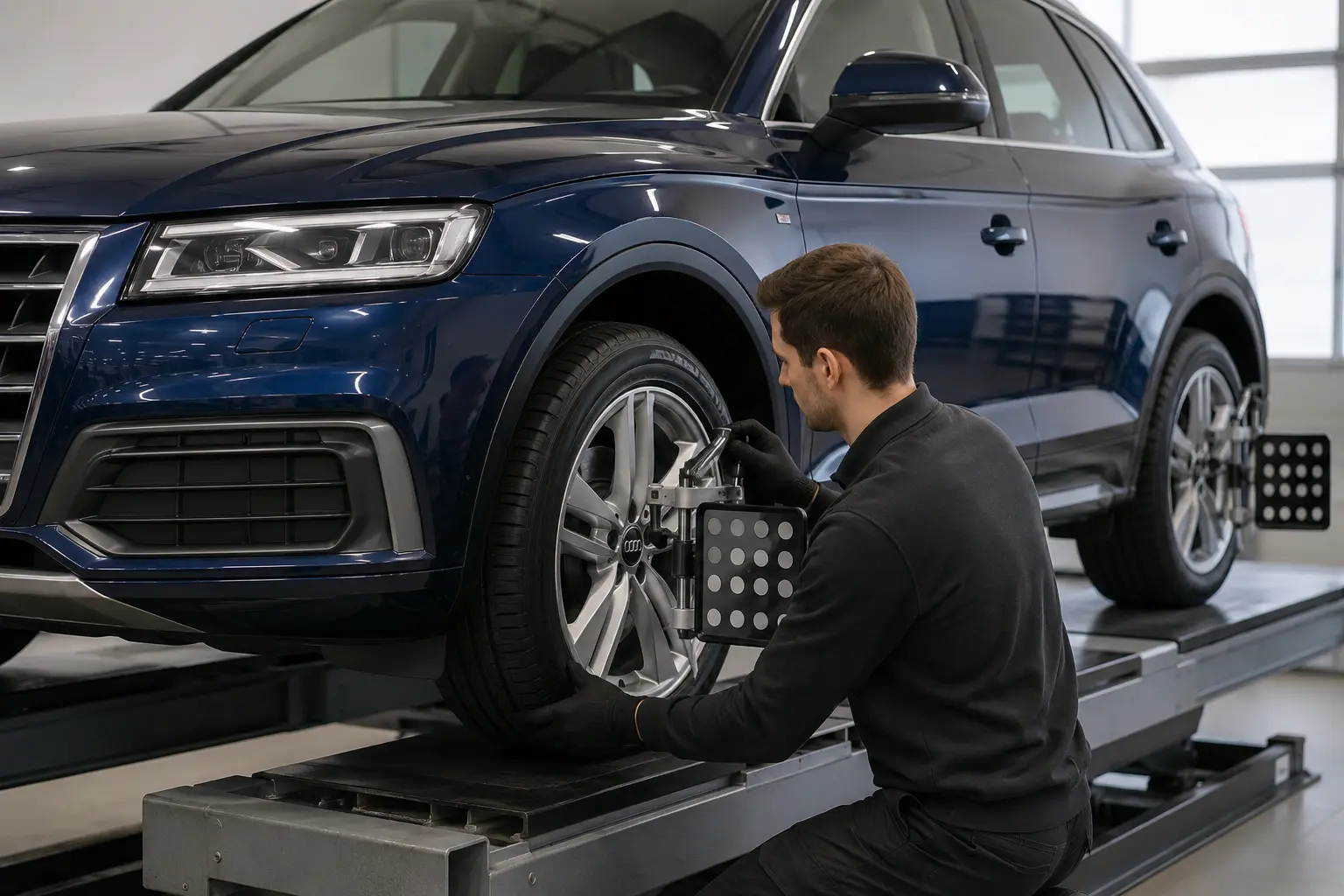
How each angle changes the way your Audi drives
Toe
Toe describes whether the fronts of a wheel pair point slightly inward or outward when viewed from above. Excess or inequality can scrub tread, disturb straight-line stability and leave the wheel off-centre. Total toe alone is not enough; individual values and the rear thrust direction matter.
Camber
Camber is the wheel’s inward or outward tilt viewed from the front. A small model-specific value may be normal. Excess negative or positive camber can concentrate wear on one shoulder, while a left-to-right difference may contribute to drift. On many Audi applications, available adjustment is limited.
Caster
Caster describes the steering axis viewed from the side. It supports return-to-centre and stability. A meaningful side-to-side difference can influence pull, yet caster may not have a routine adjustment. An abnormal value can instead point to ride height, displaced components or impact damage.
Thrust angle
The rear wheels establish the direction in which the chassis naturally travels. If that thrust line is not centred, correcting only the front can mask the cause and produce a crooked steering wheel. Four-wheel measurement lets the front axle be referenced to the rear.
Steering centre
The steering wheel is held at its true centre while toe is divided correctly between sides. Simply removing and refitting the steering wheel is not a substitute for correcting unequal front toe or investigating a displaced steering system.
Ride height and load
Suspension position changes geometry. Collapsed springs, incorrect parts, uneven load, tyre size differences or adaptive-suspension faults can skew the reading. The vehicle should be presented in a representative condition and interpreted against the relevant model procedure.
Read the tread before blaming the angles
The pattern is evidence, not a standalone verdict. We compare all four tyres, their pressures, manufacturing type, age, rotation history and the geometry result. Five common patterns help narrow the next check:
Both shoulders
Wear on both outer edges commonly directs attention to sustained low pressure or high load.
Check first: cold pressure, leaks, load history.Centre rib
Faster centre wear can follow sustained over-inflation, though construction and use also matter.
Check first: correct pressure specification.One shoulder
Inner- or outer-edge wear can align with camber or toe error, but worn joints can create the same evidence.
Check first: play, ride height, geometry.Feathered blocks
A saw-tooth feel across the tread often supports a toe or thrust-angle investigation.
Check first: individual toe and rear thrust.Cups or scallops
Repeated high and low patches are more consistent with damping, balance, runout or looseness than a simple static angle.
Check first: shock control, balance, runout.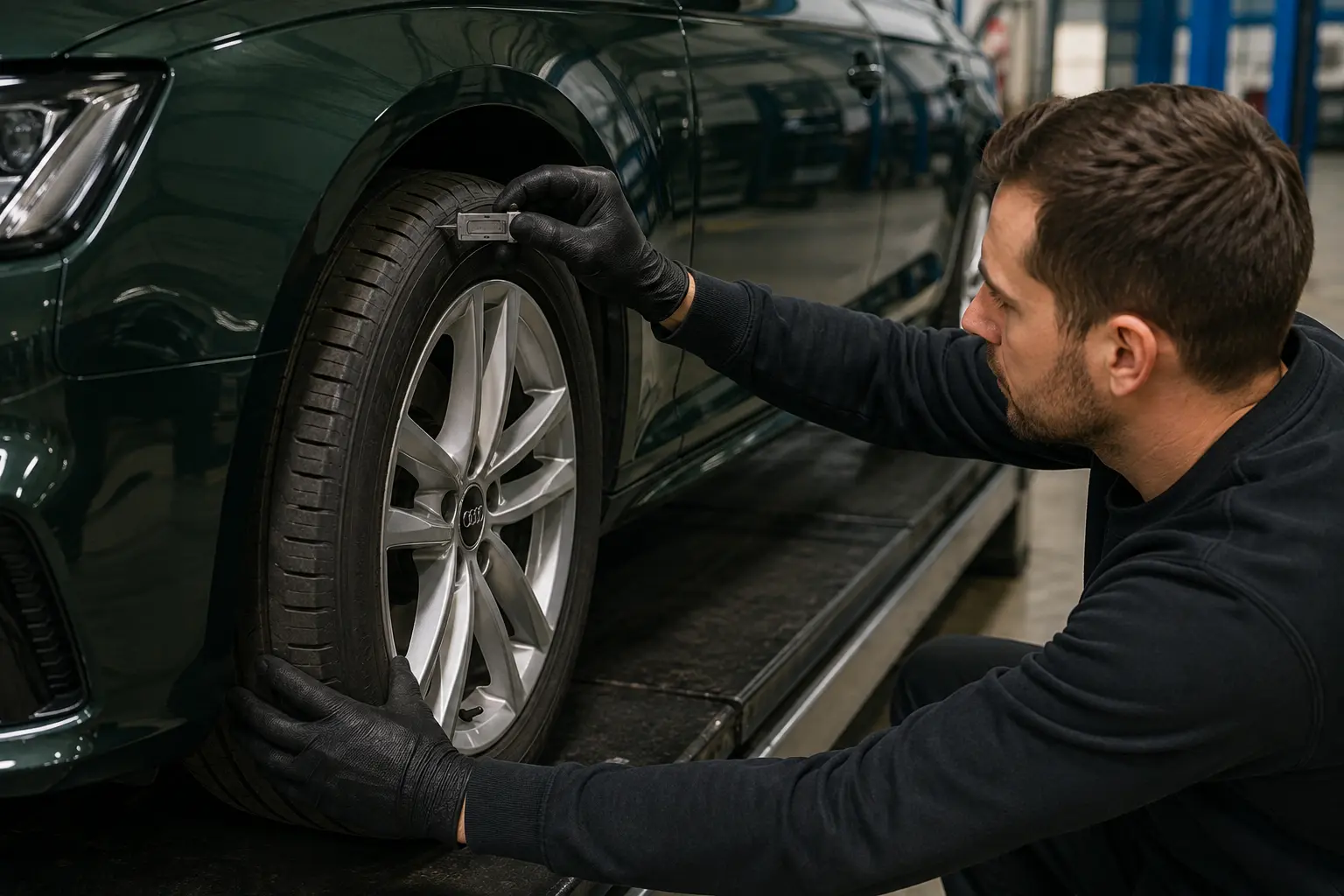
What is checked before the alignment heads go on
- Tyre pressures, sizes, condition and obvious construction differences across an axle.
- Wheel damage, bead seating, visible runout and evidence of a recent impact.
- Wheel-bearing movement, inner and outer tie rods, ball joints and control-arm bushes.
- Spring condition, damper leakage, ride-height differences and relevant adaptive-suspension warnings.
- Steering free play, steering-wheel position and the way the symptom appears during a suitable road check.
- Vehicle model, chassis, suspension package, wheel size and available manufacturer geometry data.
Where a worn component is found, the alignment is paused. Our Audi suspension repair team can assess the mechanical cause; an alignment is performed only after the platform can hold a setting.
A useful alignment report tells a sequence
The figures below illustrate how a real job is reasoned through. They are not target values for every Audi: the correct tolerances depend on the exact model and chassis data. The important point is that the first reading, correction and final verification remain connected.
| Checkpoint | Initial evidence | Decision | Final evidence |
|---|---|---|---|
| Front individual toe | Unequal left/right; wheel off-centre | Centre steering, adjust both tie rods evenly | Balanced and within model range |
| Rear toe / thrust | Small thrust offset | Correct rear first where adjustment and hardware permit | Thrust line centred |
| Camber | Left/right difference | Verify ride height and suspension position before adjustment | Documented; correction limited to available method |
| Caster | Not an adjustable service value on this example | Use as a structural and ride-height clue | No unexplained cross-caster remains |
| Steering wheel | Left spoke high on level road | Hold true centre during final toe setting | Centred during verification drive |
| Tyres / pressure | 4 psi axle difference | Correct pressure before judging pull | Equalised cold pressure |
One symptom, four controlled decisions
Alignment works best as a sequence. The complaint is described first, mechanical and tyre conditions are stabilised, geometry is measured, and only then is an adjustment approved.
Describe the behaviour
Separate drift, pull, vibration, a crooked steering wheel, poor return-to-centre and tyre wear. Record when it happens and at what speed.
Stabilise the vehicle
Correct pressures, inspect tyres and wheels, check suspension and steering play, and establish representative ride height before trusting the geometry reading.
Measure the geometry
Record four-wheel toe, camber, caster where available, thrust angle and steering centre against the correct Audi model data.
Correct and verify
Adjust only what is designed to move, torque disturbed fasteners correctly, repeat the sweep, record the final state and verify the original symptom on the road.
When alignment numbers are not the whole answer
Vibration through the seat or steering at a particular road speed usually sends the investigation toward wheel balance, tyre uniformity or rim runout. Alignment can coexist with those problems, but it does not cancel them. A wheel impact may bend the rim and move a suspension point at the same time, which is why both physical inspection and geometry matter.
A car that wanders after a road repair may have tyre conicity: the tyre itself generates a lateral force. Strategic left-to-right substitution, only where tyre design and direction allow, can help confirm it. A car with a dead band at the steering centre may have inner tie-rod or rack play. Binding or poor return can relate to the top mounts, steering column, rack or assistance system. Diagnostic warnings deserve a scan through our Audi diagnostics service, not an attempt to erase the symptom with toe adjustment.
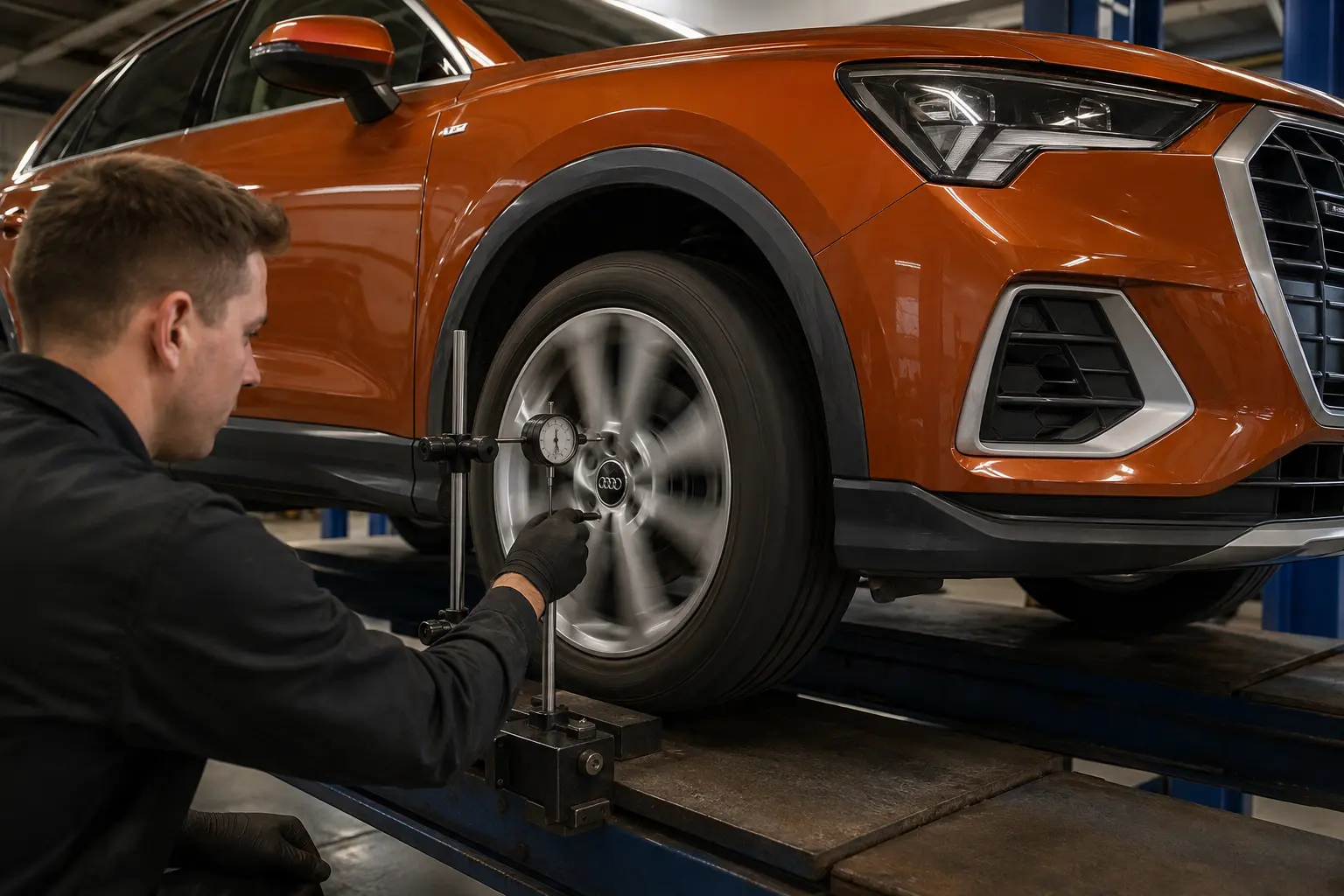
Rim runout is checked separately because a roundness error can create movement that an alignment sensor cannot repair. The inspection shown here uses a fixed reference to observe the rim while it rotates; tyre and hub seating must also be considered.
Audi wheel alignment prices in Dubai
These figures are planning ranges in AED. The exact quote depends on model, wheel size, suspension type, seized hardware, required parts and whether a mechanical fault must be repaired first. VAT is shown separately on the approved invoice.
| Service scope | What it covers | Indicative price |
|---|---|---|
| Geometry health check | Visual pre-check and four-wheel measurement report; no adjustment | AED 180–260 |
| Front toe correction | Steering centred, front toe adjusted where hardware is free | AED 220–320 |
| Standard four-wheel alignment | Measurement plus available front and rear adjustments | AED 320–480 |
| SUV / large-wheel alignment | Four-wheel geometry for Q-series or larger wheel packages | AED 380–560 |
| Adaptive / air-suspension set-up | Ride condition and model procedure incorporated before geometry | AED 480–720 |
| Steering-wheel centring correction | Geometry-based centring when no worn parts are found | AED 220–360 |
| Post-suspension repair alignment | Complete geometry after control-arm, spring or damper work | AED 340–520 |
| Post-steering repair alignment | Toe, thrust and steering centre after tie-rod or rack work | AED 340–520 |
| Tyre-wear diagnostic inspection | Pressure, tread pattern, play and geometry correlation | AED 260–420 |
| Pull / drift diagnostic session | Road behaviour, tyres and geometry assessed together | AED 320–520 |
| Wheel and rim runout check | Fixed-reference check for one wheel position | AED 100–180 |
| Additional axle runout checks | Further wheel positions checked in the same visit | AED 60–100 each |
| Seized adjuster freeing | Controlled release of accessible seized alignment hardware | AED 120–300 |
| Alignment fastener replacement | Labour for approved hardware replacement; parts additional | AED 120–280 |
| Final recheck after settling | Short-interval geometry verification when specifically advised | AED 120–220 |
Prices are estimates, not a diagnosis or fixed quotation. We confirm the scope before chargeable work proceeds.
Four transparent examples
Service AED 380 + 5% VAT AED 19 = AED 399 total.
Diagnostic session AED 360 + alignment AED 340 = AED 700; VAT AED 35 = AED 735 total.
Four-wheel alignment AED 420 + freeing hardware AED 180 = AED 600; VAT AED 30 = AED 630 total.
Wear diagnosis AED 300 + one-wheel runout AED 120 = AED 420; VAT AED 21 = AED 441 total.
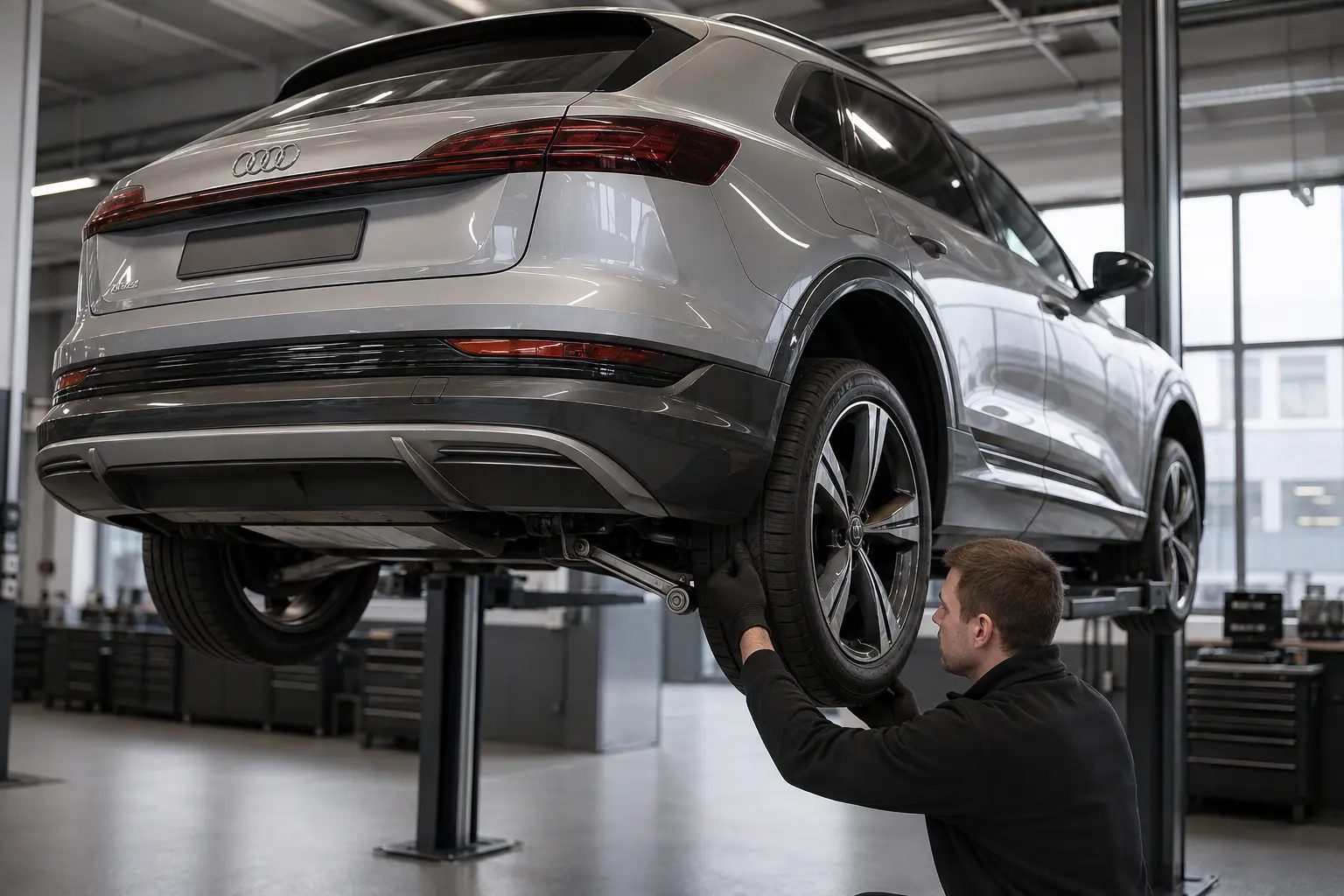
Useful triggers for an Audi alignment check
- The steering wheel sits off-centre on a representative level road.
- One tyre shoulder is wearing faster than the others.
- The car changed after a kerb, pothole or road-debris impact.
- Control arms, tie rods, springs, dampers, subframe or steering components were disturbed.
- The vehicle drifts after tyre pressures and obvious tyre defects have been checked.
- Driver-assistance or steering work requires geometry to be established before related calibration decisions.
Do not keep driving on a visibly damaged tyre, severely bent wheel, loose steering component or sudden major pull. Arrange a safe inspection rather than treating alignment as a cure-all.
The job ends with a centred result and a defensible record
After adjustment, the suspension is settled as the procedure requires and the readings are repeated. The final report should make sense as a set: individual front toe supports a centred steering wheel, rear values support the thrust direction, and any non-adjustable angle outside expectation has an explanation rather than a green-screen shortcut.
A suitable road check then looks for the original symptom, steering-centre position and normal return. The final check is not an invitation to chase every gentle response to road crown. It is a controlled comparison against the concern described at booking.
For vehicles with steering-angle or chassis warnings, mechanical geometry and electronic data may both be relevant. The correct basic setting depends on the repair history and diagnostic evidence; it is not automatically included in every routine alignment.
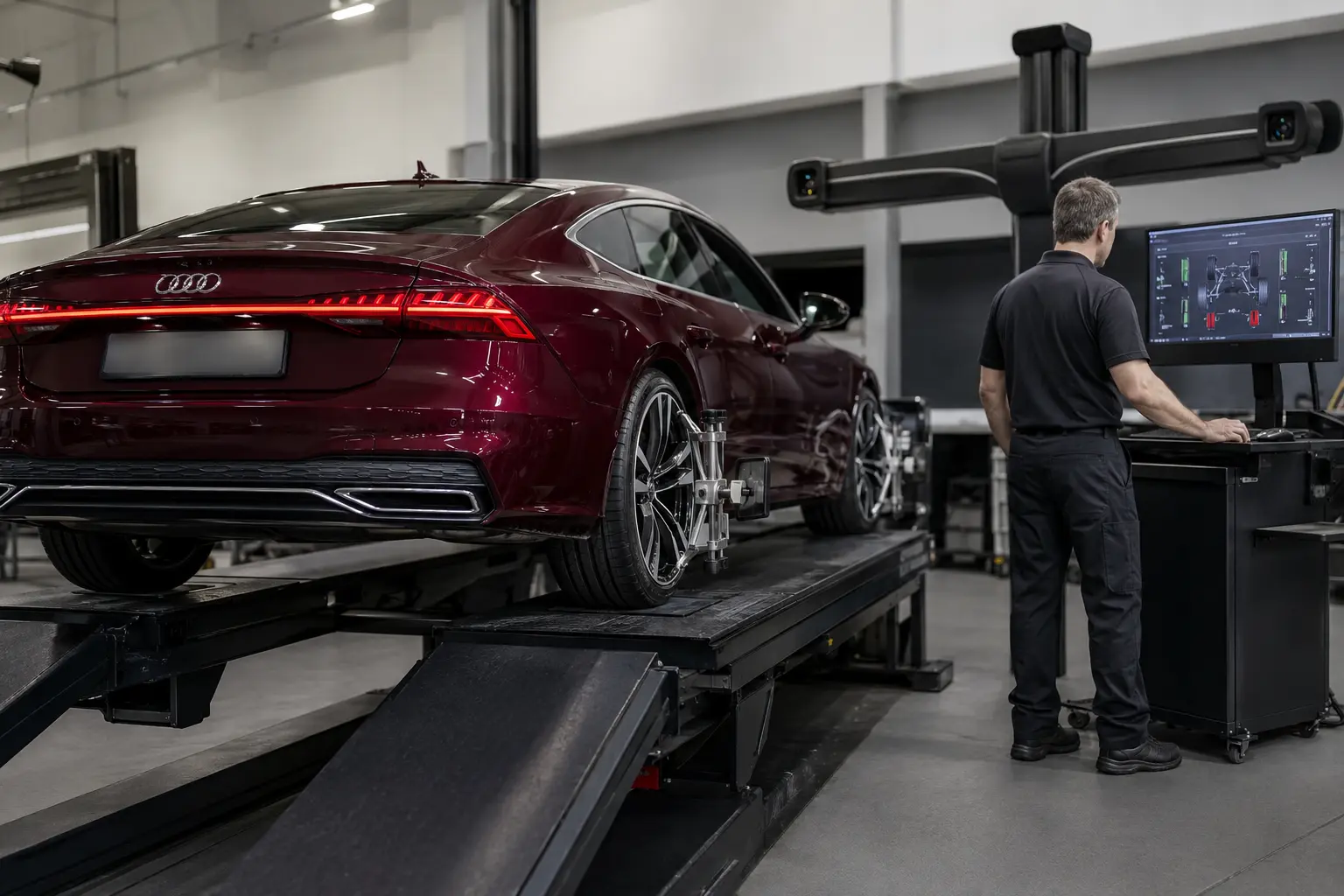
Green boxes help, but relationships explain the result
Initial values
The first complete sweep records the vehicle as presented after pressures and obvious mechanical concerns are addressed. A single red value does not automatically name a failed part. We look for patterns: unequal front toe with a crooked wheel, a rear thrust offset that changes the front reference, or camber and caster differences that follow a ride-height concern.
Target range
The permitted band comes from the selected Audi model and chassis information, not a universal “German car” setting. Suspension variant, wheel package, ride condition and the way the equipment requests loading can affect the procedure. A value close to an edge can still deserve discussion when it helps explain a repeated tyre-wear pattern.
Final values
The last sweep should follow adjustment, settling and steering-centre control. It shows what was actually corrected and what remains non-adjustable or conditional. If an impact has displaced a component, forcing an available adjuster to its limit just to colour the screen green can create a poor compromise elsewhere; the mechanical cause is the better next step.
Measurement repeatability matters. Alignment heads must stay secure, turn plates and slip plates must let the tyres move as intended, and the steering wheel must not shift while the front toe is divided. We compare the printout with the physical inspection and the road symptom, because a good report is evidence of the whole job—not a substitute for it. At handover, we explain the material changes in plain language and identify any tyre or component concern that alignment cannot reverse.
Tell us what changed before the steering changed
Three clues usually narrow the first inspection faster than a long message: what the Audi is doing, what the tyres are showing, and what happened just before the behaviour changed.
Describe what you feel
Tell us whether the car pulls, the wheel sits crooked, the steering feels vague or a vibration appears at a particular speed.
Show what the tread is doing
Uneven shoulder wear, feathering, a recent tyre change or a pressure difference can redirect the diagnosis away from adjustment alone.
Say what happened first
A kerb strike, pothole, suspension repair, steering work or wheel replacement gives the geometry reading useful context.
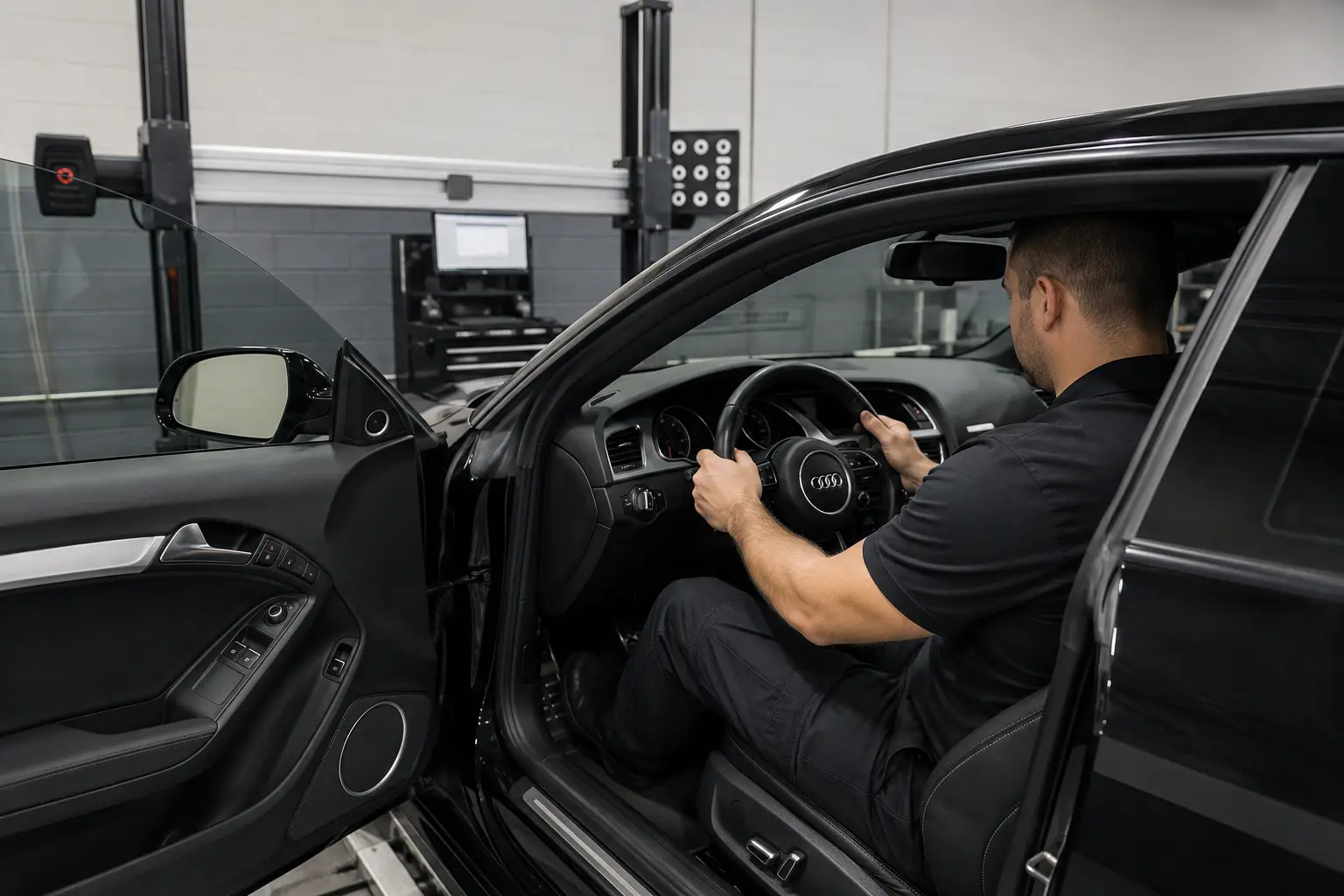
Send the details that change the diagnosis
Use the four fields below to give the workshop the context that actually changes the first inspection route. Send only what you know.
Audi wheel alignment FAQs
How do I know whether my Audi needs wheel alignment?
Common clues are a steering wheel that is off-centre, repeated one-shoulder tyre wear, a change after an impact, or a drift that remains after pressures and obvious tyre problems are checked. Measurement is the only way to confirm the geometry.
Will alignment stop a vibration at motorway speed?
Usually not by itself. Speed-related vibration more often points to wheel balance, tyre uniformity, rim runout or looseness. Alignment can be checked at the same visit, but it addresses wheel angles rather than rotating mass imbalance.
Can road camber make a correctly aligned Audi drift?
Yes. A crowned or sloping road can create a gentle directional tendency. The diagnosis compares behaviour on suitable surfaces and checks tyres and geometry before calling that tendency a fault.
What is the difference between tracking and four-wheel alignment?
Basic tracking usually refers to front toe. Four-wheel alignment measures both axles, including rear toe and thrust angle, so the front wheels can be referenced to the direction in which the chassis actually travels.
Can every camber and caster value be adjusted?
No. Adjustment availability depends on the Audi model and suspension design. An outlying non-adjustable value may direct the inspection toward ride height, worn or displaced parts, incorrect components or impact damage.
Why is my steering wheel crooked after new tyres?
The timing may be coincidental, the previous wear may have hidden a geometry issue, or tyre forces may change how the car feels. Steering centre, individual toe, pressures, tyre fitment and rear thrust should be considered together.
Should alignment be done before replacing worn suspension parts?
No. Worn joints or bushes can move under load and prevent the car holding a setting. Repair the confirmed mechanical fault first, then measure and adjust the stable vehicle.
Does an alignment include wheel balancing?
No. They are different services. Alignment sets wheel geometry; balancing corrects mass distribution in the wheel-and-tyre assembly. We recommend the service that matches the evidence.
How long does Audi wheel alignment take?
A straightforward inspection and adjustment can often be completed in one workshop visit. Seized hardware, worn parts, adaptive-suspension procedures or diagnostic warnings can extend the scope, so timing is confirmed after the initial checks.
Do you align Audi SUVs and air-suspension models?
They can be assessed, but the procedure must respect the vehicle’s ride condition, wheel package and model requirements. Any ride-height or suspension warning is investigated before treating the geometry reading as final.
Will alignment repair an already worn tyre?
No. Correcting the cause can help protect the remaining or replacement tread, but it cannot restore rubber already worn away. A tyre that is unsafe or below the permitted condition still requires replacement.
Do I receive before-and-after readings?
The service is structured around the initial evidence, available correction and final verification. We explain material readings and any angle that cannot be corrected through normal adjustment.
Is steering-angle calibration always required after alignment?
No. It depends on the model, repair history, warning status and measured data. Mechanical steering centre and geometry come first; electronic basic settings are applied only when the relevant procedure calls for them.
How much does Audi wheel alignment cost in Dubai?
A standard four-wheel service is typically estimated at AED 320–480 before VAT, while diagnostic, large-wheel, adaptive-suspension or seized-hardware work can change the total. The approved scope is quoted after inspection.
Bring the symptom, tyre history and recent repair details
We will separate geometry from the problems that imitate it, then quote the correction your Audi actually needs.