
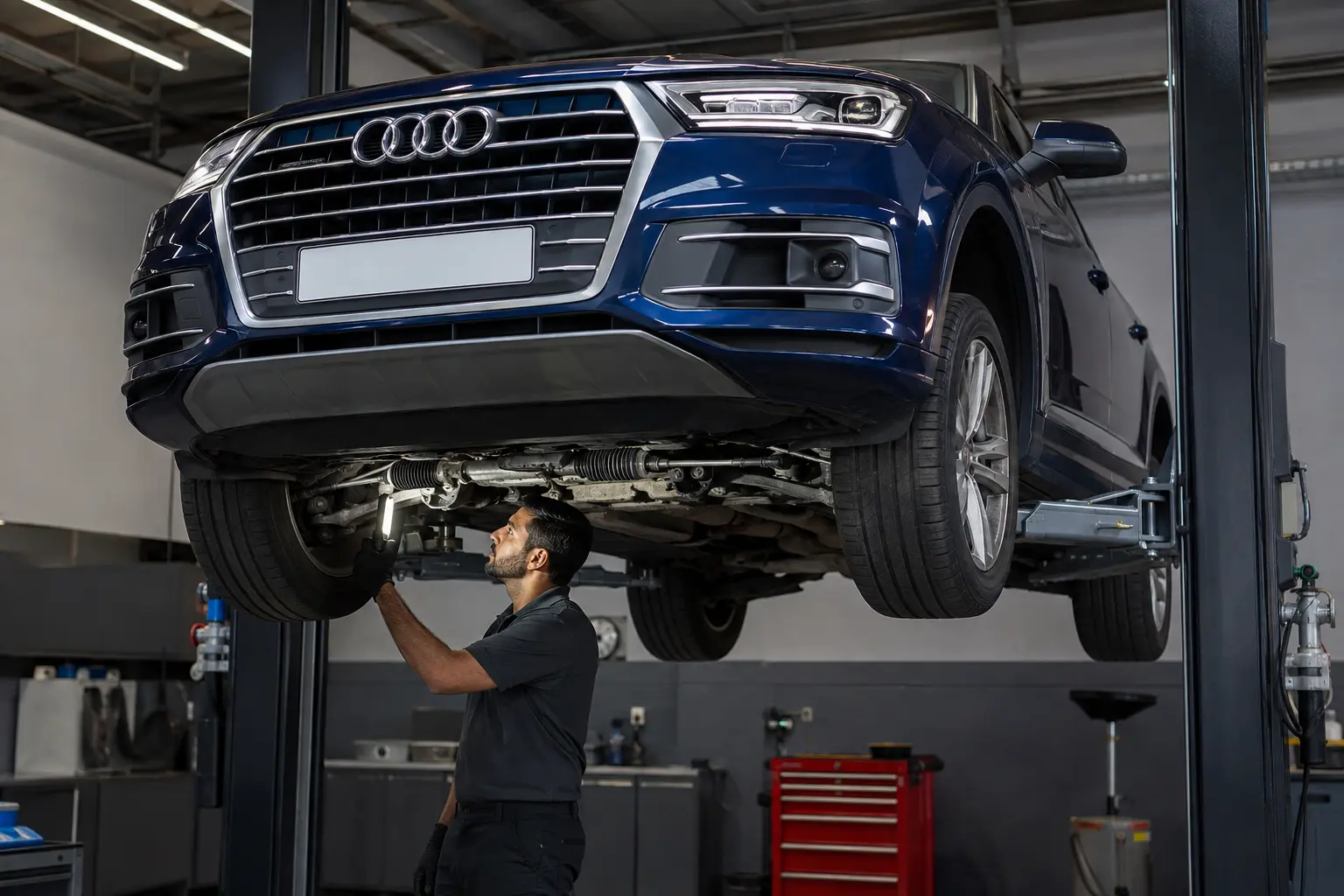
Audi Steering Rack Repair in Dubai
Leaks, play, binding and electric-assist faults can come from the rack—or from the pump, column, tie rods, battery, wiring, suspension or alignment around it. We isolate the failed system, compare repair and replacement routes, then complete the installation, basic settings and geometry the chosen route requires.
A rack-shaped problem is not always a rack failure
Drivers commonly ask for Audi steering rack repair in Dubai after seeing fluid near a gaiter, hearing a knock, feeling a dead band at the steering wheel, experiencing heavy steering or receiving a steering-system warning. Each deserves attention, but none alone identifies the rack as the failed part. If the dashboard shows an assistance or steering message, start with the Audi steering system fault guide.
On a hydraulic system, heavy steering can begin with low fluid, aerated fluid, a slipping drive, a restricted line or a weak pump. Fluid found below the car may have travelled from a hose connection or another component before collecting on the rack. On an electromechanical system, reduced assistance can follow low system voltage, battery or charging weakness, supply or ground resistance, wiring damage, connector contamination, angle data, communication faults, a motor problem or a control-unit fault.
A knock can come from an inner tie rod, outer tie-rod end, control-arm joint, anti-roll-bar link, column joint or mounting point. Steering wander can be aggravated by tyre condition or measured wheel alignment. Binding can originate at a top mount or steering column. Diagnosis therefore maps the complaint to a load, direction, temperature, speed and warning state, then tests the likely branch. Replacing the rack because it sits in the middle of the system is an expensive shortcut.
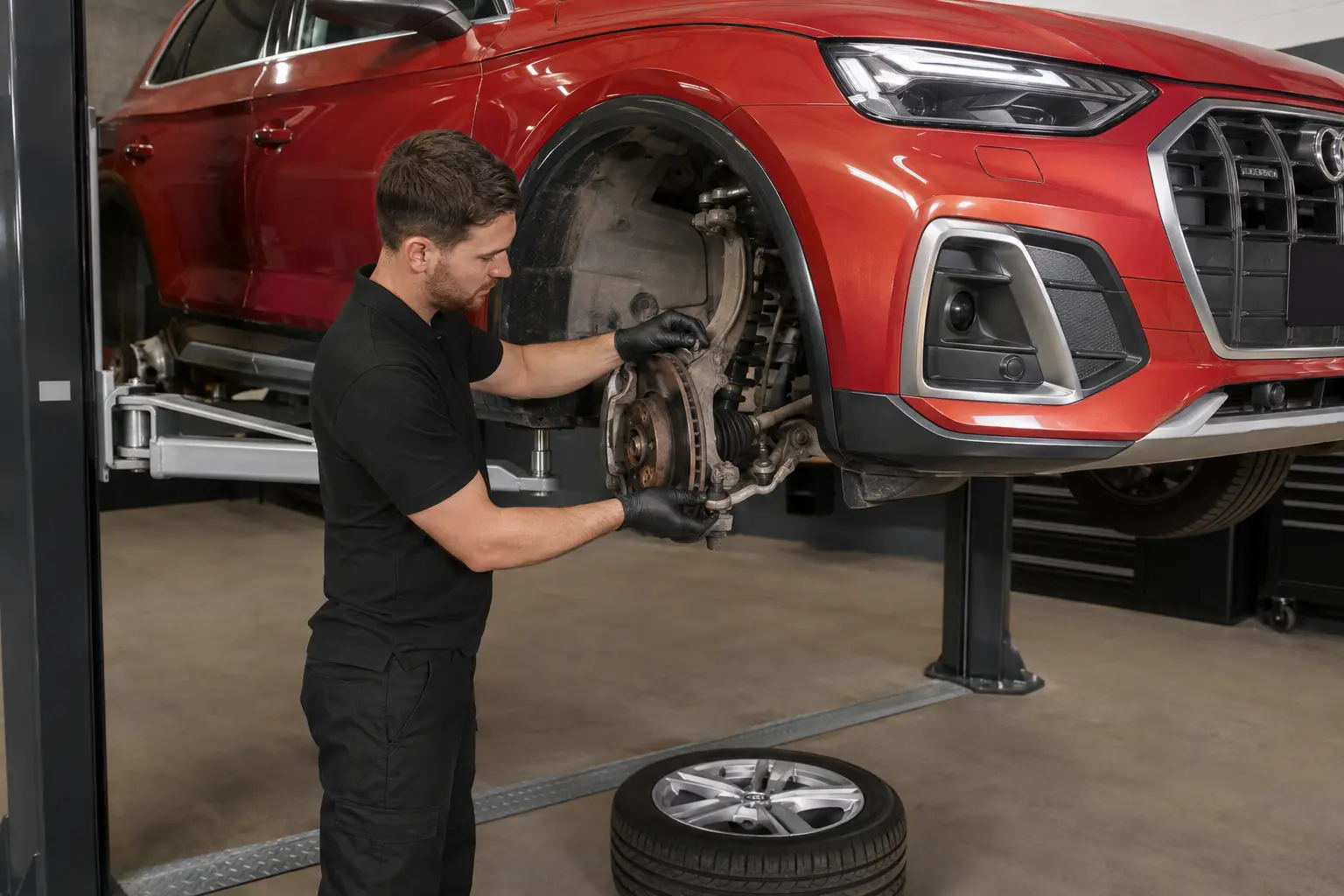
From what you feel to what we test
Fluid loss
Wet boot, falling reservoir level or fluid beneath the front axle.
Test path: identify fluid, clean and trace source, inspect lines, boots, seals and hydraulic pressure context.Free play or knock
Steering input moves before the road wheels respond, or a knock appears across direction changes.
Test path: column joints, rack mounts, rack input, inner and outer tie rods, arms and wheel bearings.Binding or poor return
Steering catches, stays turned or requires unequal effort.
Test path: tyres, top mounts, column, rack mechanical movement, hydraulic pressure or electric torque assistance.Heavy steering
Assistance is weak all the time or under a specific condition.
Test path: fluid and pump on hydraulic cars; voltage, supply, data and motor/control faults on electric cars.Warning lamp
Yellow or red steering message with normal, reduced or absent assistance.
Test path: complete scan, freeze-frame context, battery and charging state, power/ground and related basic settings.Off-centre steering
The wheel does not sit straight or angle data looks implausible after repair.
Test path: tyre pressure, toe and thrust angle, mechanical centre, steering-angle data and required adaptation.Speed-related vibration
Movement builds within a road-speed range rather than with steering input.
Test path: wheel balance, tyre uniformity, rim runout, bearings and joints before condemning the rack.One-sided pull
The vehicle continually changes lane direction on representative roads.
Test path: tyres, pressures, brakes, alignment, ride height and suspension before rack diagnosis.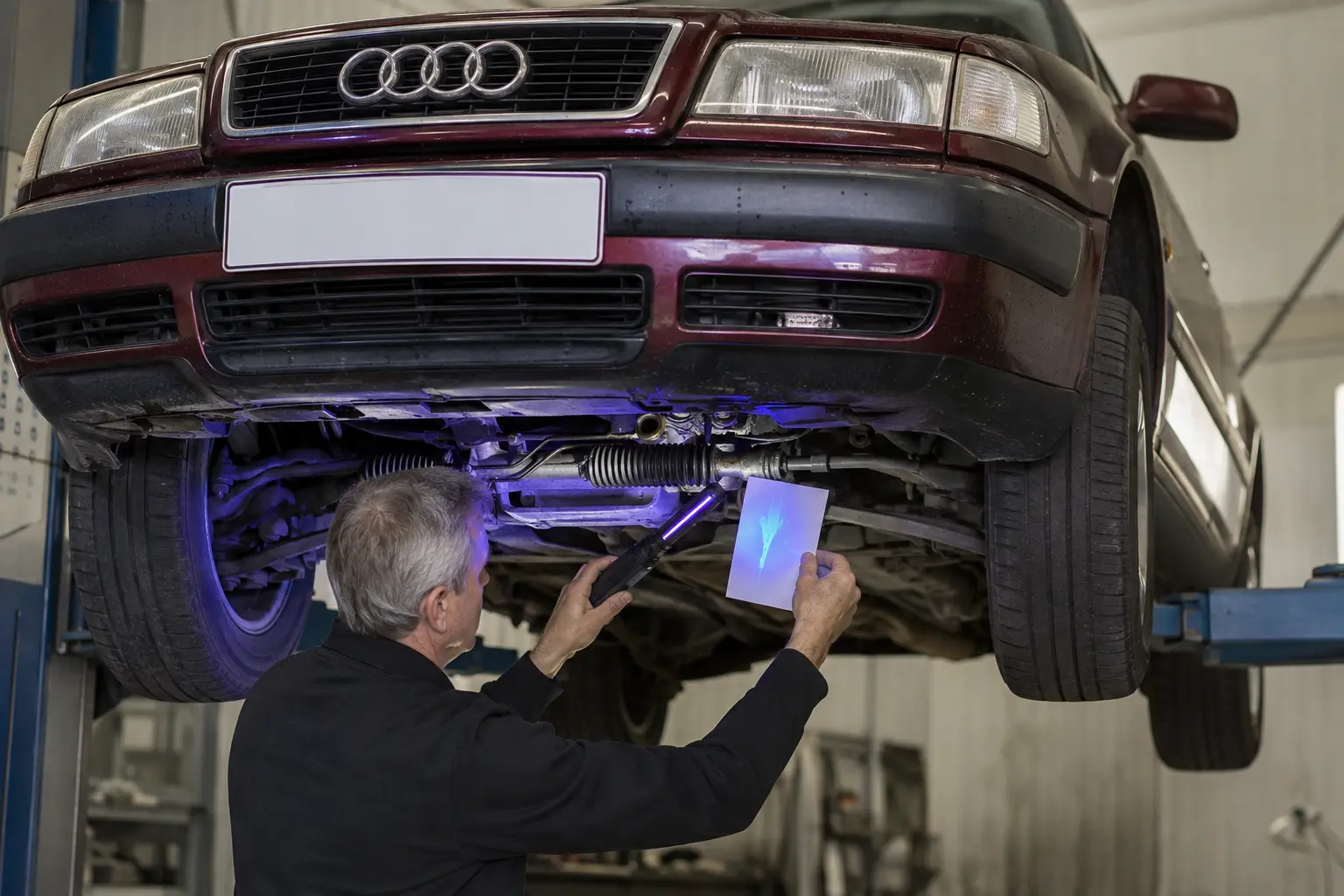
Confirm where the fluid starts, not where it lands
Hydraulic steering relies on the reservoir, suitable fluid, pump, pressure and return paths, valve action and the seals inside the rack. A damaged gaiter can allow dirt and water toward the rack bar; a wet gaiter can also hold fluid that has passed an internal seal. But external oil on the boot is not enough to approve a rack overhaul. The system is cleaned, the fluid identified and the first wet point observed.
Reservoir condition, fluid level and aeration matter because a pump drawing air can become noisy and assistance can pulse. Hoses and unions are inspected under the conditions that reproduce the leak. The rack bar is checked for corrosion or scoring once access and the approved repair route allow. Excessive wear on the bar or housing can make a seal-only job short-lived, which is why a low-cost reseal is not automatically the responsible recommendation.
System contamination also changes the scope. Metallic debris, degraded hoses or incorrect fluid can damage a repaired or replacement unit. The approved plan can therefore include line attention, flushing by the applicable method and pump assessment. The aim is not merely to stop the visible drip; it is to prevent the same cause from damaging the next rack.
Power, data, motor and mechanics belong to one diagnosis
Many modern Audi models use a steering rack with an electric motor, control electronics and torque or position information integrated into the assistance system. A warning lamp may lead directly to stored fault information, but a fault code describes where the controller noticed a problem—not necessarily which part must be purchased.
Battery voltage and charging performance are established first because steering assistance is a high-current consumer. Power and ground integrity are checked under meaningful load rather than only with an open-circuit meter. Connectors and wiring are inspected for water, pin fit, corrosion, impact damage or previous repair. Relevant network faults, steering-angle information and related chassis data are reviewed in context.
If the evidence points inside the rack, the nature of the fault still matters. A mechanical bind is different from a motor, sensor, electronics or internal position problem. Some units have viable specialist repair paths; others are better served by a complete tested unit because calibration, sealing, software compatibility or parts support limits a component-level route. Bench testing, where suitable, supports the decision but does not replace the vehicle-side checks that prove its supply and communication environment.
After installation, coding, parameterisation or basic settings may be required depending on the platform and part source. Steering angle and end-stop or centre information must agree with the mechanical installation. Related driver-assistance calibrations are considered only when the vehicle configuration and repair procedure require them; they are not bundled as a generic claim.
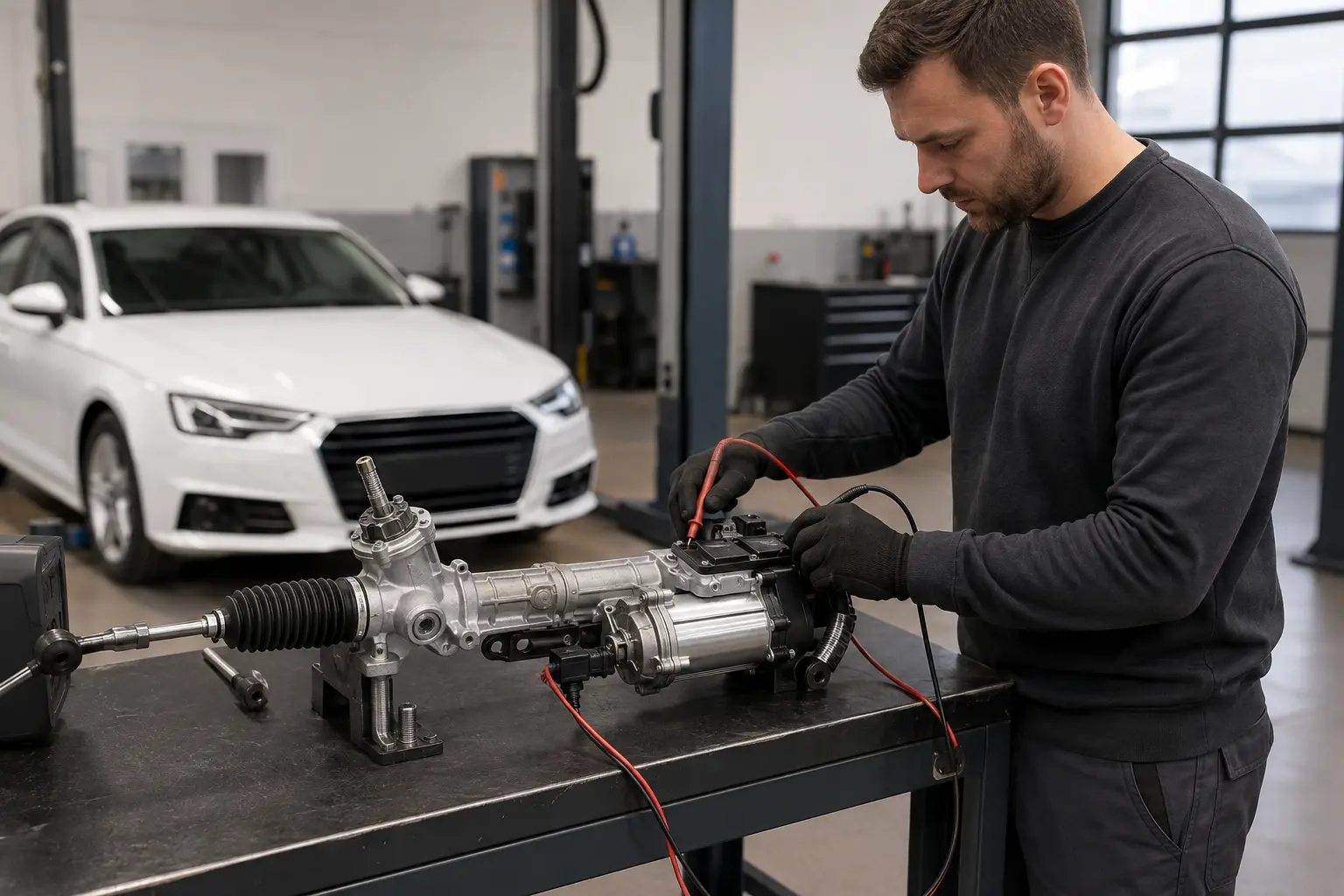
Choosing between repair, rebuilt, tested original and new
The right route depends on the exact rack part number, fault, wear, vehicle value, parts support and evidence available from the supplier. “Cheapest” and “best” are not permanent labels; they are conclusions that belong to a specific case.
| Route | Best suited to | Main checks | Important limitation | Decision signal |
|---|---|---|---|---|
| Seal or component repair | A defined leak or serviceable internal component with sound housing and bar | Wear, corrosion, parts availability, cleanliness and test method | A reseal cannot correct a scored bar, worn housing or unsupported electronic fault | Repairable evidence |
| Rebuilt rack | A failed unit where a documented rebuilding process and matching specification are available | Core identity, replaced wear items, bench result, supplier traceability | “Reconditioned” can describe very different levels of work | Process matters |
| Tested original unit | Selected vehicles where an exact used original match offers a practical route | Part number, donor condition, damage, play, test evidence and compatibility | Remaining life is less predictable and coding or immobilised data may complicate use | Case by case |
| New rack | Safety-critical wear, unsupported repair, repeat failure risk or platform-specific requirement | Correct supersession, supplied components, software and installation procedure | Highest part cost; it still requires correct diagnosis and commissioning | Strongest baseline |
A rack replacement is not finished when the bolts are tight
Prepare
Confirm part identity, steering system, fault evidence and included tie rods, boots, seals, lines or electronics.
Install
Set the rack and wheel in controlled centre positions, protect the clock spring, use correct fasteners and torque sequence.
Connect
Refill and bleed a hydraulic circuit as applicable, or restore electric connectors, power, grounds and communication integrity.
Commission
Perform the model-required coding, parameterisation, steering-angle or end-stop basic settings and clear only resolved faults.
Align and prove
Set four-wheel geometry, centre the steering, road-check assistance and return, then recheck for leaks, warnings or noise.
Tie rods, boots, mounts and the steering column
Inner tie rods connect the rack bar to the outer ends and carry steering input to the hubs. Wear can create free play that feels as if it lives inside the rack. Outer tie-rod ends add another joint, while torn boots expose the inner mechanism to grit and moisture. A boot replacement may be appropriate when caught early and the rack underneath remains dry, smooth and unworn; a boot cannot rescue a corroded or leaking assembly.
Rack mounts and the front subframe also influence the sensation. Movement between the rack and its mounting can produce a knock or delayed response. Control-arm bushes and ball joints can move the wheel without movement inside the steering gear. Those items are checked through our Audi suspension repair service when the evidence leads there.
Above the rack, the steering column and intermediate joints translate the driver’s input. A dry, damaged or binding joint can imitate rack stiffness. Column trim and access are opened only as needed, and the joint is observed while input is applied. Steering-wheel electronics, angle sensors and clock-spring concerns require their own Audi electrical diagnosis; they should not be hidden inside a rack estimate.
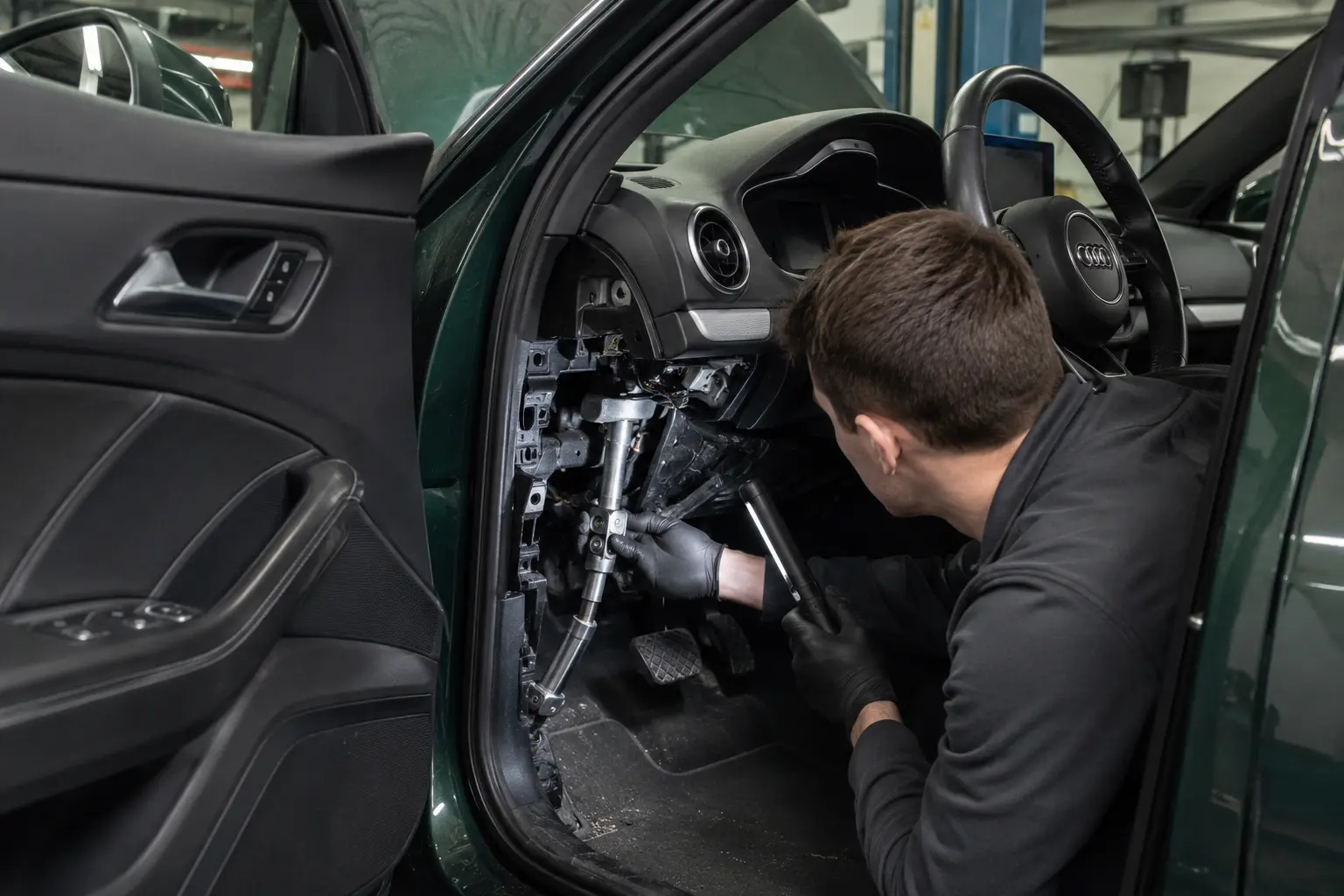
What happens before an Audi steering rack quote
1. Complaint definition
We record whether the concern is leak, noise, free play, binding, variable effort, warning or an off-centre wheel. Temperature, speed, steering direction, recent impacts and previous work change the test route.
2. Safety and visual check
Tyres, obvious joint movement, rack boots, mounts, subframe area, fluid level and visible wiring are checked. A severe leak, loose joint or damaged tyre can change whether a road test is appropriate.
3. System-specific tests
Hydraulic cars lead toward fluid condition, source tracing, pump and circuit behaviour. Electric cars lead toward complete fault memory, voltage, loading, power, ground, wiring and data plausibility.
4. Mechanical isolation
Column, rack input, inner and outer tie rods, arms, bearings and top mounts are compared so movement or binding is assigned to the correct point.
5. Part and repair research
The exact identity and fault determine whether component repair, rebuilt, tested original or new is technically sensible. Availability alone does not decide the route.
6. Written estimate
The quote identifies the rack route, related parts, fluids or wiring, installation, required settings, alignment and VAT. Optional and conditional work stays visible.
Audi steering rack repair prices in Dubai
These are indicative planning ranges in AED, not fixed quotations. Vehicle platform, hydraulic or electric system, exact rack identity, repairability, software needs, seized hardware and parts availability can materially change the total. VAT is added to the approved scope.
| Service scope | Typical content | Indicative price |
|---|---|---|
| Initial steering fault assessment | Complaint check, lift inspection and diagnostic direction | AED 250–420 |
| Electric steering scan and data review | Fault memory, relevant live data and warning context | AED 280–480 |
| Power, ground and voltage-drop testing | Loaded circuit checks for electric steering supply | AED 320–560 |
| Hydraulic leak source tracing | Clean, inspect and identify the first wet point | AED 260–480 |
| Hydraulic pressure / pump-path assessment | System-specific test plan where symptoms justify it | AED 380–680 |
| Rack boot replacement, one side | Boot and clamps where rack condition remains serviceable | AED 320–580 |
| Outer tie-rod end replacement, one side | Labour and standard hardware; part additional | AED 280–480 |
| Inner tie-rod replacement, one side | Labour, boot access and relevant hardware; part additional | AED 420–720 |
| Hydraulic rack removal and refit labour | Removal, installation and system handling | AED 1,200–2,100 |
| Electric rack removal and refit labour | Removal, installation and electrical reconnection | AED 1,400–2,400 |
| Hydraulic rack seal/component repair | Specialist repair where inspection confirms viability | AED 1,400–2,800 |
| Electromechanical rack component repair | Specialist internal route where supported | AED 1,800–3,800 |
| Rebuilt hydraulic rack supply | Matching rebuilt unit; core and specification dependent | AED 2,200–4,200 |
| Rebuilt electric rack supply | Matching tested rebuilt unit; electronics dependent | AED 3,500–6,500 |
| Tested original rack supply | Exact-match used original, subject to evidence and availability | AED 2,000–5,500 |
| New rack supply | Model- and part-number-specific new assembly | AED 5,500–12,000+ |
| Hydraulic fluid and circuit service | Correct fluid and applicable bleeding or flushing work | AED 320–720 |
| Coding / basic settings | Model-required commissioning after supported repair | AED 350–850 |
| Post-repair four-wheel alignment | Toe, thrust and steering-centre correction | AED 340–520 |
Parts ranges are especially model-sensitive. We verify the vehicle and part identity before ordering and separate reusable, mandatory and conditional items.
Four examples with VAT shown
Source tracing AED 360 + initial assessment AED 280 = AED 640; 5% VAT AED 32 = AED 672 total.
Boot labour AED 420 + outer-end labour AED 320 + part AED 280 = AED 1,020; VAT AED 51 = AED 1,071 total.
Component repair AED 1,900 + remove/refit AED 1,450 + fluid service AED 420 + alignment AED 380 = AED 4,150; VAT AED 207.50 = AED 4,357.50 total.
Rebuilt rack AED 4,200 + installation AED 1,650 + basic settings AED 450 + alignment AED 380 = AED 6,680; VAT AED 334 = AED 7,014 total.
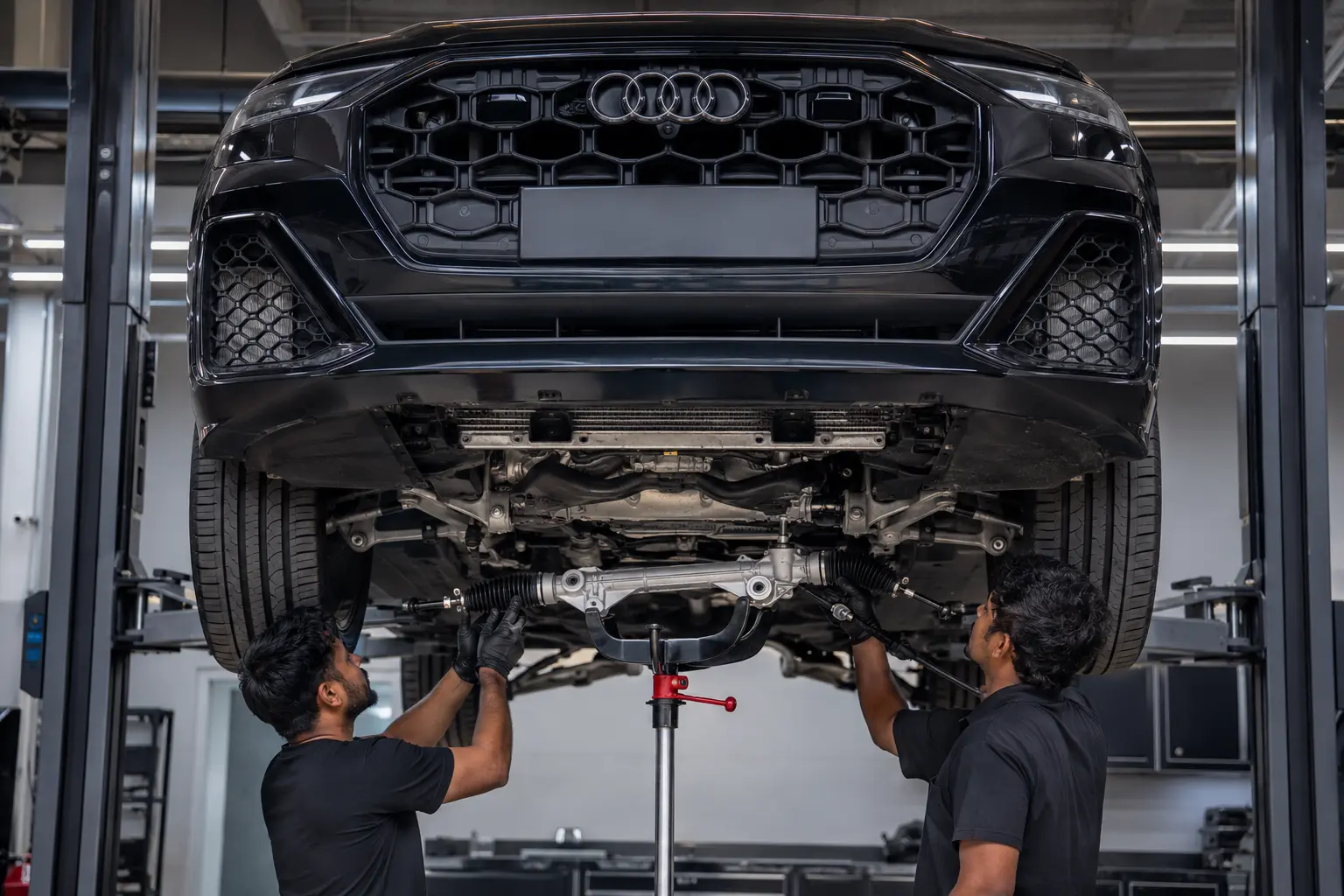
Mechanical centre, protected electronics and correct interfaces
Before removal, steering position and the connection to the column are controlled so the steering wheel and clock spring are not allowed to rotate independently. The front subframe or adjacent components may need support or repositioning depending on the Audi platform. Disturbed single-use fasteners, seals and hardware are identified in the estimate rather than quietly reused.
The replacement rack must match the vehicle’s system and specification. Transfer of tie rods, boots, heat shields, lines, brackets or electronics is based on the selected route, not assumption. Hydraulic connections are kept clean, seals are renewed as required and the circuit is filled with the specified fluid. Electric connectors are examined for pin damage and fully secured before power is restored.
Fasteners are tightened by the applicable sequence and condition. The rack’s mechanical centre is coordinated with the steering wheel and front wheels. This prevents a superficially straight wheel from hiding unequal tie-rod lengths, poor turning symmetry or a stressed clock spring.
The final three checks answer different questions
Coding or parameterisation establishes whether the installed electronic unit has the correct configuration for the vehicle. Not every repair changes a control unit, and not every rack can be commissioned by copying a generic value.
Basic settings and steering-angle data establish the controller’s known centre, end-stop or related reference where the model procedure requires it. If mechanical geometry is wrong, using software to declare a crooked position “centre” is not a repair.
Four-wheel alignment establishes toe, rear thrust and steering-wheel position after the rack or tie rods have been disturbed. It also provides a check against bent or displaced suspension parts that may have contributed to the original complaint.
The order matters: mechanically sound installation first, electronic commissioning where required, geometry and steering centre, then a road and fault-memory verification. Related advanced driver-assistance work is assessed from the model and repair procedure rather than automatically promised.
Our Audi diagnostics and alignment workflow keeps those questions connected while avoiding the claim that one calibration step solves every steering concern.
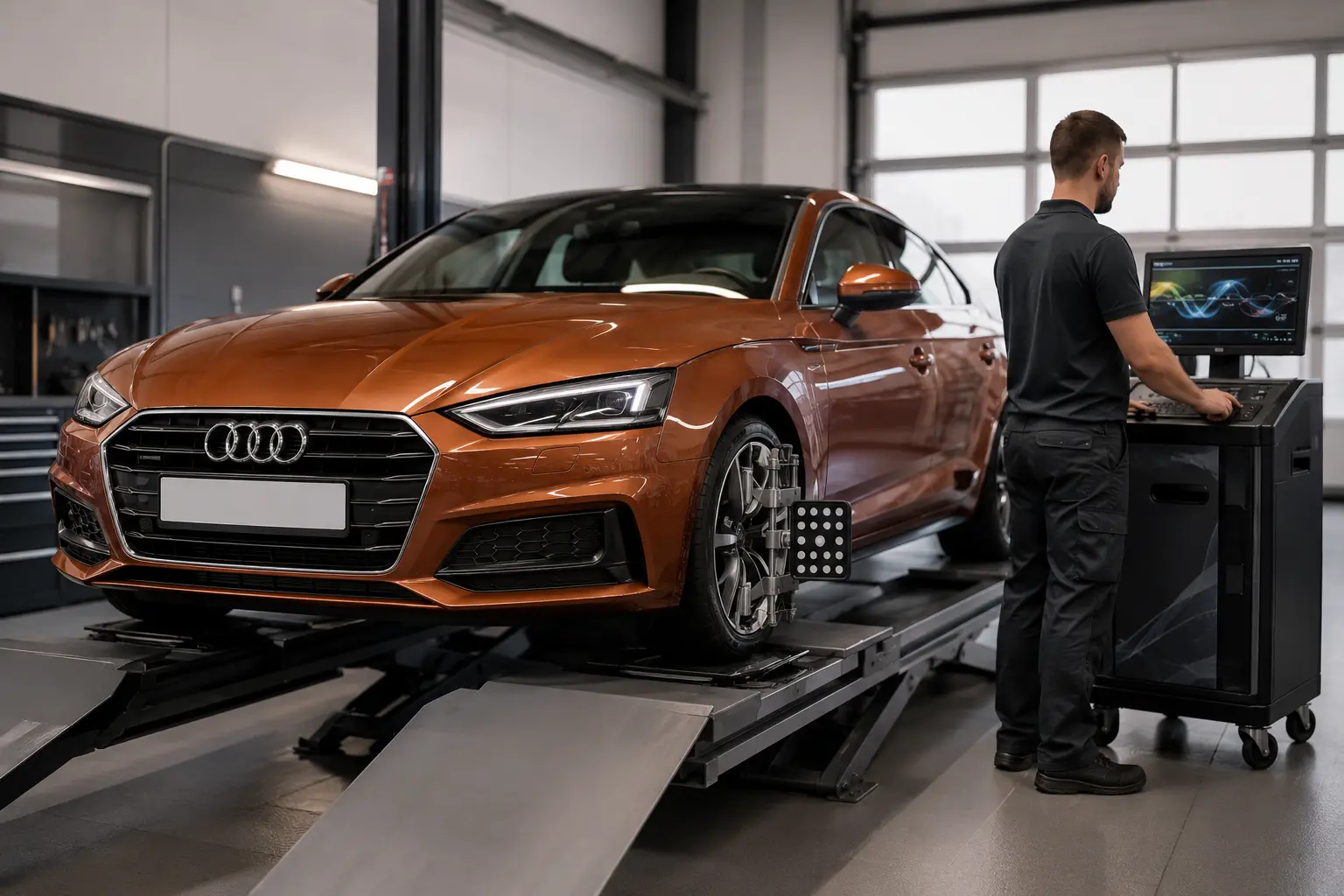
What the final verification should prove
No unresolved safety play
Steering input transfers through the column, rack, tie rods and hubs without unexplained looseness. Boots and fasteners are correctly positioned, and disturbed joints are secured.
Assistance is consistent
Hydraulic operation is free of abnormal aeration or confirmed leakage. Electric assistance has the expected warning state, data and supply behaviour for the completed repair.
Centre and geometry agree
The steering wheel, rack centre, front toe and rear thrust tell the same story. A final road check considers return-to-centre, noise, effort and the original customer concern.
A repaired steering rack is not judged by silence on the workshop floor alone. Heat, road load, steering direction and vehicle speed can reveal issues that a static check misses. The handover explains the route used, the relevant readings, any parts warranty supplied with the chosen unit, and any future observation that is genuinely required.
Describe how the steering fails before choosing a rack
A useful first message does not need a diagnosis. It needs the condition that reproduces the problem, the steering system if known, and anything that changed before the symptom started.
What does the wheel do?
Heavy assistance, free play, a knock, binding, poor return or a warning each sends the first inspection down a different branch.
When does it happen?
Parking speed, road speed, hot or cold operation, one steering direction or a specific warning colour can narrow the test route.
What happened before it?
Battery work, impact damage, suspension repair, alignment, fluid loss or previous rack work can change what should be checked first.
Audi steering rack repair FAQs
What are common signs of an Audi steering rack problem?
Possible signs include fluid collecting inside a rack boot, verified rack play, binding through part of the travel, inconsistent electric assistance or an internal rack fault supported by diagnostic tests. Similar symptoms can come from other steering, suspension, tyre or electrical components.
Can you diagnose a rack from a warning light alone?
No. The warning establishes that the steering system needs attention, but fault memory, voltage, power and ground, wiring, related data and mechanical condition determine whether the rack itself has failed.
Does heavy steering always mean the rack needs replacement?
No. Hydraulic cars may have low or aerated fluid, line restriction or pump trouble. Electric cars may have low voltage, supply, ground, wiring, data or motor-control issues. Mechanical binding can also come from the column or suspension.
Can a leaking Audi steering rack be resealed?
Sometimes. A component repair is reasonable only when the housing, bar and other internals remain suitable and the correct parts and test process are available. Scoring, corrosion or broader wear can make replacement more dependable.
What is the difference between rebuilt and tested original racks?
A rebuilt rack should have a defined refurbishment and test process. A tested original rack is a used factory unit assessed for reuse. Both require exact compatibility evidence, but their remaining-life and documentation profiles are different.
Is a new steering rack always the best choice?
A new unit offers the strongest unused baseline, but its cost may not be proportionate where a defined, supportable repair or documented rebuilt route is available. The fault, part support and vehicle context decide the recommendation.
Are tie rods included with a steering rack?
It depends on the supplied assembly. Some units include inner tie rods or boots and others do not. The quote identifies what is supplied, what can be transferred and which related wear items should be replaced.
Why is wheel alignment required after rack work?
Removing a rack or disturbing tie rods changes the front toe relationship. Four-wheel alignment restores toe against the rear thrust direction and centres the steering wheel after the mechanical installation.
Will an electric rack need coding?
It may need coding, parameterisation, steering-angle or end-stop basic settings depending on the Audi platform and part source. The exact requirement is verified from the vehicle and repair procedure rather than assumed.
Can a weak battery cause an Audi steering warning?
Yes. Electric steering is a high-current system, and low voltage or poor supply integrity can trigger warnings or reduced assistance. Battery and charging condition are checked before an expensive control assembly is condemned.
How long does steering rack repair take?
Diagnosis may be completed in the first visit, while repair time depends on parts identification, component repair or replacement route, subframe access and required commissioning. The workshop confirms timing once the scope and part availability are known.
Is it safe to drive with steering rack play or a leak?
It should be inspected promptly. Sudden major assistance loss, severe leakage, binding, visible loose joints or unpredictable steering should not be treated as a routine drive-in concern; arrange safe transport or direct workshop advice.
What warranty applies to the repaired or replacement rack?
Warranty depends on whether the route uses a component repair, rebuilt, tested original or new unit and on the supplier terms. The applicable coverage and exclusions should be stated with the approved quote.
How much does Audi steering rack repair cost in Dubai?
Diagnosis commonly starts around AED 250–560 before VAT. A viable hydraulic repair with removal, refit, fluid and alignment can run into several thousand dirhams, while electric or new-unit routes can cost more. An exact quote requires the vehicle and fault evidence.
Can alignment fix steering play?
No. Alignment sets wheel angles; it cannot remove looseness in the rack, tie rods, column, wheel bearings or suspension joints. Mechanical play is repaired before final geometry is set.
Approve a steering solution built around evidence
Bring the warning history, leak location, recent impact or repair details. We will separate the rack from its lookalikes and quote the complete repair route.