
An Audi steering system fault can mean steering assistance, steering-angle information, the steering lock or an optional rear-steering function is not working correctly. Read the complete dashboard message before moving. If it is red, tells you to stop, or the wheel has become unusually heavy, inconsistent or difficult to control, stop safely and arrange recovery.
A yellow warning with normal steering may allow a careful trip for diagnosis when the exact message and owner’s manual permit it. The warning does not prove the steering rack has failed.
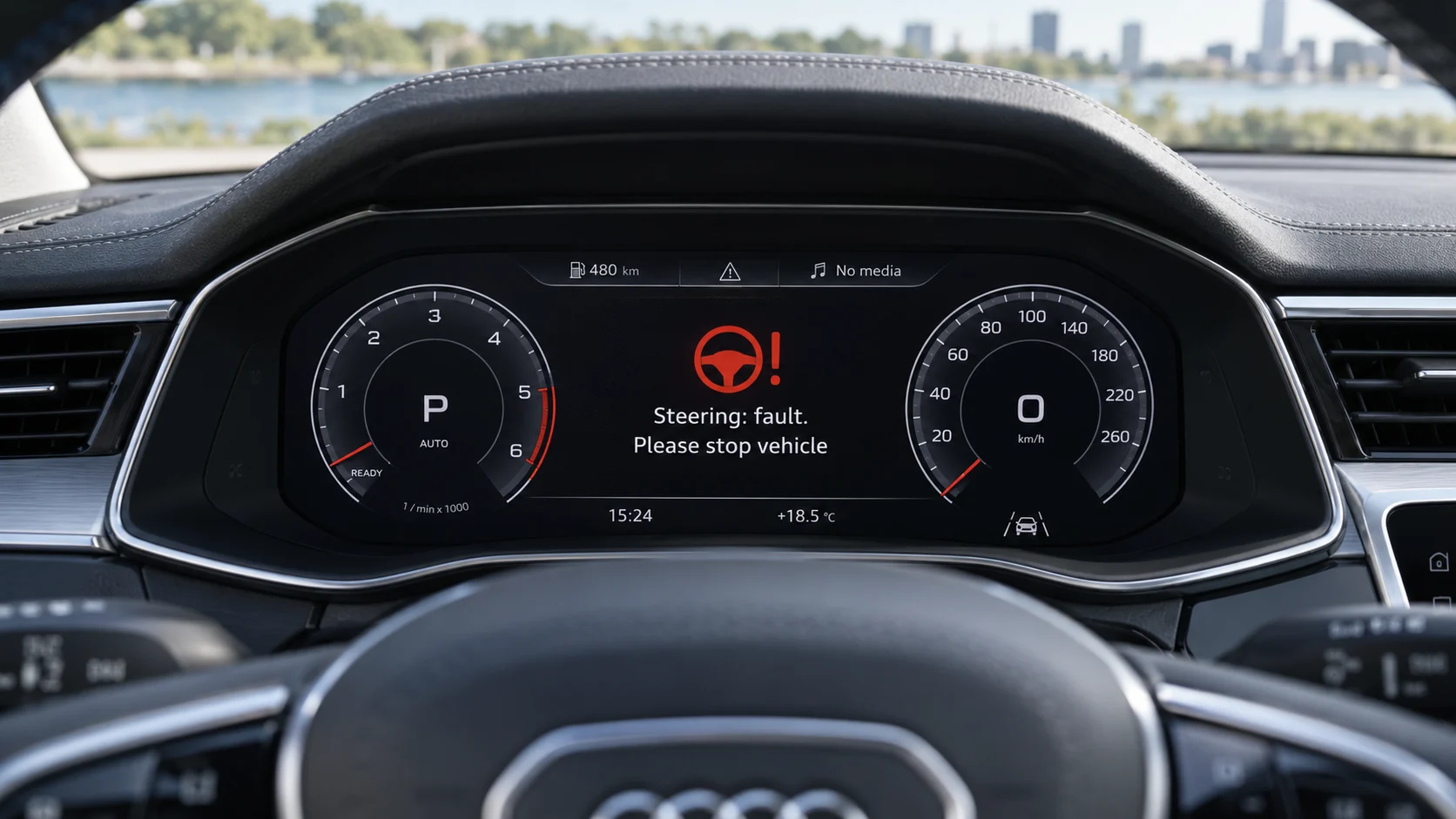
Can you drive with an Audi steering system fault
The full dashboard instruction is more useful than the symbol by itself. Audi uses different messages for different systems and fault levels. Check the instruction for your exact vehicle through the Audi owner’s manual portal.
Stop and arrange recovery
Stop if the message tells you to stop, assistance has disappeared, the wheel binds or changes effort unexpectedly, or you cannot steer the car accurately. The same applies after a kerb or road impact when the wheel position, tyre clearance or handling has changed.
Tell the recovery operator about the steering fault. If steering is restricted, the vehicle needs a loading method that does not depend on driving it onto the transporter.
A careful workshop trip may be permitted
Some yellow warnings state that driving may continue. Only consider this when the exact message permits it, steering effort remains predictable and there is no impact damage, tyre rubbing or other red warning.
Drive directly for diagnosis and follow any displayed restriction. If the steering changes while moving, stop safely.
Which steering system is reporting the fault
“Steering system fault” is broader than “steering rack fault.” The vehicle may be reporting a problem with electromechanical power assistance, steering-angle sensing, a control module, wiring, calibration, the steering-column lock or an optional dynamic or all-wheel steering system. The fitted equipment must be identified from the VIN before the fault is interpreted.
On many modern Audis, an electric motor adds steering assistance. Mechanical steering remains, but effort can rise sharply when assistance is unavailable. Other systems use steering-angle and torque information for stability control, driver assistance and headlight functions, so one steering-related fault can be accompanied by several secondary warnings.
Do not approve a steering rack from the dashboard message alone. Low system voltage, damaged wiring, a disturbed sensor or missing calibration can create steering warnings without an internal rack failure.
What the steering feels like matters

What can trigger the steering warning
Voltage and power supply
Electric steering requires a stable power supply. A weak 12-volt battery, charging fault, high-resistance connection, fuse or earth problem can reduce assistance or store undervoltage faults. Test the supply under the conditions in which the warning occurs. Replacing the battery and clearing codes is not enough when the charging or connection problem remains.
Wiring and communication
Connectors, harness damage, water entry and network communication faults can interrupt steering data or power. If several control systems report faults together, the technician should compare their timestamps and voltage history instead of treating every warning as a separate failed module.
Steering-angle or torque information
The control system needs plausible information about wheel position and driver input. A sensor, damaged connector, incorrect basic setting or mechanical alignment problem can make the values disagree. Live readings should be compared with the car’s actual position.
Steering gear and assistance motor
An internal motor, control unit or mechanical gear fault is possible. It should be supported by fault data, power and earth tests, communication checks and a physical inspection. Noise, play and binding also need their own mechanical evidence.
Dynamic or rear steering
Some Audi specifications add variable-ratio or rear-axle steering. A warning may be specific to that option while basic front steering still operates. The message, VIN and control-module scan separate this route from a general power-assistance fault.
What to record before the car reaches the workshop
- Photograph the complete warning while safely parked, including its colour and any driving instruction.
- Note whether the wheel became heavy, notchy, off-centre or slow to return.
- Record when it happened, such as during startup, parking, a U-turn, after an impact or after recent battery, alignment or suspension work.
- List other warnings that appeared at the same time. ABS, stability-control, lane-assistance or electrical messages can help reconstruct the event.
- Do not disconnect the battery or clear the fault memory before inspection. That can remove useful history without changing the cause.
How the fault should be diagnosed
- Identify the exact system and preserve the event. Confirm the VIN and fitted steering equipment. Read the steering, electrical and related chassis modules before clearing faults. Freeze-frame, voltage and communication information can change the test order.
- Check battery voltage and the high-current path. Measure the battery, charging system, steering supply, earth path and relevant protection under load. An unloaded voltage reading can miss resistance that appears only when assistance is requested.
- Compare requested and actual values. Steering angle, torque input, assistance request and module communication should agree with the physical position and driver input. Implausible data directs the inspection toward a sensor, setup or wiring route.
- Inspect mechanical movement. Check tyres, wheels, suspension, steering joints and the rack for impact damage, play, binding or water entry. Mechanical resistance can overload an otherwise functioning assistance system.
- Verify setup only after the cause is corrected. Carry out steering limits, angle calibration, alignment or driver-assistance calibration where the vehicle procedure requires them. Clear faults, recheck values and road-test only when safe.

What to expect after a low-voltage steering fault
A weak or recently disconnected battery can leave more than one steering-related fault in memory. The useful next step is not to assume the steering rack has failed. First confirm battery condition, charging voltage and the main power and earth paths under load. The steering module can then be scanned together with the gateway, ABS and other related systems so the timing of each fault is clear.
After stable voltage is restored, some Audi models require a defined steering-angle or end-stop learning procedure. That procedure is vehicle-specific and should only be performed after mechanical movement, tyre condition and wheel alignment have been checked. Clearing the warning before those checks can hide whether the fault returns during the same manoeuvre.
A successful result means the warning stays off through repeated starts and controlled steering movement, assistance remains even and the stored values agree with the wheel position. If the message returns, the recorded conditions help separate a supply problem from a sensor, wiring, calibration or mechanical steering fault.
Repair decisions and cost
Use these prices to plan the first check and likely repair budget. The diagnostic fee covers the agreed checks; replacement parts and additional testing are itemised before work begins.
| Work | Price | Scope |
|---|---|---|
| Electric steering diagnosis | From AED 200 | Initial fault assessment; required calibration is confirmed for the vehicle. |
| Wheel alignment | From AED 270 | When geometry needs correction; damaged parts and additional calibration are separate. |
| Steering rack repair labour | From AED 600 | For a repairable rack; parts, removal scope and electronic setup affect the total. |
Prices exclude 5% VAT. Repair ranges depend on the model, fitted system and parts selected; specialist assemblies can fall outside these ranges. The written estimate confirms the total and what is included.
Will you need to leave the car?
A visible connection fault, wheel-position issue or a warning that remains active may be assessed during your visit. Intermittent loss of assistance, mechanical binding or a fault that appears only when warm may require leaving the car for further checks. Alignment and calibration are planned after the underlying fault is understood.
There is no reliable single price for a steering-system warning. A poor earth connection, a damaged sensor linkage, a calibration problem and an internal steering-gear fault require different labour and parts. The estimate should follow the confirmed cause.
Before approval, ask the workshop to state the fault found, the test that confirmed it, the part number and parts tier, required alignment or calibration, VAT treatment and written warranty. A rack replacement should also explain whether the control electronics are included and what setup is required after installation.
The Audi steering rack repair page covers repair and replacement choices when the rack itself is confirmed faulty. If wheel geometry or impact damage is involved, see Audi wheel alignment. A car that cannot be steered safely should use Audi roadside assistance.

How to confirm the steering repair worked
The original fault stays cleared
Recheck all affected modules after the same start, manoeuvre or operating condition that produced the warning.
Steering effort is consistent
Assistance should be predictable from parking speed through normal driving, with no binding, unexpected change or abnormal noise.
Geometry and values agree
The wheel should be centred, the car should track correctly and live steering values should match the physical position.
Common questions about Audi steering faults
Can a weak battery cause an Audi steering warning
Yes, low or unstable voltage can affect electric steering and store related faults. The battery, charging system and steering supply still need testing because an undervoltage code does not identify why voltage fell.
Will turning the steering wheel from lock to lock reset it
Some vehicle procedures include teaching steering limits, but that is not a general repair for a red warning, heavy steering or a mechanical fault. Follow the procedure for the exact Audi only after the cause has been checked.
Does the warning mean the steering rack is faulty
No. The rack is one possible source. Battery voltage, power connections, wiring, sensors, calibration, steering-column parts and optional rear-steering equipment can produce related warnings.
Can wheel alignment switch off the warning
Alignment can be part of the correction when geometry is wrong, but it cannot repair failed assistance or damaged wiring. Mechanical alignment comes before any required steering-angle calibration.
What if the warning disappears after restart
Keep the photograph and arrange diagnosis if it returns. Intermittent faults can leave stored evidence. A restart may clear the active message without correcting the underlying condition.
Send the steering warning before moving the car
Send your Audi model, year, dashboard photo and a short description of how the wheel feels. Our Al Quoz 4 workshop can tell you whether to arrange recovery or book a diagnostic inspection.
Author profile: Abu Hashim, Audi specialist in Dubai.