
Audi climate control in Dubai
Audi AC Repair in Dubai
Audi AC repair in Dubai is a diagnostic and repair service for weak cooling, poor airflow, unusual noise or inconsistent vent temperature. Leaks, compressor control, condenser performance, fans, sensors and actuators can each change cabin cooling, so the system is tested before refrigerant or parts are recommended.
We compare the symptom with vent temperature, airflow, pressure behaviour and relevant fault evidence before recommending an AC repair or replacement route. If testing confirms low refrigerant and a suitable recharge path, continue to Audi AC regas rather than treating every cooling complaint as a refill.
A booking request is confirmed only when the workshop replies. Active overheating, smoke, severe belt noise, a burning smell or an electrical concern needs a safety conversation before routine AC booking.

Purpose-created realistic workshop visual
Editable WhatsApp intake
Build a useful AC brief
The first message should help the workshop choose the right conversation and test setup. Enter only what you know. You can edit the generated text before WhatsApp opens, and nothing is sent automatically.
Safety before comfort
Stop for heat, fumes or belt noise
Routine weak cooling is different from a condition that may affect the engine, belt drive, electrical system or people around the vehicle. If you are unsure, stop treating it as a comfort-only complaint and call.
Immediate danger comes first. If there is fire, smoke, a strong burning smell, rapid coolant loss, unsafe engine temperature or a traffic hazard, stop when safe, keep people away and contact emergency services where necessary.
- Engine temperature rises
Do not keep the AC running to reproduce the symptom. Stop when safe, switch off as appropriate and describe the warning, gauge behaviour and any coolant loss.
- Severe belt noise
A sharp, heavy or continuous belt-driven noise can involve more than cabin cooling. Switch the system off and ask whether the vehicle should be driven.
- Burning or electrical smell
Turn the affected function off. Smoke, heat, melted insulation or repeated fuse failure needs an electrical safety route, not another attempt to operate the climate controls.
- Water inside the cabin
Small condensate discharge under the car can be normal, but liquid inside the cabin needs its source confirmed. Keep it away from electrical components and do not assume it is clean water.
- Weak cooling only
If engine temperature, belt operation, electrical behaviour and vehicle control remain normal, record the exact cooling and airflow symptoms for diagnosis rather than repeatedly topping up refrigerant.
Initial workshop sequence
Test before replacing parts
A useful AC diagnosis connects the customer’s complaint to measurements made under known conditions. The exact order can change with the vehicle and symptom, but the decision should not begin with a parts guess.
Pressure readings or vent temperature without ambient conditions, control settings and vehicle information can be misleading. The technician needs to know what the system was commanded to do and what actually happened.
- Record the conditions
Confirm the Audi model, year, engine or powertrain, recent AC work, outside conditions, control settings and when the symptom appears.
- Measure vent output
Check vent temperature and airflow rather than relying only on whether the air feels cool. Record which vents and zones are being compared.
- Check airflow delivery
Inspect cabin-filter restriction, blower response, vent operation and distribution. Strong warm airflow and weak airflow are different test paths.
- Scan where indicated
Read relevant climate, engine, thermal-management or body-control modules when the symptom or warning supports it. A stored code is a clue, not a component verdict.
- Observe compressor command
Compare the requested operation with actual compressor, control-valve or clutch behaviour where the exact system uses those components.
- Measure both pressure sides
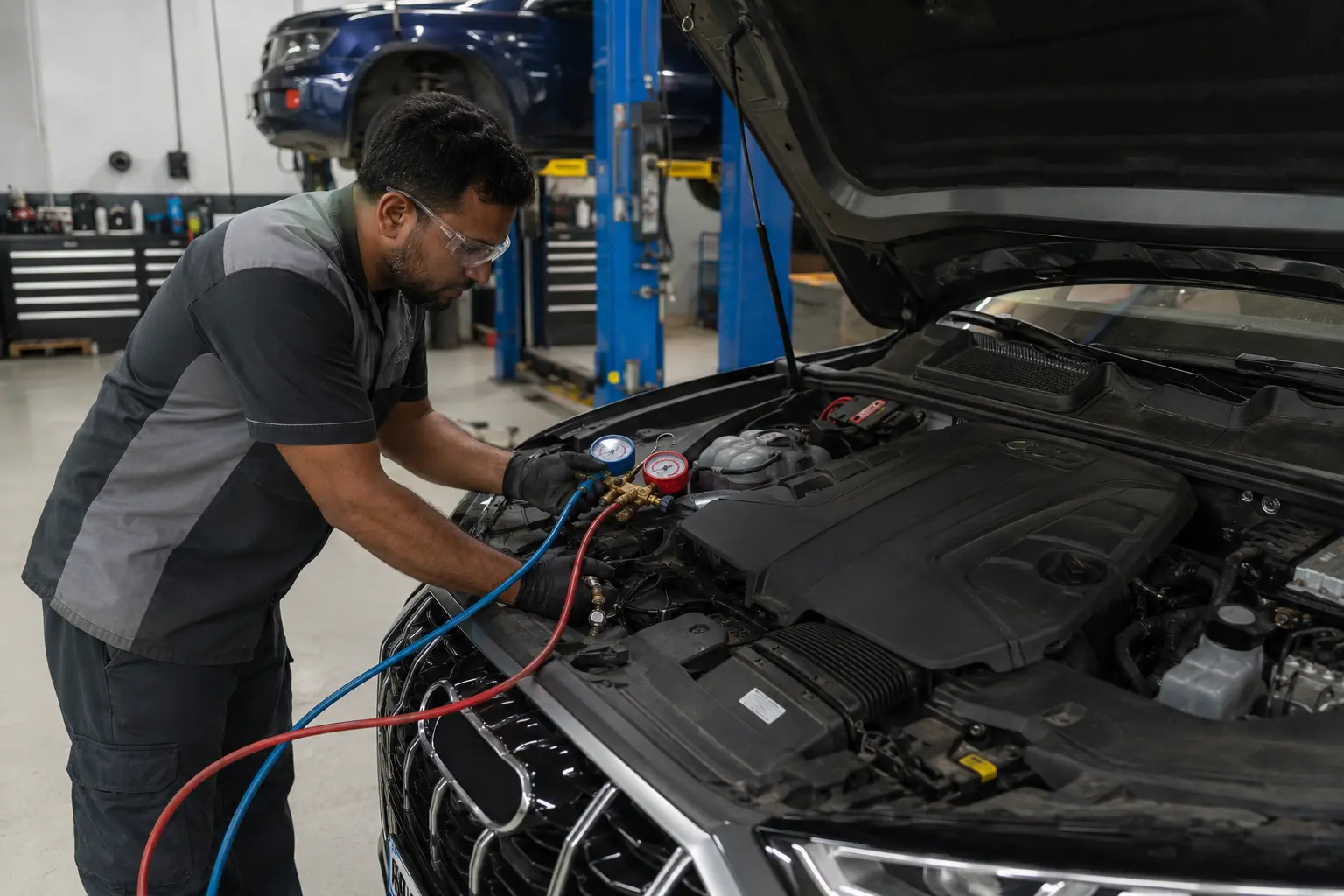
Use the correct equipment and interpret low-side and high-side behaviour against the exact vehicle, refrigerant, ambient conditions and operating state.
- Check heat rejection
Inspect condenser airflow, cooling-fan operation and visible obstruction or damage. Road speed and idle can create different airflow conditions.
- Trace leakage responsibly
Select a leak-test route suitable for the suspected area and system condition. A low charge alone does not identify the leak location.
- Agree the repair route
Only after the evidence is bounded should the estimate define repair, replacement, access, parts identity, fluids, related work and closing checks.
No universal pressure or vent-temperature target is published here. The expected result depends on vehicle data, refrigerant, ambient temperature, humidity, control settings, engine speed, fan operation and the test procedure approved for that Audi.
AC circuit decisions
Follow heat through the system
Cabin cooling depends on the refrigerant circuit moving heat, the condenser rejecting it, the evaporator absorbing it, and air being moved through the right path. Control electronics decide when and how several of those actions occur.
The component names are useful only when the workshop can connect them to a measured condition. A warm vent does not identify which stage failed.
Compressor route
Command, load, pressure change, noise, control-valve behaviour and internal condition need separating.
Condenser route
Airflow, fan operation, external damage, sealing and internal cleanliness affect the decision.
Expansion route
The applicable valve or orifice device controls flow and can influence pressure and evaporator behaviour.
Evaporator route
Leakage, temperature sensing, icing, drain condition and access requirements can differ by model.
Cabin route
Filter, blower, controller, ducts, flaps, actuators and zone commands determine what reaches each vent.
Refrigerant, engine or thermal-management coolant and cabin air follow different circuits. They can influence one another through control decisions and heat exchangers on some vehicles, but they are not interchangeable fluids and they do not share one universal layout across all Audi models.
Measured condition, not cause
Low refrigerant needs a reason
Customers often call refrigerant AC gas. A measured low charge can explain poor performance, but it does not show why the system became low or where material escaped.
Possible leak locations include service ports, hoses, pipe joints, seals, the condenser, compressor, evaporator and other model-specific connections. The list is a test map, not a claim that every Audi shares the same failure.
What evidence can show
Visible oil or dye evidence may guide attention, but it must be interpreted in context. Electronic detection can help locate escaping refrigerant when the conditions are suitable. Controlled pressure testing with an approved inert medium can help test a circuit when the exact procedure permits it.
Each method has limits. Dye can remain from previous work, electronic tools can react to contamination or poor access, and pressure testing still requires safe procedure, isolation and time. The estimate should name the method actually selected rather than implying that one quick check proves the whole circuit.
What topping up cannot do
Adding refrigerant may temporarily change cooling, but it does not seal a known leak, repair a damaged component or remove contamination. It can also make later diagnosis harder if the original charge state and service history are not recorded.
A responsible route records the recovered quantity where the equipment provides it, checks the suspected leak path, identifies the correct refrigerant and explains whether the next step is testing, repair or a controlled recharge. A top-up is not presented as a completed repair when leakage is known.
Leak location matters
Test the accessible path first
An electronic leak detector can help trace refrigerant at accessible joints, pipework and condenser connections. The technician controls airflow around the probe, approaches the suspected area slowly and repeats the check before treating one response as a confirmed location.
An evaporator can require a different route because the core is enclosed. Drain-tube sampling, instrument-panel vent checks, pressure decay, dye history and model-specific access may contribute, but none should be presented as automatic proof on its own.
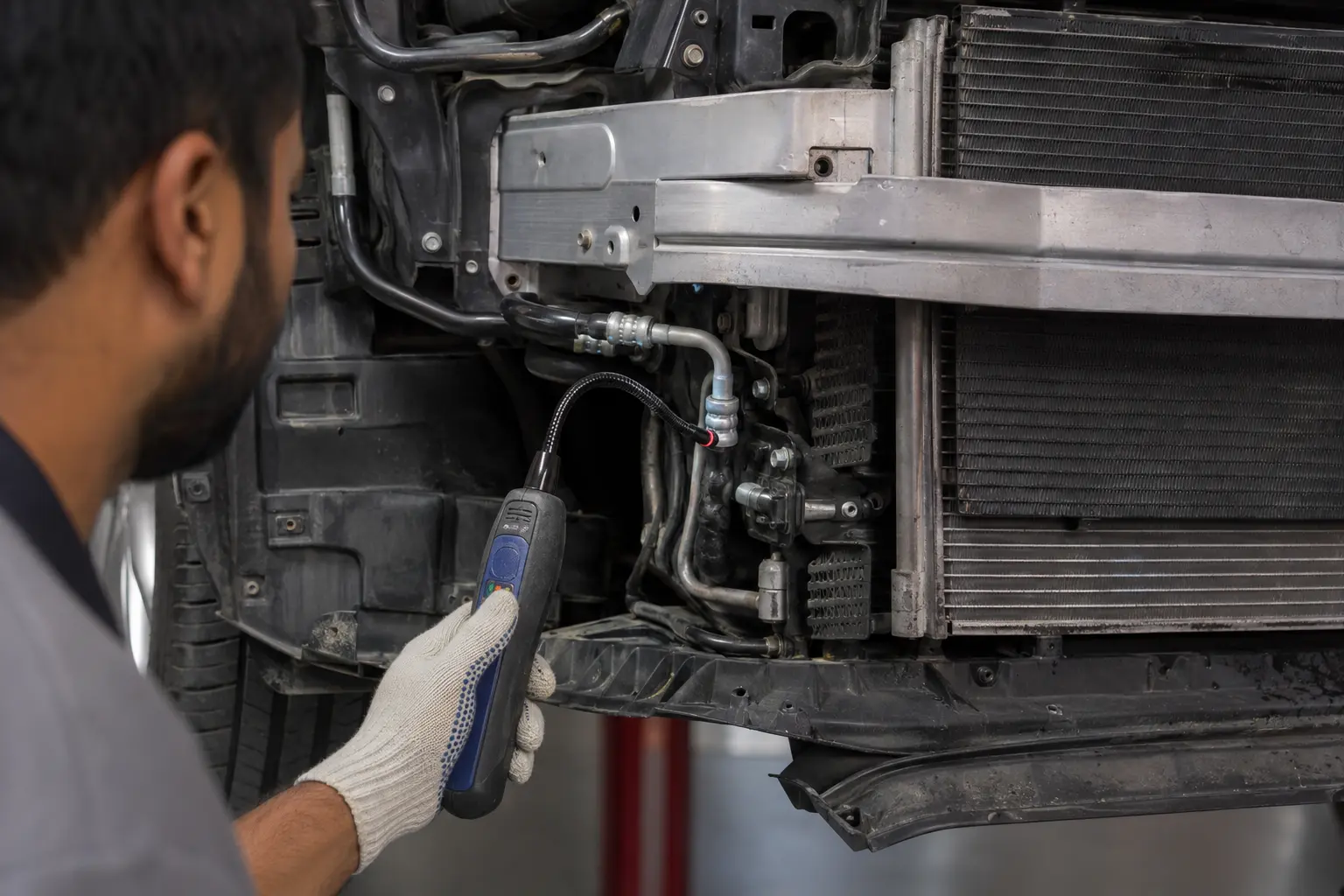
Correct AC service
Charge by identity and weight
The vehicle label and applicable repair information control the refrigerant type and specified quantity. R134a and R1234yf are examples of different refrigerant systems and must never be treated as interchangeable.
Pressure is part of diagnosis, but it is not a substitute for identifying the system and charging by the specified weight.
Before charging
- Confirm the exact vehicle and refrigerant label.
- Record recent service, repairs and known leakage.
- Recover the existing refrigerant through suitable equipment.
- Assess whether leak testing or repair must happen first.
- Confirm the correct compressor-oil type and whether any controlled addition is actually required.
After charging
- Charge the confirmed refrigerant by the specified weight.
- Do not guess oil quantity or add oil automatically.
- Observe pressure behaviour, vent output and fan operation under recorded conditions.
- Recheck the repaired area and any accessible joints as the chosen procedure requires.
- Record what was recovered, added, replaced and tested on the job documentation.
No universal gas quantity is quoted on this page. Refrigerant identity, charge weight, compatible oil and controlled oil quantity are vehicle-specific decisions. The written estimate should identify them before the work is approved.
Controlled service route
Recover before recharging
A service station is used to recover and manage refrigerant rather than release it. The recovered amount and machine record can support the diagnosis, but the number still needs context because earlier work, leakage and incomplete charging can affect what is found.
Evacuation helps remove air and moisture and provides one bounded test of system integrity. It is not a substitute for every leak-test method. After a repair, the correct refrigerant is charged by the vehicle-specified weight and performance is rechecked under recorded conditions.
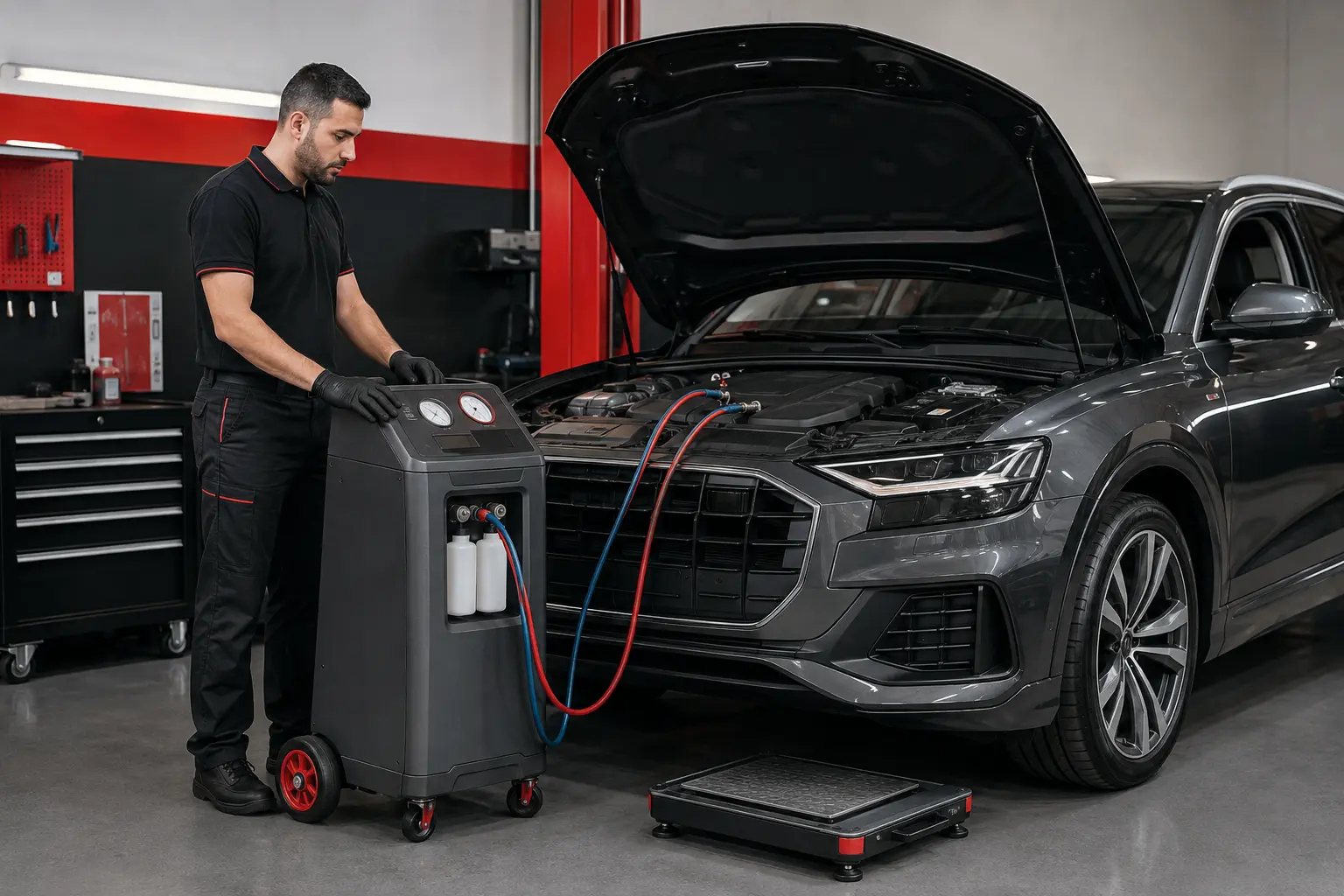
Condenser replacement policy
Only new condensers
Audi Specialist Dubai does not install used AC condensers. If diagnosis confirms that replacement is required, the offered route is a suitable new quality aftermarket unit or a new Audi Genuine unit, subject to exact fitment and current supplier availability.
The condenser sits in the front cooling pack where air must move across it. External impact, blocked airflow, fan behaviour, sealing and internal contamination can all influence the repair decision. That does not mean every weak-cooling complaint needs a condenser.
Fitment before price
Confirm the complete route
The written estimate should name the actual condenser brand and part number, not just say aftermarket. If Audi Genuine supply is selected, the estimate should confirm VIN fitment and availability. A supplier-manufacturer brand remains part of the new aftermarket route and does not become a vague extra quality tier.
Front-end access can vary considerably. The estimate must say whether it includes refrigerant recovery and recharge, new seals, receiver-drier work where applicable, pressure or leak testing and a cooling-fan check. If dismantling reveals impact damage or contamination beyond the original view, the workshop should pause and explain the changed scope before proceeding.
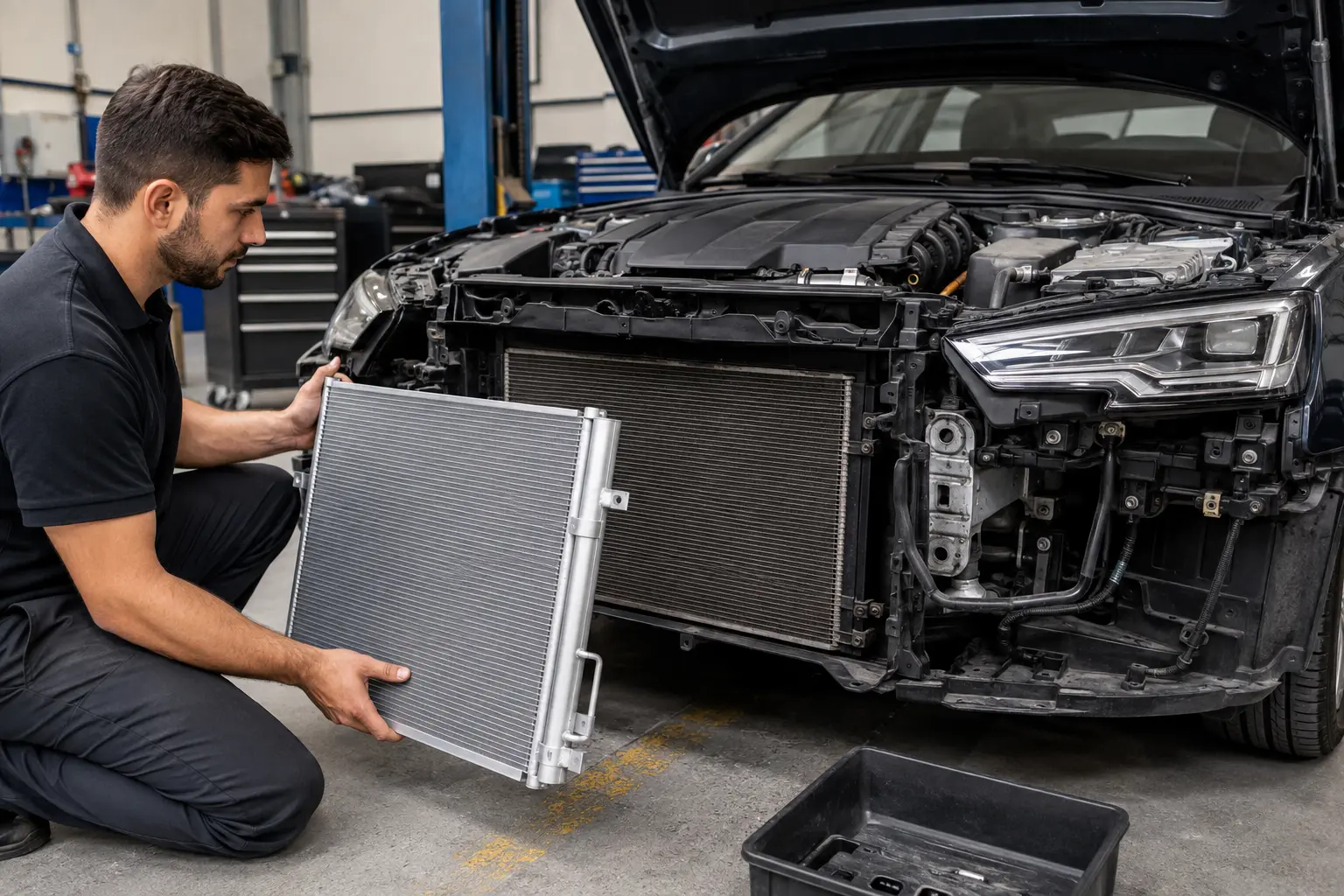
| Condenser route | Offered | What the estimate must explain |
|---|---|---|
| Used condenser | No | The workshop does not install used condensers. No used, repaired or unverified condenser is presented as a budget option. |
| New quality aftermarket | Where verified | Name the actual manufacturer brand, exact part number, fitment evidence, included seals, fitting scope and written supplier warranty. |
| Audi Genuine | Where available | Confirm Audi part number, VIN fitment, supply status, included work and the exact written warranty terms. |
A lower component price is not responsible if the sealing, internal cleanliness, external condition or fitment cannot be supported. The customer should compare complete fitted routes, not an isolated part price.
Compressor repair choices
Compare the fitted route
A compressor choice is not simply used versus new. Exact identity, system condition, contamination risk, control compatibility, related work, supplier support and repeat-labour exposure determine whether a route is responsible.
A pressure reading, noise or fault code does not automatically prove internal compressor failure. Command, control-valve operation, electrical supply, belt drive, refrigerant state and heat rejection may need to be separated first.
| Compressor route | Suitable when | Evidence required | Main trade-off | Quote requirement |
|---|---|---|---|---|
| Used original compressor | An exact compatible unit is available, its condition can be assessed and the vehicle system remains suitable for the route. | Exact part number, source, visible condition, sealed ports, supplier test or return evidence and workshop inspection. | Lowest typical purchase cost, but unknown service history and more limited warranty or return terms. | State used condition, supplier, related work, exclusions and exact written warranty. |
| New aftermarket | A verified independent brand has the exact application and sensible supplier support. | Named brand, exact fitment, specification and supplier terms. | Lower new-part cost, with quality and support varying by manufacturer. | Name the brand and part reference. Never quote only aftermarket. |
| New OE-supplier | The supplier-branded part is verified for the exact application. | Manufacturer, part reference, fitment evidence and supplier warranty. | May balance new condition, known manufacturer identity and cost. | Identify the actual manufacturer and do not call it Audi Genuine. |
| Audi Genuine | The customer selects Audi-branded supply or the exact application requires it. | Audi part number, VIN fitment and supplier evidence. | Highest typical purchase cost with model-specific availability. | State supply status, included work and written terms. |
Condition is not equivalence
Used can be eligible
A used original compressor may be a sensible lower-cost route when the exact compatible unit is available and passes the eligibility checks. It is not represented as equivalent to new, and matching one visible number is not enough to prove internal condition or electronic compatibility.
Before installation, the workshop can assess identity, external condition, port storage, signs of leakage, connector condition, pulley or shaft behaviour where applicable, supplier evidence and return terms. A visual inspection cannot fully prove the condition of internal surfaces, valves, bearings or an electronically controlled unit under operating load.
The customer should see the cost of the complete route. Saving on the unit can be outweighed by repeated refrigerant recovery, access and fitting labour if an uncertain component fails or proves incompatible.
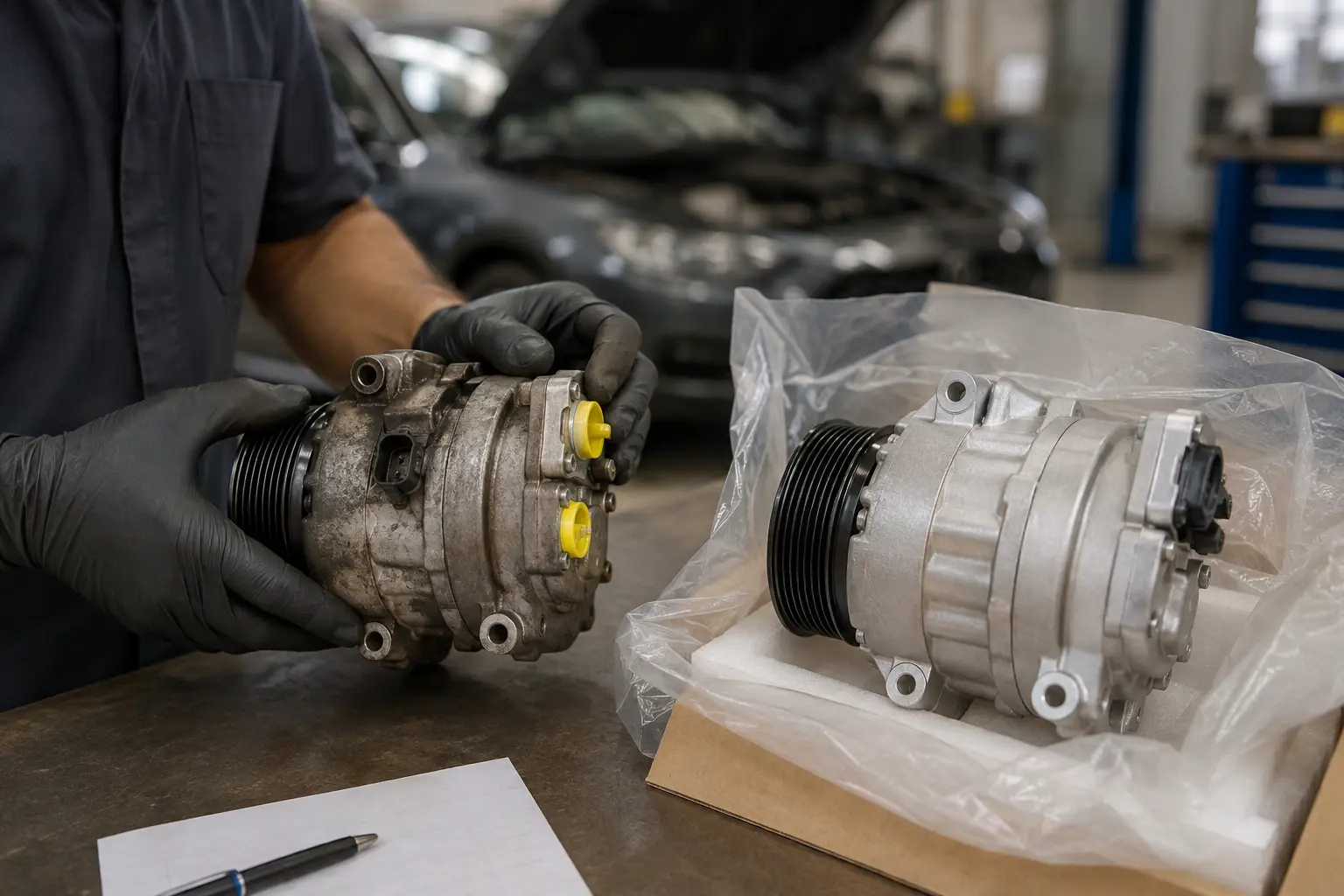
Used-unit gate
Pause when evidence is weak
A used route should be rejected or paused if the workshop cannot bound contamination, identity, compatibility, storage or supplier support. The decision protects the rest of the refrigerant circuit and avoids presenting a cheap unit as a complete repair.
- The exact compressor identity or control compatibility cannot be confirmed.
- Ports were left open, storage history is uncertain or internal contamination is suspected.
- The previous compressor failed internally and debris may remain in the circuit.
- The system cannot be cleaned to the required standard or flushing is unsuitable.
- The unit shows damage, leakage, abnormal movement or electrical concerns.
- Supplier return or warranty terms do not support a responsible fitted repair.
Related work is diagnosis-led. The quote must say whether recovery, evacuation, technically suitable flushing, receiver-drier or accumulator work, the expansion device, correct oil, seals, refrigerant by weight, leak testing, pressure checks, scans, basic settings and road-condition rechecks are included. Those items are not added automatically to every compressor job.
Air delivery diagnosis
Separate flow from cooling
Weak airflow and strong airflow that is not cold are different complaints. The first points toward the cabin-air path and blower control. The second keeps refrigerant, compressor and heat-exchange checks more prominent.
Both can exist together, so the workshop records vent strength at more than one setting and compares the requested distribution with what each vent actually delivers.
Restriction and control checks
A heavily restricted cabin filter can reduce air volume, but replacement is not a complete diagnosis when the blower stops, speeds change unpredictably or one outlet remains different. Blower motors, electronic controllers or resistors, power supply, earth paths, ducts, distribution flaps and actuators can each affect delivery.
Noise location matters. A leaf or damaged fan wheel can sound different from an actuator cycling behind the dashboard. The technician should reproduce the noise at controlled blower and temperature settings before deciding which area to access.
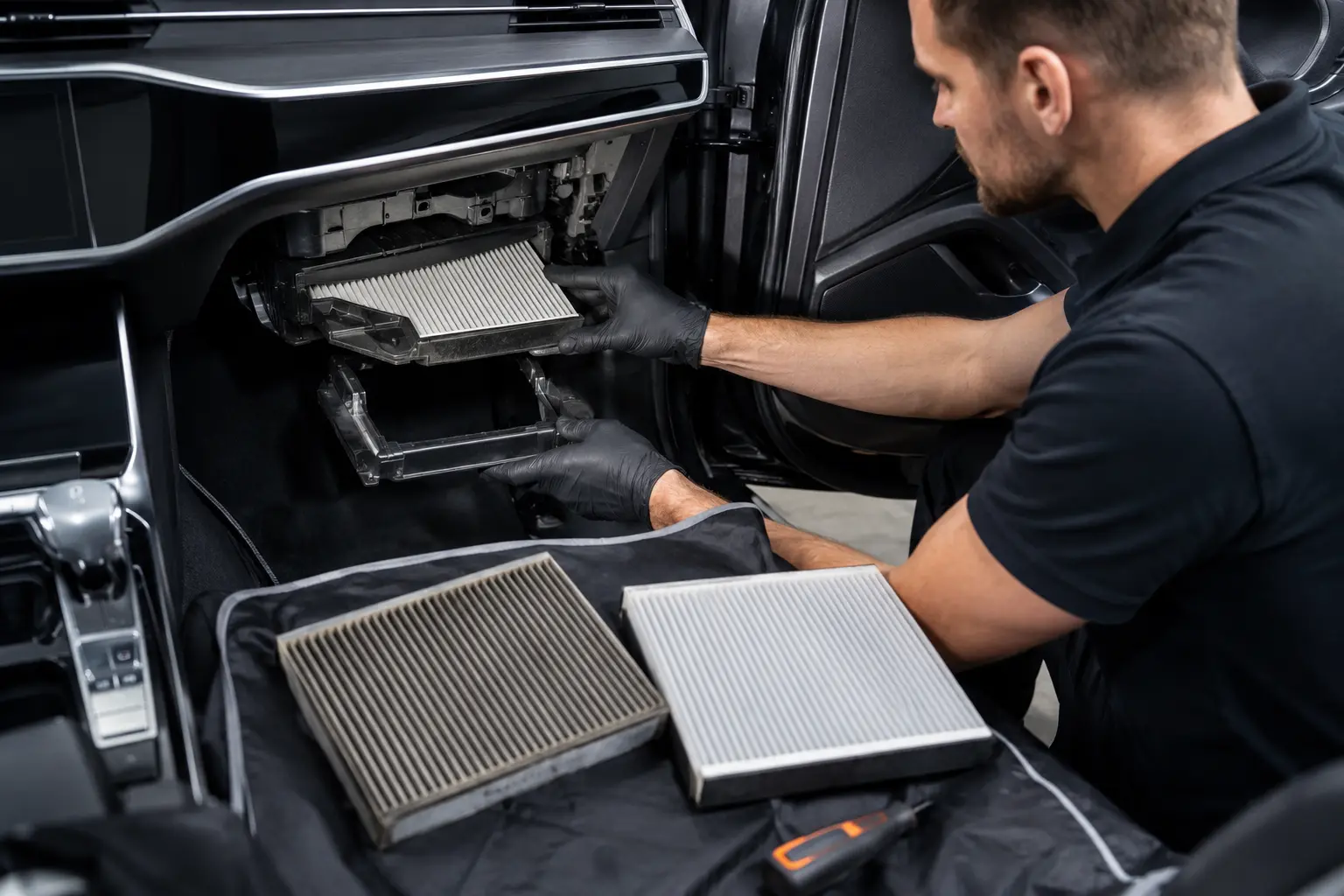
Confirm the correct element, installation direction, housing seal and whether debris has entered the blower area.
Compare requested speed with actual operation, noise, current behaviour and controller response where testing supports it.
Check face, footwell, windscreen and rear delivery rather than assuming every flap follows the displayed command.
Compare temperatures only after control settings, airflow and sensor inputs are made consistent across the cabin.
Hidden components
Confirm access before removal
The evaporator, temperature sensors, expansion control and several air-distribution components may sit behind substantial trim or dashboard structure. Labour should follow a confirmed fault and verified component location, not a guess based on poor cooling alone.
Evaporator leakage
An enclosed evaporator can be difficult to inspect directly. Detector response, drain evidence, pressure behaviour and previous dye history may help, but the method and limitations should be recorded before dashboard access is quoted.
Temperature sensing
An evaporator or outlet sensor that reports an implausible value can change compressor or flap control. The reading should be compared with actual conditions and circuit checks before replacement.
Expansion control
A metering device can influence pressure and evaporator behaviour. Diagnosis must account for refrigerant quantity, contamination, temperature and compressor performance before blaming the valve.
Dashboard access
The quote should state which panels or major assemblies need removal, what becomes visible after access and how newly discovered damage or brittle trim will be handled.
Drain and moisture
Water inside the cabin can involve a blocked or displaced drain, sealing or another liquid source. Confirm the liquid and route before treating it as normal condensate.
Closing assembly checks
After access, confirm vent distribution, actuator operation, trim fit, electrical functions and unwanted noises as well as the cooling complaint.
Electrical climate control
A code starts a test
Climate-control systems combine sensors, pressure signals, valves, fans, relays, wiring, actuators and control modules. A scan can reveal what the vehicle recorded or commanded, but the code description does not prove that the named component is faulty.
When the primary problem becomes a wider power-supply, network, wiring or module concern, the deeper repair belongs to a dedicated electrical diagnosis rather than being hidden inside an AC recharge.
What the scan can support
- Stored, intermittent and current fault information.
- Requested compressor, fan, valve or flap operation.
- Sensor values that can be compared with measured conditions.
- Basic settings or actuator tests where applicable.
- Communication status between relevant modules.
A result should be reproduced or electrically tested where practical. For a broader vehicle scan route, see Audi diagnostics in Dubai.
What still needs testing
- Power, earth, signal and voltage-drop behaviour under load.
- Connector condition, corrosion, heat damage and previous repair quality.
- Whether a fan or actuator physically follows a valid command.
- Whether a pressure or temperature value is plausible for the actual conditions.
- Whether coding, adaptation or calibration is required after the repair.
The estimate should separate the AC performance issue from the deeper electrical repair if the scope changes.
Separate fluid circuits
Coolant is not refrigerant
Refrigerant circulates through the air-conditioning circuit. Engine or thermal-management coolant moves through a separate liquid-cooling circuit. Some Audi powertrains connect their decisions through shared control strategies and heat exchangers, but the exact layout varies by model.
Correct refrigerant cannot replace correct coolant, and correct coolant cannot repair a refrigerant leak. The VIN, vehicle label and applicable repair information determine what belongs in each circuit.
Specification before colour
Use the exact coolant standard
Good-quality coolant is acceptable only when it meets the exact Audi or VW specification required by that vehicle and is supplied or mixed at the correct concentration. Colour alone is not a specification, and visually similar products can be chemically incompatible.
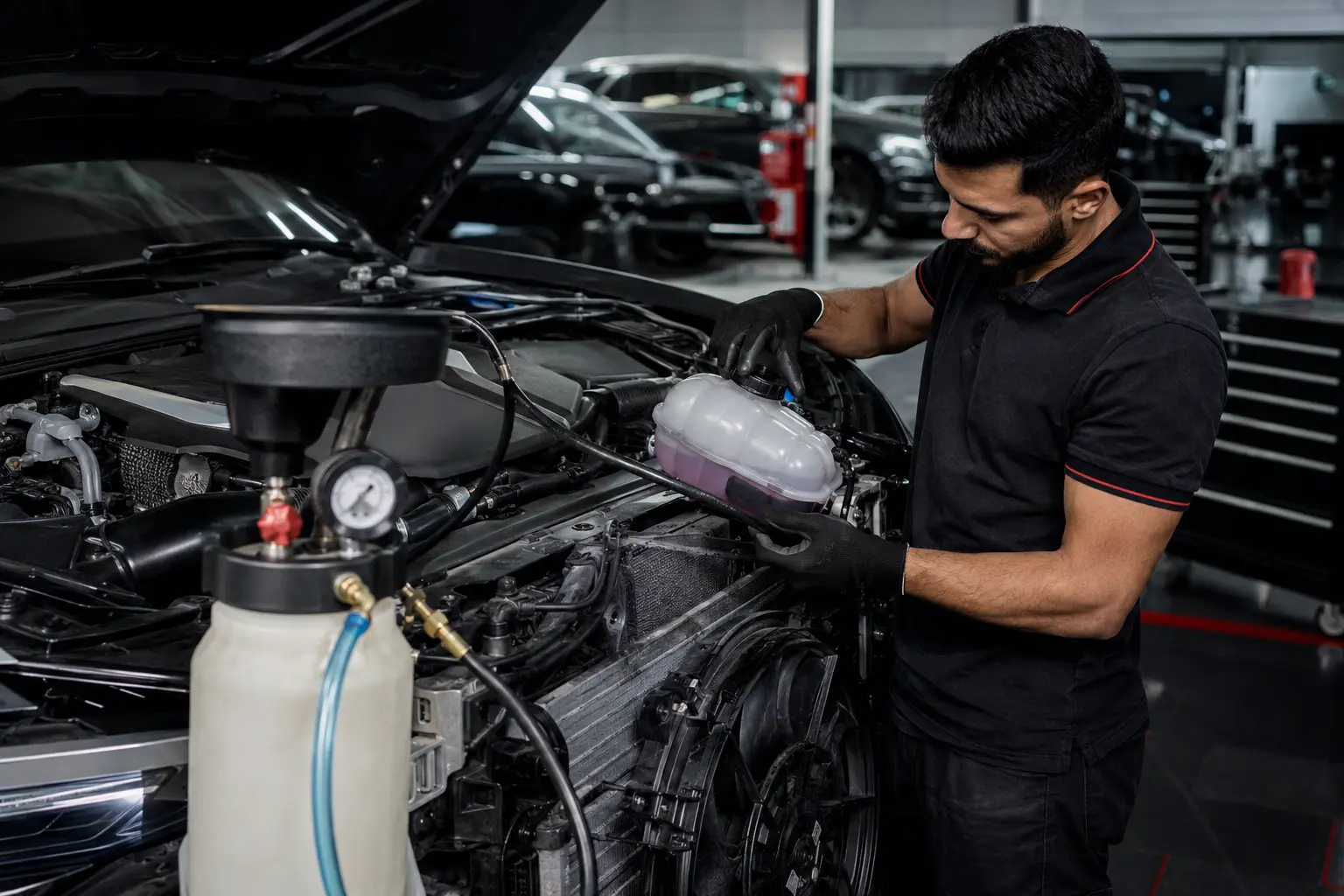
If coolant work is relevant to the AC or thermal-management complaint, the estimate or invoice should name the product, formal specification and quantity. It should also state whether drain, refill, vacuum filling, bleeding, leak checks and post-repair temperature monitoring are included.
Air trapped after cooling-system work can alter circulation and temperature control. Bleeding must follow the applicable vehicle procedure rather than a generic warm-up assumption. For routine service context beyond the AC complaint, use the Audi maintenance service page.
Repair-price planning
Quote the complete job
A responsible public figure needs verified workshop history, current supplier evidence and a defined fitted scope. Those figures are not available for every route here, so the page shows inspection and VIN quote instead of inventing a low starting price.
The written quote should identify diagnosis, part, labour, refrigerant, oil, seals, flushing, drier, expansion device, coolant and 5% VAT as included, excluded or not applicable. Compare the total repair route, not one component price.
Define booked test time, symptom reproduction, basic vent and airflow checks, relevant scan scope and whether deeper leak or electrical testing is separate.
State operating conditions, equipment connection, measurement time and whether refrigerant recovery is required or excluded.
Name the approved method, accessible areas, test duration, refrigerant or inert-gas handling and limits of the result.
Confirm refrigerant identity, specified charge weight, recovery, evacuation, controlled oil decision, post-charge readings and 5% VAT.
Name the filter brand and type, part, labour, housing inspection and 5% VAT. Do not bundle it as proof of a cooling repair.
Separate motor, controller or resistor, wiring repair, access, coding or basic settings, testing and 5% VAT.
Identify the exact actuator, access route, adaptation or calibration, trim reassembly, zone verification and 5% VAT.
Name the verified brand and part, access, seals, recovery, recharge, related drier decision, fan check, leak test and 5% VAT.
Confirm Audi part number, supply status, the same full fitted scope, written warranty and 5% VAT.
State the unit source and condition, supplier evidence, related cleaning or component decisions, refrigerant, oil, labour, written terms and 5% VAT.
Name the manufacturer, exact application, full fitted scope, related-system decisions, supplier warranty and 5% VAT.
Identify the supplier brand without calling it Audi Genuine, then define fitment, related work, written terms and 5% VAT.
Confirm Audi part number, supply evidence, related circuit work, refrigerant and oil scope, written terms and 5% VAT.
Confirm the fault, component location, dashboard or trim access, refrigerant work, seals, expansion-device decision, reassembly checks and 5% VAT.
Name the product, Audi or VW specification, concentration, quantity, bleeding process, leak checks, labour and 5% VAT.
Ask for the assumptions in writing. If access, contamination or supplier availability may change the figure, the quote should say what is provisional, what triggers approval and whether VAT is already included. The Audi service cost guide explains the same estimate discipline across other workshop work.
Parts and warranty
Write the route clearly
There is no responsible single warranty sentence for every AC repair. Workmanship, new-part supplier coverage, used-part terms and a later leak from a different component are separate issues.
Confirm current supplier routes and written terms before approving work. Verbal phrases such as original quality, German quality or OEM are not substitutes for the actual part identity.
| Quote item | What must be written | What it does not automatically cover |
|---|---|---|
| Workmanship | The exact fitting or repair work covered, duration, conditions and the process for reporting a concern. | Failure of an unrelated component or damage outside the completed scope. |
| New-part supplier coverage | Named brand, part number, supplier term, claim process and whether removal or refitting labour is included. | A different leak, contamination from another failure or an excluded labour cost unless expressly written. |
| Used-part terms | Used condition, source, test or return evidence, duration, replacement or credit route and labour responsibility. | New-part equivalence, unknown history or every internal fault that could not be assessed before fitting. |
| Refrigerant leakage | The repaired location and any documented post-repair leak checks. | Future leakage from a different hose, seal, heat exchanger, service port or component unless the terms say so. |
| Customer-supplied parts | Whether fitting is accepted, inspection limits, fitment responsibility, labour terms and what happens if the part is wrong. | Supplier warranty management or repeat labour unless the workshop accepts it in writing. |
Check part identity, condition, included work, exclusions, VAT, expected access and written warranty.
Pause if the fault, contamination or required related work changes materially. Obtain approval before expanding the job.
Receive the recorded work, parts route, refrigerant or coolant details where relevant and the closing checks.
Representative workshop case
Warm at idle with a fan-control fault
This technically realistic case record shows how measurements can prevent an unnecessary compressor or refrigerant repair. It is an illustrative diagnostic scenario, not a claim about a named customer vehicle or a universal performance target.
- Complaint reproducedAirflow stayed strong, but the centre vent warmed during a stationary five-minute check. Engine temperature remained normal and no severe belt or electrical smell was present.
- Conditions controlledThe technician recorded maximum cooling, recirculation, the same blower setting, closed windows and the same centre vent for each comparison.
- Pressure behaviour observedHigh-side pressure rose at idle and returned to a more stable level when condenser airflow increased. The refrigerant label in this scenario identified R1234yf, so no other refrigerant route was considered.
- Fan command comparedThe scan data showed a high cooling-fan request while the fan remained stationary. Power, earth and the control signal were present at the assembly under the tested condition.
- Fault boundedThe confirmed fault in this representative record was the integrated fan-control stage, not the compressor, condenser or low refrigerant charge.
- Options explainedA new exact-fit supplier-branded fan assembly route and an Audi Genuine route were compared by availability, total fitting, written terms and closing checks.
- Approved repair completedThe Audi Genuine fan assembly route was selected in the scenario. The refrigerant circuit remained sealed, so no refrigerant or compressor oil was added.
- Job closed under the same conditionsThe fan followed command, pressure stabilised, centre-vent output remained consistent at idle and on the road, and accessible joints showed no electronic detector response.
| Initial centre vent | 19.4°C at idle after five minutes under the recorded setup |
|---|---|
| Moving comparison | 10.8°C with road-speed airflow under the same cabin settings |
| Initial high side | 24.6 bar at idle while the commanded fan remained stationary |
| Airflow comparison | 16.1 bar when condenser airflow was restored for the controlled check |
| Electrical finding | Fan request present, power and earth verified, fan-control stage not responding |
| Closing centre vent | 9.7°C at idle after ten minutes under the same recorded setup |
| Closing high side | 15.8 bar at idle with the replacement fan following command |
| Fluid work | No refrigerant or coolant circuit opened, no top-up and no oil addition |
These values belong only to this representative scenario. They are not pass or fail targets for another Audi, refrigerant system, ambient condition or test procedure.

Dubai operating conditions
Test the actual heat load
High ambient temperature, sun load, heat soak and long periods of idling make small performance differences easier to notice. They do not prove that a particular component has failed more often, and they do not replace measurements.
A useful test records the outside condition, time after start, control settings and whether the vehicle is stationary or moving. That makes the customer’s experience reproducible instead of comparing an indoor check with a hot traffic complaint.
Record the pull-down
A cabin that has sat in direct sun begins with stored heat in the trim, glass and air. Record how vent output and cabin comfort change over time rather than judging one first burst.
Check condenser airflow
Road speed no longer supplies the same airflow. Fan command, fan response, grille obstruction and pressure behaviour become useful comparisons when cooling changes at idle.
Repeat the symptom safely
A controlled road check can confirm whether cooling fades, returns with speed or differs by zone. It should never be used to reproduce overheating, severe belt noise or an electrical safety concern.
Questions owners ask
Audi AC repair questions
The answers below define the first decision and its limits. Your Audi still needs vehicle-specific identification and testing before a part, fluid or repair is approved.
Why is my Audi AC cold while driving but warm at idle?
Cooling that improves with road speed can make condenser airflow, cooling-fan operation, pressure behaviour and compressor performance relevant. It does not prove a failed fan, condenser or compressor. Record whether airflow from the vents stays strong, whether engine temperature changes and how quickly cooling returns when moving.
Does weak cooling always mean low gas?
No. A measured low refrigerant charge is one possible condition, but weak cooling can also involve airflow restriction, fan behaviour, compressor command, heat exchange, sensors, actuators or control faults. If the charge is low, the workshop still needs to consider why it became low and whether leakage is present.
Which refrigerant does my Audi use?
The vehicle label and applicable repair information control the answer. R134a and R1234yf are examples of different systems and are not interchangeable. Do not select refrigerant from model name or year alone when the exact label and VIN information can be checked.
Can you fit a used AC condenser?
No. Workshop policy is to install only a new condenser when replacement is confirmed. The available routes are a verified new quality aftermarket unit or Audi Genuine, subject to exact fitment and supplier availability. The quote must name the actual part and full fitted scope.
Is a used Audi AC compressor sensible?
It can be a lower-cost route when an exact compatible original unit is available, the system is suitable, storage and visible condition are acceptable, supplier evidence is adequate and the related work is defined. It remains used, with more limited history and terms than a new unit. It should be rejected when identity, contamination or compatibility cannot be bounded.
How do aftermarket and Audi Genuine differ?
Aftermarket means an independently branded part and can cover very different manufacturers and support levels, so the brand must be named. An OE-supplier route identifies the actual supplier-branded manufacturer but is not Audi Genuine. Audi Genuine is Audi-branded supply confirmed by Audi part number and VIN fitment.
Does compressor replacement include flushing and gas?
Only if the written quote says so. The diagnosis determines whether recovery, technically suitable flushing, drier or accumulator work, expansion-device work, seals, correct oil, refrigerant by weight, scans and closing checks are required. Not every system can or should be flushed in the same way.
Can the wrong coolant affect thermal management?
Yes, an incompatible coolant specification or incorrect concentration can affect corrosion protection, circulation and heat transfer. Coolant must be chosen by the exact Audi or VW specification, not colour. Refrigerant remains a different fluid in a separate circuit.
Why is one side colder than the other?
Zone commands, cabin or outlet sensors, distribution flaps, actuators, airflow and refrigerant behaviour may all be relevant. Compare sides under the same settings and airflow before replacing an actuator. Scan data can guide testing but does not prove the named part has failed.
How much does Audi AC repair cost in Dubai?
The price depends on diagnosis, vehicle, refrigerant, access, exact part route, related circuit work and written warranty. This page uses inspection and VIN quote where a responsible current range is not verified. Ask whether parts, labour, refrigerant, oil, seals, related components, testing and 5% VAT are included.
Send the symptom, not a parts guess
Your navigator and message fields remain on this page. Add the model, year, mileage, idle-versus-moving behaviour, airflow and any warnings before opening WhatsApp.
Audi AC Repair
AC and electrical service routes
These pages extend the decision path without replacing diagnosis or repeating the same service intent.