
Audi AC regas in Dubai
A regas is sensible when the correct refrigerant is identified, the system passes the relevant checks and low charge is confirmed. If it cannot hold the test, loses cooling again or has the correct charge but poor performance, it needs AC diagnosis rather than more gas.
We recover the existing charge, inspect the pressure-loss route, vacuum the system, charge the exact specified mass by weight and judge the result under recorded conditions.
R134a and R1234yf are different refrigerants. The vehicle label and specification decide which service applies. Model name alone is not enough.
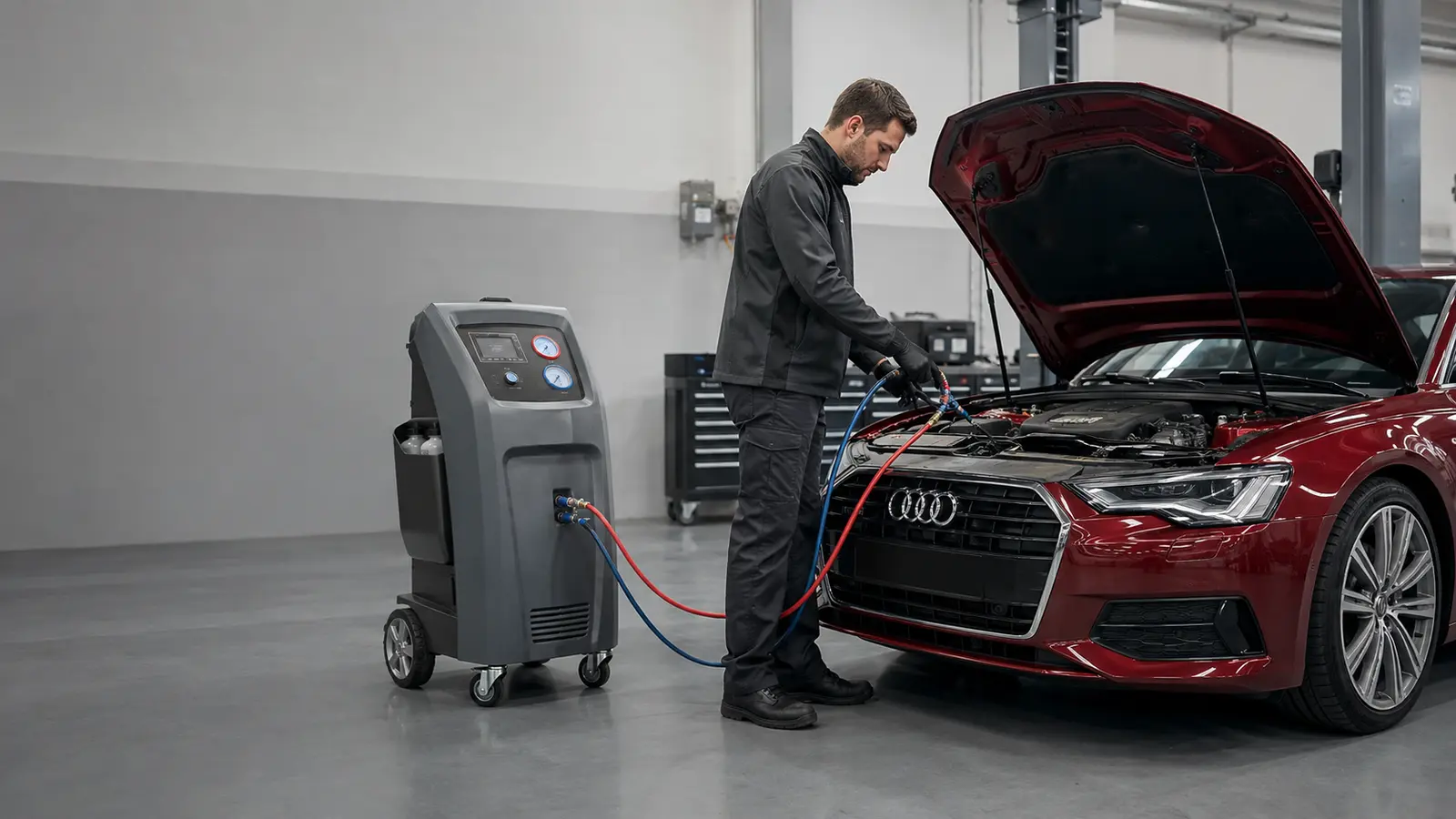
Low gas is a finding
Warm air is not proof that the system only needs refrigerant. The useful first decision is whether charge is actually low, why it is low and whether the rest of the system can turn the correct charge into stable cooling. Use the Audi AC not-cooling guide to separate the most useful symptom patterns before booking.
A sealed AC circuit is not intended to consume gas like fuel. Refrigerant can escape through a leak or be removed during component work, but repeated blind topping up is not maintenance. If cooling returns briefly and then fades, the lost charge needs an explanation.
Pressure behaviour, vent temperature and recovered amount can support the diagnosis, but none should be interpreted alone. Ambient temperature, cabin heat load, fan operation, compressor control and airflow all change what the technician sees. That is why an online pressure figure or a single gauge reading cannot approve an Audi regas.
The narrow booking on this page is for identification, recovery, vacuum, initial leak screening, exact-weight charging and verification. Compressor, condenser, evaporator, valve, fan, blower, flap, sensor and control repairs remain with the broader AC Repair service.

Read the vehicle label
The Audi model badge is not a safe refrigerant identifier. Model year, market specification and powertrain can change the fitted system, so the vehicle label and exact specification control the service.

Used on many applicable vehicles. The charge still has to match the exact label and the service equipment must be suitable for R134a.
Used on many later applications. It requires suitable dedicated handling and normally has a higher refrigerant cost.
Never mix or substitute
R134a and R1234yf are not interchangeable. Unknown, mixed or contaminated recovered gas changes the job before any recharge. A traceable uncontaminated supply, compatible connections and the correct equipment are part of the service, not optional upgrades.
There is no universal Audi refrigerant quantity. The charge mass is taken from the exact vehicle specification and added by weight. The air-conditioning circuit uses refrigerant, not engine coolant. They are different systems, even though an engine-cooling or fan fault can sometimes influence cabin performance.

Recover, test, charge, verify
Each stage changes the next decision. Skipping recovery or exact weighing may produce a temporarily cold vent without showing whether the charge, leak risk and system control are actually correct.
Confirm the system
Record model, year, VIN or label data, powertrain, refrigerant type and the exact complaint.
Record performance
Note ambient conditions, vent temperature, airflow, compressor request, fan operation and visible concerns.
Read both sides
Review low-side and high-side behaviour with suitable equipment and interpret it with temperature, load and control state.
Recover the charge
Identify and recover existing refrigerant rather than venting it. Record the recovered amount when the machine supports it.
Inspect the system
Check ports, caps, accessible hoses, condenser area and visible oil, dye or accident clues.
Vacuum and hold
Evacuate air and moisture and perform the appropriate hold check. A pass is useful but does not prove every small operating leak is absent.
Charge by weight
Add the exact specified refrigerant mass. Oil or approved dye is added only when the actual process requires the correct type and amount.
Close the job
Recheck vent temperature, pressure behaviour, compressor request, fan operation, port sealing and relevant climate functions.
Regas or repair
The same warm cabin can come from low charge, poor heat rejection, weak airflow or an electronically controlled fault. The finding, not the symptom name, selects the route.
| Finding | Correct next route | Do not assume |
|---|---|---|
| Correct system, passes checks and low charge is confirmed | Recover, vacuum, charge the exact mass and verify performance. | Every warm-air complaint needs a component. |
| Very low or empty charge | Leak assessment before or within the controlled charging plan. | The gas disappeared without a cause. |
| Cooling fades after a recent regas | Leak detection and the broader AC Repair route. | Another top-up is the repair. |
| Correct charge but weak cooling | Compressor, fan, valve, sensor, airflow or control diagnosis. | More gas will improve it. |
| Warmer at idle but cooler when moving | Condenser airflow and cooling-fan diagnosis. | Low gas is the only cause. |
| One side warmer than the other | Climate flap, sensor and air-distribution checks. | Refrigerant charge is divided by cabin side. |
| Low airflow from the vents | Cabin filter, blower, evaporator and flap route. | Refrigerant controls airflow volume. |
| Contaminated or incorrect recovered gas | Contamination handling before any recharge. | Mixing refrigerants is acceptable. |
| Plug-in hybrid or electric system | Exact refrigerant, oil and contamination-control procedure. | Conventional oil and equipment are safe. |
No single test sees every leak
A vacuum hold check is valuable, but a small seal leak that appears with temperature, pressure or shaft movement may not reveal itself in the same way under vacuum.
The suitable route depends on whether the system is partly charged, empty, recently repaired, contaminated or visibly damaged. Common areas include service ports, O-rings and connections, the condenser, hoses and pipes, compressor body or seal, expansion-valve connections and the evaporator.
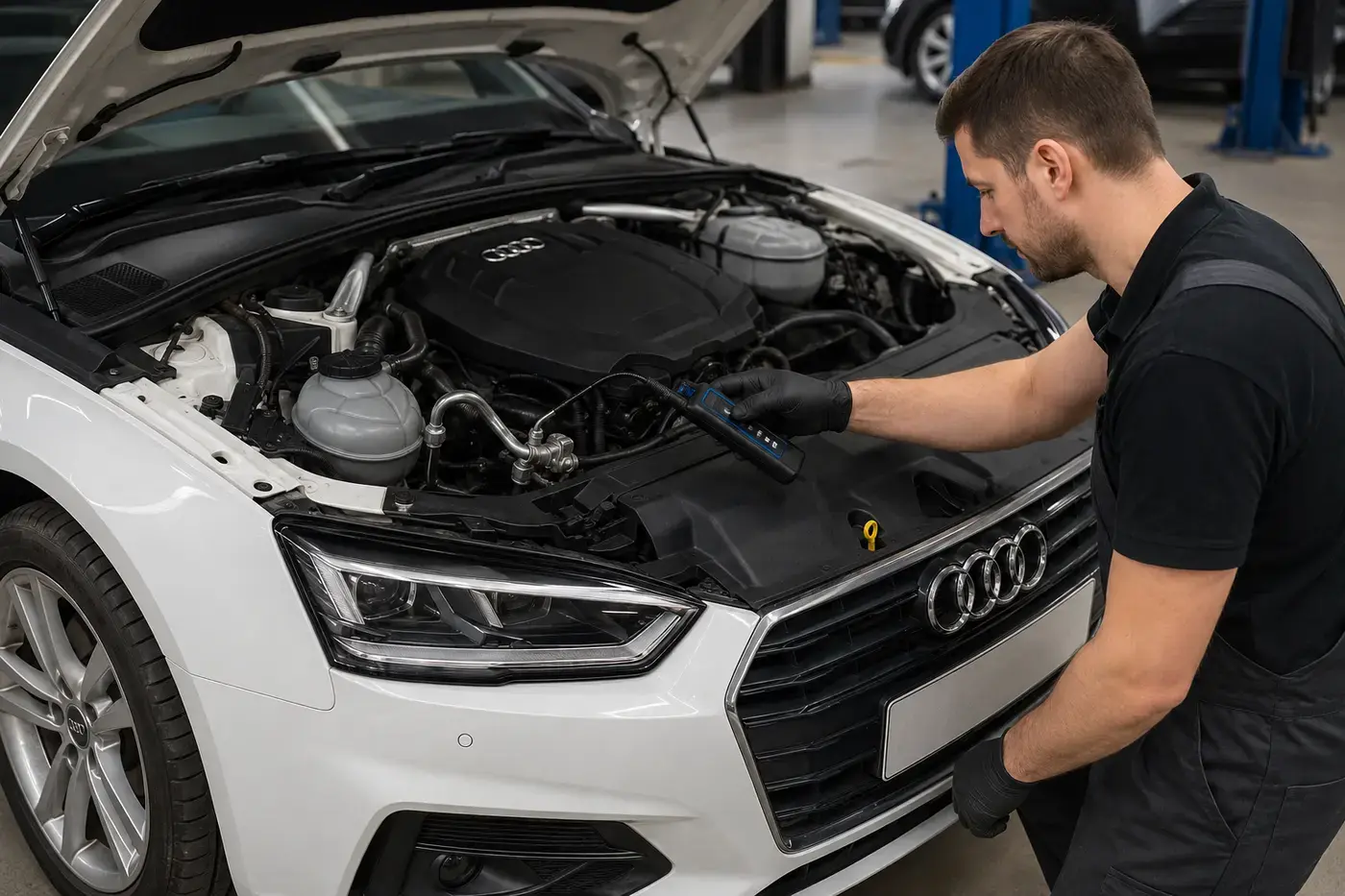
Visual inspection
Oil traces, dye, impact marks, rubbed pipes and damaged condenser fins can direct testing. A clean-looking part is not proof that it is sealed.
Electronic detector
A suitable detector can identify refrigerant at an accessible escape point. Air movement and access affect the result.
UV dye
Compatible dye can support a planned follow-up inspection. It is not an automatic additive and must suit the system.
Vacuum hold
Shows whether pressure rises during the test and helps the charging decision, but cannot guarantee every operating leak is absent.
Pressure testing
Nitrogen or approved forming gas may be used with suitable equipment. Oxygen and compressed air are not safe substitutes.
Repair options
Once a leak is located, the estimate moves to seals, pipe, condenser, compressor or evaporator work on the AC Repair page.


Exact mass, exact oil decision
The charging machine does not decide the specification. The technician selects the verified refrigerant and exact mass for the vehicle, then confirms the result rather than chasing a generic gauge target.
Compressor oil is not a routine extra dose. Type and quantity depend on the exact system, the amount recovered and any component work. Excess oil can reduce performance, while the wrong oil can cause material or electrical compatibility problems.
Plug-in hybrid and fully electric Audi climate systems can use electrically driven compressors. Where the exact system requires electrically compatible oil, contamination from conventional service oil or equipment must be controlled. The VIN, label and repair information decide the handling, not the word hybrid alone.
Stop-leak sealer, unknown refrigerant and mixed gas are not shortcuts. If the recovered material is contaminated or its identity cannot be confirmed, the workshop should pause the normal charge route and define the safe handling and repair scope.
What the approval should name
- Verified refrigerant type
- Specified charge mass
- Recovery and recovered amount record
- Vacuum and hold result
- Oil type and reason if added
- Dye type and reason if used
- Leak-repair exclusions
- Final temperature and function checks

Regas and follow-up prices
Checked 2 September 2026. Consumer-facing ranges include 5% VAT. They assume ordinary access and a traceable parts or refrigerant route. A VIN-linked written estimate overrides this page.
| Service route | Tentative range | Included assumptions and variables |
|---|---|---|
| Initial performance and vent-temperature check | AED 150 to 300 | Diagnostic service, no refrigerant included. Ambient conditions, airflow and basic visible checks recorded. |
| R134a recovery, vacuum and exact-weight regas | AED 250 to 500 | R134a included within ordinary Audi capacity; recovery, vacuum, initial leak screening and verification included. Repairs, oil and dye only if separately justified. |
| R1234yf recovery, vacuum and exact-weight regas | AED 650 to 1,200 | R1234yf included within ordinary capacity; suitable equipment, recovery, vacuum, screening and verification included. Exact mass drives material cost. |
| Pressure, temperature and control assessment | AED 250 to 500 | Diagnostic service only. Compressor request, fan operation and relevant control data where accessible; no repair parts. |
| Vacuum and hold test billed separately | AED 150 to 350 | Test service only. Does not guarantee every operating leak is absent and does not include refrigerant. |
| Electronic refrigerant leak detection | AED 250 to 550 | Accessible-area detector inspection. Dismantling, gas and repair excluded; access and remaining charge affect the route. |
| UV dye and follow-up inspection | AED 150 to 400 | Compatible dye only when appropriate plus planned inspection. Refrigerant and repairs are separate. |
| Nitrogen or approved forming-gas leak test | AED 350 to 750 | Test service with suitable gas and equipment. Access, dismantling and leak location time move the figure. |
| Service-port valve or small seal before regas | AED 250 to 750 plus refrigerant | Ordinary labour and small sealing part. R134a or R1234yf charge is separate; cap and port condition confirmed. |
| Accessible O-ring or connection repair | AED 350 to 900 plus refrigerant | Ordinary labour and specified seal at accessible connection. Line damage, difficult access, oil and recharge vary. |
| AC hose or pipe repair route | AED 800 to 2,500 plus refrigerant | Installed repair or replacement planning range. Part source, routing, access, oil and gas type affect total. |
| New reputable aftermarket condenser | AED 1,200 to 3,000 | New condenser and ordinary labour, model dependent. Refrigerant, dryer decisions, seals and bumper access confirmed in writing. Used condensers are not offered. |
| New verified OE or Audi Genuine condenser | AED 2,500 to 6,000+ | Installed new part planning range. VIN, supersession, front-end access, seals, gas and related damage move the quote. |
| Good-condition used compressor budget route | AED 1,200 to 3,200+ | Qualified AC Repair option only. Compatibility, contamination, source condition, limited warranty, labour and refrigerant must be written. Not suitable for every fault. |
| Reputable aftermarket compressor | AED 2,000 to 4,800+ | Installed planning range with exact fitment. System contamination, oil, condenser or dryer scope and gas are application dependent. |
| Verified OE or Audi Genuine compressor | AED 4,000 to 9,000+ | Installed planning range. VIN, supplier, electric or belt-driven type, oil, contamination and related components change total. |
| Pressure sensor or control component | AED 600 to 1,800 | Installed part and ordinary labour planning range. Diagnosis, part tier, access and coding determine quote. |
| Expansion-valve route | AED 900 to 2,400 | Installed planning range. Access, seals, refrigerant, oil balance and contamination assessment vary. |
| Evaporator leak and dashboard access | AED 3,500 to 8,000+ | Wider AC Repair planning range. Dashboard access, part tier, seals, refrigerant and associated items must be scoped. |
The largest price changes are refrigerant type and mass, model-specific access, whether the circuit is empty, leak-test time, powertrain and compressor type, the need for oil or dye, part tier, contamination, related component work and whether a repair is approved before recharge.
Worked service example
R134a with low charge and satisfactory checks
A vehicle identified as R134a recovers less than its specified charge, passes the appropriate checks and shows no immediate reason to stop. Tentative route: AED 250 to 500 including 5% VAT for recovery, vacuum, ordinary screening, exact-weight R134a charge and verification. Leak repairs are excluded.
Worked service example
R1234yf exact-weight service
The label confirms R1234yf and the system is suitable to charge. Tentative route: AED 650 to 1,200 including 5% VAT. The range is higher because refrigerant cost and the exact mass vary. Oil is not automatically added.
Worked service example
Cooling lost soon after a regas
Another blind fill is not approved. Start with a AED 250 to 550 electronic test or AED 350 to 750 pressure-test route where suitable, including 5% VAT. Repair and final refrigerant are quoted after the leak location and component access are known.
Correct charge, poor cooling
Once the specified charge is confirmed, adding more refrigerant risks moving farther from the correct baseline. The next test follows the symptom and measured system response.
A compressor may fail to create the required pressure difference, or an applicable variable compressor may have a control-valve or command problem. A damaged condenser or weak fan can prevent heat rejection, especially at idle. A pressure sensor, expansion valve, evaporator leak, blower, restricted cabin filter, flap actuator or control-unit fault can also produce weak or uneven cooling.
One side warmer than the other is more likely to send the job toward air distribution, temperature sensing or flap control than to a split refrigerant charge. Low airflow belongs to cabin-filter, blower, evaporator and flap inspection. Wider wiring or module damage can move to Audi Electrical Repair, while uncertain multi-system warnings may need Audi Diagnostics.
If a compressor has failed internally or the circuit is contaminated, the estimate may include flushing decisions and new lines, condenser, dryer, valve or other components. A compressor-only quote is not safe until the debris route and oil balance are understood. A used condenser is not offered; a good-condition used compressor is only a qualified budget option after compatibility, condition, contamination and written warranty limits are reviewed.

What the quote includes
Two regas prices are only comparable when they describe the same refrigerant, charge quantity, recovery process, screening and verification.
- R134a, R1234yf or another exact specification
- Refrigerant mass assumed and whether gas is included
- Recovery and recovered-amount record
- Initial pressure, temperature and airflow review
- Vacuum and hold check
- Leak screening included before charging
- Oil or dye type, amount and reason if applicable
- Hybrid or electric compressor handling
- Service-port sealing and caps
- Post-charge temperature and function checks
- Leak-repair and dismantling exclusions
- 5% VAT treatment
The quote should also say what happens if the system is empty, fails the hold check, contains the wrong gas or shows a wider fault. That decision point protects the customer from paying for refrigerant that should not yet be installed.
A cabin filter can be considered through Audi service and maintenance when restricted airflow is confirmed, but replacing it is not a substitute for refrigerant diagnosis. The full list of workshop routes remains on Audi Repair Services.
Verify more than cold air
A cold vent immediately after charging is useful, but the job closes only when the system response, controls and service connections have been checked under recorded conditions.
Vent temperature, airflow and side-to-side behaviour are compared with the starting complaint and ambient conditions.
Low and high sides, compressor request and condenser-fan operation are reviewed in context, without publishing a generic Audi target.
Ports and caps are checked, the refrigerant type and amount are recorded, and any unresolved leak or component route is explained before handover.
AC regas FAQs
How much does Audi AC regas cost in Dubai?
A tentative R134a recovery, vacuum and exact-weight regas is AED 250 to 500. R1234yf is usually AED 650 to 1,200 because refrigerant type and mass change the material cost. Both ranges include 5% VAT and assume the system can proceed without leak repair.
Does my Audi use R134a or R1234yf?
Check the vehicle refrigerant label and exact specification. Model name or registration year alone is not reliable enough because market, model-year and powertrain differences can change the system.
Can R134a and R1234yf be mixed?
No. The specified refrigerant, compatible equipment and suitable connections must be used. Unknown or contaminated gas changes the service plan before charging.
Is AC regas the same as AC repair?
No. Regas establishes the correct refrigerant charge and verifies performance. A leak, compressor, fan, sensor, valve, evaporator, blower, flap or electrical fault requires the wider AC Repair route.
How do I know whether the AC needs gas?
Symptoms can suggest a route but do not prove it. The useful evidence is refrigerant identification, recovered amount, pressure and temperature behaviour, leak screening and the system response after the specified mass is restored.
Why did the AC become warm after a recent regas?
The charge may have escaped through a leak, or low gas may never have been the only fault. Test the loss route before paying for another blind top-up.
Should an Audi AC system need gas every year?
There is no universal annual regas rule. A sealed system is not designed to consume refrigerant. Repeated loss needs investigation rather than a fixed refill habit.
Can you top up the gas without recovering it?
A controlled service recovers the existing refrigerant so its identity and amount can be considered, then vacuums and charges the exact specified mass. Guessing what remains makes the final charge uncertain.
Why is charging by weight better than pressure alone?
Pressure changes with ambient temperature, load, airflow, fan operation and system control. The specified mass by weight gives the correct baseline, while pressure and temperature checks judge how the system works from that baseline.
Does vacuum testing prove there is no leak?
No. A stable vacuum is useful evidence, but it cannot reveal every small leak that appears only under operating pressure, heat or component movement.
Is R1234yf more expensive than R134a?
Usually, yes. The refrigerant and handling cost is higher, while the final price also depends on the exact charge mass, system condition and whether leak testing or repair is needed.
Can a weak cooling fan look like low gas?
Yes. Poor condenser airflow can make the AC warmer at idle and better while moving. Fan operation and condenser condition should be considered before low gas is treated as the only cause.
Do hybrid and electric Audis need different handling?
They may. Electrically driven compressors can require exact electrically compatible oil and contamination control. The label, VIN and repair information decide the refrigerant, oil and equipment procedure.
What happens if a leak is found?
The workshop identifies the accessible leak route and prepares the relevant repair estimate. Refrigerant is added only when the agreed test and repair plan supports charging the system.
Start with the right AC check
Tell us how the cooling changes and attach a clear refrigerant-label photograph in WhatsApp. We can separate a straightforward R134a or R1234yf service from leak diagnosis or broader AC repair before parts are discussed.