
Workshop guide
Audi OverheatingDiagnosis in Dubai
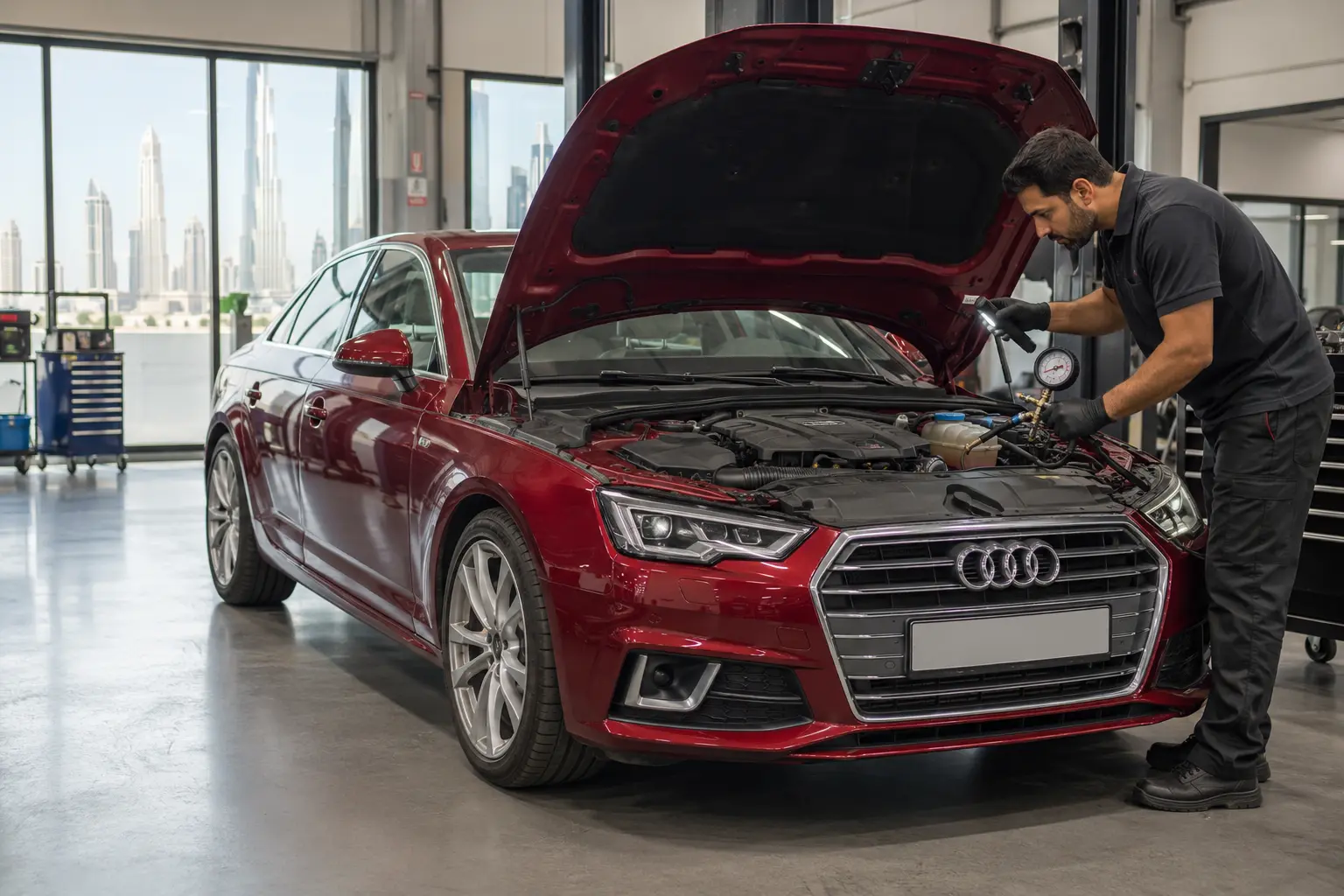
If the red coolant-temperature warning appears, steam is visible, coolant is escaping or the engine loses power, stop safely and switch the engine off. Do not remove a hot expansion-tank cap. Recovery is safer than driving when temperature remains high or coolant will not stay in the system. A proper diagnosis separates a leak, trapped air, thermostat, pump, fan, radiator, sensor or internal-engine problem before parts are approved.
The short answer
Stop first. Diagnose after cooling.
A high-temperature event should be treated as a safety and damage-control decision before it becomes a repair decision. If temperature remains high, coolant escapes, steam appears or the engine changes how it runs, switch off and recover the car. If the warning cleared, record the circumstances and still arrange prompt testing. Do not use a fresh top-up or a cleared warning as proof that the system is healthy.
The rest of this guide shows why the same warning can come from very different faults and how a workshop narrows them without starting from a parts list.
Useful first details
Prepare the workshop brief
Send only what changes the first assessment: model and year, the warning or gauge behaviour, when it happened, whether coolant escaped and whether the car has been driven since. The complete message stays visible before WhatsApp opens.
Do not restart a hot engine merely to create a video. A photograph taken safely after the vehicle has cooled can be enough.
Safety comes first
Three urgency levels
Stop immediately
Red temperature warning, steam, sudden coolant discharge, knocking, misfire, power loss or temperature continuing to rise. Park safely, switch off and arrange recovery.
Do not continue the trip
A repeated low-coolant warning, heater suddenly going cold while the engine heats, a strong sweet smell or a visible leak needs inspection before ordinary driving.
Book prompt diagnosis
A fan running unusually long, temperature fluctuation that has settled or slow coolant loss still needs testing. A normal gauge afterwards does not prove the cause has gone.
The first distinction
Overheating is an event, not a diagnosis
The dashboard warning describes a temperature condition or a coolant-level input. It does not name the failed part. Topping up can temporarily restore the level while leaving the leak, circulation restriction or combustion pressure untouched. Clearing a fault memory can remove stored evidence without correcting the reason the control unit recorded it.
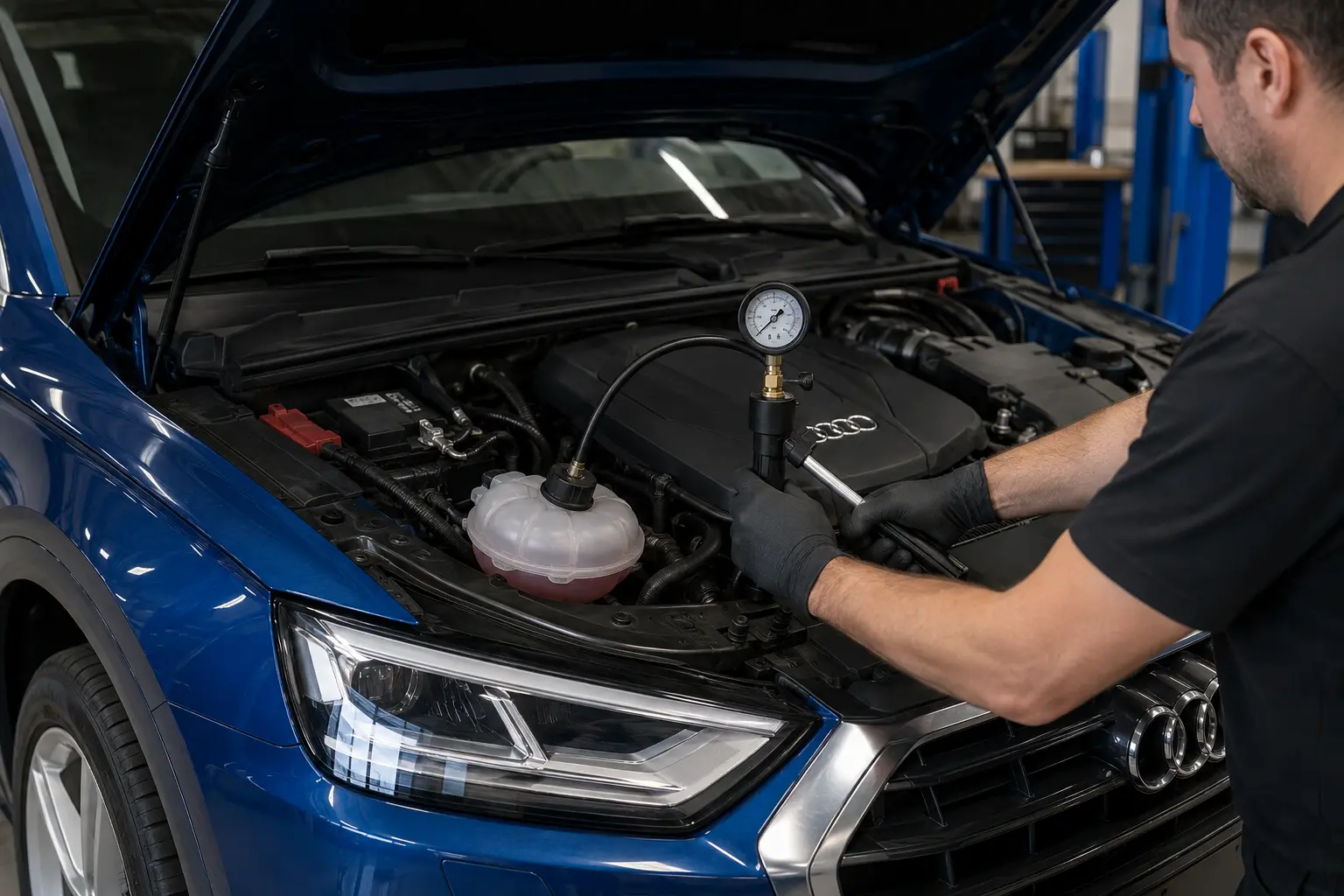
The starting point is a cold visual inspection, coolant-level and condition check, scan of all relevant control units and a careful account of the event. We look for dried coolant residue, wet joints, split hoses, cap or tank damage, undertray staining, fan damage, recent parts disturbance and oil or coolant contamination. Stored and live data can show implausible sensor values, fan-command faults, pump-control issues or the conditions recorded when a warning set.
If the vehicle is safe to test, pressure is applied at a controlled level. A system that loses pressure may reveal an external leak immediately or only after undertrays and covers are removed. If it holds cold but fails when warm, temperature-dependent leakage, cap behaviour, restricted flow or combustion pressure may require a different test route.
Our Audi cooling-system repair page explains the repair scope after the failed component is identified. This guide owns the earlier decision: whether to stop, recover and diagnose, and how different causes are separated.
Temperature-event timeline
What happened before the warning matters
- Before starting
A cold low level, puddle, crusted residue or recent top-up suggests loss or incomplete bleeding. Record what was seen without opening a hot system.
- Warm-up
Very slow warm-up, rapid rise, poor cabin heat or changing heater temperature can help assess thermostat behaviour, circulation and trapped air.
- Traffic or idle
Temperature that rises mainly while stationary places fan command, fan operation, airflow and heat rejection high on the test list, but does not prove the fan itself has failed.
- Road speed or load
Overheating at speed, under acceleration or on a long climb can point toward low coolant, restricted radiator flow, pump output, thermostat restriction or internal pressure.
- Switch-off
Coolant discharge after parking can occur because heat soak raises local temperature and pressure. The leak point, cap and circulation still need testing.
- After cooling
Level change, residue location, hose condition and retained pressure help decide the next test. Repeatedly adding coolant is not an acceptable long-term plan.
Symptom-to-test matrix
The next test follows the evidence
Several faults can create the same dashboard message. The useful question is not “which part is common?” but “which observation can confirm or eliminate each route on this vehicle?”
| Observed pattern | Possible routes | Useful next checks | Why guessing fails |
|---|---|---|---|
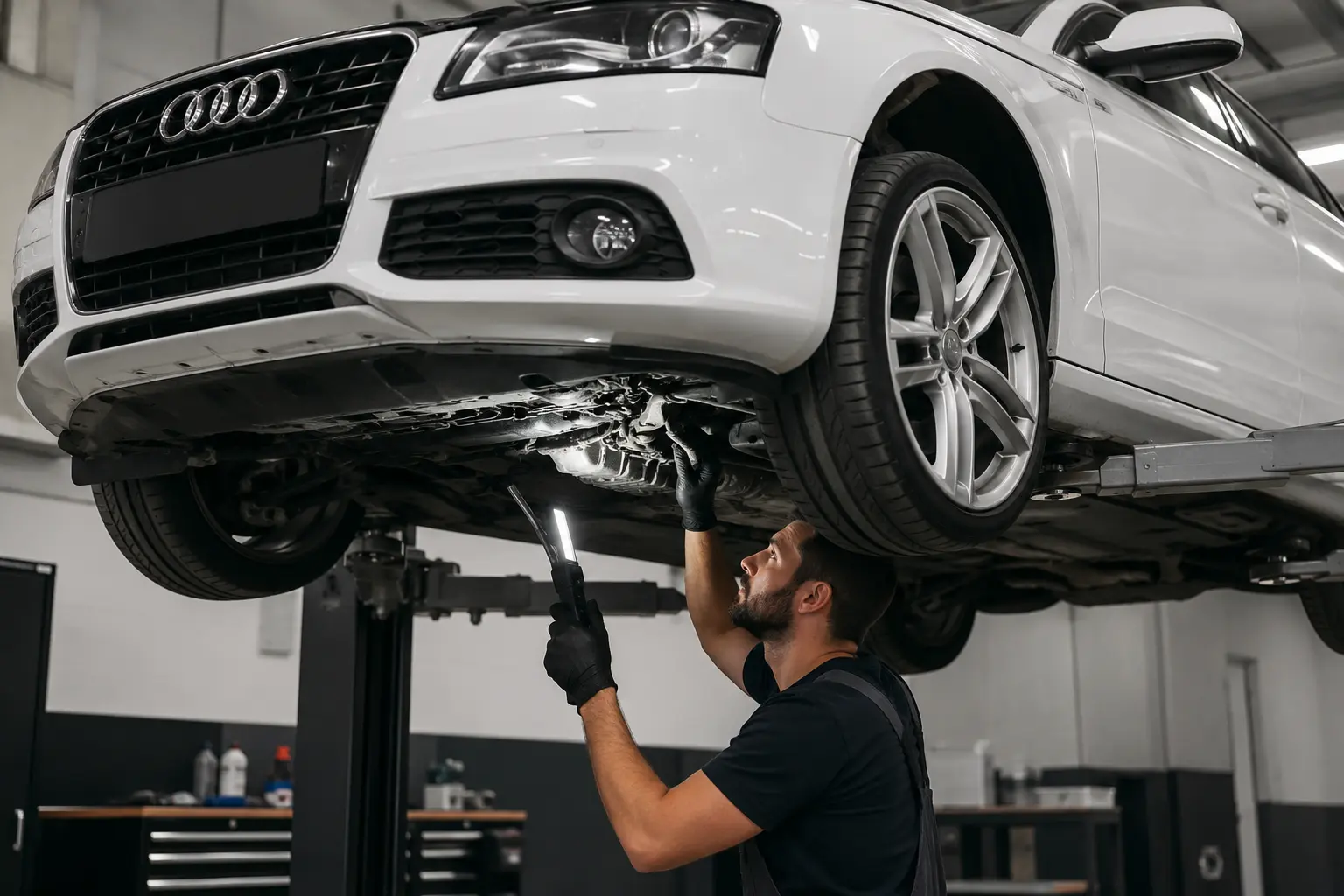
| Coolant level drops | Tank, cap, hose, flange, radiator, pump, heat exchanger or internal loss | Cold pressure retention, residue tracing, underbody inspection and fluid checks | The drip can travel along covers and appear far from its source. |
| Hot mainly in traffic | Fan, fan control, airflow obstruction, low coolant or sensor input | Live temperature, requested versus actual fan operation, wiring and airflow | A fan that is not turning may lack a command, power supply or working motor. |
| Hot mainly at speed | Restricted radiator, thermostat, pump circulation, low level or combustion pressure | Temperature distribution, circulation assessment, pressure behaviour and gas test where justified | Road airflow rules out neither internal restriction nor poor circulation. |
| Heater turns cold | Low level, trapped air, pump circulation or heater-core flow | Cold level, bleed state, pump function and hose-temperature comparison | The cabin heater is part of the coolant circuit, not a separate diagnosis. |
| Warning but normal measured temperature | Level sensor, temperature sensor, wiring, connector or implausible data | Scan data compared with known temperature, circuit inspection and plausibility testing | Replacing a sensor without checking its signal path can preserve the fault. |
| Hard hoses or repeated discharge | Cap fault, local boiling, blocked flow or combustion pressure | Cap test, controlled warm monitoring and combustion-gas assessment if indicated | Pressure is normal in a sealed hot system; its timing and rate matter. |
| Oil and coolant contamination | Oil cooler, heat exchanger, gasket, casting or previous contamination | Fluid-source tracing, pressure tests and component-specific isolation | Appearance alone cannot identify which circuit crossed into the other. |
Fault families
How the likely causes are separated
Coolant loss and pressure
The expansion tank, cap, radiator seams, quick connectors, hoses, plastic flanges, pump seals, turbo or EGR cooling circuits and heat exchangers may leak. Some leaks appear only hot, pressurised or under load.
Thermostat behaviour
A thermostat can stick closed, open late, remain partly open or be affected by its housing and control circuit. Warm-up data and hose or radiator temperature patterns are more useful than replacing it from mileage alone.
Water-pump circulation
A mechanical or electrically controlled pump problem may involve the impeller, seal, bearing, drive, actuator, wiring or command. Leakage and poor circulation are different failure modes and need different evidence.
Fan command and airflow
The fan assembly, control electronics, fuse, supply, wiring, sensor data or blocked heat exchangers can reduce low-speed cooling. Commanding the fan through diagnosis helps separate control from hardware.
Radiator flow
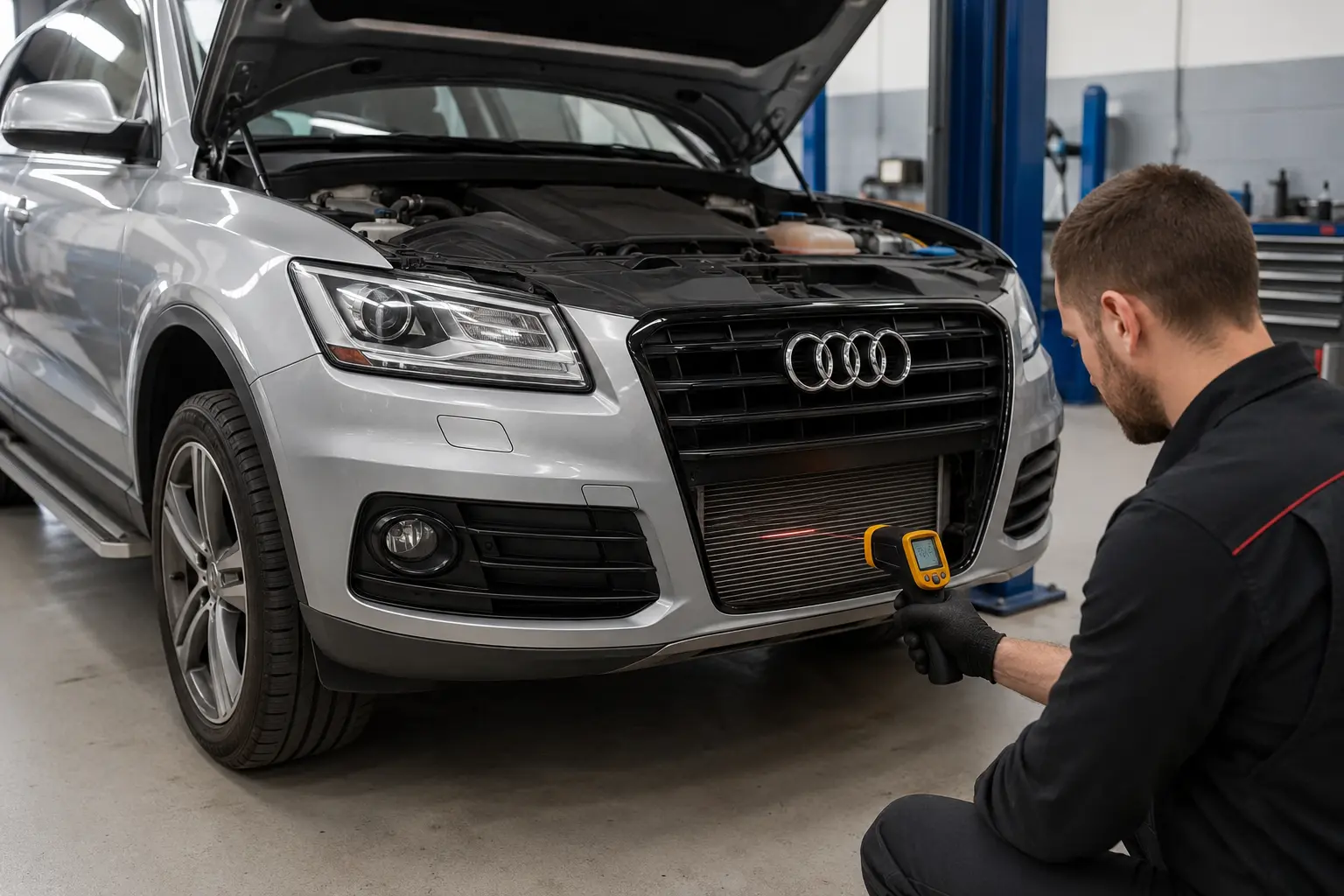
External debris can limit airflow; internal restriction can produce uneven temperature distribution. Infrared comparison and inlet-to-outlet behaviour support the decision, while allowing for thermostat state and fan operation.
Internal-engine pressure
Combustion-gas indications, repeated pressurisation from cold, unexplained loss, misfire or contamination can justify deeper testing. One discoloured sample is not enough to condemn a cylinder head or gasket.
Electronics and mechanics
A fan fault is not always a fan motor
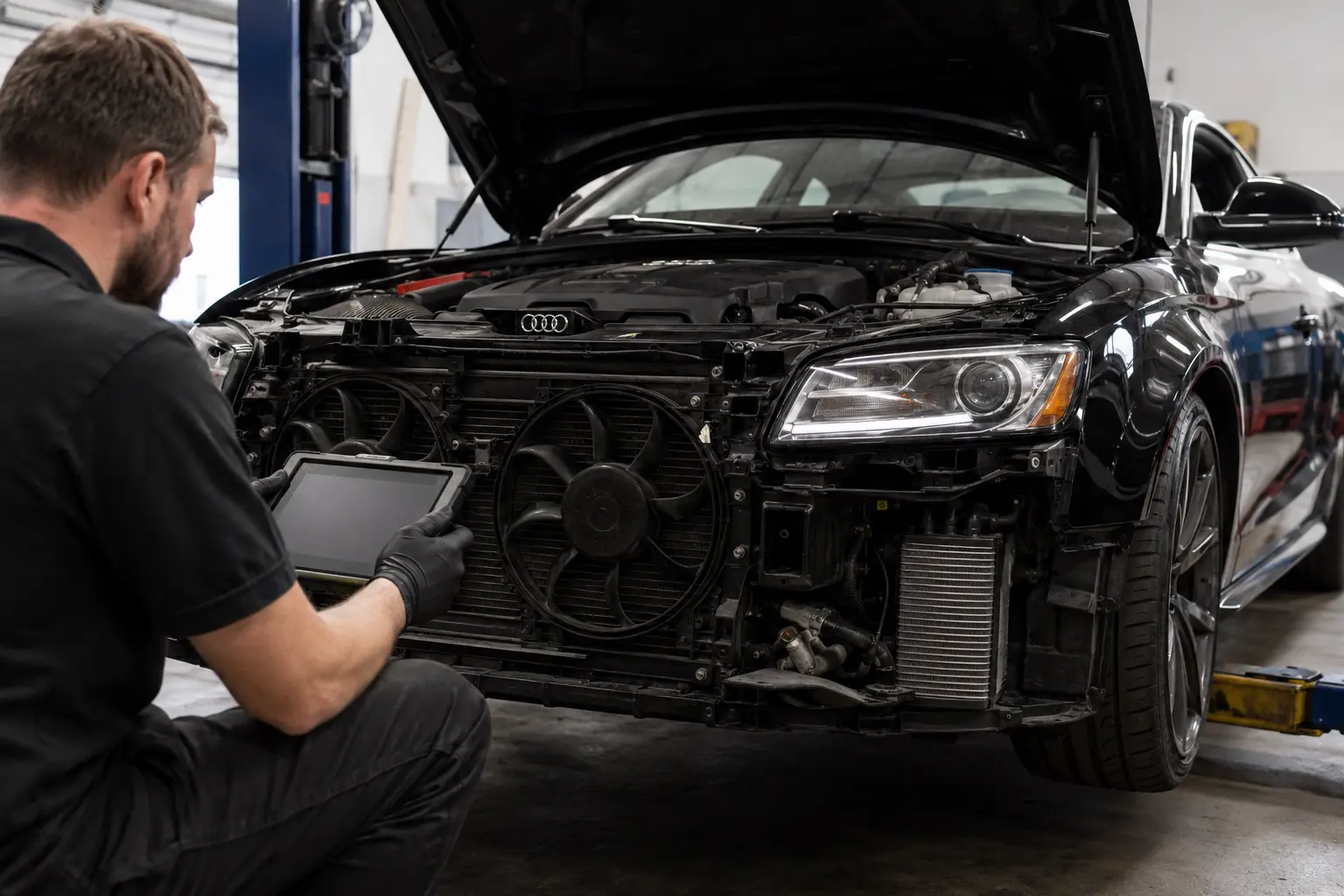
Modern Audi cooling control uses temperature, pressure, engine-load and air-conditioning information to request fan operation. A fan can remain off because its motor or controller has failed, but also because power, earth, wiring, a fuse, a connector or the data that triggers the command is wrong. Conversely, a fan that runs at high speed after shutdown may be responding to real heat, a protection strategy or an implausible sensor input.
Diagnosis compares requested fan activity with what the fan actually does. The electrical path is checked under load, not merely for the presence of unloaded voltage. Heat exchangers are inspected for blocked fins or debris, and fitted shutters or ducting are considered where applicable. This prevents a costly fan assembly being used to mask a control or airflow fault.
When temperature values conflict, the scan reading can be compared with a known cold start and an independent temperature measurement. Our Audi diagnostics service covers the wider scan, wiring and control-unit route when the overheating event is driven by an electrical or communication fault.
Circulation before replacement
Thermostat, pump and trapped air
Poor circulation can feel similar whether the restriction is a thermostat, a pump is not moving the expected volume, or an air pocket interrupts flow. The exact engine code and cooling layout matter because Audi models use different pump drives, valves, auxiliary pumps and mapped thermostats.
Temperature is followed from cold through warm-up. We compare heater performance, hose behaviour and radiator temperature distribution while considering the command state of electrically controlled parts. A recently opened system may need the correct filling and bleeding procedure, but “air in the system” should not become a convenient answer when the system is still losing coolant.
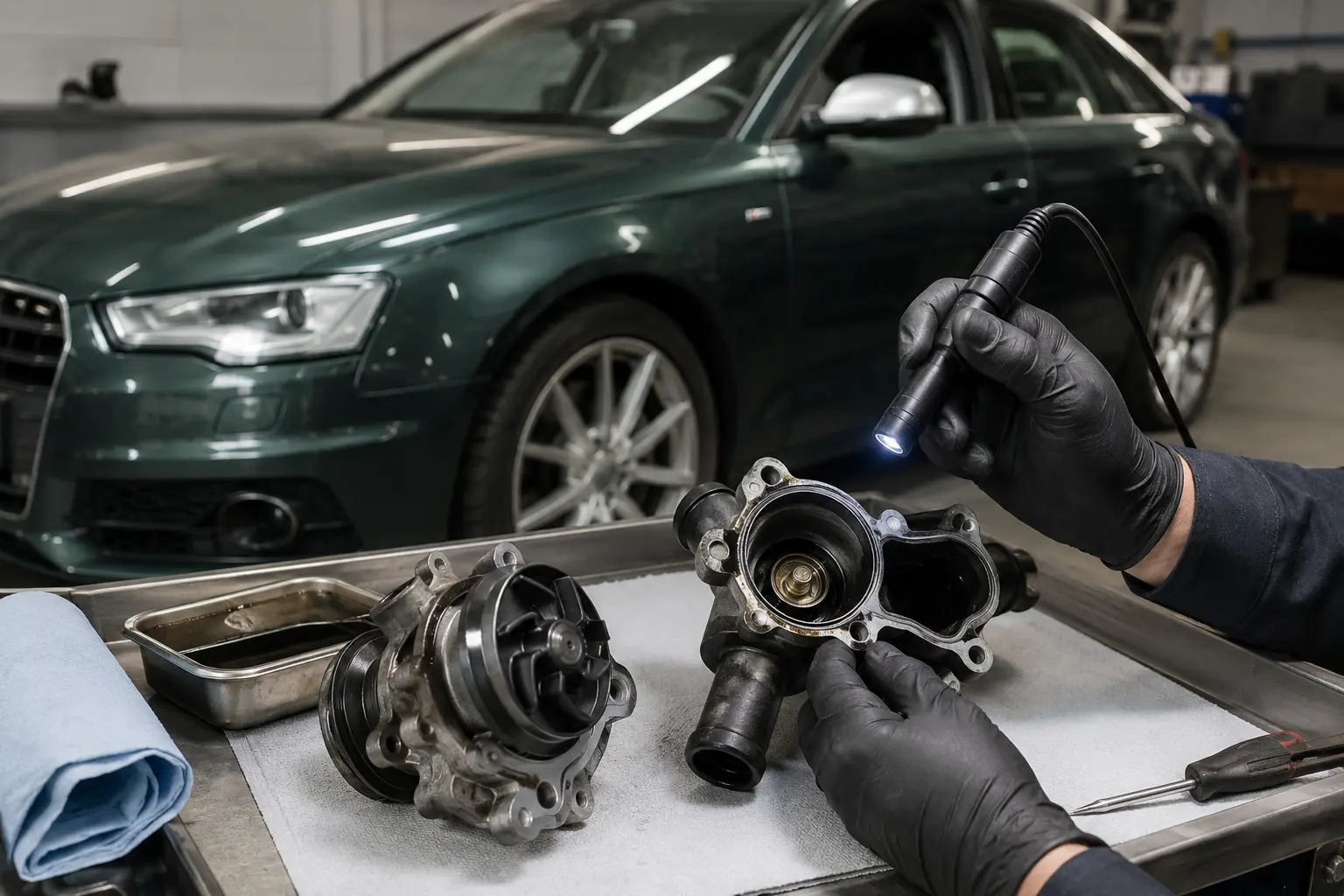
A leaking pump may leave dried residue around a vent or housing while still circulating. A pump with an impeller or control problem may circulate poorly without an obvious puddle. Access labour also varies widely: some assemblies are external and direct, while others share space with belts, covers, intake components or thermal-management modules.
Do not condemn the engine early
Combustion gas and cross-contamination
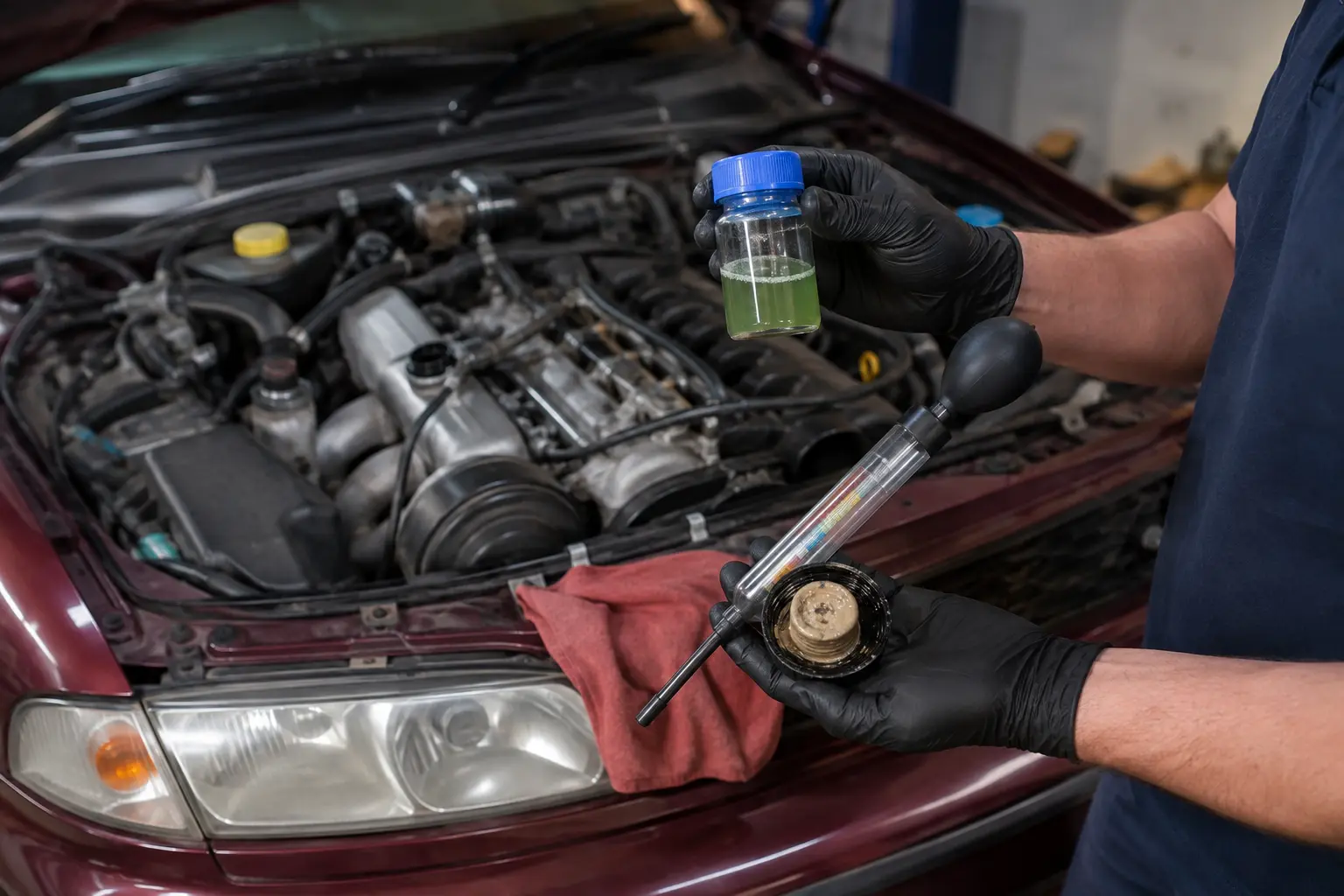
Repeated pressure from cold, coolant pushed out without a confirmed external leak, persistent bubbles, white exhaust vapour after warm-up, cylinder-specific misfire or mixed fluids can raise concern about an internal path. The next step is controlled testing, not an immediate head-gasket quotation.
A combustion-gas test can support the diagnosis, but its timing, fluid condition and the way the engine is tested matter. Pressure decay, cylinder leak-down, spark-plug condition, cooling-system behaviour and model-specific heat-exchanger routes may also be relevant. Oil in coolant can come from an oil cooler or another exchanger; coolant in oil may have several possible paths. Previous sealants or incorrect fluid can also distort what a sample looks like.
If testing supports cylinder-head, gasket or internal-engine work, the quotation should separate confirmation, strip-down, measurement, machining where applicable, fasteners, seals, fluids and reassembly. The Audi engine repair page owns that deeper mechanical scope. This page stays focused on identifying when that route is genuinely justified.
Tentative Dubai guide
Audi overheating diagnosis prices
These AED ranges are planning figures, not a quotation. They assume a normally accessible vehicle and standard workshop labour. Exact model, engine, cooling layout, parts tier, access, damage found and VAT treatment must be confirmed in the written estimate. Parts are included only where the row says so.
| Scope | Tentative AED range | Typically includes | Main variables |
|---|---|---|---|
| Initial overheating assessment | 250–450 | Event review, cold visual checks and focused scan | Model access and warning history |
| Cooling-system pressure test | 180–350 | Controlled cold pressure application and leak inspection | Undertray removal and slow leaks |
| Cap pressure check | 80–180 | Cap inspection and pressure-function check | Cap type and adapter availability |
| Combustion-gas screening | 180–350 | Indication test when symptoms justify it | Engine state and repeat testing |
| Coolant drain, fill and bleed | 350–750 | Labour and suitable coolant allowance | Capacity, vacuum fill and contamination |
| Expansion tank or cap replacement | 350–950 | Quality part, fitting and basic recheck | Model, sensor integration and parts tier |
| Accessible hose or flange repair | 450–1,250 | Part, seals, labour and coolant allowance | Location, brittle adjacent parts and access |
| Radiator fan electrical diagnosis | 300–650 | Command, supply, earth and circuit checks | Intermittency and front-end access |
| Fan assembly replacement route | 1,250–3,500 | Quality fan assembly and installation | Single/dual fan, controller and parts tier |
| Thermostat or housing route | 1,100–3,800 | Part, seals, labour, coolant and bleed | Engine layout and combined modules |
| Water-pump replacement route | 1,400–4,800 | Pump, seals, labour, coolant and testing | Mechanical/electric design and access |
| Radiator replacement route | 1,600–4,500 | Quality radiator, fitting, coolant and test | Cooling package, shutters and parts tier |
| Oil cooler or heat-exchanger route | 1,800–6,500 | Confirmed component, seals, fluids and cleaning allowance | Contamination extent and access |
| Internal-engine confirmation | 650–1,800 | Deeper pressure, leak-down or related testing | Engine access and test sequence |
Arithmetic shown clearly
Three hypothetical estimates
These examples explain how a written estimate may be assembled. They are not records of customer jobs and do not replace inspection.
Slow leak at an accessible flange
Focused assessment AED 300 + quality flange and seals AED 280 + labour AED 420 + coolant allowance AED 180 = AED 1,180 before any separately stated VAT. Additional brittle hoses or connectors would require approval.
Fan control fault with assembly replacement
Electrical diagnosis AED 450 + quality fan assembly AED 1,650 + installation AED 650 + final warm test AED 150 = AED 2,900 before any separately stated VAT. Front-end access and exact fan specification can change the total.
Water pump and thermostat module route
Diagnostic confirmation AED 400 + quality pump/thermostat module AED 1,850 + seals and coolant AED 350 + labour AED 1,200 = AED 3,800 before any separately stated VAT. The exact engine code decides whether these parts are combined.
Repair is not the last step
Final testing and handover
After an approved repair, the system is filled with the suitable coolant mixture and bled according to the vehicle’s arrangement. The repaired area is checked under pressure, live temperature behaviour is monitored through warm-up, cabin heat and fan operation are observed, and a road test is performed only when safe.
The handover should identify what failed, what was replaced or repaired, the parts tier used, whether contamination or previous sealant affected the work, and which checks were completed. The coolant level may be rechecked after a full heat cycle. If a fault can only be assessed after further driving or a separate internal-engine test, that limitation belongs in the written notes rather than being hidden.

Questions after a temperature warning
Audi overheating FAQs
Can I drive my Audi after an overheating warning?
Do not continue if the warning is red, the gauge remains high, steam or leakage is visible, the heater has gone cold, or the engine runs poorly. Move only as needed to reach a safe position, switch off and arrange recovery. Continuing can turn a contained cooling fault into major engine damage.
Should I open the coolant cap to check the level?
Never remove the expansion-tank cap while the system is hot or pressurised. Escaping steam and coolant can cause severe burns. Check the level only when the engine is fully cold and follow the vehicle instructions.
Does topping up coolant solve overheating?
No. Topping up may restore the level temporarily, but coolant does not normally disappear without a cause. Leakage, trapped air, a pressure fault or an internal path still needs to be identified.
Why does my Audi overheat only in traffic?
Low-speed overheating can involve fan command, fan hardware, electrical supply, blocked airflow or low coolant. Testing requested versus actual fan operation and live temperature is more reliable than assuming the fan motor has failed.
Why does it overheat at motorway speed?
Temperature rise at road speed can involve low coolant, restricted radiator flow, thermostat restriction, poor pump circulation or combustion pressure. Road airflow alone cannot overcome every circulation or heat-transfer fault.
Can a bad temperature sensor cause the warning?
Yes, a sensor, connector or wiring fault can create an implausible reading, but the real engine temperature must be verified before treating it as an electrical false alarm.
Why is the cabin heater cold when the engine is hot?
A cold heater during a temperature event can indicate low coolant, trapped air, interrupted circulation or restricted heater-core flow. It is a useful symptom, not proof of one particular part.
Does coolant in the oil always mean a head gasket?
No. A gasket or casting fault is possible, but oil coolers and other heat exchangers can also create cross-contamination. Fluid tracing and pressure tests should establish the route.
Can an Audi water pump fail without leaking?
Yes. A pump can have an impeller, drive, control or circulation fault without an obvious external leak. It can also leak while continuing to circulate, so both functions require assessment.
How long should an overheating diagnosis take?
A visible leak may be found quickly, while an intermittent hot-only fault can require cooling, pressure retention, warm monitoring and repeat testing. The workshop should explain which test stage is authorised rather than promise a universal time.
Will you replace the thermostat and pump together?
Only when the exact engine layout, confirmed fault, shared access, part condition and economics support doing so. Some Audi engines use combined or closely linked modules; others do not.
What should I send on WhatsApp?
Send the model, year, warning or gauge behaviour, driving conditions, whether the engine was switched off, coolant level when fully cold, visible leak area, recent cooling work and safe photographs. Do not restart a hot engine to make evidence.
Evidence without risk
What to record before recovery
Useful first notes describe the sequence, not a guessed part. They let a technician reproduce the right conditions and avoid discarding clues after the vehicle arrives cold.
Dashboard and timing
Record the exact warning colour and wording if it is safe to do so, whether the gauge moved, ambient conditions, traffic speed, journey length, engine load and whether the air conditioning or cabin heater changed. State whether the warning disappeared after switching off. A photograph is useful only when it can be taken without remaining in a hazardous road position or restarting the engine.
Coolant and ground marks
After the engine is fully cold, note the level relative to the tank marks and any dried pink, white or crusted residue. Photograph the ground, undertray edge and visible tank area. Do not crawl under an unsupported vehicle and do not add sealant. If coolant was added, record the product, quantity and time because that changes how concentration and contamination are interpreted.
Recent work and repeat pattern
List any recent pump, thermostat, radiator, hose, engine, air-conditioning or front-end work, even if it seems unrelated. Note whether the event repeats mainly at idle, after a motorway run, on acceleration or after parking. Include unusual fan noise, cabin-heat changes, misfire, smoke or fluid mixing. This pattern is more diagnostic than saying the car simply “runs hot.”
Recovery staff should be told if coolant is actively escaping, the vehicle cannot be started, steering or brakes feel different, or a warning instructs the driver to stop. The workshop should receive the keys, saved fluid container if relevant and the same notes, without anyone opening the hot system for confirmation.