
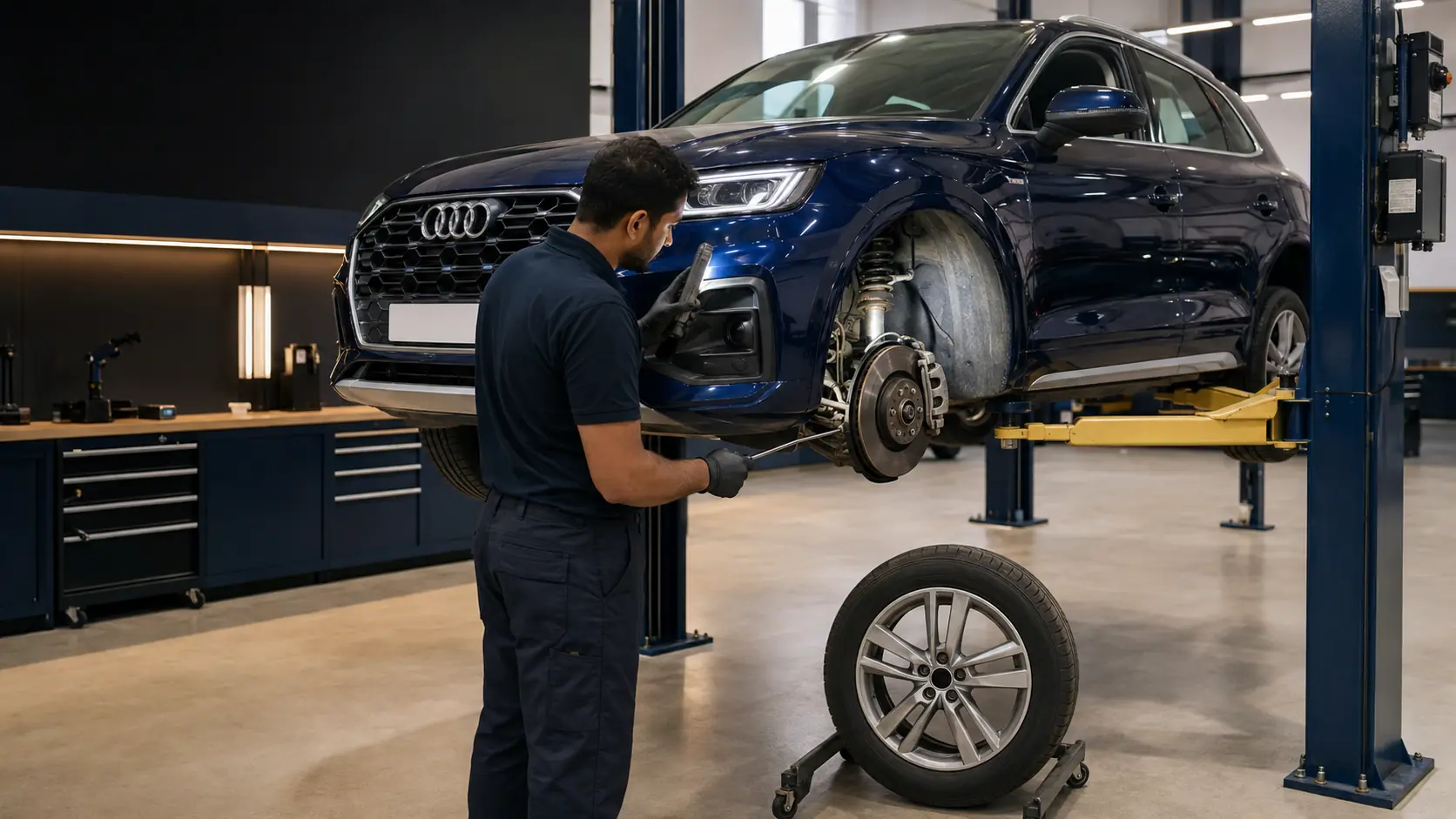
Noise, ride and height diagnosis
Audi Suspension Repair in Dubai
If your Audi knocks over bumps, feels unsettled, sits unevenly or shows a suspension warning, the first job is to identify the fitted suspension and reproduce the condition safely. We inspect tyres, wheels, steering mechanism, brakes, mountings and driveline overlap before naming a suspension part, then measure the relevant joints, ride height, geometry or electronic system using the correct vehicle procedure.
A sudden corner drop, tyre contact, severe steering looseness or loss of directional control needs recovery, not a road test. If control and tyre clearance still feel normal, avoid high speed and harsh driving and arrange an inspection promptly. A symptom selected online cannot confirm that the car is safe to drive. If a dashboard message is present, check the Audi suspension warning guide before moving the vehicle.
Describe the ride or steering change
Use what you know. Choosing “Not sure” is useful and will not block the message.
Safety first
Is it safe to drive
Check safety before trying to reproduce a noise. A workshop road test should happen only after the vehicle passes the initial steering, wheel-position, tyre-clearance and body-height assessment.
Stop driving
Arrange recovery
Do not continue if a corner has collapsed suddenly, the tyre or spring is contacting the body, a wheel appears displaced, a broken spring threatens the tyre, steering is severely loose, the car will not hold direction, or the body is unstable or bouncing without control. A dashboard instruction to stop belongs in this route. Keep clear of a self-levelling vehicle that may move.
Move carefully
Only if control remains normal
A mild new noise with normal steering, normal visible height, clear tyres and no stop warning may allow a short, careful move for inspection. Avoid high speed, abrupt steering, hard braking and rough surfaces. This is a cautious route, not an online assurance that the vehicle is safe.
Book soon
Do not wait for it to worsen
Persistent noise, uneven tyre wear, reduced ride comfort or a warning that returns still needs prompt inspection when no stop-driving condition is reported. The route may become more urgent once looseness, damage, heat, tyre contact or a ride-height fault is found.
Symptom navigator
Map the symptom
Start with what you can observe. Choose the symptom, its location and the condition that brings it on. The result shows the systems that overlap and the checks that separate them. It guides the inspection route; it does not diagnose the car or authorise a part replacement remotely.
What do you notice
Where do you notice it
When does it happen
Noise over movement or bumps
- What you report
- A knock over bumps, a creak while turning or a noise as the body takes load, at the front, rear or one corner.
- Systems that overlap
- Arms, bushes, joints, links, mounts, spring seating and fasteners overlap with steering, brakes, bearings, exhaust, undertrays and body contact.
- What we check
- After the safety gate, reproduce the surface, speed and steering input. Inspect tyres, wheels, mountings, seating, witness marks and movement using the correct procedure.
- What may follow
- Repair when applicable criteria confirm separation, abnormal movement, play, damage or hydraulic-bush leakage. Record superficial ageing that has not failed, or route a non-suspension source correctly.
Noise mainly under braking keeps brake and hub causes open. Noise while turning keeps steering parts, top mounts, spring seating and body contact open.
This route narrows the inspection. It does not identify a failed part or confirm that the vehicle is safe to drive.
Bounce harshness or poor control
- What you report
- Repeated bounce, floating, pitching, nose dive, excess body movement, harsh impacts or a change between drive modes.
- Systems that overlap
- Dampers, struts, springs, mounts and adaptive controls overlap with tyre construction, pressure, matching, load and wheel condition.
- What we check
- Record load, pressure, surface, speed and drive mode. Confirm the fitted system, apply its mechanical criteria and scan only when electronic damping or level control is fitted.
- What may follow
- Correct tyre or load conditions, investigate electronics, repair a confirmed spring or mounting fault, or replace a damper when supported. A generic scanner cannot state passive-damper life.
This route narrows the inspection. It does not identify a failed part or confirm that the vehicle is safe to drive.
Vibration pulling or steering feel
- What you report
- Vibration at speed, during acceleration, under braking or through steering, plus pulling or an off-centre wheel.
- Systems that overlap
- Joints, bushes, height and subframe position overlap with tyres, balance, runout, bearings, brakes, steering, CV joints, driveshafts and engine or gearbox mounts.
- What we check
- Classify when it happens, then check tyres, wheels, pressures and relevant balance or runout history. Keep brake, driveline and steering causes open under their matching conditions.
- What may follow
- Suspension, tyre, wheel, brake, driveline or steering work. Final alignment follows only after looseness, tyre damage, bent parts and ride-height faults are corrected.
This route narrows the inspection. It does not identify a failed part or confirm that the vehicle is safe to drive.
Uneven or changing ride height
- What you report
- One corner looks low, height changes after parking, the vehicle sits unevenly or levelling appears slow.
- Systems that overlap
- Coil springs, fitted air components, lines, connections, valve block, sensor linkage, calibration and compressor control overlap with ground, tyre pressure and load.
- What we check
- Confirm the system, then control ground, pressure, load, mode, settling and interval. Use the correct datum, applicable scan and approved leak route.
- What may follow
- Correct the set-up, repair a spring or seating fault, trace the air or control system, calibrate when required, or repeat the observation. Overnight sag proves no single part.
This route narrows the inspection. It does not identify a failed part or confirm that the vehicle is safe to drive.
Suspension warning or uncertain symptom
- What you report
- The exact dashboard message, an intermittent warning or a symptom that is difficult to classify.
- Systems that overlap
- Electronic damping, level control, sensors, wiring and supply overlap with wider chassis, voltage, communication and mechanical faults.
- What we check
- Record the wording or photo, confirm the installed system, scan the relevant module and preserve status, freeze-frame and useful live data. Compare them with physical evidence.
- What may follow
- Repair wiring or supply, test a sensor or actuator, investigate a mechanical fault, continue through Audi Diagnostics, or obey a stop instruction. A code is a lead, not a replacement verdict.
This route narrows the inspection. It does not identify a failed part or confirm that the vehicle is safe to drive.
Competing causes
What else feels similar
A symptom chooses the next test; it does not prove which component has failed. Road-speed, braking and acceleration conditions are particularly useful because they can move the investigation away from suspension.
| What you notice | Systems that overlap | First separating checks | Likely next route |
|---|---|---|---|
| Knock over a bump | Arms, bushes, joints, links, mounts, steering, brakes and body contact | Reproduce the exact input, inspect mountings and assess movement with the correct loaded or unloaded method | Repair the confirmed source, record a non-failed condition or continue tracing the noise |
| Vibration at steady road speed | Tyres, wheel balance, runout, bearings and suspension | Tyre and wheel condition, pressure, relevant balance or runout history, bearing and joint checks | Wheel repair or tyre work, bearing work, suspension repair or further diagnosis |
| Vibration mainly under braking | Brake discs, pads, hub condition, wheel and suspension movement | Brake and hub inspection plus checks for looseness that changes under braking load | Continue with brake and hub diagnosis; when pad or disc evidence is confirmed, see Audi Brake Repair |
| Vibration mainly under acceleration | CV joint, driveshaft, engine or gearbox mounts and suspension | Controlled reproduction under load followed by driveline, mounting and suspension checks | Driveline or mounting diagnosis when suspension does not explain it |
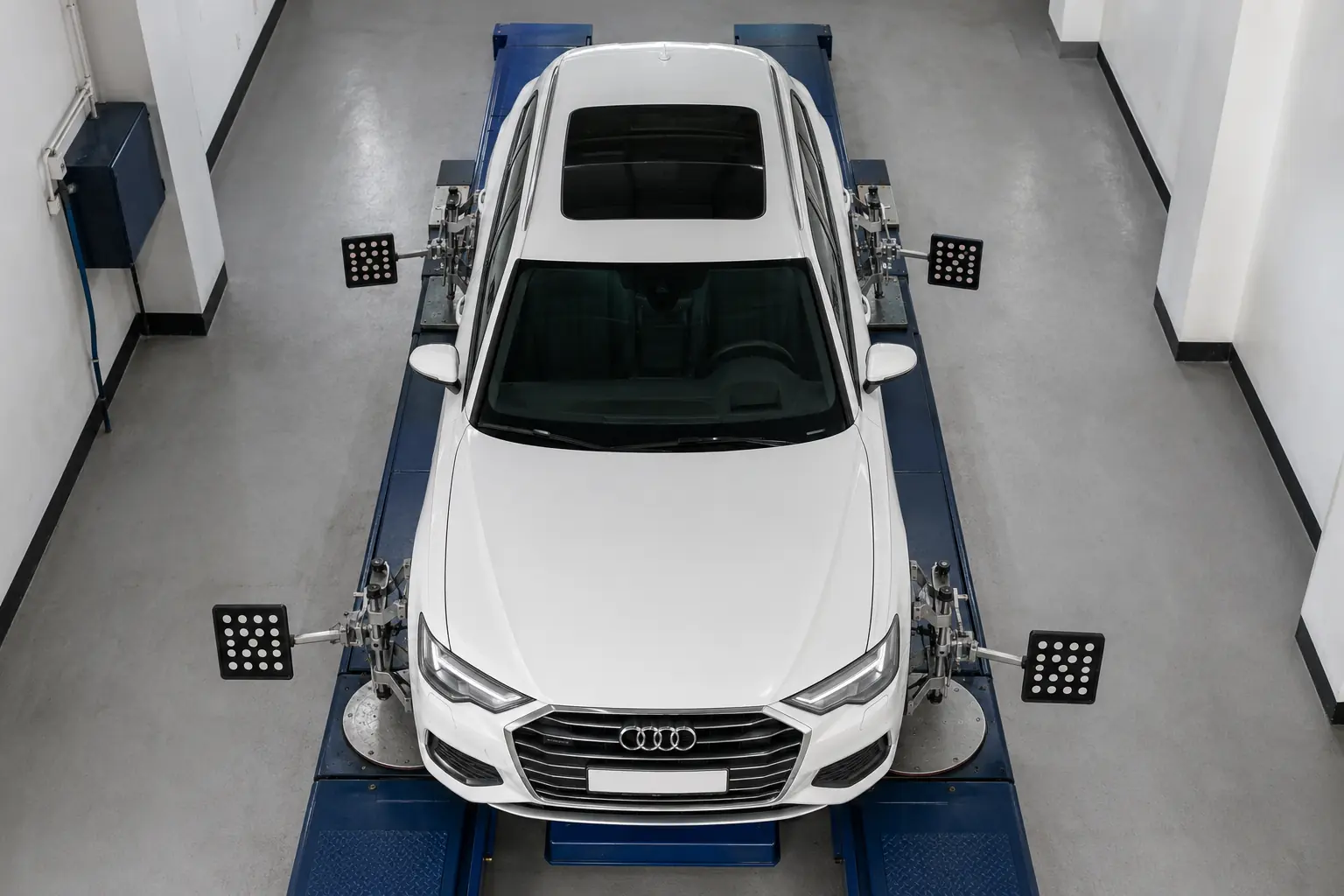
| Pulling or off-centre steering | Tyres, pressure, conicity, brake drag, alignment, height, joints, bent parts and subframe position | Tyres and pressures first, then looseness, height, brake drag and geometry | Correct the cause before final alignment |
| One low corner | Ground, load, tyre pressure, spring seating or breakage, air system, sensor and calibration | Comparable four-corner set-up, spring inspection, applicable scan and approved leak route | Mechanical repair, air-system diagnosis, required calibration or repeat observation |
| Suspension warning | Level control, adaptive dampers, wiring, voltage, network and mechanical condition | Exact message, installed-system confirmation, scan evidence and physical inspection | Chassis-system repair or wider diagnostic work |
Diagnosis before parts
How we diagnose the fault
Diagnosis starts by fixing the conditions of the complaint, not by choosing a replacement part. The same word, such as vibration or clunk, can describe several systems. Each stage below either narrows the route or stops an unsafe test from taking place.
Record the vehicle and condition
Record model, year, VIN or verified configuration, warning text, location, road speed, surface, temperature, load, drive-select mode and whether it occurs while turning, braking, accelerating or travelling straight. S line, quattro and drive select do not establish the fitted suspension.
Check ride height and tyre clearance
Inspect wheel position, tyre clearance, spring displacement, body height, steering security and instability before deciding on a road test. A vehicle that fails is not driven.
Reproduce the concern
When safe, use a controlled route and record the input and response. A single-wheel bump, steering load, braking or steady speed provides the useful distinction.
Check tyres wheels and overlaps
Confirm tyre sizes, matching, pressures, wear and damage. Check wheel condition and relevant balance or runout history while keeping brakes, bearings, steering, mountings and driveline open.
Read the fitted electronic system
Scan relevant chassis modules when electronic damping or level control is fitted. Preserve faults, status, freeze-frame information and useful live values. A code directs investigation; it does not authorise replacement.
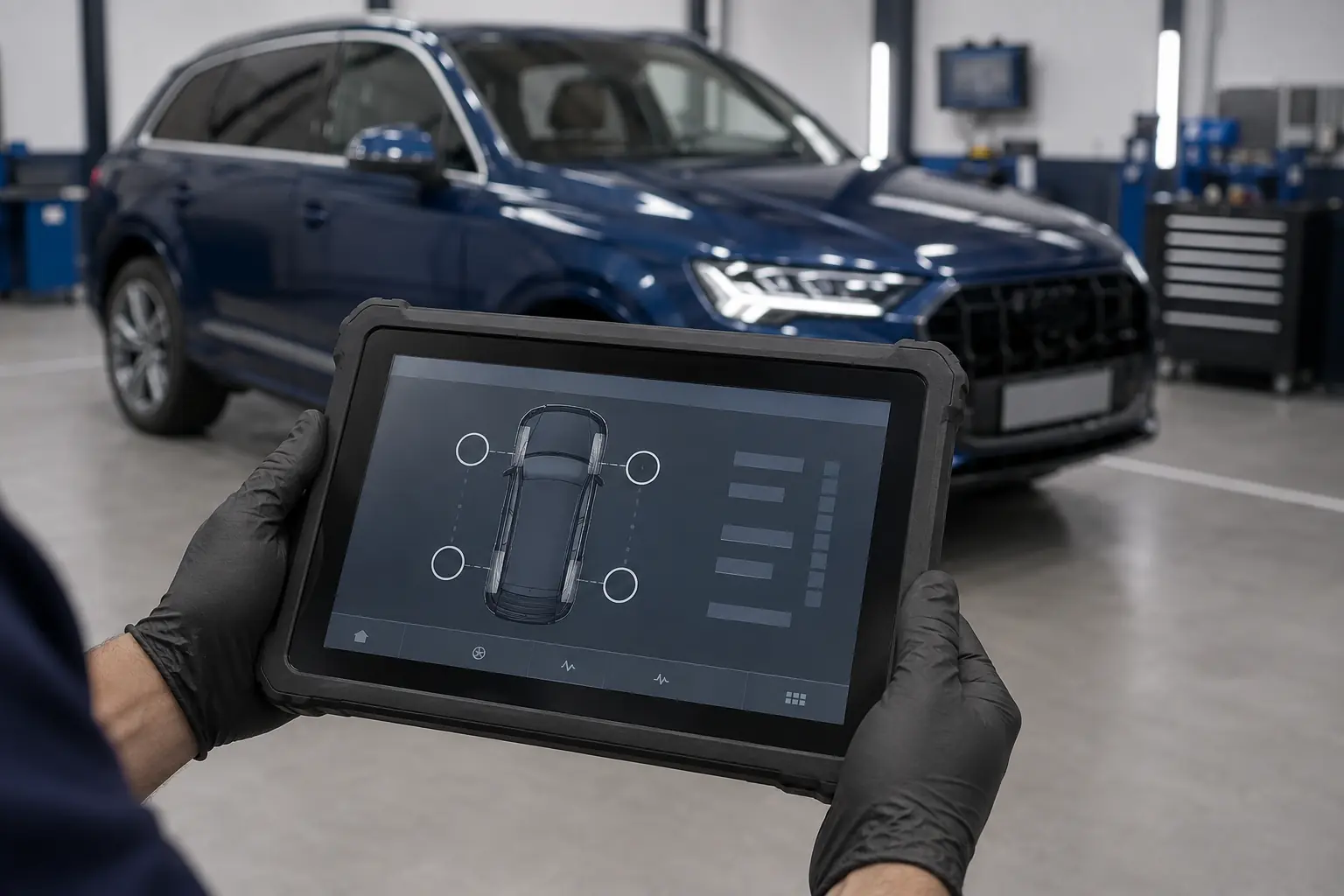
Inspect loaded and unloaded
Use the correct loaded or unloaded procedure to inspect arms, bushes, joints, anti-roll-bar parts, mounts, springs, seats, dampers, stops, boots, subframe mounts, wiring, sensors and fasteners.
Measure ride height correctly
Use level ground, the correct datum, controlled tyre pressures, defined load and prescribed settling. Wheel-arch appearance is not a specification.
Use the correct limit
Check play, runout, geometry or sensor values with the model-specific method and tolerance. No universal limit fits every Audi.
Correct faults before alignment
Resolve looseness, tyre faults, bent parts and ride-height faults before final alignment. The vehicle must be mechanically ready.
Complete settings when required
Basic settings, height calibration, steering-angle work, adaptation or coding follow only when the current procedure for the verified system requires them.
Verify the original symptom
Re-scan applicable modules, align where geometry was disturbed, repeat the relevant road condition and record whether the original symptom remains.
Mechanical inspection
Arms, bushes and joints
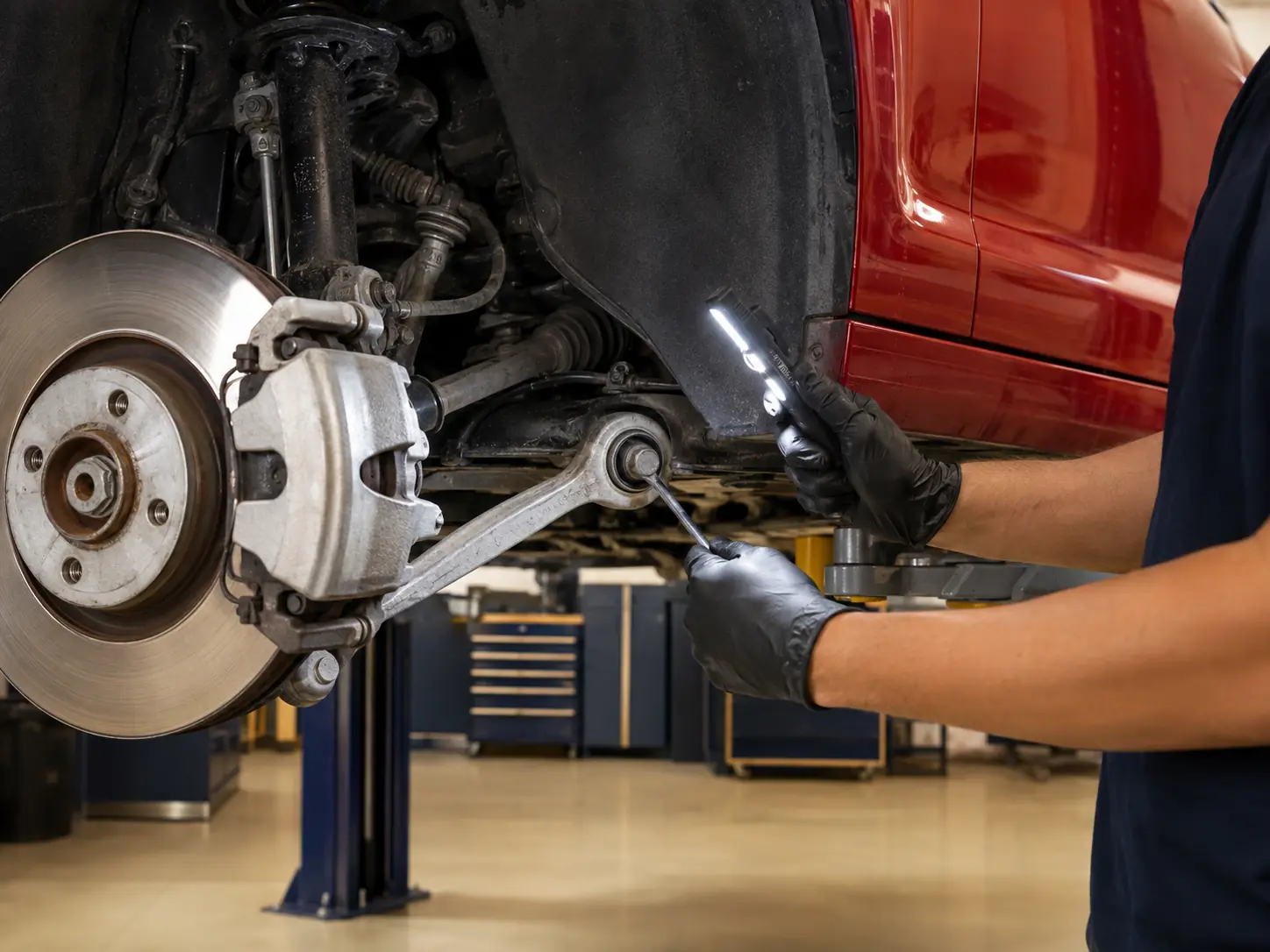
A control arm locates the wheel assembly. A bush isolates and controls movement at a mounting point. A ball joint permits controlled articulation. They are different components, and the estimate should say which one has evidence of failure.
Age can make rubber look weathered without proving that a bush has lost control of the arm. The useful evidence is separation, fluid loss in a hydraulic bush, abnormal movement under the specified check or a measurable joint fault. A torn joint boot and measurable joint play are also different findings and should be reported separately.
Once the fault is established, the next question is serviceability. Some bushes or joints can be replaced separately; another layout may require the approved complete-arm repair. Safety-critical arms and joints should not be heated, welded or straightened, and untraceable used parts do not belong in this repair route.
The fitting method matters. Specified single-use fasteners must be identified, and bonded-rubber bushes are tightened at the manufacturer-specified normal ride or control position where required so they are not locked in permanent twist. Whether one side or both sides are recommended depends on the procedure, part, age, condition, matching requirements and approved workshop policy. It is not one rule for every Audi.
Separate jobs and findings
Shocks, springs and mounts
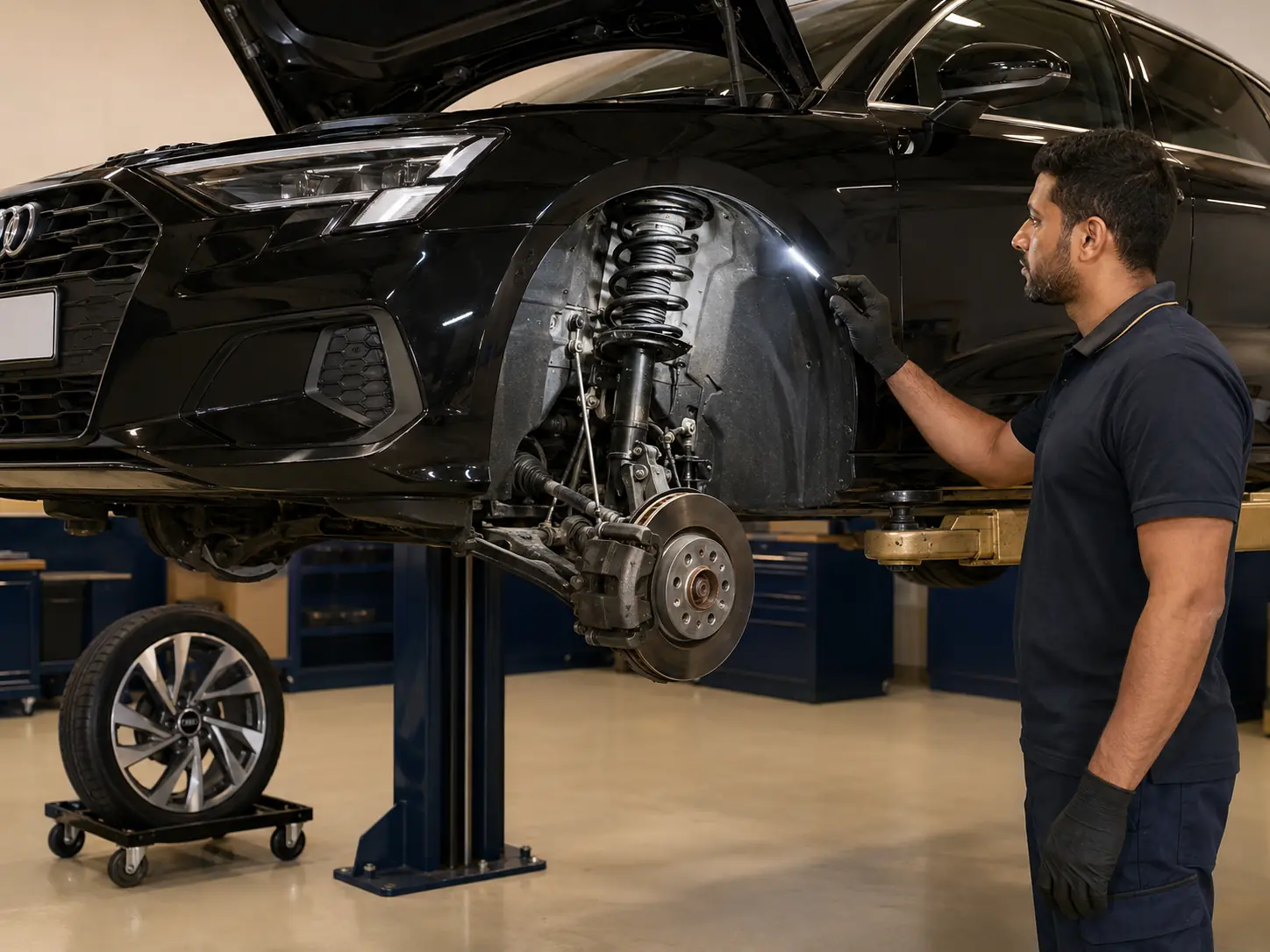
The spring supports the vehicle’s weight. The damper controls how movement settles. A structural strut carries suspension loads in a way that a separate shock absorber does not, while the top mount, spring seat, bump stop and dust boot each have their own job. Naming the part correctly changes the repair scope.
A broken or wrongly seated coil spring, a damaged mount, a degraded stop or boot and a worn damper are separate findings. Light surface misting on a damper is not automatically a confirmed failure; the applicable inspection criteria decide whether it is acceptable or evidence of loss. A passive damper has no universal replacement interval, and a generic scanner cannot measure its remaining life.
The A3 scene here shows an illustrative 8Y-generation A3 standard passive front McPherson set-up. It does not imply that every Audi uses the same architecture, and rear layouts vary. Platform, year, equipment and front or rear location change the components and access. One-side or matched-side replacement must follow the current procedure, part condition, matching needs and agreed policy rather than an automatic pair rule.
Configuration before diagnosis
Air suspension checks
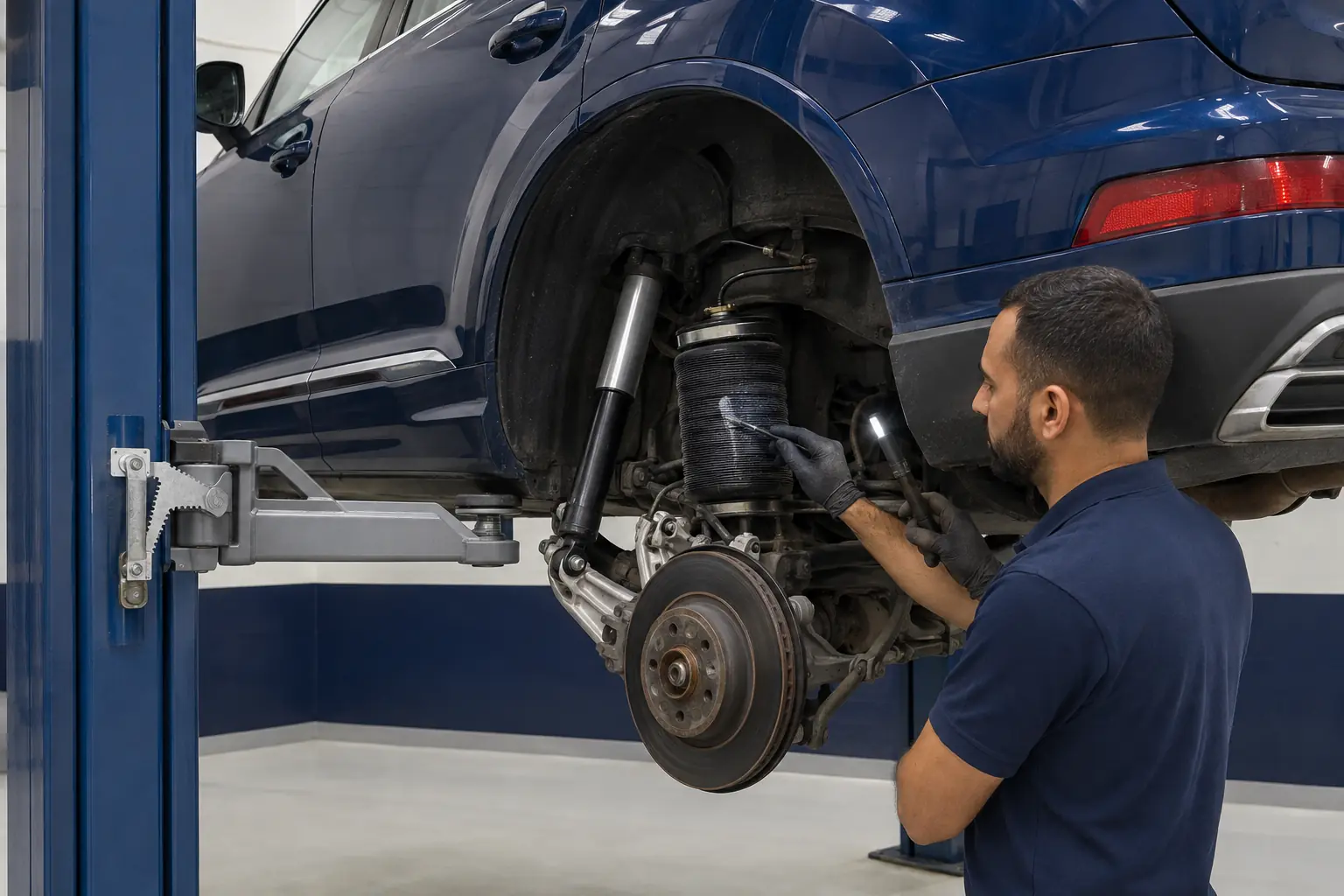
Air suspension is one fitted configuration, not a synonym for every adaptive Audi system. Passive steel-spring suspension with fixed dampers, fixed sports suspension, electronically controlled adaptive dampers, Audi magnetic ride, adaptive air suspension and Dynamic Ride Control require different checks. Audi magnetic ride changes damper force through magnetorheological fluid; it is not air suspension and does not provide ride-height change by itself. On applicable RS configurations, DRC uses diagonally cross-linked hydraulic dampers. S line, quattro and Audi drive select do not identify the installed hardware by themselves.
- Confirm the system. Use VIN, build date, equipment or PR codes, reliable parts data and physical inspection as applicable. An air spring and damper may be combined as an air strut or installed separately.
- Read electronic evidence. Record stored faults and live height-sensor values, then compare them with physical measurements. A code does not prove which mechanical part has failed.
- Establish a comparable height. Use calibrated four-corner readings on a level surface with controlled tyre pressures, load, suspension mode and settling procedure.
- Compare settled height. When the condition develops after parking, use the same set-up and a documented equal observation interval rather than judging the wheel arches by eye.
- Trace the fitted pneumatic path. Inspect the relevant bellows or air springs, separate or combined air struts, pipes, unions, valve block, reservoir or reservoirs and compressor or drier as fitted.
- Trace the electrical and control path. Check the fitted motor driver or relay, power supply, wiring, control evidence and height sensors or linkages using the vehicle-specific procedure.
- Measure only when supported. Compressor fill time, duty, thermal behaviour and pressure are useful only when the model-specific procedure defines how they are tested.
- Keep other adaptive systems separate. Adaptive dampers require wiring, connector, correct-part, mechanical and fault checks. Applicable RS models with DRC require model-specific pressure diagnosis and service equipment; DRC is not air suspension.
Why one low corner is not a verdict
A corner that settles may be caused by a bellows leak, pipe or connection, valve block, height-sensor linkage, calibration, control issue or another mechanical condition. A compressor can also be overworked by an unresolved leak elsewhere. Replacing only the compressor can leave the cause in place.
Work safely around stored pressure
Pressurised suspension lines require the approved depressurisation and service state. A self-levelling vehicle also needs correct mechanical support before anyone works beneath it. The air system or lift hydraulics alone must never be treated as protection against vehicle movement.

From observation to decision
What the measurements show
A measurement earns its place only when the vehicle is prepared correctly and the right procedure defines the datum. The purpose is to connect the reported condition to a finding that can be repeated, not to fill a report with universal numbers.
Repeatable knock
Test Controlled reproduction followed by the applicable loaded or unloaded movement check.
Finding Whether abnormal movement, contact or looseness can be localised.
Decision Repair the confirmed part, record a non-failed condition or continue tracing.
Height changes after parking
Test Comparable four-corner readings and an approved leak route where fitted.
Finding Whether height loss repeats and where loss is actually confirmed.
Decision Repair the proven source, investigate control causes or repeat the comparison.
Pull or off-centre steering
Test Tyres, pressures, brake drag, height, joint condition and geometry in the right order.
Finding Whether geometry remains the cause after other faults are corrected.
Decision Align only when the vehicle is mechanically ready.
Road-speed vibration
Test Tyre and wheel condition, relevant balance or runout history, bearings and joints.
Finding Whether suspension evidence explains the vibration.
Decision Route to wheel, tyre, bearing or suspension work.
Electronic warning
Test Exact message, installed configuration, module evidence, wiring and physical checks.
Finding Whether an electronic lead agrees with a measured or inspected fault.
Decision Repair the supported cause or continue wider diagnosis.
Damper surface film
Test Apply the relevant leakage and performance criteria.
Finding Whether the appearance is acceptable misting or evidence of loss.
Decision Record and monitor or replace only when criteria support it.
Scoped price guidance
Repair choices and cost
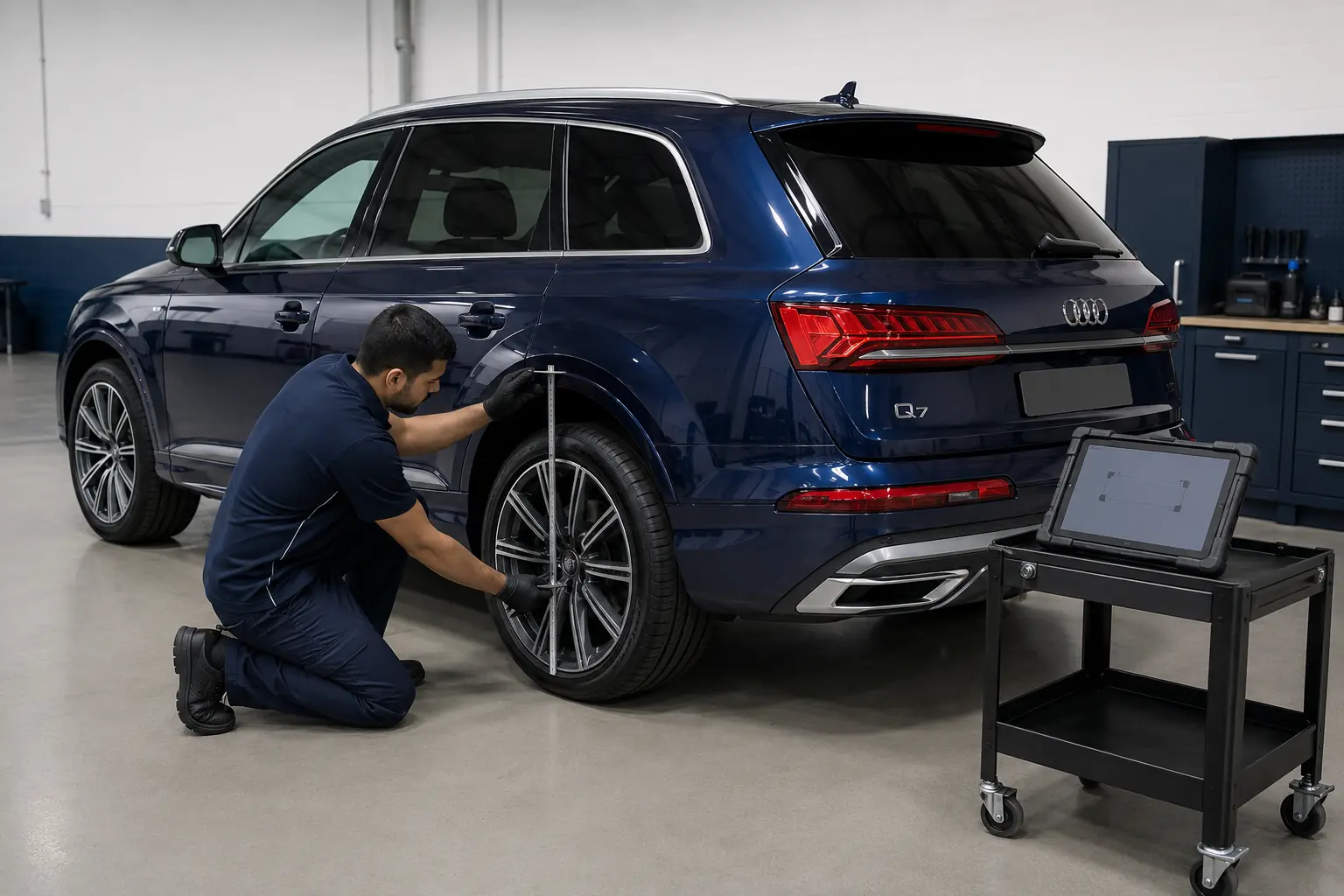
Suspension prices only make sense when scope and configuration are clear. An 8Y-generation A3 with standard passive front suspension, a Q7 4M air-suspension fault and an electronically controlled damper do not share one parts route or calibration requirement.
The figures below are public UAE market observations, not Audi Specialist fixed prices. Advertised inclusions vary and several listings do not confirm VAT, parts, labour, model, side or fitted suspension. A written estimate follows inspection and VIN or configuration confirmation.
| Scope | Public UAE market observation | What the written estimate must state |
|---|---|---|
| Initial suspension or air-suspension inspection | One Dubai workshop listing shows suspension-system diagnosis and air-suspension inspection as separate services, each from AED 200. | Diagnostic depth, road test if safe, electronic testing, labour, VAT and whether further testing is additional. |
| Audi control-arm bushing job | One public Dubai Audi listing states parts plus labour: A4 AED 1,200–2,000, Q5 AED 1,500–2,500 and A6 AED 1,800–3,000. | Exact location and bush count, parts brand or grade, hardware, alignment and VAT. The public listing does not confirm those details. |
| Complete control arm | One generic UAE workshop estimate, not Audi-specific, gives AED 300–2,000 each. | Front or rear, left or right, vehicle configuration, new-part route, labour, single-use fasteners, alignment and VAT. |
| Non-controlled shock absorbers | One generic UAE workshop estimate, not Audi-specific, gives AED 300–1,500 per pair. It does not establish suitability for adaptive, magnetic-ride or air systems. | Applicable passive layout, front or rear location and left/right scope, parts and labour, mounts, boots, stops, hardware, whether alignment is required by the exact procedure and VAT. |
| Structural struts | One generic UAE workshop estimate, not Audi-specific, gives AED 500–2,500 per pair; the public range does not define front/rear or left/right scope. | Applicable configuration, front or rear location and left/right scope, new-part route, labour, springs, mounts, bearings, hardware, whether alignment is required by the exact procedure and VAT. |
| Four-wheel alignment | One generic UAE estimate gives wheel alignment at AED 100–500. A separate Dubai four-wheel 3D listing starts at AED 210 and notes that luxury, air-suspension or lowered vehicles may cost more. | Measurement, permitted adjustments, report, seized adjusters, corrective parts, whether calibration is required by the exact procedure and VAT. |
| Anti-roll-bar links or bushes | VIN and finding based written estimate after diagnosis. | Front or rear and left or right scope, separate serviceability, new-part route, labour, hardware and VAT. |
| Coil springs mounts stops or boots | VIN and finding based written estimate after diagnosis. | Exact corner or matched sides, separate components, new-part route, labour, hardware, alignment and VAT. |
| Adaptive or magnetic-ride damper | VIN and configuration based written estimate after diagnosis. | Correct electronic damper, exact side, new-part route, labour, mounts, hardware, whether basic settings or alignment are required by the exact procedure and VAT. |
| Air spring or combined air strut | VIN and configuration based written estimate after leak diagnosis. | Exact fitted architecture and corner, new-part route, seals, labour, matched-side decision, whether calibration is required by the exact procedure and VAT. |
| Compressor | Written estimate only after the air leak, power supply and compressor behaviour are tested. | Exact part, new-part route, labour, fitted motor-driver or relay and supply work, unresolved leak repair, whether calibration is required by the exact procedure and VAT. |
| Valve block line connection or height sensor | Written estimate after the failed item and air path are confirmed. | Exact component and location, new-part route, labour, seals, wiring or line work, whether calibration is required by the exact procedure and VAT. |
| Basic settings or ride-height calibration | Configuration based written estimate only when the repair procedure requires it. | Exact procedure, prerequisite repairs, diagnostic time, alignment relationship, labour and VAT. |
| Dynamic Ride Control | Model-specific written estimate after DRC diagnosis. | Applicable RS model, pressure diagnosis, specialist equipment, parts, fluid, labour, repeat checks and VAT. |
What changes the quote
The final scope changes with VIN and configuration, front or rear and left or right location, passive or adaptive system, separately serviceable bush versus complete-arm design, parts route, specified single-use hardware, access and seized fasteners, alignment or calibration, tyre or collision damage, parts availability and approved warranty scope. Genuine Audi, traceable OE-supplier and reputable new aftermarket options must be labelled separately. Untraceable used safety-critical parts are not included.
Warranty and turnaround belong on the written estimate only when their exact boundaries have been approved. For adjacent ownership and routine-service cost context, see the Audi Service Cost Guide.
Public-market context checked 31 August 2026: PRO.CTO, The Mechanic Autos, Smart Mechanic UAE and iTyreCare. These are unstable public examples, not Audi Specialist prices or endorsements.
Worked diagnostic example
Q7 rear corner drops after parking
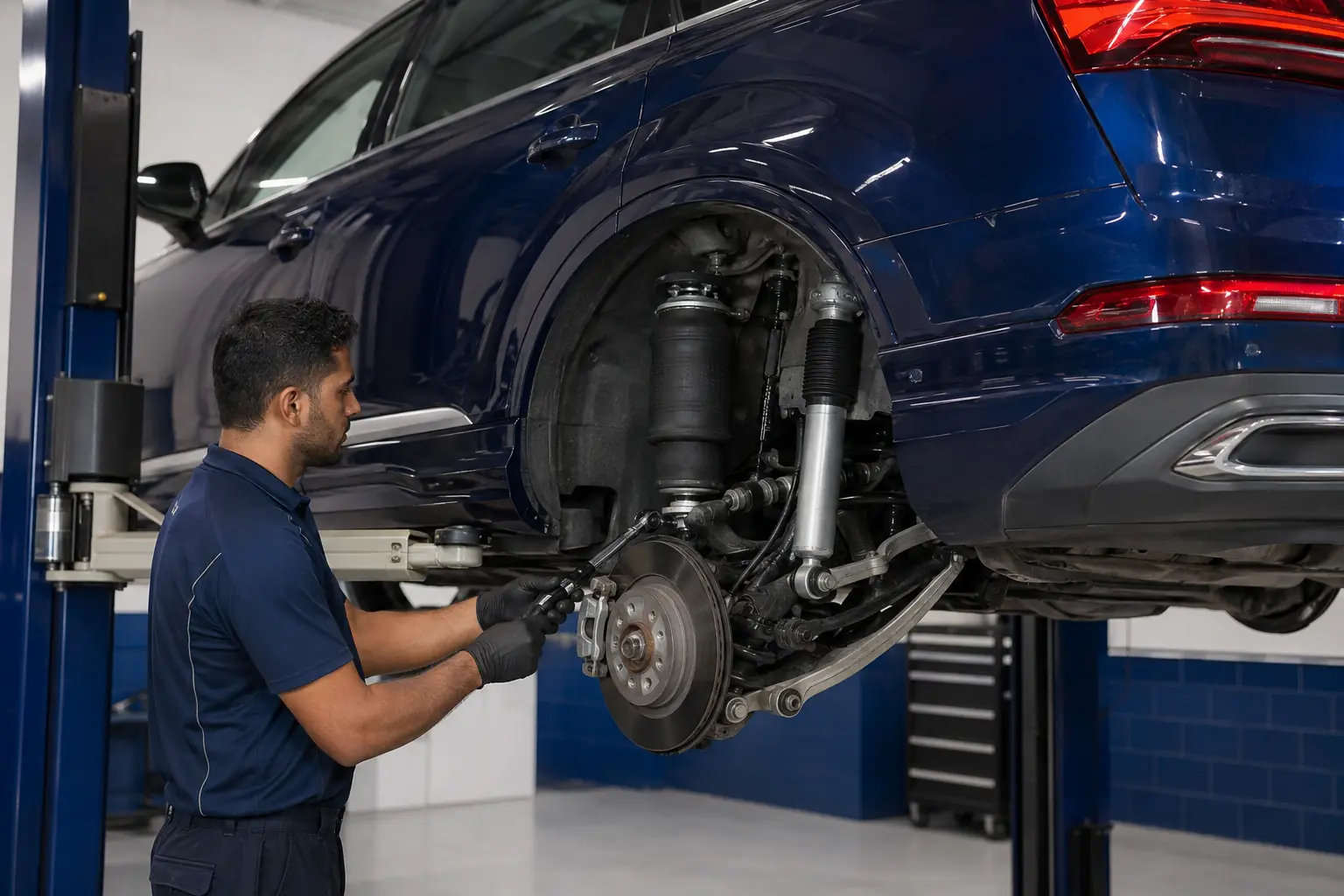
This illustrative example concerns a Q7 4M-generation configuration with adaptive air suspension. It is not the third-generation Q7 launched in June 2026, a customer record or a universal fault pattern.
Reported condition
The rear-left corner settles after parking and the compressor seems to run longer after restart. These observations prove neither an air-spring leak nor measured compressor duty, pressure or thermal behaviour.
Safety before movement
Check tyre clearance, body height, exact warning text and directional control before movement. A severe drop, contact or instability requires recovery.
Configuration confirmation
On a real vehicle, confirm the Q7 4M generation and fitted adaptive-air configuration through VIN, build or PR-code data, reliable parts information and physical inspection. This example claims no VIN lookup or part number.
Comparable four-corner baseline
Set each tyre to the vehicle-specified pressure for its position and load, match left to right, document the settings and hold them constant for both comparisons. Use the same level floor, defined load, suspension mode, completed normal levelling cycle and comparable ambient conditions. Read all four corners from the vehicle-specific datum and repeat after an equal interval. Wheel-arch appearance is not a specification; no invented millimetre values are used.
Level-control evidence
Scan level control and preserve status, freeze-frame information and useful live values. A fault remains a lead. Longer compressor operation becomes a result only when run time, pressure behaviour, thermal state, supply voltage and applicable data are measured correctly.
Leak source confirmation
The approved leak inspection confirms loss at the rear-left bellows and excludes the connected pipe, connection or union and nearby fittings. Consider a residual-pressure valve only if the VIN-specific air path includes one. Keep the line connected and the vehicle on locked mechanical support.
Compressor and valve checks
Do not condemn the compressor or valve block from those observations. Check supply, applicable fill and thermal behaviour, system response and other circuits. The bellows leak may explain extra compressor work; it does not prove compressor damage.
Repair choice
Select fitment from VIN, build or PR-code data. Decide one-side or matched-side work from procedure, age, condition, matching needs and policy. The estimate states the new-part route, seals, fasteners, labour, VAT, calibration and warranty boundary.
Installation
Install the selected new component with required seals and fasteners. Complete settings or height calibration only when the exact procedure requires it. Use the approved depressurisation, service state and support method.
Repeatable verification
Repeat the leak inspection and four-corner comparison after the same parking interval. Re-scan and repeat the controlled road condition against the original report.
Illustrative outcome
In this example, the record would show stable height during the defined period and no repeat symptom in controlled verification. This is not a customer result, prediction or lifetime guarantee.
Decision points recorded
- Whether the vehicle can move or needs recovery
- Whether the loss is proven at the bellows or remains elsewhere
- Whether evidence supports compressor or valve-block work
- Which verified fitment and new-part route is authorised
- Why one-side or matched-side replacement applies
- Whether calibration or alignment is required for the actual repair
Post-repair record
Checks after repair
A repair is complete when the original condition has been checked again under comparable conditions. The final route depends on what was disturbed and which suspension system is fitted. Alignment, calibration and coding are not automatic additions to every job.
- Confirm installed parts, seals, specified single-use fasteners and the required tightening position.
- Recheck tyre clearance, spring seating, mountings, wiring and visible ride height.
- Repeat the relevant joint, leak or four-corner measurement using the same controlled method.
- Complete basic settings, height calibration, steering-angle work, adaptation or coding only when the exact procedure requires it.
- Complete alignment when geometry was disturbed, after looseness, tyre faults and ride-height faults have been corrected.
- Re-scan fitted electronic suspension modules where applicable.
- Repeat the original controlled road-test condition and record whether the reported noise, movement, warning or height change remains.
Useful decisions
Suspension questions before booking
Is it safe to drive with a suspension noise
A mild new noise with normal control, normal visible height, clear tyres and no stop warning may allow a careful move for prompt inspection. A sudden drop, tyre contact, displaced wheel, severe steering looseness, inability to hold direction, major instability, uncontrolled bounce or a dashboard instruction to stop needs recovery. An online answer cannot confirm safety.
Does a clunk mean a control arm has failed
No. Arms, bushes, ball joints, anti-roll-bar parts, top mounts, loose fasteners, steering parts, brakes and body contact can create similar noises. The workshop must reproduce the exact condition and confirm abnormal movement, damage or another applicable failure criterion before naming the part.
Can a scan identify the failed suspension part
A scan can provide faults, status, freeze-frame information and useful live values when electronic damping or level control is fitted. It does not prove that a passive bush, arm or damper has failed. Even an electronic fault needs wiring, supply, mechanical and measurement checks before replacement.
Does one low corner mean the air spring has failed
Not by itself. Uneven ground, tyre pressure, load, a coil-spring problem, an air leak, pipe, connection, valve block, sensor linkage, calibration or control fault can alter height. Comparable four-corner readings and the approved leak or diagnostic procedure are needed to identify the route.
Must suspension parts be replaced on both sides
There is no single rule for every arm, spring or damper. The current repair procedure, component type, age, condition, matching requirements and approved workshop policy determine whether one-side or matched-side replacement is appropriate. The estimate should state the decision and its scope clearly.
Does every repair need alignment or coding
No. Alignment is relevant when geometry was disturbed or needs correction after looseness, damage, tyre and ride-height faults are resolved. Calibration, basic settings, adaptation or coding apply only when the verified system and repair procedure require them.
Can alignment fix pulling or vibration
Alignment can correct geometry, but it does not repair a loose joint, damaged or conical tyre, bent component, brake drag, wheel runout, bearing fault or unresolved ride-height problem. Those causes must be checked first. Acceleration-led or braking-led vibration may belong to the driveline or brake route rather than alignment.
How much does Audi suspension repair cost
The useful figure depends on the verified suspension system, exact corner or sides, whether a bush is separately serviceable, the new-part route, hardware, access, alignment and any required calibration. Use the indicative ranges above as market context only. A written estimate must state scope, inclusions, VAT status and configuration limit.
Prepare the first message
What to send us
Send the Audi model and year, or say if you are not sure. Add where the symptom is heard or felt, the road or parking condition that brings it on, the exact warning text or a clear photo, and whether the ride height changes after parking. Tell us immediately if a tyre contacts the body or the vehicle feels unstable.
Audi Suspension Repair
Suspension, inspection and model routes
These pages extend the decision path without replacing diagnosis or repeating the same service intent.