
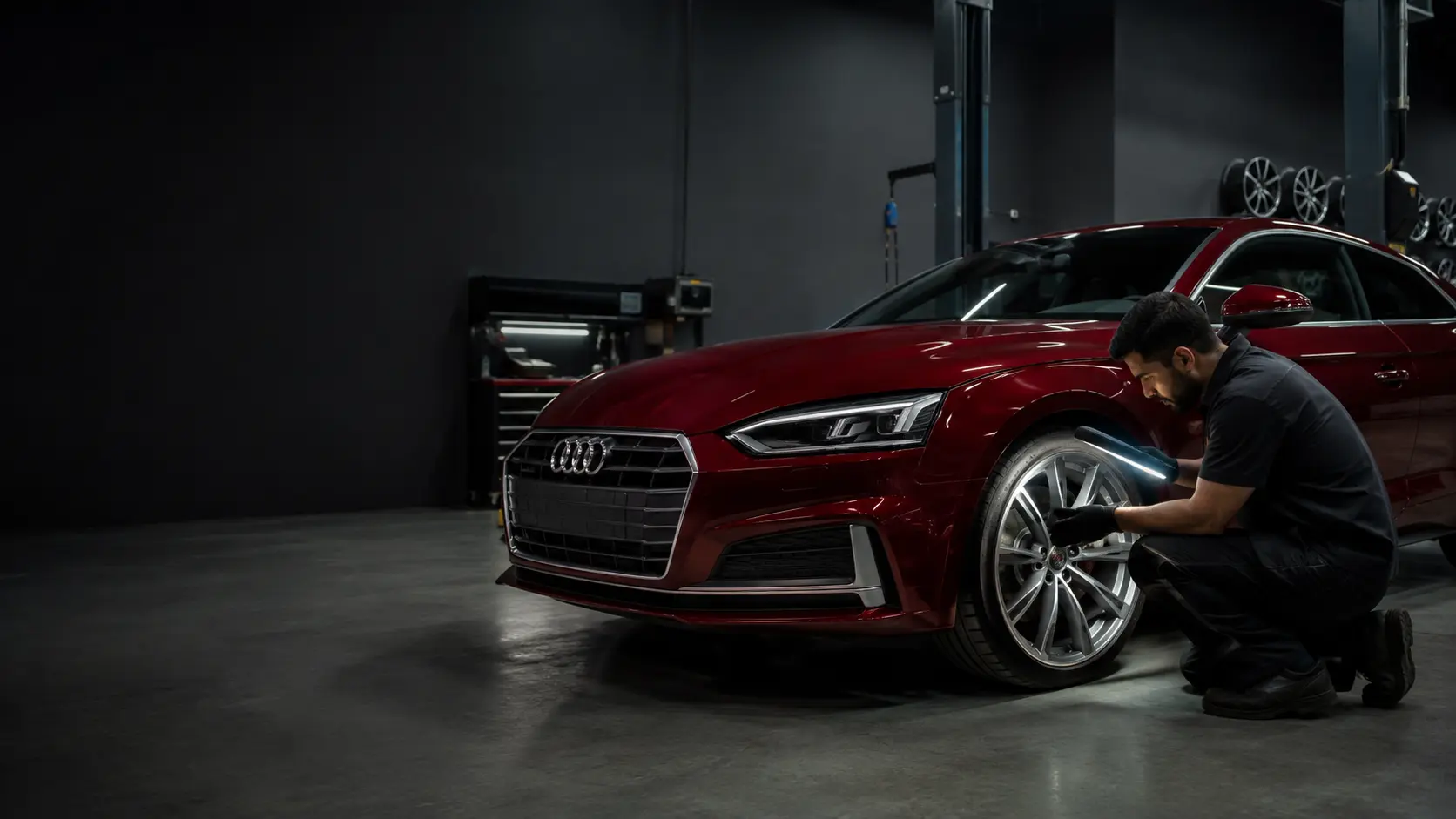
Audi rim and alloy wheel repair in Dubai
Audi rim and alloy wheel repair in Dubai is suitable only after the wheel is checked for bends, cracks, bead-seat damage and previous repairs. We separate cosmetic kerb rash from structural damage, identify painted or diamond-cut finishes, then explain whether the sensible route is refinishing, controlled straightening, a conditional crack repair or wheel replacement.
Some wheel damage needs the car parked
A rapid pressure loss, visible crack, badly distorted rim, tyre bead separating from the wheel, steering shake after a heavy impact or contact between the wheel and brake or suspension needs prompt inspection. Do not keep inflating a tyre that immediately loses pressure.
If the same impact also damaged a bumper, panel or structural mounting point, keep that separate from the wheel repair and use the Audi body-shop assessment for the collision scope.
Show us the wheel, tyre and damage
The first useful view is the complete wheel on the car. Add close photos of the damaged area, wheel size and tyre sidewall, plus the impact or driving symptom. The builder shows the message before WhatsApp opens.
Photographs can guide the booking, but repairability is confirmed only after tyre removal and inspection where the damage requires it.
Where the damage sits changes the decision
A scuff on the visible face is a different job from a bend on the inner barrel or a crack near a spoke. The tyre can hide damage that is not visible while the wheel remains on the car.
Outer rim lip
Common location for kerb rash, paint loss and light metal abrasion. Depth, distortion and finish type determine whether the job is cosmetic.
Wheel face
Chips, lacquer peel, staining and previous colour mismatch affect the refinishing route. Deep spoke damage needs closer inspection.
Spoke and hub area
Cracks or distortion near load-carrying spokes and bolt holes raise greater safety concerns. Replacement may be the correct route.
Inner barrel
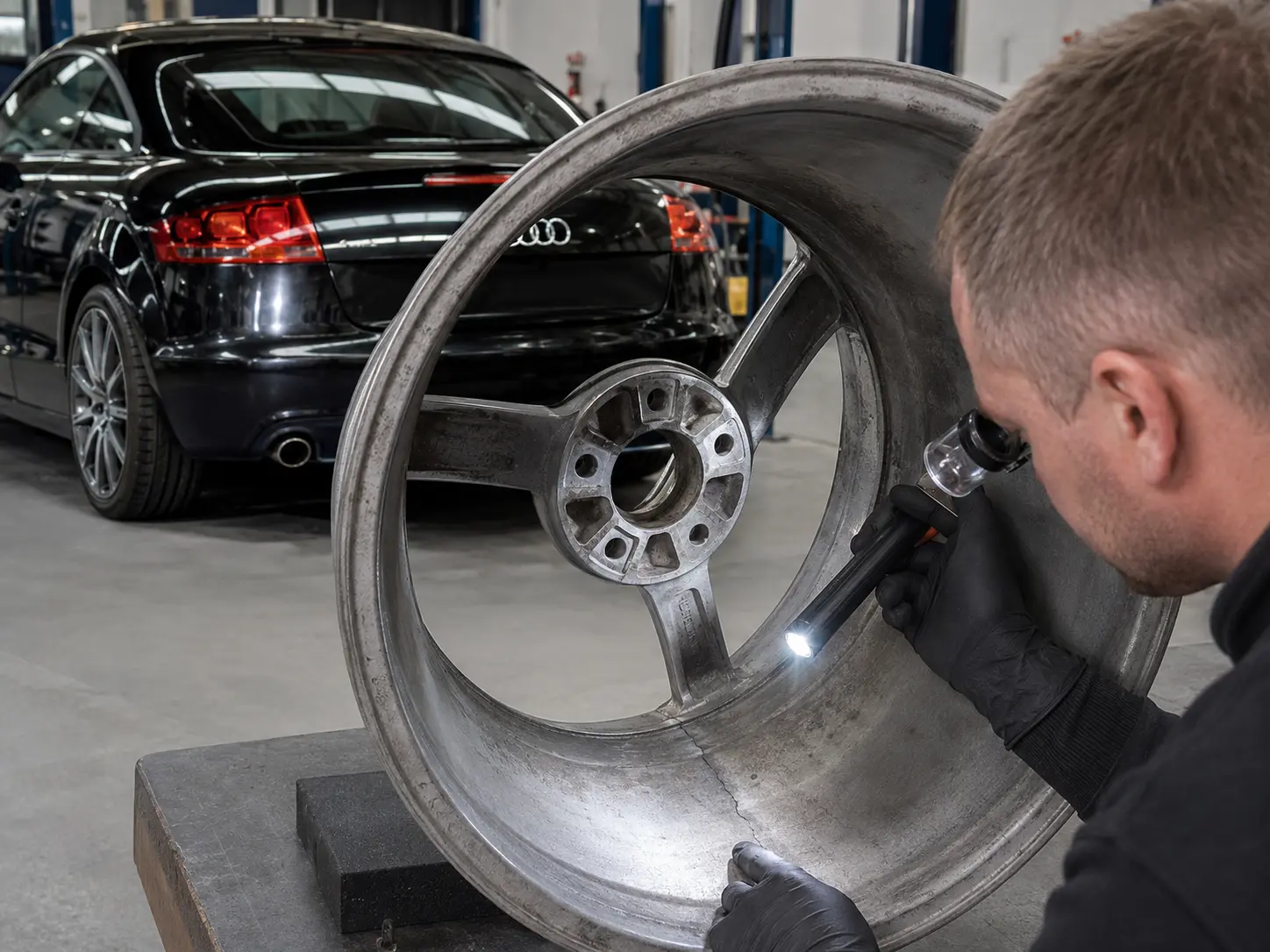
Pothole impacts often bend the inner rim where damage is difficult to see. Runout measurement and tyre removal expose the condition.
Bead seat
Corrosion, impact damage or poor prior repair can prevent the tyre from sealing. The tyre bead must also be inspected.
Centre bore and mounting face
Damage or contamination here can prevent the wheel from sitting correctly, creating vibration even when balancing figures appear acceptable.
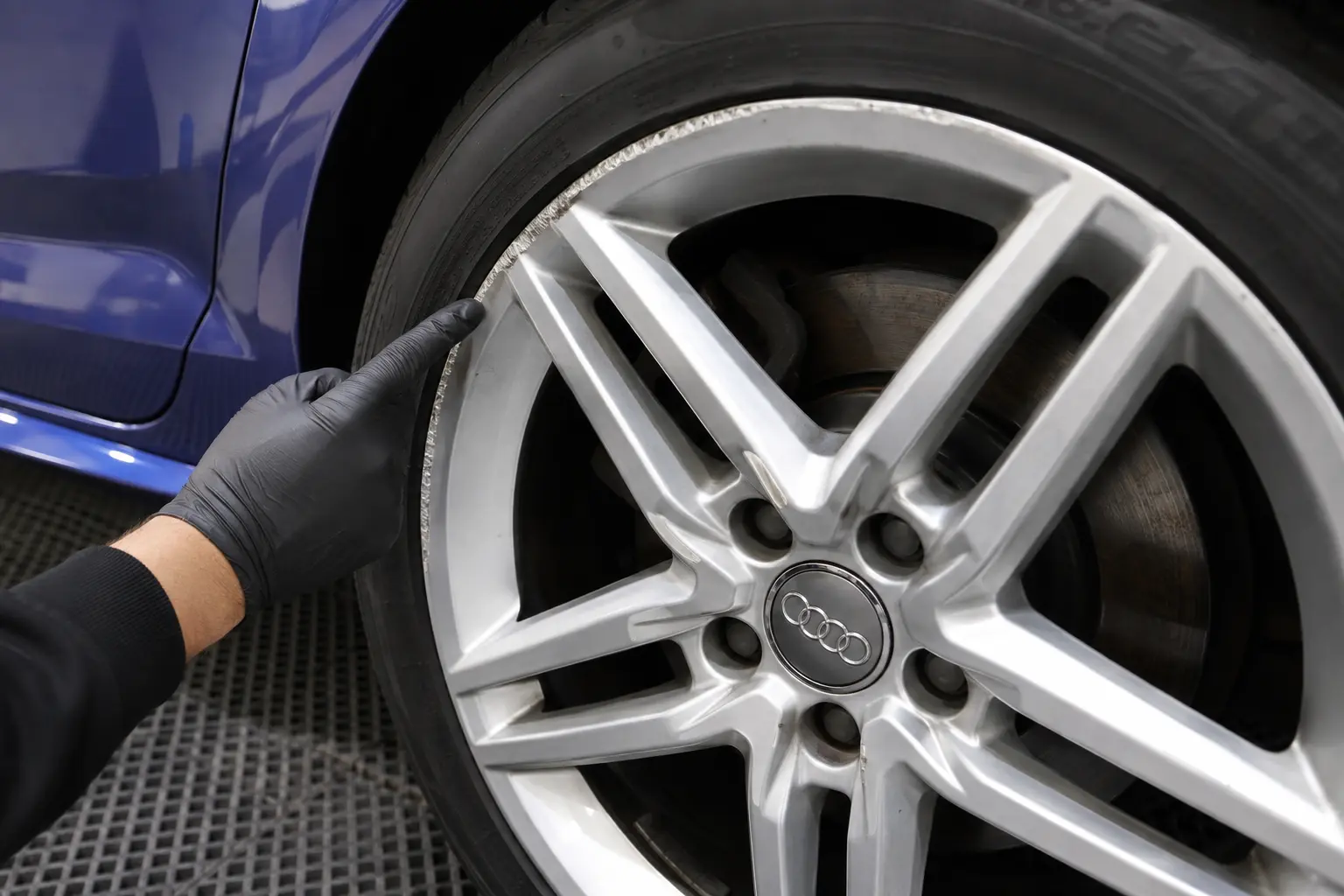
Kerb rash can be local, but finish matching is not automatic
Light damage may be limited to the outer lip and coating. The wheel still needs a check for a flat spot, crack or tyre-sidewall injury if the contact was hard. A quick surface repair can look acceptable at first yet fail early if corrosion, poor preparation or damaged lacquer remains underneath.
The finish controls the method. A painted wheel is prepared, filled where suitable, primed, colour-coated and lacquered. A diamond-cut face requires controlled machining only when enough material remains and the wheel design and previous cut history permit it.
From surface mark to replacement decision
The safest route is based on damage location, depth, runout, crack direction, prior repairs and the wheel’s construction, not on appearance alone.
Photograph
Record wheel face, damage, tyre size and complete vehicle context.
Measure
Check radial and lateral runout, pressure loss and mounting condition.
Expose
Remove the tyre when the inner barrel, bead seat or crack needs inspection.
Classify
Separate cosmetic coating damage from controlled structural work.
Choose
Refinish, straighten, repair conditionally or replace the wheel.
What each finding usually changes
| Finding | First checks | Possible route | Related work to keep separate |
|---|---|---|---|
| Light kerb rash | Depth, coating, tyre sidewall and local distortion | Local or full-face cosmetic refinish | Tyre replacement only if the tyre is damaged |
| Lacquer peel or corrosion | Extent under coating and finish type | Strip, prepare and refinish | Colour change is a separate choice |
| Steering or seat vibration | Tyre condition, balance, runout and mounting face | Straightening only if a repairable bend is confirmed | Balancing and alignment have different purposes |
| Slow air leak | Tyre puncture, valve, bead seat, crack and porosity | Bead-seat repair or crack decision | TPMS sensor and tyre repair priced separately |
| Visible crack | Location, length, direction, prior weld and wheel construction | Conditional specialist repair or replacement | Do not refinish before repairability is decided |
| Severe flat spot or distortion | Runout, spoke movement, mounting face and tyre impact | Replacement where controlled straightening is unsuitable | Inspect suspension and alignment after a heavy impact |
| Diamond-cut face damage | Cut history, remaining material, corrosion and edge depth | Machine and lacquer if safely suitable | Painted conversion is an alternative finish decision |
Balancing cannot remove a bent-wheel shape
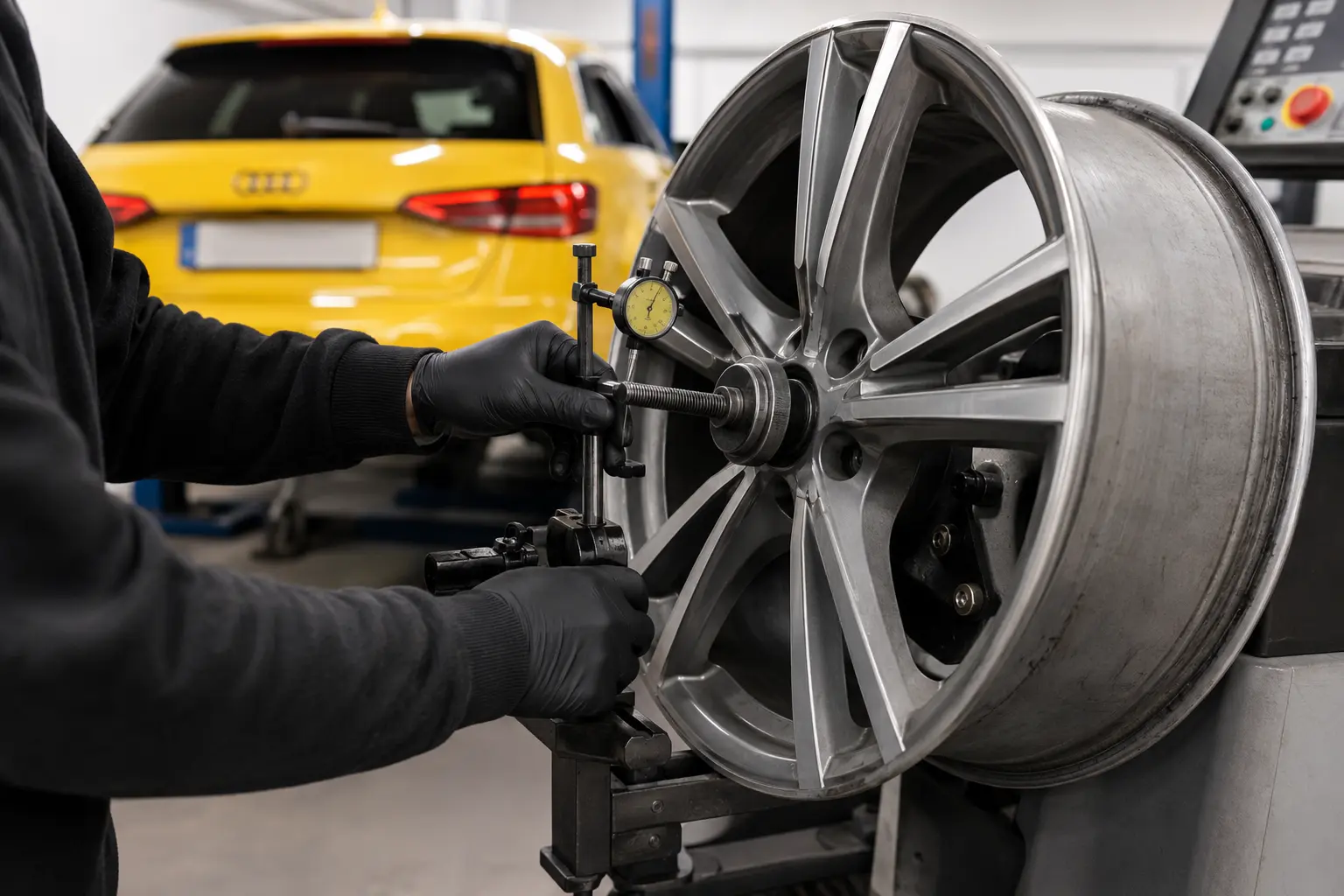
Wheel balance corrects uneven mass. Runout measures how far the rim moves away from a true circle or side-to-side plane as it rotates. A wheel can balance on the machine and still cause vibration if it is distorted. A tyre with internal damage can create a similar complaint.
We compare the wheel and tyre separately when needed. Controlled straightening is considered only after the bend location and severity are measured. Heat, pressure and movement must be controlled; repeated or severe deformation can make replacement the better choice.
Match the original look or choose a deliberate change
The estimate should name the intended finish and whether the work covers one wheel or a complete set. A perfect isolated match cannot be promised when the other wheels have aged differently.
Painted finish
Suitable for solid silver, graphite, black and many multi-stage painted looks. Preparation and colour control matter more than simply spraying over the damage.
- Can cover repaired surface areas consistently
- Allows an intentional colour change
- Clear coat protects the final colour
Diamond-cut finish
The bright face is cut on a lathe, often beside painted pockets. Each cut removes material, so previous refinishing and damage depth affect suitability.
- Wheel must be measured and mounted accurately
- Machining cannot continue indefinitely
- Lacquer-edge corrosion can return if damage recurs
Polished or specialist finish
Some surfaces require a different preparation and coating route. Photos help identify the appearance, but inspection confirms the actual construction and finish layers.
- Finish sample may be needed
- Repair time can differ from standard paint
- One-wheel matching has natural limitations
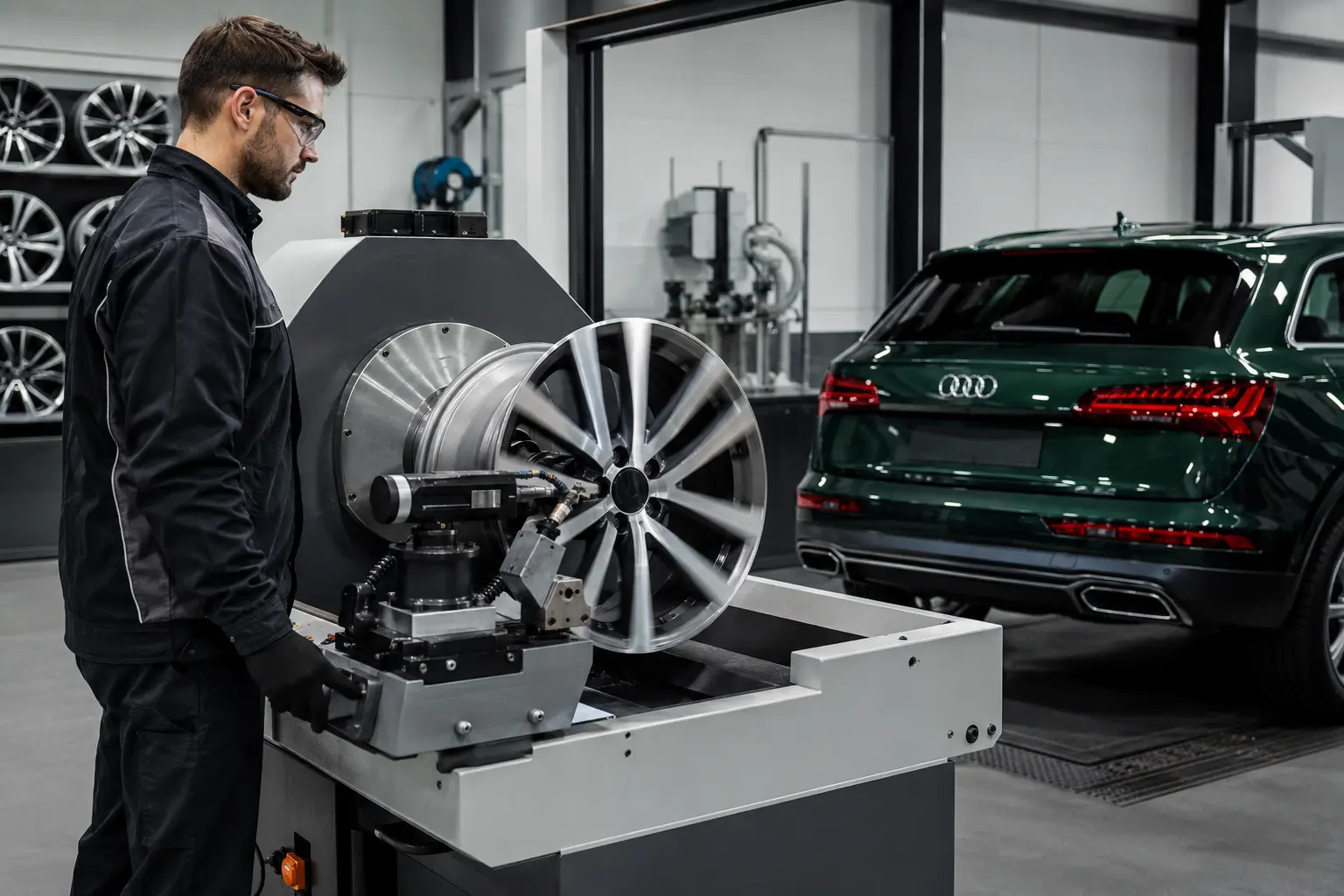
A fresh machine cut must leave enough wheel
Diamond-cut refurbishment is not a deeper version of sanding. The face is measured and machined to create the bright pattern, then protected with lacquer. Damage that would require excessive material removal, distortion that prevents accurate mounting, or a wheel that has already been cut repeatedly may not be suitable.
If a further cut is unwise, a painted conversion may be discussed as a visual alternative, provided the wheel itself remains structurally acceptable. That choice should be agreed across one wheel or the full set because the appearance will change.
The wheel can move down four different paths
Prepare and refinish
For coating damage, kerb rash and suitable surface marks without structural distortion. The finish specification is agreed before work.
Controlled straightening
For repairable distortion where location, severity and wheel condition support controlled correction and remeasurement.
Conditional repair
Only after tyre removal and assessment of location, direction, prior work and the effect on sealing and structure.
Wheel replacement
Recommended for unsuitable crack locations, severe distortion, damaged mounting areas, repeated failures or a repair that cannot carry a sensible boundary.
If the impact has changed ride height or created suspension noise, book an Audi suspension inspection. If the wheel is structurally serviceable but the steering wheel is off-centre or the car pulls, use Audi wheel alignment after tyre and wheel safety are confirmed. Other workshop concerns can be routed through the Audi repair services hub.
A visible crack is not automatically a welding job
The tyre is removed so the inner barrel, bead seat and both ends of the crack can be inspected. Location matters. Damage near spokes, the hub, mounting face or a highly stressed transition can carry a different risk from a limited inner-lip crack. Previous welds, multiple cracks and broad distortion change the decision again.
Where repair is not suitable, we explain the replacement route. If a conditional specialist repair is considered, the estimate should separate structural work, straightening, refinishing, tyre refitting and balancing.
Only the rows that fit this service
These tentative Dubai planning bands include 5% VAT. Wheel size, finish, damage location, tyre condition, previous repairs, colour matching and whether one wheel or a set is booked can change the estimate.
| Inspection or work | Tentative AED | Scope and boundary |
|---|---|---|
| On-car wheel and tyre assessment | 210–420 | Visible damage, pressure, tyre and driving complaint review; tyre removal excluded. |
| Tyre removal and internal inspection | 158–315 | Per wheel where crack, bead seat or inner barrel must be exposed. |
| Runout measurement | 158–315 | Radial and lateral measurement on the removed wheel; straightening excluded. |
| Local painted kerb-rash repair | 315–630 | Suitable limited cosmetic damage on one wheel; exact matching limitations apply. |
| Full painted wheel refinish | 525–945 | Strip or prepare, repair suitable surface damage, colour and lacquer per wheel. |
| Diamond-cut refinish | 630–1,260 | Per suitable wheel after cut history, damage depth and runout checks. |
| Minor controlled straightening | 420–840 | Per repairable bend, including remeasurement; finish repair may be separate. |
| Complex straightening assessment and work | 735–1,365 | For more involved repairable distortion; replacement may still be advised. |
| Bead-seat preparation and sealing repair | 420–840 | Per wheel where corrosion or surface damage prevents sealing; tyre faults excluded. |
| Conditional crack repair route | 630–1,260 | Only for a suitable location and wheel; tyre removal, refinish and balancing may add cost. |
| Colour or finish matching allowance | 210–525 | Additional work for sample matching or aged adjacent wheels where needed. |
| TPMS valve or service item | 158–420 | Per wheel depending on sensor type and service parts; sensor replacement excluded. |
| Wheel balancing | 105–210 | Per wheel after repair or tyre refit; does not correct a bent wheel. |
| Four-wheel alignment check | 315–525 | Separate service after impact or when steering and tyre wear justify it. |
| Replacement Audi wheel | VIN quote | Depends on size, design, finish, new or used source and confirmed part number. |
Four ways a total can be assembled
These are hypothetical arithmetic examples including 5% VAT. They are not customer jobs or quotations for a particular Audi.
Painted kerb-rash repair
One wheel has limited cosmetic damage and no tyre or runout issue.
- Assessment
- AED 210
- Local repair
- AED 420
- Balance
- AED 105
- Total
- AED 735
Diamond-cut refinish
One suitable wheel needs tyre removal, machining, lacquer and balancing.
- Internal inspection
- AED 210
- Diamond-cut refinish
- AED 840
- Balance
- AED 126
- Total
- AED 1,176
Bent wheel after impact
Runout confirms a repairable bend and alignment is checked after the impact.
- Runout measurement
- AED 210
- Straightening
- AED 630
- Balance
- AED 126
- Alignment check
- AED 420
- Total
- AED 1,386
Conditional inner-lip crack repair
Tyre removal confirms one suitable crack and the approved route includes refinishing.
- Inspection
- AED 263
- Crack repair
- AED 840
- Painted refinish
- AED 630
- Balance
- AED 147
- Total
- AED 1,880
Measure before pressure, then measure again
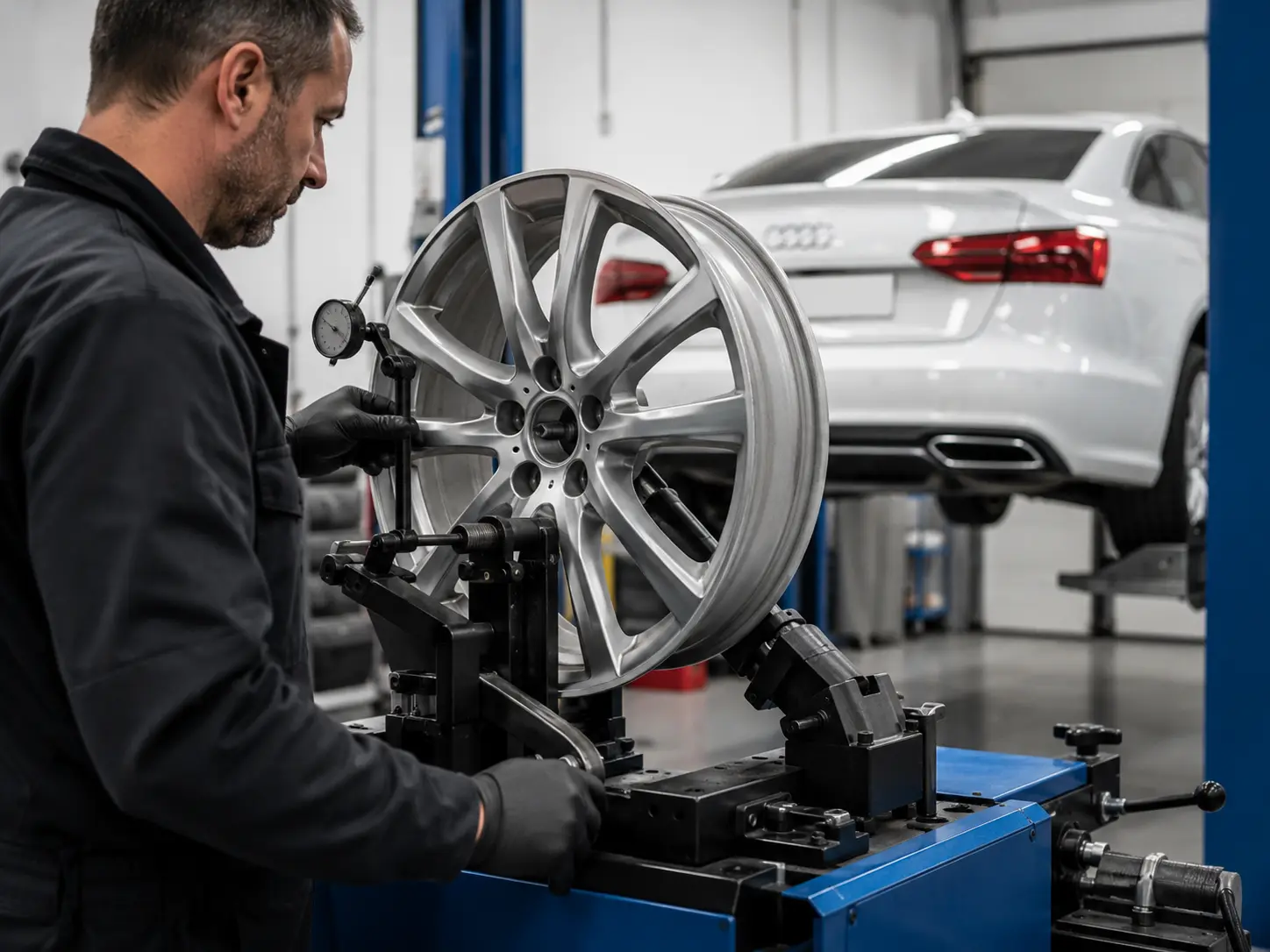
The wheel is secured on suitable equipment and the bend is mapped. Correction is gradual and monitored. The aim is to restore acceptable geometry without chasing a number through excessive movement. The wheel is remeasured after the correction and inspected for any new evidence that changes repairability.
Straightening does not repair a damaged tyre, worn suspension, poor hub mounting or alignment. Those systems remain separate even when the original impact affected more than one area.
From wheel intake to refitting
Record the complaint and finish
We note the impact, vibration, pressure loss or cosmetic concern, then identify wheel size, finish and whether the customer wants an original-look repair or deliberate change.
Inspect the tyre and mounted wheel
Tyre sidewall, pressure, valve, wheel face, visible rim edges and mounting condition are checked. A heavy impact can justify suspension or alignment inspection.
Remove and measure where required
The tyre is removed for inner-barrel, bead-seat or crack inspection. Runout is measured when bend or vibration is suspected.
Agree the repair limits
The estimate separates structural work, cosmetic finish, tyre and TPMS handling, balancing and alignment. Replacement is recommended where repair is unsuitable.
Repair and refinish
Approved correction, preparation, colour, machining and coating steps follow the agreed wheel and finish route.
Refit and verify
The tyre bead and sensor are handled correctly, the assembly is balanced, and the wheel is fitted with clean mounting surfaces and the correct tightening procedure.
Wheel repair includes careful removal, not automatic tyre replacement
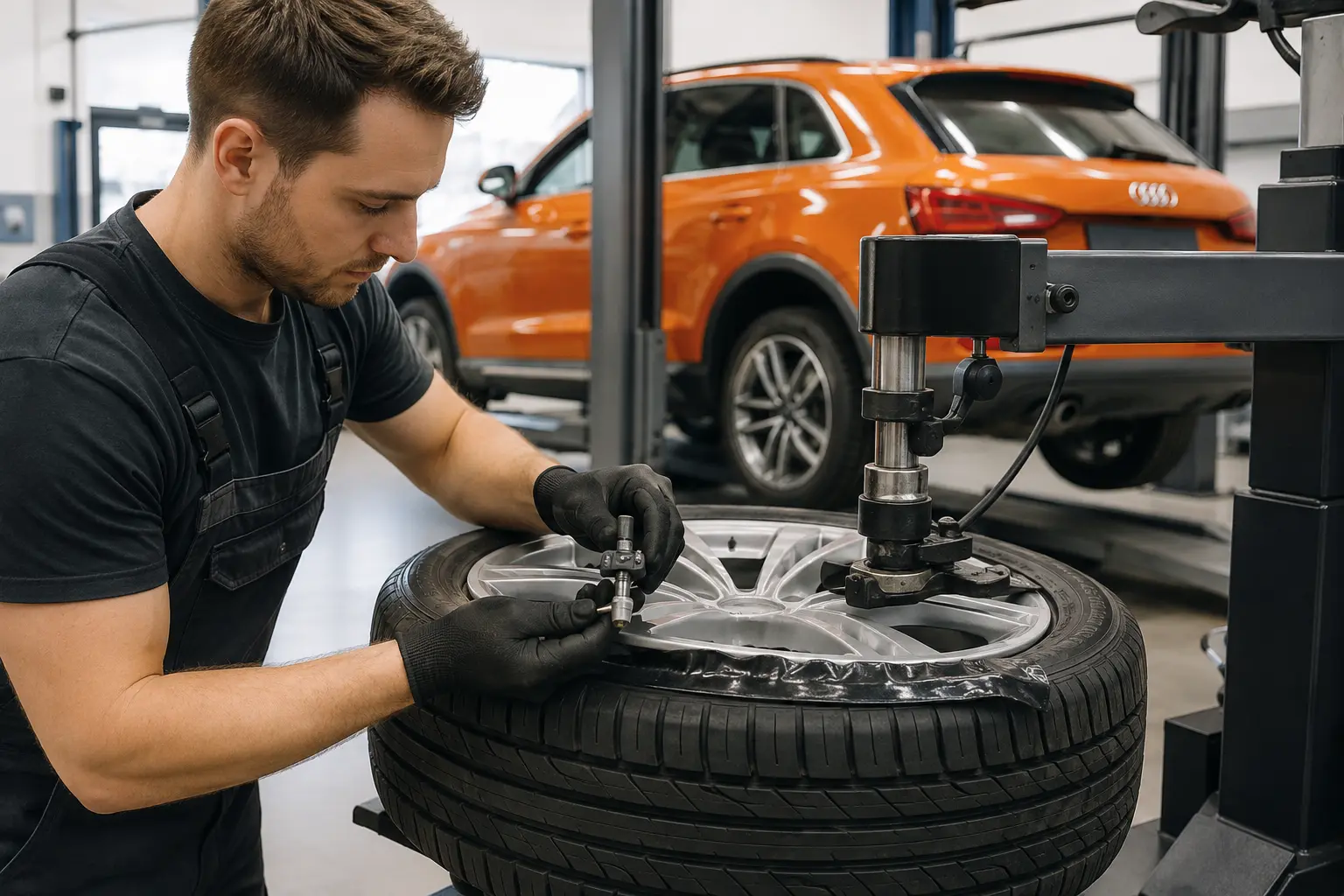
The tyre must come off for many structural and complete-refinish jobs. Its bead and sidewall are inspected, and the TPMS sensor position is identified before removal. A damaged valve or service seal can be replaced without assuming the complete sensor has failed.
After repair, the tyre is refitted in the correct direction where applicable and the wheel is balanced. A TPMS warning may require pressure correction, sensor service, diagnosis or relearning depending on the fitted system.
Check the complete wheel in balanced light
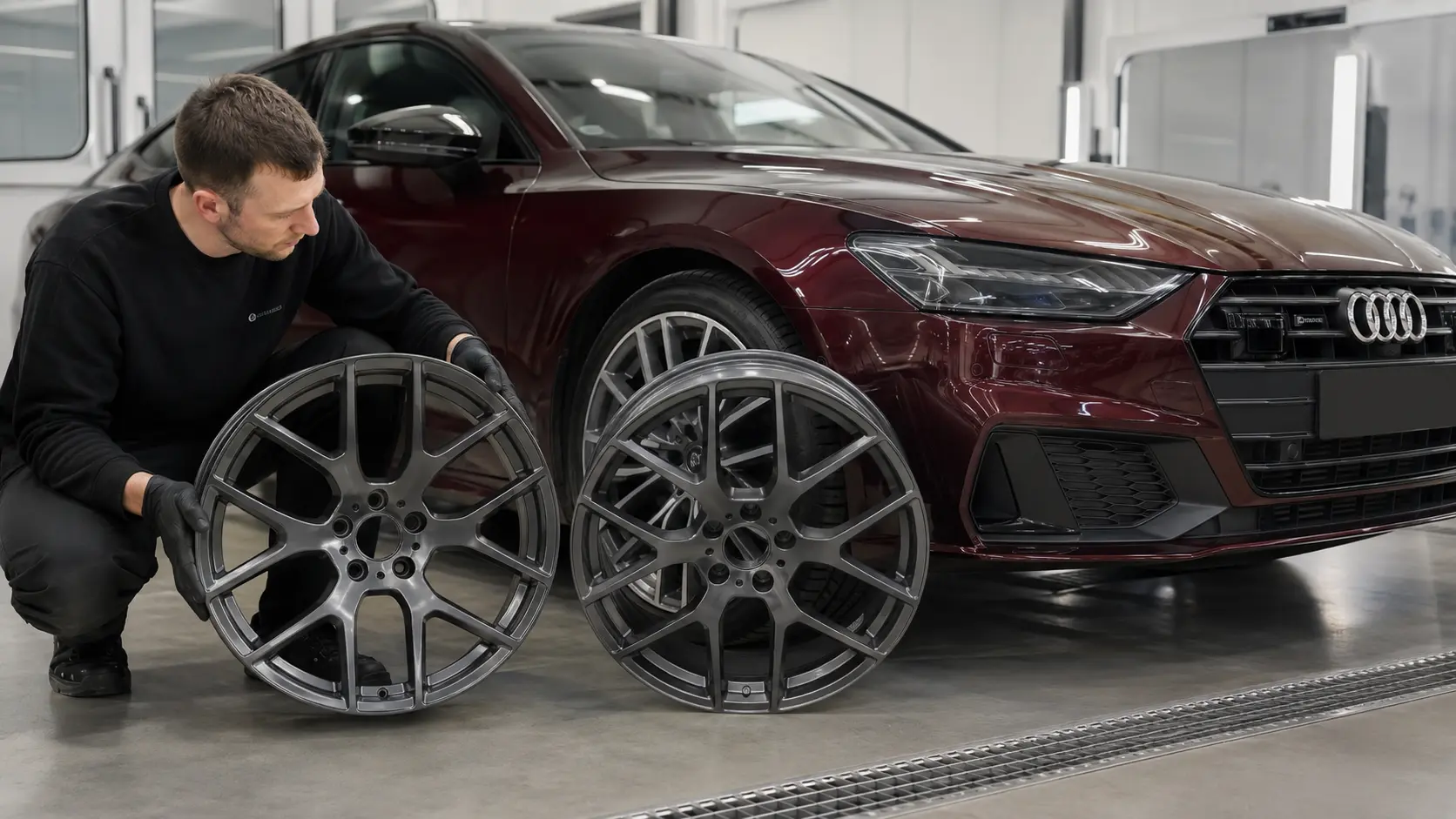
Colour, gloss, machined pattern and repaired edge are reviewed before fitting. The handover should state what was repaired and any limitation caused by age, previous work or a one-wheel match.
Runout rechecked where straightening was performed.
Colour, lacquer, edge and visible repair area inspected.
Tyre, valve or TPMS item and balance confirmed.
Mounting face, tightening and relevant road symptom checked.
Audi rim repair FAQs
Can every cracked Audi alloy wheel be repaired?
No. Crack location, direction, length, prior welds, distortion and wheel construction determine whether a conditional repair can be considered. Damage near spokes, hub or mounting areas may require replacement.
How much does Audi rim repair cost in Dubai?
Limited cosmetic work may fall around AED 315–630 per wheel, while full refinishing, diamond cutting, straightening or suitable crack work can cost more. The page ledger shows planning ranges including 5% VAT, but inspection confirms the route.
What is the difference between rim repair and wheel alignment?
Rim repair corrects suitable damage to the wheel itself. Alignment adjusts suspension geometry. A pothole impact can create both needs, but one service does not replace the other.
Will balancing fix a bent wheel?
No. Balancing corrects uneven mass by adding or adjusting weights. A bend changes wheel geometry and must be measured separately. Tyre distortion can also create vibration.
Can diamond-cut wheels be refurbished more than once?
Sometimes, but each cut removes material. Previous machining, damage depth, wheel design and remaining material affect whether another cut is sensible. A painted conversion may be discussed when further machining is unsuitable but the wheel remains structurally acceptable.
Can you match one repaired wheel to the other three?
We can target the existing colour and gloss, but exact matching can be limited by age, sunlight, cleaning chemicals and previous repairs. A complete-set refinish gives greater consistency when appearance is the priority.
Does the tyre need to be removed?
Tyre removal is usually needed for crack inspection, bead-seat work, inner-barrel damage, straightening and complete refinishing. A limited cosmetic assessment may begin with the tyre fitted.
What causes a repaired wheel to leak air?
The cause may be a tyre puncture, valve, TPMS service seal, bead-seat corrosion, crack, porosity or poor prior repair. The leak source should be identified before refinishing.
Is a welded wheel safe?
Safety cannot be decided from the word “welded.” The original crack location, wheel construction, preparation, repair method, distortion and inspection result matter. Some damage should not be welded and is better handled by replacement.
Can kerb rash damage the tyre?
Yes. A hard kerb contact can cut or pinch the sidewall even when the visible wheel damage appears cosmetic. Tyre condition and pressure loss should be checked with the rim.
Will rim repair remove steering vibration?
Only if a confirmed repairable wheel defect caused the vibration and the remaining tyre, hub, balance, suspension and alignment are suitable. Diagnosis should not assume the wheel is the only cause.
Do you replace TPMS sensors during wheel repair?
Only when diagnosis or physical inspection supports replacement. Valve cores, seals or service items may be sufficient. The sensor position is protected during tyre removal and refitting.
Should all four wheels be refinished together?
Not always. One wheel may be enough for isolated damage where the match is acceptable. Refinishing a set is worth considering for a colour change, widespread coating failure or more consistent appearance.
What photos should I send for an estimate?
Send the complete wheel on the car, a straight close view of the wheel face, close photos of the damage, the tyre-size marking and any visible part number. Describe vibration, pressure loss or the impact.
Request an Audi wheel inspection and repair estimate
Call with the model and wheel concern, or prepare a WhatsApp message and add clear photos. We will explain whether the next step is a cosmetic booking, tyre-off inspection, runout measurement or replacement check.