
An Audi suspension warning light means the car has detected a fault in its suspension control, damping or ride-height system. Read the full dashboard message before moving. If it tells you to stop, the car has dropped noticeably, a tyre is rubbing or handling feels unsafe, stop safely and arrange recovery. A warning alone cannot tell you whether the fault is an air spring, compressor, height sensor or electrical connection.

A Q7 sitting low after parking needs a different investigation from an Audi that sits level but displays a suspension malfunction message. This guide helps you decide what to do now, what information to send the workshop and which checks should come before a repair quote.
Park safely first. Send your Audi model, year, exact dashboard message and an outside photo showing how the car is sitting. Our Al Quoz 4 workshop can discuss the next step and whether recovery needs to be planned.
Can you drive with an Audi suspension warning
The instruction on the display takes priority over the colour of the icon. Messages vary by model and equipment. Some permit restricted driving; others require you to stop because clearance or steering is limited. Check the vehicle-specific instructions through Audi’s owner’s manual portal.
Stop and arrange recovery
Do not continue if the display instructs you to stop, a corner or axle has collapsed, tyres touch the bodywork, or the car scrapes the road. Severe bouncing, instability, restricted steering or suspension damage after an impact also make recovery the safer route.
Tell the recovery operator that the suspension is low. Loading clearance and the vehicle’s transport instructions need checking before the car is moved.
Restricted driving may be allowed
Only consider a direct trip to a workshop when your exact dashboard message and manual permit it, clearance is adequate and the car remains controllable. Follow any displayed restriction and avoid abrupt manoeuvres.
A speed limit shown on another Audi is not a universal safe speed for yours. If you cannot establish whether it is safe to move, call before driving.
A yellow warning is not permission to drive a visibly sagging car over speed humps or a basement ramp. For transport planning, see our Audi roadside assistance and recovery service.
Air suspension and adaptive damper warnings are different
Air suspension supports the vehicle on pressurised air springs and controls ride height. A loss of air or a levelling fault may leave one corner, one axle or the whole car low. The air supply, valves, sensors and control electronics all affect how the system works.
Adaptive dampers control suspension movement. A fault in damper control can trigger a suspension warning even when the car sits at its normal height. An electronically controlled damper does not, by itself, mean the vehicle has air springs.
Equipment differs across Q7, Q8, A8, allroad and other Audi models, years and specifications. The VIN and installed suspension must be identified before ordering parts. “Suspension malfunction” is a starting point for diagnosis, not a part name.
A brief levelling-status message is also different from a persistent fault. If normal height is not restored, or the message changes to a warning, follow the displayed instruction rather than repeatedly selecting another drive mode.
What your Audi’s suspension symptoms suggest
These patterns help direct an inspection. Several faults can produce the same symptom, so none is enough to approve a replacement on its own.
One corner drops after parking
Record which corner is low and how long the car was parked. Loss of air through a spring, fitting or line is one possibility; a valve fault also needs consideration. A car that rises again on starting has not necessarily repaired itself. The air supply may simply be compensating for the loss.
The front or rear axle sits unusually low
The technician needs to compare actual height with sensor readings and investigate the relevant air circuits and valve control. Do not assume that two low corners mean two failed air springs. Keep the car stationary if clearance is inadequate.
The car will not rise and the compressor runs repeatedly
Repeated or prolonged compressor operation may mean the system is struggling to build or retain pressure. A leak can overwork the compressor, so replacing the pump without finding the air loss can leave the original problem unresolved. Monroe’s air-suspension guidance describes this connection between leaks and compressor wear.
If the compressor is silent, the diagnosis still needs its electrical supply, control command and protection status checked. Silence alone does not prove that the motor has failed.
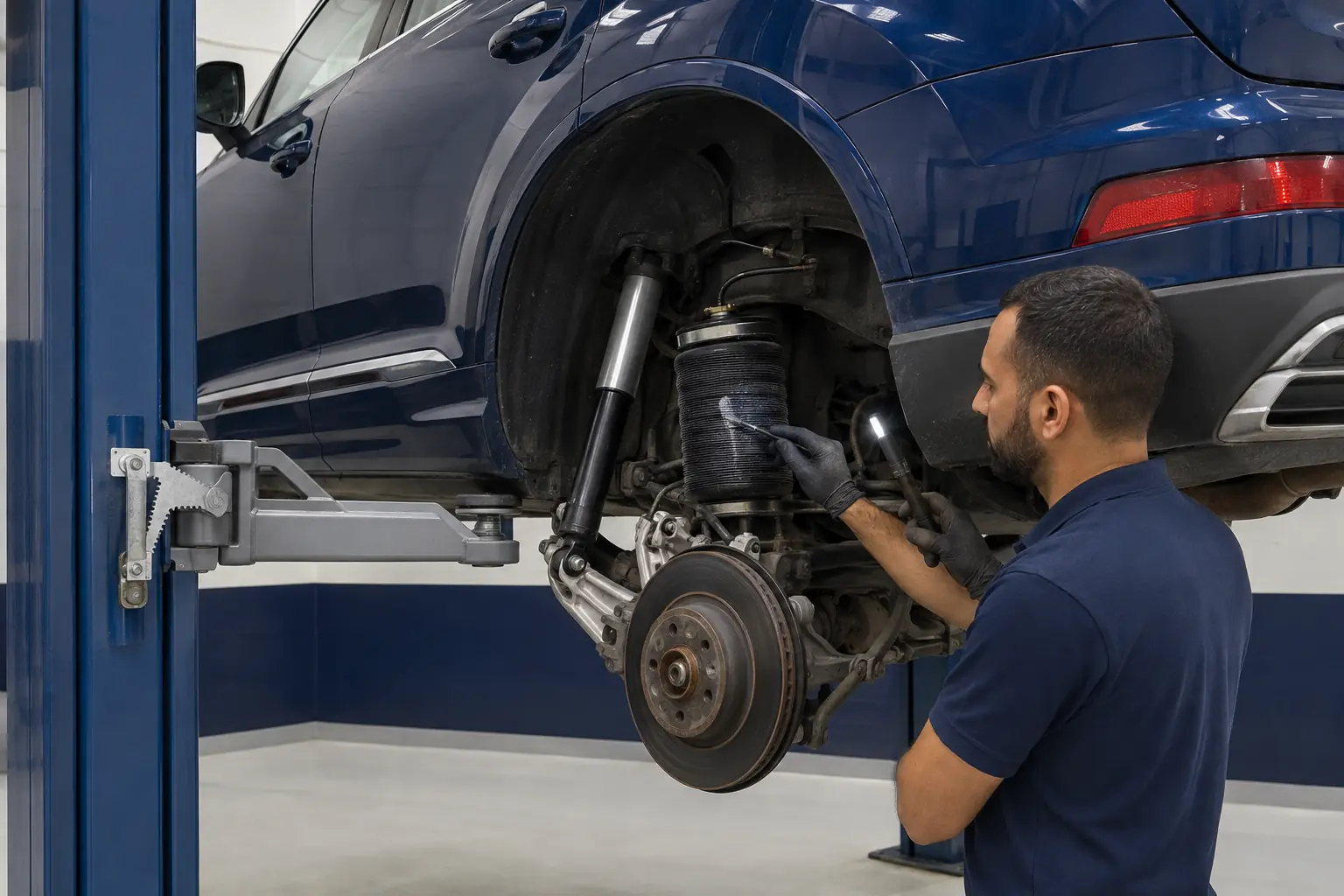
The warning is on but the car looks level
Normal height does not rule out a suspension fault. Sensor signals, wiring, damper control and stored electrical faults still need checking. A height sensor measures suspension position; a damaged linkage can report the wrong position even when the car appears level. HELLA explains the role of vehicle-level sensors and the electrical and mechanical faults that can affect them.
The warning started after battery or suspension work
Tell the workshop exactly what was done. Supply-voltage faults, disturbed connectors, sensor-linkage installation, service-mode settings or missing setup procedures may be relevant. The timing is a clue to investigate, not proof that the battery or the previous repair caused the problem.
The warning disappears after restarting
Keep the photograph and arrange a scan if the warning returns or the ride height changes. Intermittent faults may leave useful stored information. Clearing codes or disconnecting the battery before diagnosis can remove evidence without resolving the cause.
What you can check safely before calling
- Photograph the exact message. Include its colour and any speed, clearance or stop instruction.
- Look at the car from outside. If already parked safely on level ground, photograph both sides. Note whether one corner or an entire axle is lower than usual.
- Record when it happened. After overnight parking, loading luggage, a road impact, battery work or a height adjustment are useful details.
- Describe what you already noticed. Hissing, unusually frequent compressor noise, a harsh ride or rubbing helps the workshop choose the first checks. Do not drive to reproduce a dangerous symptom.
Do not crawl beneath an air-suspended car or reach into a tight wheel-arch gap. Its height can change. Do not loosen air lines, bypass relays or repeatedly command the car to raise. Lifting and depressurising the system require the correct equipment and vehicle procedure.
How an Audi suspension warning should be diagnosed
A useful diagnosis connects the fault code to a measured problem. Ask which test supports the recommended part replacement.
- Identify the suspension and preserve the fault record
Confirm the VIN, equipment and exact warning. Read the relevant suspension modules with a compatible diagnostic tool and retain the fault details before clearing anything. An engine-only code reader may miss chassis information.
- Inspect the vehicle and measure its height
Check wheels, tyres, suspension links, sensor mountings and visible damage. Measure at the specified reference points under the required conditions, then compare those measurements with the live sensor values.
- Test the circuit indicated by the evidence
For suspected air loss, isolate and test the relevant springs, connections, lines and valves. For an air-supply complaint, check pressure build-up and compressor operation against vehicle specifications. For a sensor or damper fault, inspect wiring and test the supply and signal before condemning the component.
- Explain the repair and required setup
The quote should name the confirmed fault, the proposed parts and any filling, calibration or alignment procedures. Replacing a part and erasing the warning are separate from proving that the system works.

Why a sensor code needs a physical inspection
An Audi technical bulletin issued in November 2021 for specified A6/A7-family vehicles calls for photographs of the self-levelling sensor, checks for suspension and wheel impact damage, and a diagnostic log. It illustrates the need to inspect the cause before replacing parts. It is not a diagnosis or warranty promise for every Audi with a suspension warning.
Audi suspension warning repair cost in Dubai
Use these prices to plan the first check and likely repair budget. The diagnostic fee covers the agreed checks; replacement parts and additional testing are itemised before work begins.
| Work | Price | Scope |
|---|---|---|
| Suspension or air-system inspection | From AED 200 | Initial scan, physical inspection and ride-height checks. |
| Air spring replacement | AED 900–2,500 per unit | Guide range for compatible replacement air springs; complete electronic struts can cost more. |
| Air compressor replacement | AED 600–1,800 | Guide range for compatible units; the exact Audi system and parts choice determine the quote. |
Prices exclude 5% VAT. Repair ranges depend on the model, fitted system and parts selected; specialist assemblies can fall outside these ranges. The written estimate confirms the total and what is included.
Will you need to leave the car?
An obvious damaged linkage or a persistent warning may be checked during the first visit. A small air leak is different: the car may need to stand for several hours or overnight while we compare ride height and test air retention. If it drops only after parking, leaving it with us helps reproduce that problem and check the repair under the same conditions.
There is no reliable single price for this warning. A damaged connector, a leaking air spring and an air-supply fault have different parts and labour requirements. Even within one model, equipment and part numbers can change the repair scope.
Before approving the work, ask for an itemised quote covering:
- The diagnostic findings and the component or circuit confirmed faulty.
- The replacement part’s brand, specification and compatibility with your VIN.
- Labour, necessary fittings and any related damage that needs attention.
- Required setup, calibration, alignment and final verification.
- VAT, the written warranty terms and anything excluded from the price.
One defective part does not automatically justify replacing the whole suspension. Equally, a leaking spring and a compressor damaged by excessive operation may both need attention if testing confirms both faults. For repair options and booking, see Audi suspension repair in Dubai.
Does the air spring or the complete strut need replacing
That depends on the assembly fitted, the confirmed damage and the approved repair options. Ask whether the air spring is available separately and whether the damper is also worn or faulty. Any recommendation to replace a pair should be explained using the component manufacturer’s requirements and the condition of the opposite side.
How to confirm the suspension repair worked
Before collecting the car, ask what was checked after the repair. The answer should cover the original symptom, not simply that the dashboard is clear.
- Correct ride height. Actual measurements should meet the vehicle specification, with sensor readings and required basic settings checked.
- Air retention where relevant. If the complaint was sinking after parking, confirm that it was observed long enough to check the original symptom again.
- Normal system operation. Confirm that permitted height or damping changes work and that the air supply behaves correctly under the relevant test conditions.
- Mechanical and diagnostic checks. Inspect disturbed connections, check for returning faults and carry out a road assessment only after the vehicle is safe to drive.
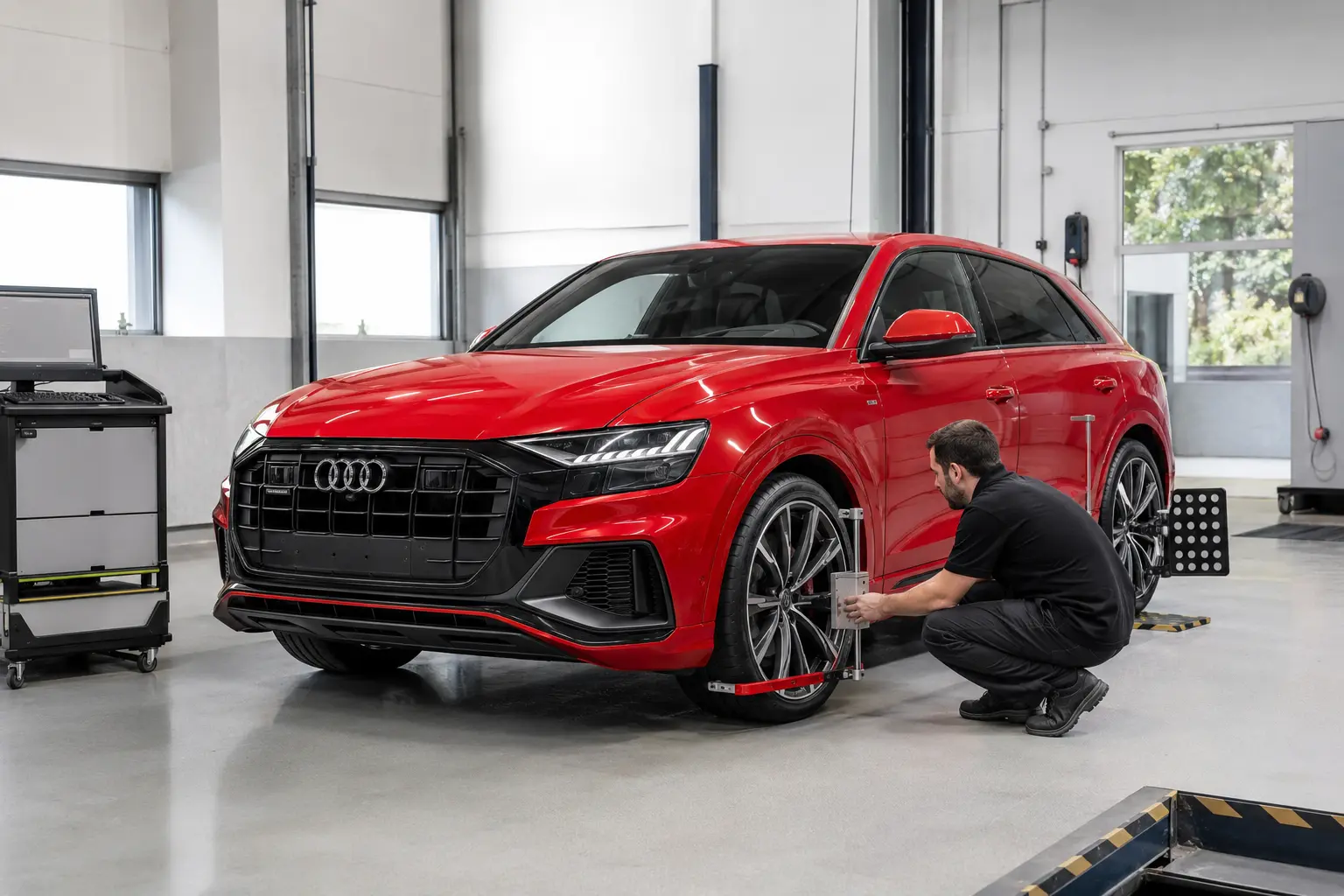
Air-spring installation also needs the correct filling procedure before the vehicle is lowered. BILSTEIN’s installation guidance explains why this matters. If the repair affects suspension geometry, the workshop should identify whether wheel alignment is required.
Common questions about Audi suspension warnings
Can I reset the Audi suspension warning myself
A reset is not a repair for lost air, a damaged sensor or a failed damper circuit. Preserve the warning and fault information first. Calibration is a vehicle-specific workshop procedure, not a general button sequence to try when the car is sagging.
Is the car with arrows symbol always an airbag leak
No. It points to the height-control system, which includes sensors, valves, air supply and electrical connections as well as air springs. The message and diagnostic results determine which part needs testing.
Why does my Audi rise again after sitting low overnight
The system may be replenishing air that escaped while parked. Record the pattern and have it tested. Restoring the height on startup does not establish that it will stay at the correct height or that further driving is safe.
Can a weak battery trigger a suspension warning
An electrical-supply problem can be relevant, especially if several warnings appeared together. The workshop should check voltage-related fault information and the supply condition. Do not assume the battery explains a physically collapsed corner.
Does an Audi Q7 or Q8 warning always mean a new compressor
No. The installed system must be identified and tested. Air loss, valve control, sensor faults and electrical problems can produce overlapping symptoms. A compressor quote should explain the failed test and whether the rest of the system retains air.
Get the suspension fault checked in Dubai
Call or WhatsApp Audi Specialist in Al Quoz 4 with the dashboard photo, model, year and ride-height symptoms. If the car is low, rubbing or displaying a stop instruction, keep it parked safely and discuss recovery before setting off.
Author profile: Abu Hashim, Audi specialist in Dubai.