

The Audi EPC warning light means the engine-management system has detected a problem in the electronic control of engine power, or in an input it uses to calculate and supervise that power. It does not identify a failed part by itself. The urgency depends on what the car does next. Severe power loss, stalling, strong misfiring, smoke, a burning smell, overheating, an oil-pressure warning, or a safety-critical brake or steering warning calls for a safe stop and recovery. A stable car with reduced performance should be driven only as far as necessary to reach safety and should be diagnosed promptly. When the lamp is steady and the Audi appears normal, record the exact message and arrange a scan soon. The owner’s manual for the specific VIN always takes priority.
Stop, limit driving or arrange diagnosis
An EPC lamp needs context, not a reflex answer. Look at the way the engine responds, the other warnings on the cluster and what happened immediately before the light appeared. The three routes below are deliberately conditional because the same symbol can accompany very different faults.
Choose the route that matches the car
Move to the more cautious route whenever several symptoms appear together or the vehicle cannot be controlled normally.
Stop in a safe place when EPC is joined by severe power loss, repeated stalling, heavy misfire, smoke, a burning smell, overheating, an oil-pressure warning, or a serious brake or steering warning. Continuing can create more risk than the original fault.
When the Audi remains stable but throttle response or available power has clearly changed, avoid hard acceleration, high speed and heavy load. Use only the distance needed to reach safety or an appropriate workshop route.
A steady EPC lamp with apparently normal behaviour still deserves a prompt scan. Photograph the cluster, note the driving conditions and do not treat a successful restart as proof that the fault has cleared.
The broader Audi warning-lights guide explains how colour, flashing behaviour and accompanying messages change urgency across the whole dashboard. When the car should not be driven, use a recovery route rather than attempting repeated restarts or a high-load road test.
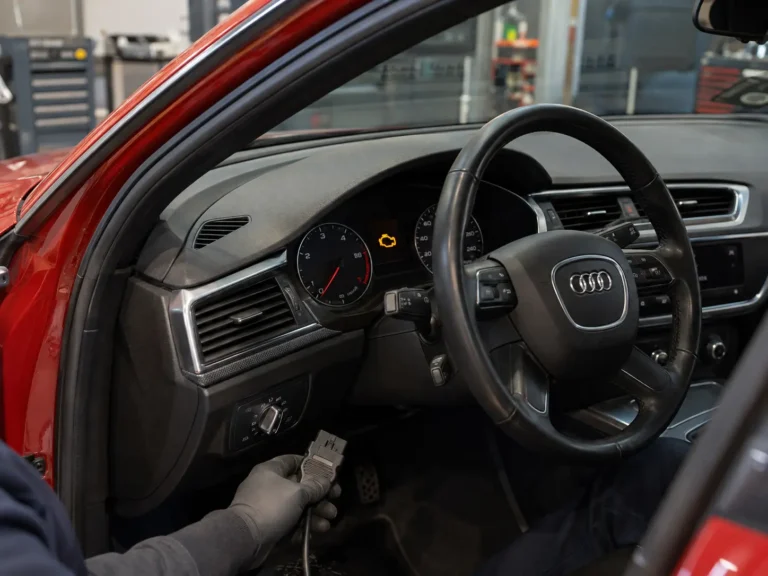

What the EPC warning means
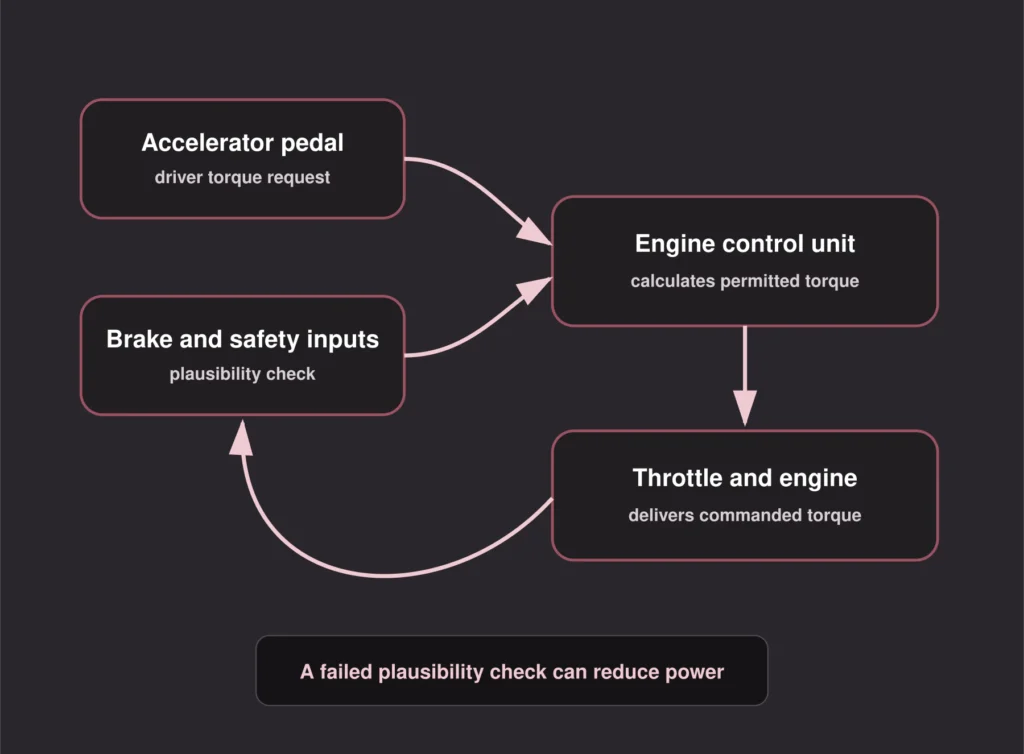
EPC stands for Electronic Power Control. In a combustion-engine Audi, the driver’s request for acceleration is interpreted electronically. Pedal-position signals, engine speed, load, temperature, air and pressure information, braking inputs and other model-specific data can all influence the torque the engine control unit allows. The system then supervises whether the commanded result and the measured result agree.
That is why describing EPC as only a throttle-body light is misleading. The throttle system can be one branch of the diagnosis, but it is not the only branch. A problem may concern the driver request, an actuator, a shared input, the engine’s ability to produce the requested torque, its power supply, wiring, or communication with another control unit. The precise path varies with model year, engine, market specification and software.
The cluster lamp therefore gives the workshop a starting point. It tells us that the vehicle has detected a control or plausibility problem important enough to warn the driver. It does not tell us which component to order.
The accelerator position and current driving situation establish the requested response.
The engine controller evaluates the request with limits, temperatures, load and other relevant inputs.
Throttle, ignition, fuelling, boost and other available controls are coordinated according to the engine.
Sensors and control units report the result so the system can test whether signals and response remain plausible.
Read the symptoms together
The warning becomes more useful when it is paired with the driver’s observation. A loss of power points the first checks in a different direction from a lamp that appeared after a battery event. Rough running changes the risk and the test route again. The Audi problems guide helps organise noises, vibration, smells and performance changes that sit outside the warning lamp itself.
Swipe horizontally to compare all three columns.
| What the driver notices | What it changes diagnostically | Sensible next step |
|---|---|---|
| EPC only and the Audi feels normal | The complaint may be intermittent or limited to a monitored signal. Stored status, frequency and operating conditions become important. | Photograph the cluster, note when it appeared and arrange a prompt full-vehicle scan. Do not clear the memory first. |
| EPC with reduced power or slow response | The controller may be limiting torque because a signal or result is not trusted. The vehicle’s ability to merge, climb or accelerate safely has changed. | Avoid load and unnecessary driving. Move only to safety or the agreed workshop route, then diagnose before testing performance. |
| EPC with rough idle, shaking or misfire | Combustion quality and the engine’s ability to produce controlled torque become part of the investigation. Continued running can add risk. | Stop when the misfire is strong, persistent or joined by a flashing engine warning, smoke or fuel smell. Recovery is the safer route. |
| EPC with the check-engine light | Two indicators can refer to related evidence, but they still do not name the same failed part. Emissions and torque-control faults need to be read together. | Preserve all codes and context. A single generic code reader result is not enough to approve a component. |
| EPC after battery work, a jump-start or low voltage | Supply-voltage history, disturbed connectors, adaptations and unrelated stored faults need separating before parts are blamed. | Report the exact battery event and recent work. Check power supply and the full fault record before assuming a throttle fault. |
| EPC with brake-light or brake-input symptoms | On some models, brake-pedal information is one of the inputs used for torque plausibility and intervention. The actual circuit must be tested. | Check whether the brake lamps behave correctly and mention any cruise-control change, but do not replace a switch from the symptom alone. |
| EPC disappears after a restart | The condition may no longer be active even though useful history remains. Availability of stored detail varies by control unit and model. | Record the event while it is fresh and scan before repeated driving or memory clearing removes useful context. |
The matrix is a routing tool, not a diagnosis. Two cars can show the same combination and require different tests because their engines, control architectures and previous repairs are different.
What the warning can prove
The EPC lamp proves one useful fact: the vehicle recognised a fault or implausible condition within the systems it uses to control or supervise engine power. Everything beyond that must come from the fault record, live data, electrical checks and a test that reproduces or isolates the concern.
What the lamp can tell us
- The car detected a condition worth warning the driver about.
- The exact symptoms and accompanying lamps affect urgency.
- There should be a diagnostic trail to preserve and investigate.
- Model, engine, recent work and operating conditions matter.
What it cannot confirm
- That the throttle body has failed.
- That the first fault code names the defective part.
- That clearing the warning completes the repair.
- That a lamp which disappears after restart cannot return.
How we diagnose an EPC warning
A useful EPC diagnosis is a sequence rather than a scan-and-replace event. Our Audi diagnostics service starts by preserving the complaint and vehicle identity, then narrows the problem with the correct information for that Audi. The order below is a working framework, not a claim that every model follows identical test steps.
Confirm the complaint
We ask when the lamp appeared, whether it stayed on, what the driver felt, which other warnings appeared and whether restarting changed anything. An intermittent event at idle is not approached like a repeatable loss of power under boost.
Identify the exact Audi
Model year, engine, powertrain, software level and recent repairs shape the test plan. A component name that applies to one engine can be irrelevant to another, so VIN and engine identity come before assumptions.
Scan the full vehicle
We read more than the engine controller when the architecture and complaint justify it. Shared brake, transmission, voltage and network information can explain why the engine controller restricted torque or rejected a signal.
Preserve fault context
Fault status, frequency, timestamps and freeze-frame or environmental data are saved where the control unit provides them. Clearing the record before this step can remove the conditions needed to reproduce the fault.
Check supply and plausibility
Power supply, grounds and relevant live-data relationships are checked before an expensive actuator is condemned. Two signals can each look reasonable alone while their relationship fails the controller’s plausibility test.
Test the suspected system
The next test may concern a connector, wiring load, pedal or throttle signal, brake input, combustion, air path, boost control or another model-specific system. The test must separate cause from consequence.
Verify the result
After repair, the vehicle is re-scanned and checked under controlled conditions appropriate to the original complaint. A warning that merely stays off in the workshop is weaker evidence than a result that survives the conditions which previously triggered it.
Why full-vehicle context matters
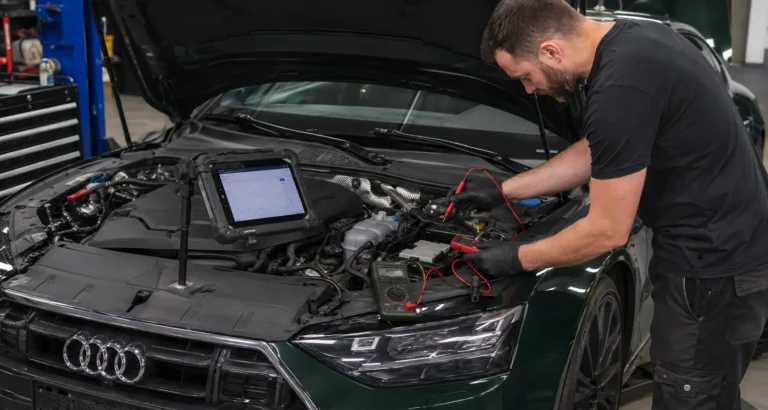
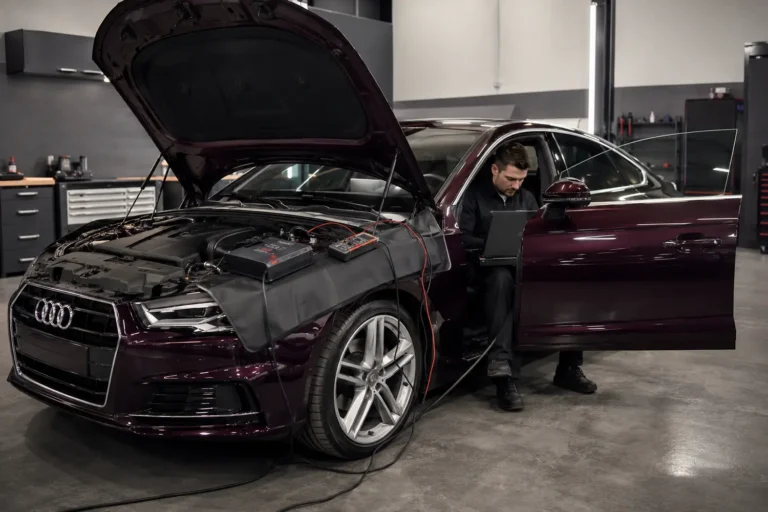
Modern Audi control units do not work as isolated boxes. They receive sensor information, create their own calculated values and exchange data with other controllers. An engine controller may therefore react to an input that originates elsewhere in the vehicle, or another module may store the clue that explains why torque was restricted.
This does not mean every EPC diagnosis requires dismantling the whole car. It means the first scan should be broad enough to avoid tunnel vision. If the engine controller reports an implausible brake signal, for example, the correct question is not simply which engine part to replace. The brake-input circuit, shared data and actual lamp operation must be compared. If several controllers record undervoltage around the same time, that pattern deserves attention before unrelated components are ordered.
What the driver saw, felt and heard, including the conditions in which it happened.
What the technician can reproduce or verify on the vehicle during intake and testing.
Fault status, operating context and related module evidence available from the vehicle.
The fault isolated by measurement or a test which separates it from lookalike causes.
Why EPC may disappear after restart
A restart changes the operating state. A signal that was implausible for a moment may return to an acceptable range, a protective torque limit may no longer be active, or the conditions that triggered the warning may not be present while the car is stationary. The lamp can therefore go out without the underlying reason being understood.
Depending on the Audi and control unit, useful history may remain as a stored, sporadic or passive fault. It may also carry frequency or environmental information. That is why the best time to record the event is before repeated restarts, battery disconnection or code clearing. Note the road speed, engine temperature, load, weather, fuel level, recent work and whether the concern returns under the same conditions.
A disappeared lamp lowers neither the technical question nor the importance of the symptoms that accompanied it. If the car stalled, misfired strongly or lost most of its power, treat that event seriously even when the cluster looks normal after restarting.
What the tests may uncover
The possibilities below show where the evidence may lead, not what should be replaced. Some do not apply to every engine. The fault record and measured behaviour decide what deserves testing.
Pedal-position signals, throttle actuation and the relationship between requested and measured values may need comparison.
A strong misfire can prevent the engine from delivering controlled torque and may create EPC alongside an engine warning.
Air-path leaks, pressure control or an actuator which cannot reach its command can change the torque calculation on relevant engines.
Brake-pedal information and other shared signals can influence torque intervention on some model architectures.
Low voltage, poor grounds, connector damage and wiring faults can disturb several signals at once and imitate component failure.
Recent component work, adaptation requirements or software context may matter after the electrical and mechanical condition is verified.
What shapes the repair quotation
There is no honest single price for an EPC warning because EPC is a control-system warning, not a repair name. A scan can establish the diagnostic direction, but the quotation depends on what testing confirms. The cost can stay close to diagnosis and a small wiring repair, or expand when access, an actuator, related mechanical work, programming or adaptation is required.
The actual circuit, actuator or mechanical condition determines the parts and labour scope.
Some checks are external; others require trim, intake or component access before a measurement is meaningful.
A visible broken wire and an intermittent fault inside a harness require very different tracing and verification time.
Replacement or repair may need model-specific basic settings, adaptation or calibration after fitment.
Software is considered only where the vehicle information and repair procedure support it, not as a universal first step.
The original trigger conditions must be checked safely enough to show that the repair solved the complaint rather than hiding it.
For a wider explanation of diagnosis, labour, parts and verification variables, use the Audi service-cost guide. A workshop should explain what is confirmed, what remains conditional and what would cause the estimate to change.
What to record before booking
A useful first message can shorten the path from warning light to the correct test bay. Send facts rather than a guessed part name. A ten-second cluster video and a clear account of when the warning appeared can be more valuable than a screenshot of a generic internet cause list.
- Audi model and model year
- Engine or powertrain where known
- The exact warning symbol and cluster message
- Whether EPC stayed on after restarting
- Any loss of power or delayed throttle response
- Rough running, stalling or a starting change
- Every other warning light shown at the same time
- Recent battery replacement, jump-start, repair or maintenance
- The speed, temperature and load when the warning appeared
- A cluster photo, video or existing diagnostic report
Do not deliberately reproduce a severe symptom on a public road for the sake of gathering evidence. When the Audi cannot accelerate predictably, stalls, misfires strongly or shows another critical warning, a controlled recovery and workshop check is the safer choice.
Common EPC questions
What does EPC mean on an Audi?
EPC means Electronic Power Control. The warning indicates that the engine-management system detected a fault in the electronic control or supervision of engine power, or in an input used for that control. It does not identify one failed component. The exact tests depend on the Audi model, engine and operating conditions.
Can I drive with the Audi EPC warning light on?
There is no universal yes or no. Stop and recover when the light is joined by severe power loss, stalling, strong misfire, smoke, burning smell, overheating, oil-pressure warning, or a serious brake or steering warning. If the car is stable but performance has changed, avoid load and drive only as far as needed for safety. Even with normal behaviour, arrange diagnosis soon and follow the vehicle-specific owner’s manual.
Why did the EPC light go away after restarting?
Restarting changes the operating state, so an intermittent signal or protective limit may no longer be active. The reason has not necessarily been repaired. Depending on the model and control unit, useful stored history may remain. Record the conditions and scan the car before clearing codes or disconnecting the battery.
Why are EPC and the check-engine light on together?
The two lamps can appear together when engine-performance, combustion, emissions and torque-control evidence overlap. They still do not confirm a single failed part. Read the complete fault record and the symptoms together, especially when the engine is rough, power is reduced or the engine warning is flashing.
Can low battery voltage contribute to an EPC warning?
Low or unstable 12-volt supply can disturb control units and sensor relationships, particularly around a weak battery, jump-start or recent battery work. That makes supply voltage, grounds and the time relationship between faults worth checking. It does not mean every EPC warning is a battery problem.
Does EPC always mean the throttle body has failed?
No. Throttle control is one possible test path, but pedal signals, wiring, power supply, brake input, combustion, air or boost control, software context and other model-specific systems can produce a similar warning. A throttle body should be condemned only after the code context and measured tests support it.
Can EPC cause reduced power?
The vehicle may limit available torque when it cannot trust a control signal or the measured result. Drivers may notice slower response or a reduced-power mode. The amount of power available and the safe next step vary, so avoid hard acceleration and arrange diagnosis rather than testing the limit on the road.
What should I send before booking diagnosis?
Send the Audi model, year, engine if known, a clear cluster photo or video, every accompanying warning, the exact driving conditions, whether the light remained after restart, changes in power or idle, and details of recent battery or repair work. Include any previous scan report without treating its first code as the confirmed cause.
Sources and technical scope
This article is a diagnostic overview for combustion-engine Audi vehicles that use an EPC indicator. Dashboard wording, stored data, control inputs and repair procedures vary by model, model year, engine, market and software. The owner’s manual for the specific VIN and current vehicle-specific Audi repair information take priority.
- Audi online owner’s manuals for vehicle-specific warning guidance.
- Audi erWin information tour describing current vehicle-specific repair, wiring and diagnostic information.
- Audi vehicle-data information explaining that control units receive sensor data, generate values and exchange information.
Send the warning before parts are guessed
Share the Audi model, year, cluster photo, symptoms, accompanying warnings and recent battery or repair work. We can then advise whether the safer route is diagnosis at the workshop or vehicle recovery.