
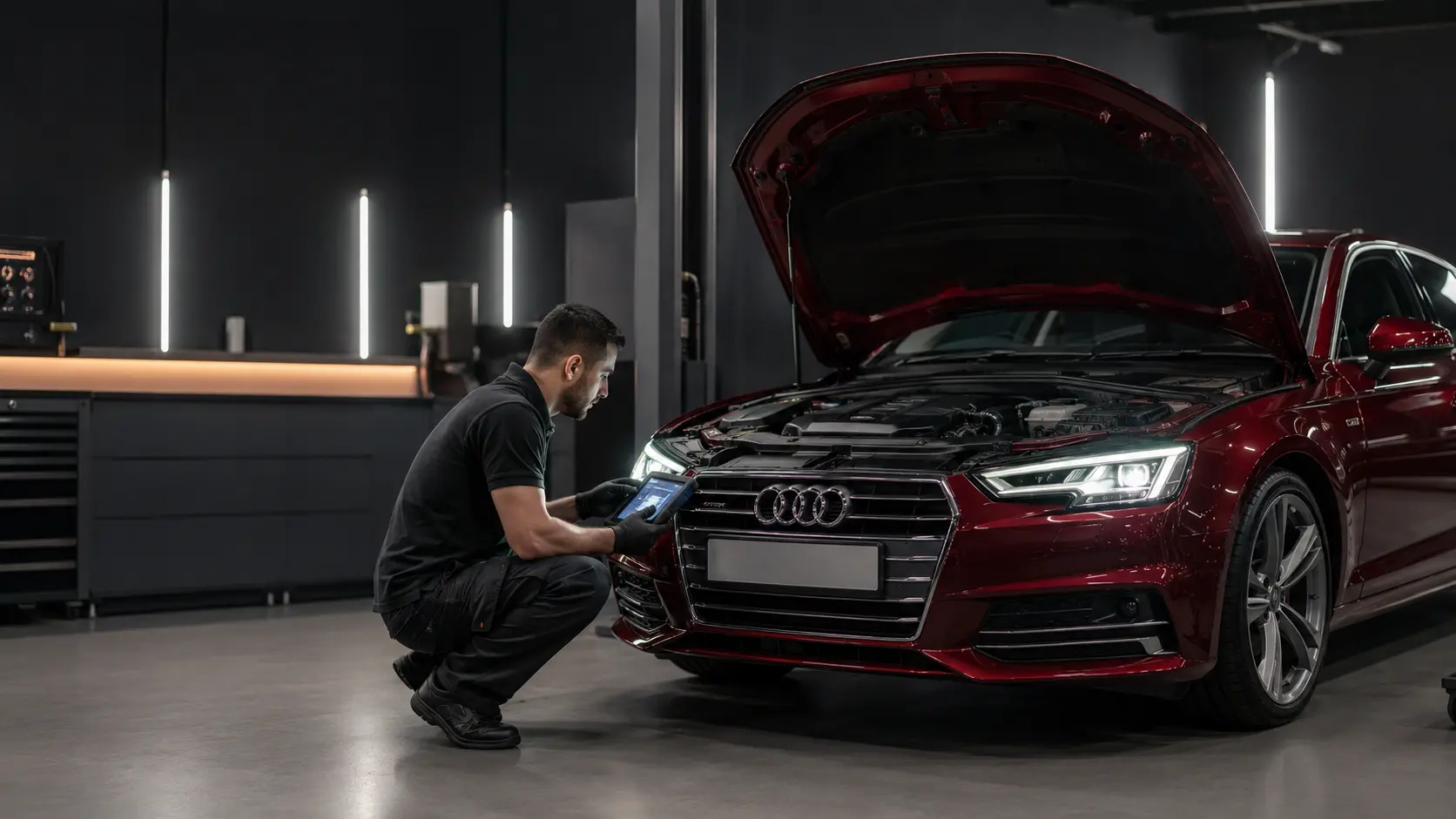
Audi Headlight Repair in Dubai
Audi headlight repair is possible when diagnosis isolates the failed lens, seal, mounting point, bulb, ballast, LED driver, wiring or levelling component. A dark lamp or warning does not automatically require a complete headlight. We identify the fitted halogen, xenon or LED system, test its inputs and outputs, then compare targeted repair with replacement.
Can the Audi headlight be repaired?
Often, yes. Repair makes sense when the housing is structurally usable and the failed area can be reached, tested and restored without compromising sealing, beam control or safety. Examples include a replaceable xenon bulb or ballast, a serviceable LED driver, damaged external wiring, a broken mounting tab or a seal defect with no serious internal corrosion.
A complete lamp is more likely when the lens or housing is badly fractured, several internal functions have failed, water has damaged multiple circuits, adaptive mechanisms are mechanically broken or an earlier repair has left the unit unsafe. The first workshop task is therefore to identify the lamp and prove where the fault begins.
Build a useful headlight enquiry
Send the vehicle details, side affected and exact symptom. A clear stationary photo of the lamp, warning message or moisture pattern can help select the first checks, but it cannot replace electrical and optical testing.
A lamp is a system, not one replaceable part
The power path and optical path vary by model and lamp specification. Testing follows the fitted equipment rather than assuming every Audi headlight is built the same way.
Match the symptom to the first sensible check
Similar warnings can come from different faults. The pattern, side, weather, previous work and fitted lamp type narrow the test plan.
One lamp is completely dark
Check command, fuse strategy, loaded voltage, ground, connector condition and the applicable bulb, ballast or driver. Swapping unverified modules can add faults or damage connectors.
Electrical test firstFlicker or colour has changed
A xenon bulb may age or a ballast may become unstable, but voltage drop, moisture and connector heat can look similar. Compare sides and test the relevant circuit.
Do not ignore heatDRL works intermittently
The DRL may use a separate LED board or driver path from the low beam. Thermal behaviour, stored faults and module output help separate the affected function.
Module route variesCondensation keeps returning
A light mist that clears can differ from droplets, pooled water or recurring heavy fog. Inspect vents, caps, seams, cracks and previous openings before resealing.
Find entry routeLamp points too high or low
Check tyre and suspension condition, ride-height inputs, levelling linkages, actuator response and physical mounting before turning adjusters.
Aim follows repairAdaptive-light warning appears
The cause may be a lamp motor, control module, steering-angle input, suspension-level signal, wiring or calibration requirement. Read the whole fault context.
System-level diagnosis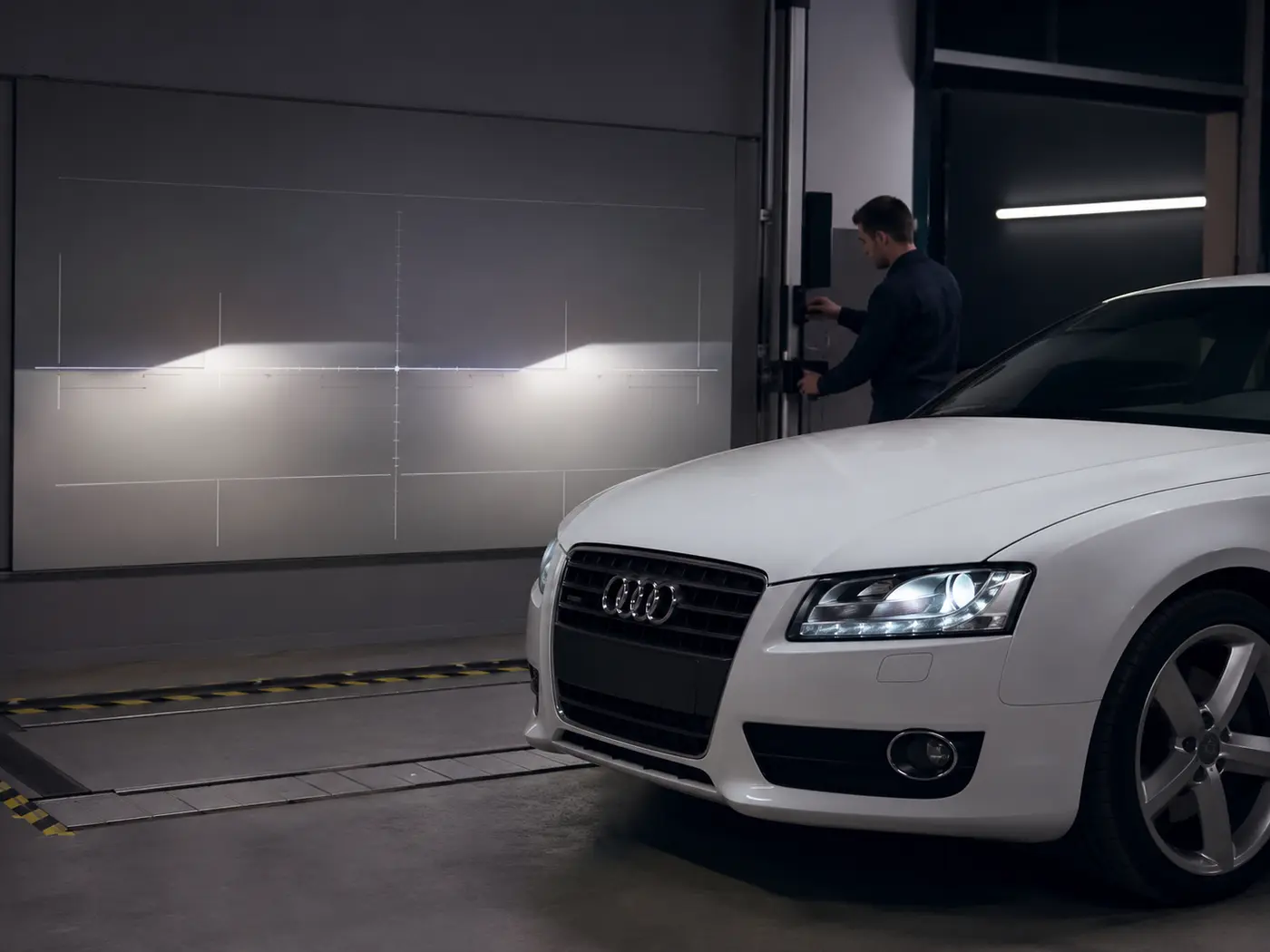
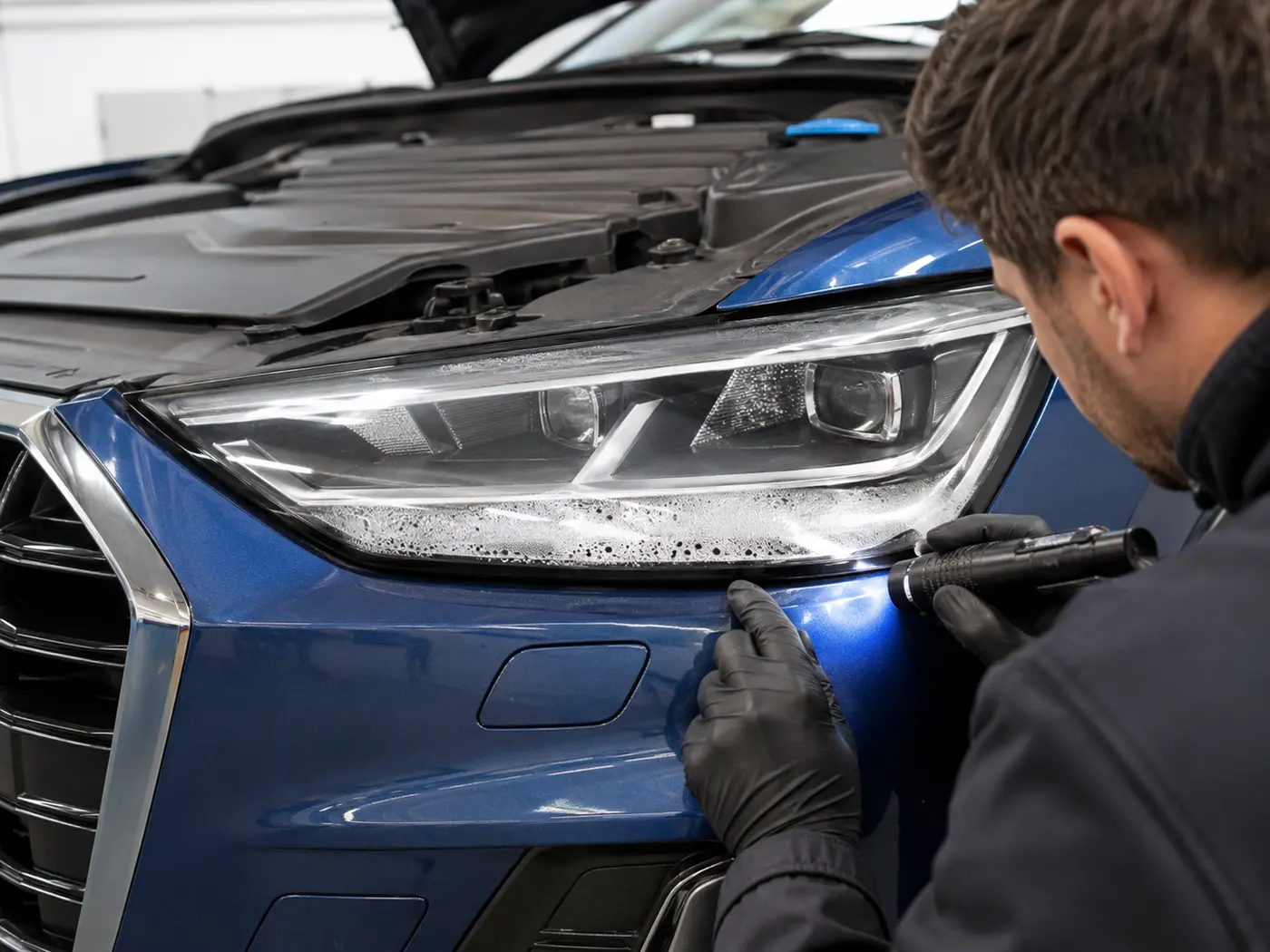
Drying the lamp is not the same as stopping water entry
Moisture is judged by amount, location and recurrence. A brief light haze after a temperature change may clear through the lamp vents. Distinct droplets, a water line, corrosion or repeated fogging after washing require a closer source check. The housing may have a displaced rear cap, blocked or damaged vent, cracked lens, split seam, impact damage or an earlier opening that was not resealed correctly.
The lamp should be dried in a controlled way only after the likely entry route is addressed. Heat that is too aggressive can deform plastics or damage coatings. If water has reached electronics, connectors and modules need inspection before power is repeatedly applied.
- Photograph the moisture pattern before it clears.
- Inspect caps, vents, seams and impact points.
- Check connectors and modules for water tracks or corrosion.
- Leak-test a repair without over-pressurising the housing.
- Verify clearing and function after refitting.
Targeted repair or complete headlight?
The cheapest visible part is not always the correct route. The decision should protect beam quality, weather sealing, mounting and electronic compatibility.
Identify the exact unit
Use VIN, side, part number and visible equipment to establish lamp technology and revision. A similar-looking unit may use different modules or functions.
Define the failed layer
Separate external wiring, replaceable electronics, optics, mounting, housing and vehicle inputs. Record what tests support the finding.
Check repairability
Confirm that heat damage, corrosion, internal breakage and previous repairs have not made a narrow fix poor value or unsafe.
Compare complete costs
Include parts, removal, sealing materials, coding, basic settings and aiming. Compare warranty and compatibility, not only the part price.
What diagnosis should establish before parts are approved
The complaint is reproduced where possible, then the technician records which functions work: low beam, high beam, DRL, indicator, cornering or adaptive movement. A scan identifies stored faults and communication state. Electrical testing checks power and grounds under the relevant load rather than relying only on an unloaded voltage reading.
For a single-side fault, a safe side-to-side comparison can be useful, but modules should not be swapped casually. Some controllers are coded, protected or vulnerable to water damage. Xenon systems also involve high voltage. A controlled test plan uses wiring information and known-good conditions without creating a second fault.
Physical inspection covers the lens, housing, caps, vents, mounting tabs, connectors and evidence of impact or previous opening. If the symptom relates to aim or adaptive movement, the sensor linkages, suspension stance and actuator response are part of the same investigation. General vehicle electrical faults belong on the Audi electrical repair route once the evidence extends beyond the lamp system.
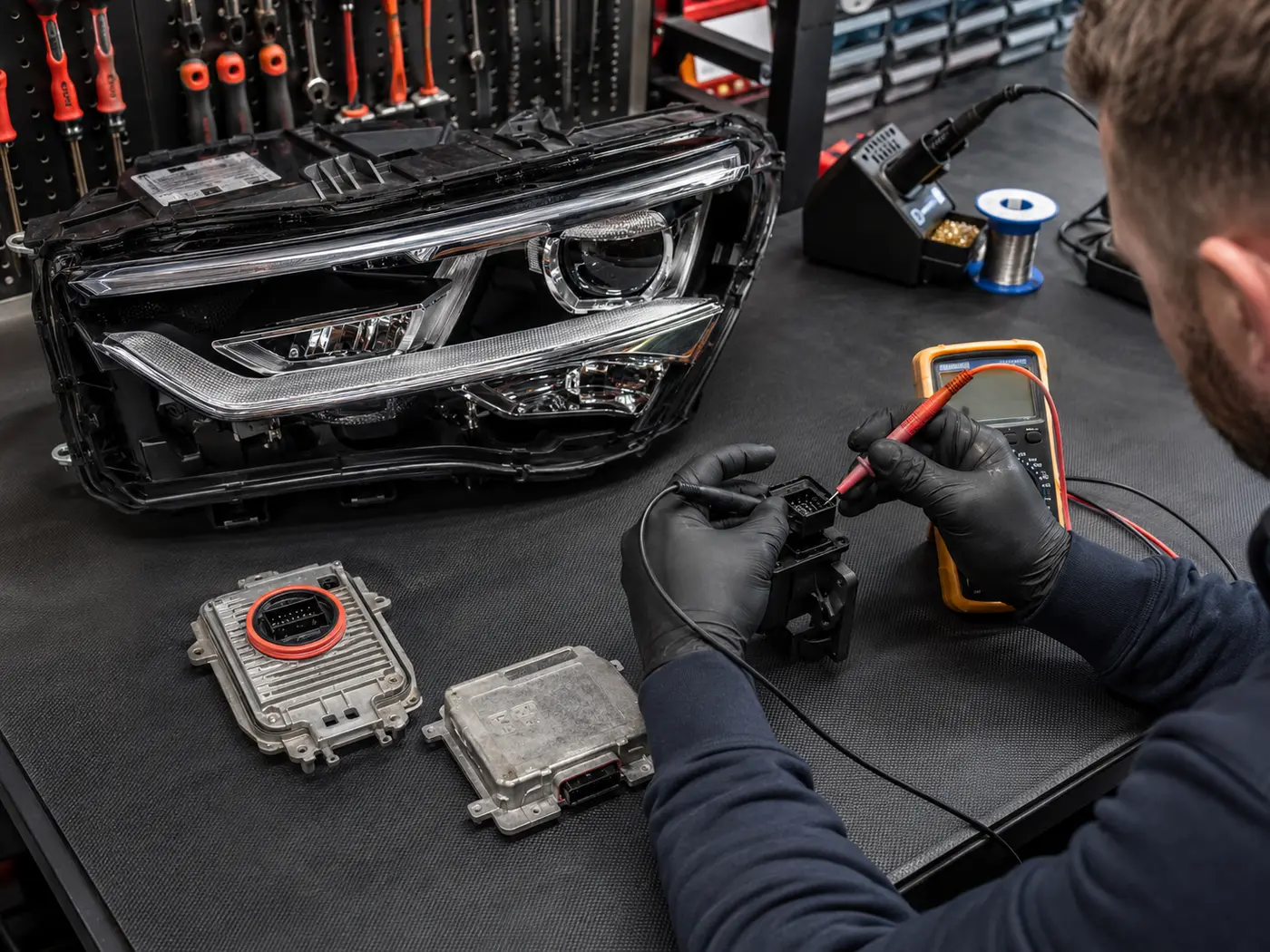
Four practical repair options
The appropriate scope depends on which layer has failed and whether the remaining assembly is serviceable.
External circuit repair
Used when the lamp is healthy but supply, ground, connector or accessible wiring is faulty.
- Trace the circuit under load
- Repair heat or corrosion damage correctly
- Protect and secure the repaired harness
Targeted lamp repair
Used for a serviceable bulb, ballast, LED driver, seal area or mounting point when the housing remains suitable.
- Match the component revision
- Control contamination and heat
- Restore sealing and mounting
Housing or lens repair
Considered when physical damage can be repaired without compromising optical quality, structural location or moisture resistance.
- Inspect internal contamination
- Confirm lens and seam condition
- Aim the lamp after refitting
Complete unit replacement
Used when damage is extensive, internal mechanics are broken, multiple circuits are corroded or targeted work is poor value.
- Verify exact part identity
- Define included modules
- Code, set up and aim as required
Repair, module replacement and complete-unit replacement
A useful estimate compares the routes against failure evidence, remaining-condition risk and what is included after installation.
| Route | Works best when | Main limitation | Verification needed |
|---|---|---|---|
| Wiring or connector repair | The fault is outside the housing and the lamp passes functional checks. | Hidden harness damage may extend beyond the visible point. | Voltage drop, load test and full lamp function. |
| Bulb, ballast or driver replacement | A replaceable component has failed and the housing is dry and intact. | Incorrect revision or an unresolved leak can damage the new part. | Fault memory, stable operation and output comparison. |
| Housing or mounting repair | Damage is local and optical alignment can be restored. | Heat damage, multiple broken points or cracked internal supports can make it unsuitable. | Secure mounting, leak check and beam aim. |
| Complete lamp replacement | Internal damage or corrosion makes targeted work unreliable. | Highest parts cost; compatibility and module content vary. | Coding or basic settings, every lighting function and aim. |
Audi headlight repair cost in Dubai
The ranges below are tentative planning figures including 5% VAT. They assume ordinary workshop access and no concealed crash damage. Lamp technology, side, part revision, module content, parts tier and prior repairs can change the total.
| Service scope | Tentative AED | What changes the range |
|---|---|---|
| Initial headlight fault scan and function check | AED 315–525 | Number of affected systems and whether the fault is intermittent. |
| Electrical supply, ground and connector diagnosis | AED 315–735 | Access, circuit complexity and load-test time. |
| Moisture-source inspection | AED 315–630 | Amount of trim removal and whether water has reached modules. |
| Controlled drying and minor vent correction | AED 315–735 | Water amount, internal access and condition of electronics. |
| Housing seam reseal, suitable unit | AED 630–1,365 | Lamp removal, previous opening and length of affected seam. |
| Mounting-tab repair, per repairable point | AED 315–735 | Location, missing material and need to remove the lamp. |
| Halogen bulb supply and fit, per side | AED 158–420 | Bulb specification and access. |
| Xenon bulb supply and fit, per side | AED 525–1,260 | Bulb tier, access and whether paired replacement is selected. |
| Xenon ballast replacement | AED 840–2,205 | Part revision, source and moisture damage. |
| LED or DRL driver/module replacement | AED 945–2,940 | Module type, programming and part availability. |
| Lamp-side wiring or connector repair | AED 420–1,470 | Number of damaged terminals and harness condition. |
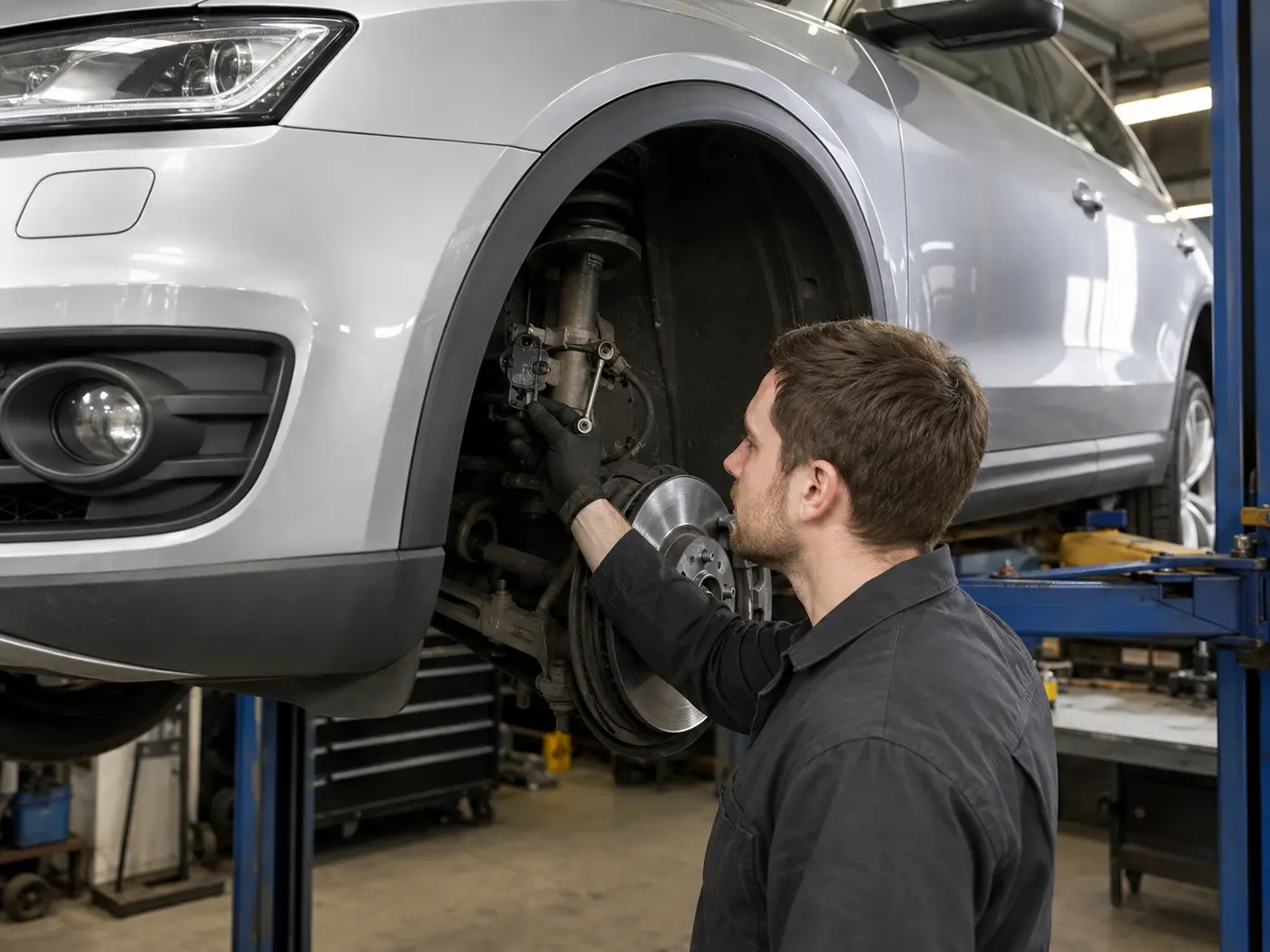
| Levelling sensor or link replacement | AED 630–1,680 | Axle location, seized fasteners and sensor type. |
| Adaptive-light diagnosis | AED 525–1,260 | Fault complexity and input-signal checks. |
| Headlight coding or basic settings | AED 315–840 | Controller state and required setup route. |
| Beam aiming check and adjustment | AED 126–315 | Mounting condition and whether mechanical repair is needed. |
| Complete headlight unit replacement labour | AED 525–1,260 | Bumper or trim removal, module transfer and setup. |
| Complete lamp assembly, parts planning range | AED 2,940–14,700+ | Halogen, xenon, LED or matrix type; new, OEM-equivalent or used source; included modules. |
Worked quote examples
Use these calculations to compare a straightforward bulb-and-aiming job with moisture diagnosis or lamp-electronics work. They are not quotations, and the totals already include 5% VAT.
Bulb and aiming check
Hypothetical halogen lamp with straightforward access and no wiring fault.
- Bulb and installation
- AED 210
- Beam aim check
- AED 126
- Total
- AED 336
Recurring moisture diagnosis
Hypothetical repairable housing with a seam leak and serviceable electronics.
- Moisture diagnosis
- AED 315
- Remove, dry and reseal
- AED 840
- Vent correction
- AED 126
- Total
- AED 1,281
LED driver repair
Hypothetical confirmed driver fault with compatible replacement available.
- Electrical and scan diagnosis
- AED 420
- LED driver module
- AED 1,470
- Coding and aiming
- AED 315
- Total
- AED 2,205
Complete LED lamp replacement
Hypothetical damaged lamp requiring a compatible premium replacement assembly.
- Lamp assembly
- AED 7,350
- Removal and installation
- AED 630
- Coding/basic settings
- AED 420
- Beam aiming
- AED 210
- Total
- AED 8,610
How the headlight job moves from symptom to handover
The sequence prevents a lamp assembly from being ordered before the actual failure and compatibility requirements are known.
Record the complaint
We note the exact warning, affected side, weather relationship, recent front-end work and which lighting functions fail. Photos help preserve an intermittent moisture or flicker pattern.
Identify the lamp
VIN, visible equipment, side and installed part information are used to establish halogen, xenon, LED or adaptive configuration and any module differences.
Inspect and scan
The lens, housing, caps, vents, mounting, connectors and accessible wiring are checked. Relevant control units are scanned without treating a code as a replacement instruction.
Test the failed path
Power, grounds, communication, output, actuator response or moisture route is tested according to the complaint. Unsafe high-voltage shortcuts are avoided.
Compare repair options
The estimate distinguishes targeted repair, module replacement, housing work and complete lamp replacement. Conditional items and excluded crash or body work are stated.
Repair after approval
The selected component or housing area is repaired with compatible materials and controlled handling. Modules are protected from static, moisture and contamination.
Set up and verify
Where required, coding, basic settings, levelling checks and beam aiming are completed. All related lighting functions are operated before handover.
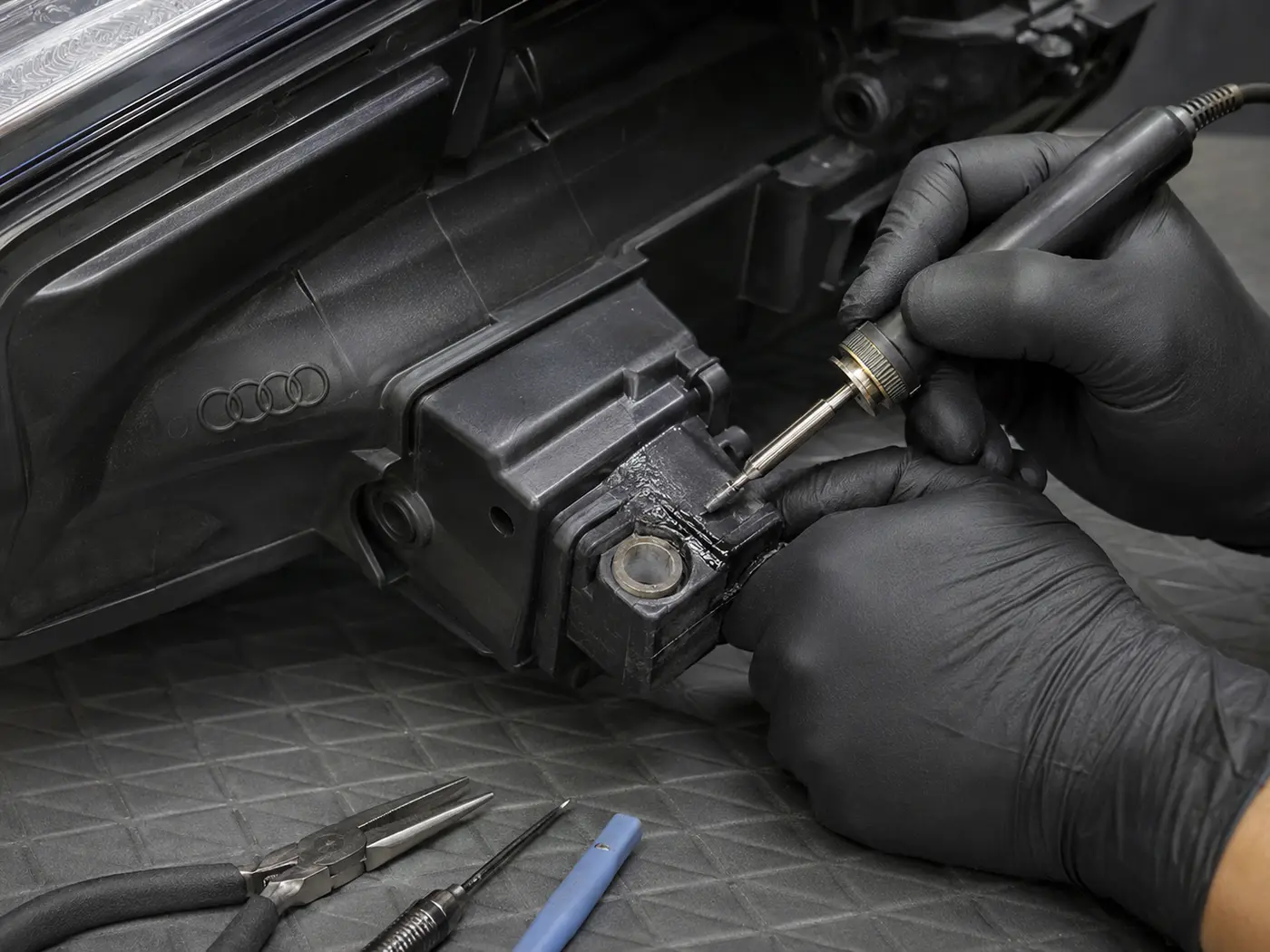
Parts identity matters more than a similar-looking lens
Audi models can use several headlight specifications within one body shape. Market equipment, production date, left- or right-hand traffic pattern, adaptive functions and included controllers can all differ. A quotation should say whether the proposed part is new genuine, OEM-equivalent, aftermarket, remanufactured or used, and whether bulbs or modules are included.
A used lamp needs careful inspection for broken tabs, cloudy optics, water marks and earlier sealant. A bare new housing may still require transfer or replacement of expensive modules. Cheapest purchase price can therefore create a higher fitted cost if the unit is incomplete, incompatible or cannot be coded.
Repair materials must suit the housing plastic, operating temperature and sealing duty. General-purpose glue or heavy external sealant can hide a leak temporarily while making later service difficult. The repaired unit still has to mount securely and produce an aimable beam.
Verify the repair, not just the light output
A lamp switching on is only one part of handover. The final check should relate to the original complaint, the components disturbed during repair and the fitted lighting system.
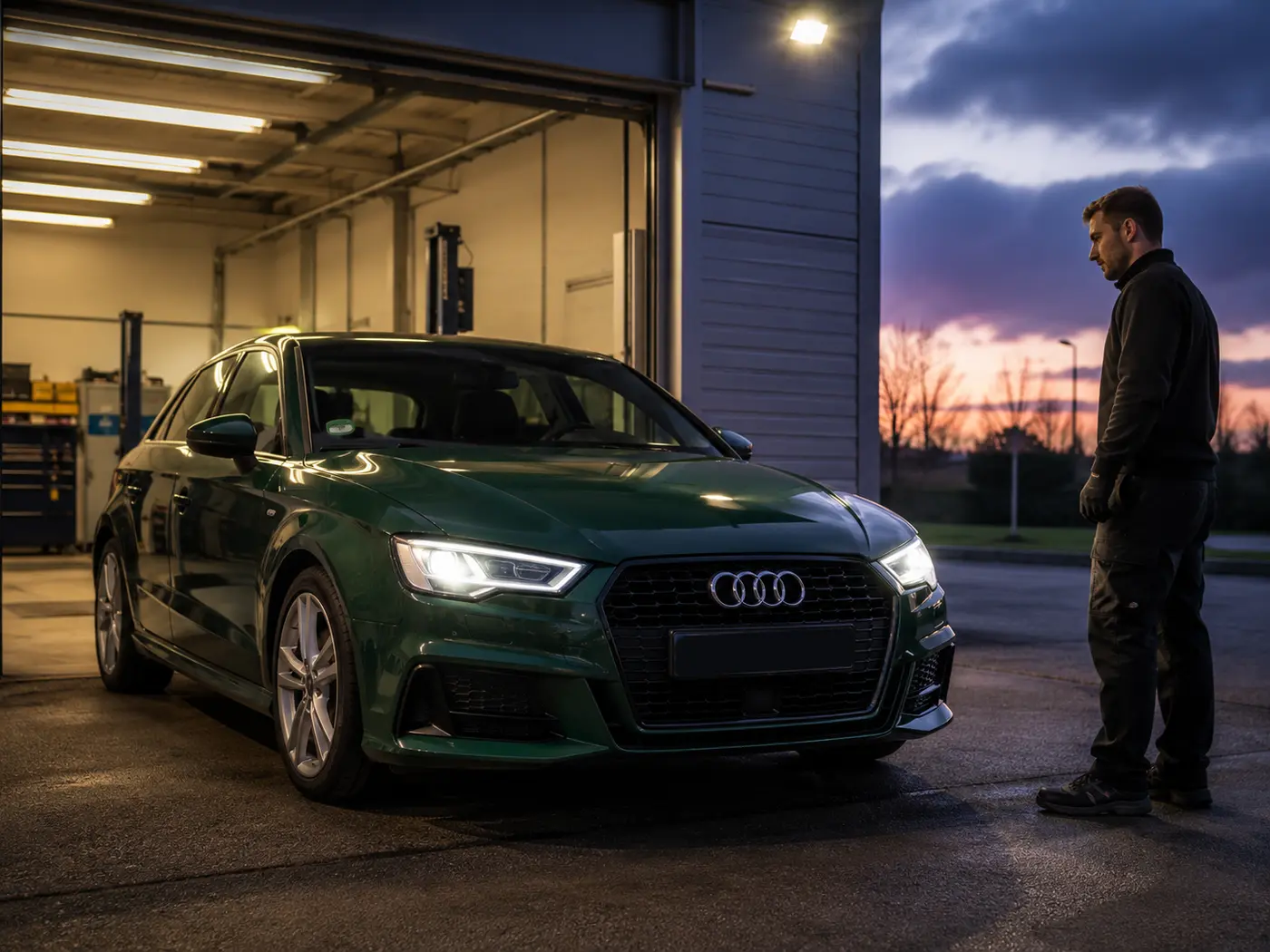
Audi headlight repair questions
The answers below separate bulb, wiring, control-unit, sealing and complete-lamp faults. The fitted headlight system must be identified and tested before parts are ordered.
Can an Audi LED headlight be repaired?
Sometimes. A serviceable driver, connector, seal area or mounting point may be repairable. A failed sealed LED array, extensive corrosion or broken internal optics may require a complete unit. Testing and exact lamp identification come first.
Does one dark headlight mean the whole unit has failed?
No. A bulb, ballast, LED driver, fuse strategy, connector, ground, wiring or control input can stop one function. The fitted system should be tested before a lamp is ordered.
Why does my Audi headlight have condensation?
Moist air can enter through normal vents, a displaced cap, damaged vent, cracked lens, failed seam or previous opening. Light temporary haze differs from droplets, pooled water or recurring heavy fog, so the pattern and source need inspection.
Can you reseal a headlight without replacing it?
A reseal may be viable when the lens and housing are structurally sound and the leak path can be accessed. The unit must be dried correctly and any affected electronics inspected. Resealing cannot reverse severe internal corrosion.
How much does Audi headlight repair cost in Dubai?
Tentative diagnosis and minor repair ranges may begin around AED 126 to AED 735, while modules, housing work or complete LED and adaptive lamps can cost far more. The exact system, side, part source, coding and damage determine the quotation.
Is a used Audi headlight a sensible option?
It can reduce parts cost, but the exact part number, market specification, included modules, mounting points, lens condition and moisture history must be checked. Coding or component protection may also affect the fitted route.
Will a replacement headlight need coding?
Some lamps or modules require coding, parameterisation, component-protection work, basic settings or adaptation. Others may only need functional checks and aiming. The requirement depends on the fitted controller and replacement source.
Does the headlight need aiming after repair?
Aiming is appropriate after lamp removal, mounting repair, replacement or any work that can change its position. Suspension stance, tyre condition and levelling inputs also need to be credible before adjustment.
Can I drive with one headlight not working?
Driving visibility and legal compliance may be affected, especially at night. Avoid driving if lighting is inadequate, the unit flickers, wiring smells hot, water is close to electronics or an adaptive mechanism is behaving unpredictably.
What causes an adaptive headlight warning?
Possible causes include a lamp actuator, control module, steering-angle or ride-height input, suspension sensor linkage, wiring, low voltage, coding or a mechanical fault inside the unit. A scan alone does not identify which part to buy.
Can a weak battery cause headlight faults?
Low or unstable voltage can create control-module and communication faults. Battery history, charging voltage, power and grounds should be checked when the symptom pattern supports it, but voltage is not the only possible cause.
Can a cracked headlight mounting tab be repaired?
Some local tab damage can be repaired when the remaining housing is sound and the lamp can be positioned securely. Multiple fractures, missing structure or internal breakage may make complete housing replacement the safer route.
Do you repair cloudy or yellow headlight lenses?
Surface restoration may improve suitable outer-lens oxidation, but it will not correct internal reflector damage, deep cracking, delamination or electrical failure. The lens condition and beam output need inspection before recommending the route.
Is body repair included with headlight replacement?
Not unless the written estimate says so. Damaged bumper mounts, brackets, panels or crash alignment can fall outside the lamp service and may need a separate body-repair assessment before accurate aiming is possible.
What should I send for a first WhatsApp assessment?
Send the model, year, VIN if available, affected side, exact warning, lamp type if known, weather relationship and recent battery, bulb or front-end work. Add a stationary photo of the lamp or warning when safe.
Describe the lamp fault before buying parts
Call with the model and symptom, or use the enquiry builder to send the side, warning, lamp type and recent history. The first goal is to identify a testable fault and compare the repair routes.