
Audi Alternator Replacement in Dubai
A flat battery or battery warning light does not automatically mean the alternator has failed. The fault can be the battery itself, belt drive, pulley, regulator, positive cable, earth, fuse, battery-management system, parked-current drain or a 48-volt starter-generator system. We identify the fitted charging architecture and test the system under the conditions in which the warning appears before recommending repair or replacement.
Test the battery, commanded charging output, cables and belt drive before pricing an alternator.
If there is smoke, a burning smell, repeated stalling, a red electrical warning with functions failing, or visible belt damage, stop driving and arrange a safe assessment.
Battery route
A weak, discharged, incorrectly matched or unregistered battery can distort charging tests and cause repeat starting trouble.
Generator route
Commanded output, actual current, regulator behaviour and ripple decide whether a conventional alternator needs repair or replacement.
Belt and cable route
A pulley, belt, tensioner, positive cable, earth or fusible link can interrupt a healthy generator’s work.
Drain or control route
Parked-current draw, LIN communication and energy-management faults belong to broader electrical diagnosis when the generator is sound.
48-volt or e-tron route
A belt starter-generator or DC-to-DC supply is a different architecture, not a universal bolt-on alternator job.
Identify the system first
The model badge is not the charging specification
An A4, A6, Q5 or Q8 badge does not reveal the generator output, control method, cooling arrangement or access time. Production date, engine, market and equipment can change the installed system within one model range.
What fixes the identification
Model generation, production date, engine and fuel type start the match. Private VIN or build data confirms the configuration. The installed part number, connector, output, belt layout and cooling are compared with the current supersession.
Battery condition matters because strategy responds to temperature, state of charge, load and energy requests. A full scan distinguishes conventional 12 V, mild-hybrid, 48 V and battery-electric routes.
- Vehicle identity
- Model generation, production year, engine code and build data.
- Architecture
- Conventional 12 V, 12 V mild hybrid, 48 V mild hybrid or battery-electric.
- Generator
- Part number, output rating, connector, mounting and current supersession.
- Drive
- Belt routing, overrunning pulley, tensioner, idlers and alignment.
- Cooling
- Air cooled or liquid cooled where the exact application uses coolant.
- Control
- Regulator command, LIN communication, measured output and fault context.
- Storage
- Battery type, capacity, state of charge, health and registration history.
- Access
- Undertray, intake, mount, front-carrier, coolant and one-time hardware needs.
Conventional 12-volt alternator
An engine-driven auxiliary belt turns the alternator. Its regulator supports vehicle loads and battery charging, while the car may vary the requested output.
Smart charging
Energy management uses battery state, temperature, load and communication data. Commanded and actual values matter more than one idle snapshot.
48-volt belt starter-generator
Selected mild hybrids can use a belt starter-generator for charging, recuperation, start-stop and engine restarting, with a 48 V battery and DC-to-DC connection to 12 V.
Battery-electric e-tron
A battery-electric Audi has no engine-driven alternator. High-voltage systems and a DC-to-DC converter support the 12-volt network, so an alternator sale would be the wrong route.
Symptoms choose tests
A warning suggests a route, not a replacement part
The same dashboard symbol can appear after a weak battery, a slipping belt, high resistance in a cable or a generator-control fault. The useful first check depends on when the symptom appears and what the vehicle does next.
| Customer report | Charging-system possibility | Important alternatives | First useful checks |
|---|---|---|---|
| Battery warning while driving | Low or incorrect charging output. | Belt, cable, fuse, control or battery fault. | Full scan, belt inspection, battery state and commanded charging test. |
| New battery goes flat | The alternator may not be restoring charge. | Parasitic draw, poor connection, wrong battery or registration issue. | Battery validation, charging response and parked-current history. |
| Starts with a jump then dies | Charging supply may be insufficient. | Battery connection, main fuse, belt or engine fault. | Safe charging and main-cable checks before further driving. |
| Dim or flickering lights | Voltage instability or diode fault is possible. | Battery, ground, lighting module or load-specific problem. | Voltage drop, ripple and controlled-load testing. |
| Whine or grinding near the belt | Alternator bearing or overrunning pulley. | Tensioner, idler, air-conditioning compressor or another accessory. | Belt-drive inspection and component isolation under workshop procedure. |
| Belt squeal or flutter | Pulley or tensioner can affect generator speed. | Contamination, alignment or another driven component. | Belt, pulley, tensioner, idlers and alignment. |
| Electrical system fault | Alternator or starter-generator operation. | Battery management, network, software, sensor or DC-to-DC fault. | Full-module scan and system-specific measured values. |
| 48V warning or start-stop unavailable | Belt starter-generator route may apply. | 48 V battery, software, communication, cooling or another module. | Architecture identification and guided 48 V diagnosis. |
| Car is flat after parking | Alternator diode leakage is one possibility. | Parasitic draw or battery self-discharge. | Charge and validate the battery, then sleep-current testing if required. |
| Burning smell or smoke | Belt slip, seized component or overheated connection. | Oil leak, wiring short or another accessory. | Stop driving and arrange safe assessment. |
| No crank | Charging history may have discharged the battery. | Starter, relay, key authorisation, battery or cable fault. | Battery and cranking-system diagnosis, not an automatic alternator order. |
Stop and arrange recovery
Stop for smoke, burning smell, belt damage, repeated stalling, declining electrical functions, a related steering or cooling concern, or a 48 V stop instruction.
Limit driving and book promptly
Repeated warnings, fluctuating lights, recurrent jump starts or belt noise need prompt assessment before the reserve is exhausted.
Diagnose before authorising parts
One warning after a flat battery, later discharge or intermittent start-stop loss should not trigger an expensive unit without cable and output tests.
Test sequence
Diagnosis before replacement
A scan fault mentioning the generator is context, not final proof. The sequence stabilises the battery, identifies the system and compares electrical command with mechanical drive and delivered output.
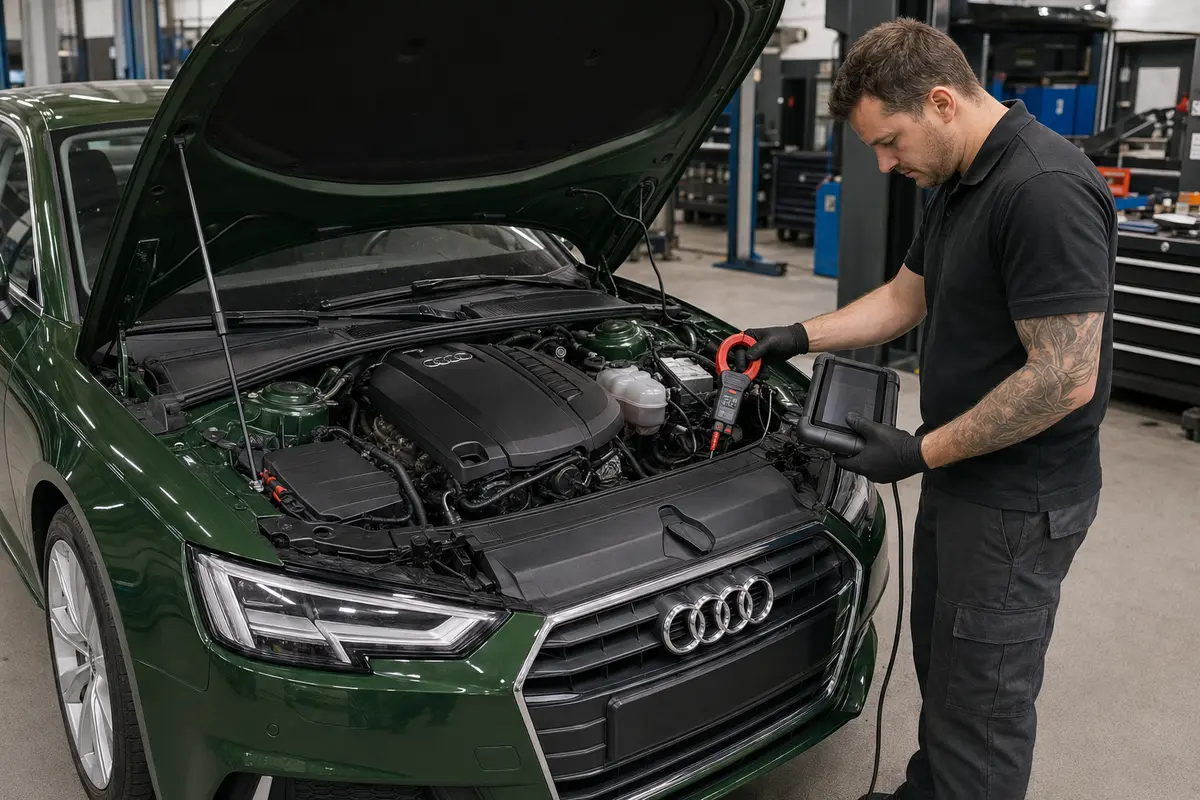
- Record the complaintCapture the warning, start and jump history, battery age, and when the fault appears.
- Identify the architectureConfirm vehicle, engine, build data and whether the route is 12 V, mild hybrid, 48 V or battery-electric.
- Inspect the supply pathsCheck battery terminals, earths, main positive connection, fuses, fusible links, mounting and the visible auxiliary drive.
- Stabilise the batteryA deeply discharged battery distorts testing. Charge or support it where the procedure requires stability.
- Retain fault contextRecord faults, event data and communication before clearing information that could explain the event.
- Test battery conditionCharge state differs from capacity and health. A battery can show voltage yet fail under load.
- Compare command and responseMeasure requested generator activity, actual voltage and current, load and available system values under controlled conditions.
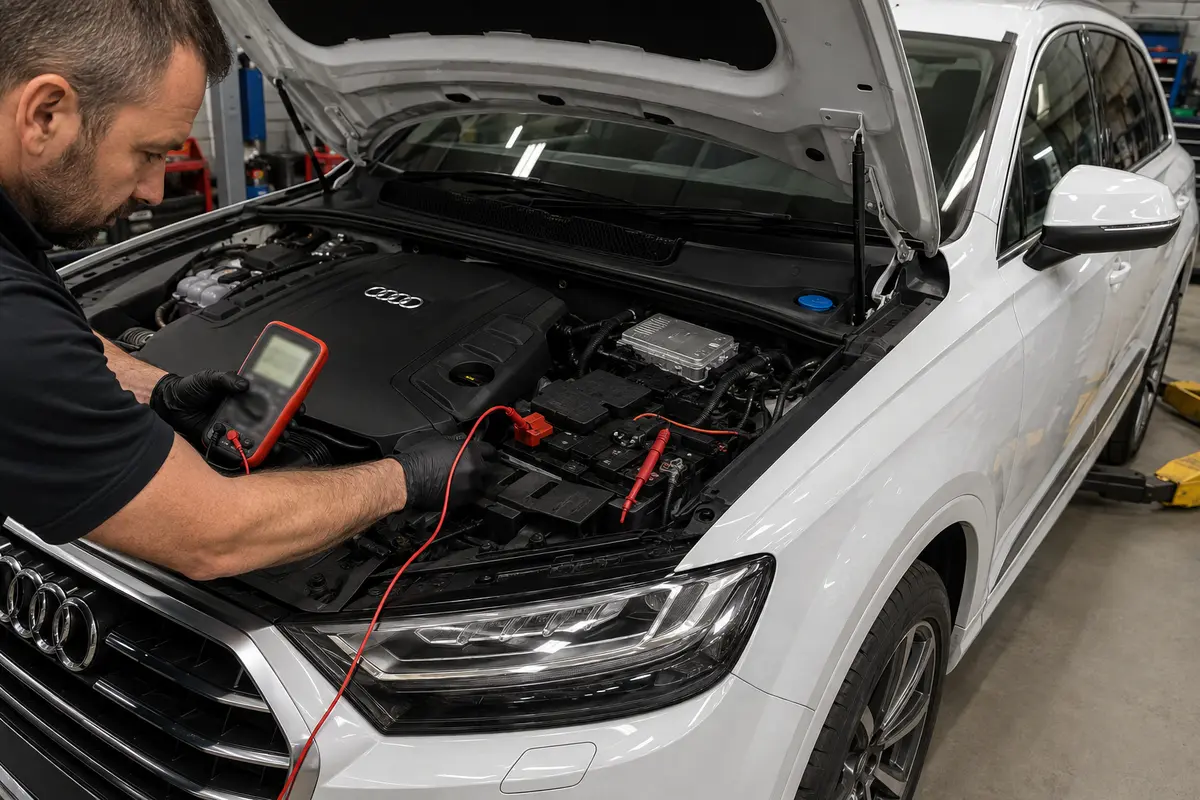
- Measure voltage dropTest the positive and earth paths under load. A generator can produce correctly while resistance prevents useful power reaching the battery and vehicle.
- Assess ripple where relevantOn a conventional alternator, AC ripple and diode behaviour can expose rectifier faults that a simple DC snapshot misses.
- Inspect the belt driveCheck belt condition, tensioner movement, idlers, pulley operation and alignment. Another accessory can imitate alternator bearing noise.
- Check control communicationWhere fitted, inspect regulator command, LIN wiring and measured communication rather than substituting an alternator for a control fault.
- Separate recharge from drainFailure to recharge while driving and current consumed after the car enters sleep are different diagnoses, even when both end in a flat battery.
- Price the confirmed routeThe written estimate identifies the part tier, access, belt-drive work, cooling, software, hardware, core terms, VAT and post-fit tests.
Keep the good component
Repair and replacement routes
The correct commercial outcome can be a cable repair, a pulley, an internal alternator repair, a remanufactured exchange unit or a new generator. The cause and residual risk decide, not the page title.
Battery or connection route
If generator response meets the vehicle request, retain it. The work may be controlled battery charging, a battery-specific replacement, terminal service, an earth or positive-cable repair, or a fuse or fusible-link repair. Battery selection and registration remain the Battery Replacement page’s intent, while larger wiring repairs belong to Audi Electrical Repair.
Belt and pulley route
A worn belt, weak tensioner, rough idler or failed overrunning pulley can create noise, flutter and reduced generator speed. The pulley is separately serviceable only where the exact unit and procedure allow it. An auxiliary belt is not the engine timing belt.
Regulator or internal repair
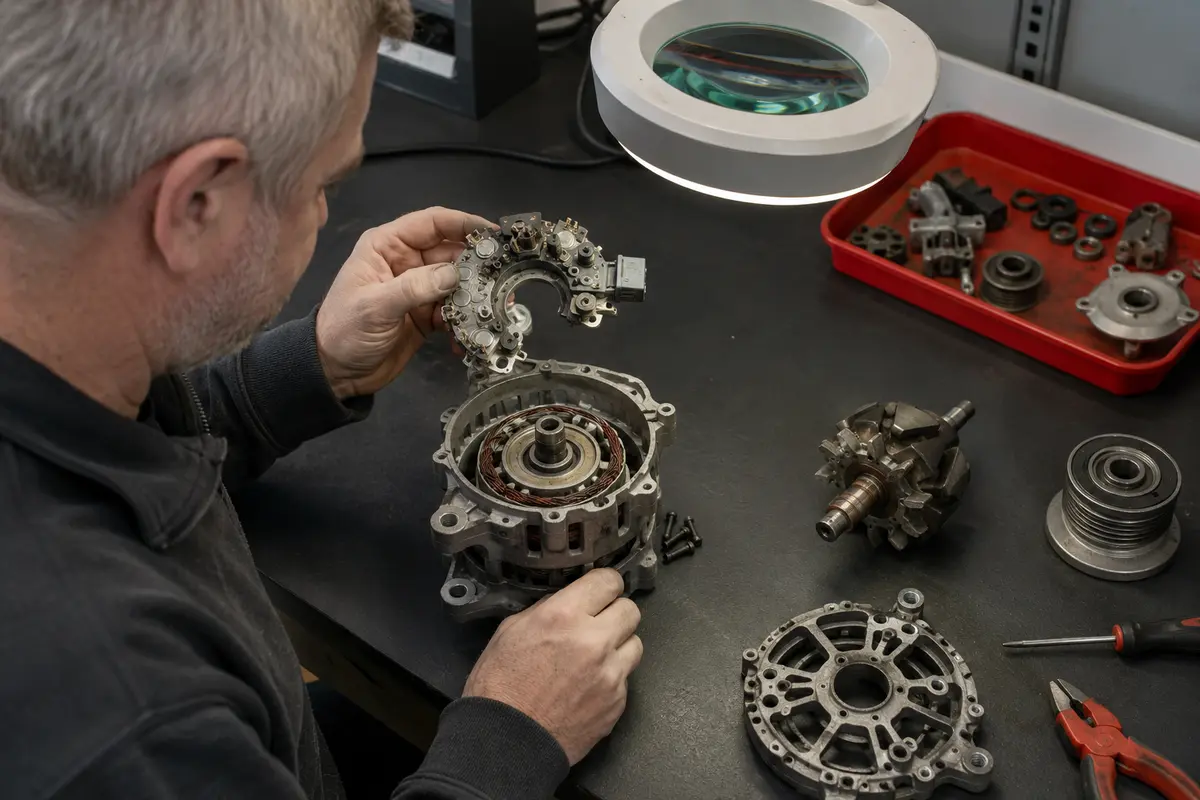
A serviceable design may accept regulator, brush, bearing, rectifier or diode work. Damaged windings, housing, severe contamination or uncertain parts can favour replacement.
Remanufactured or exchange unit
Require a named supplier, recorded internal work, output test, pulley status, core terms and written warranty. Fresh paint on a used unit is not remanufacturing.
New conventional alternator
Selection confirms output rating, connector, mounting, pulley, cooling and current supersession against the VIN and installed unit. The estimate states whether the belt, tensioner, fasteners, coolant, battery charging and any required basic settings are included.
Belt starter-generator route
Keep this separate. Diagnosis can involve 12 V and 48 V batteries, DC-to-DC conversion, cooling, communication, software and starter-generator response. Confirm capability and procedure first.
Broader electrical route
If generation is correct, parasitic draw, network communication, battery management, starter and DC-to-DC faults move to Electrical Repair or Audi Diagnostics. Selling an alternator would not solve the complaint.
Mechanical and electrical paths
The alternator is one part of the charging route
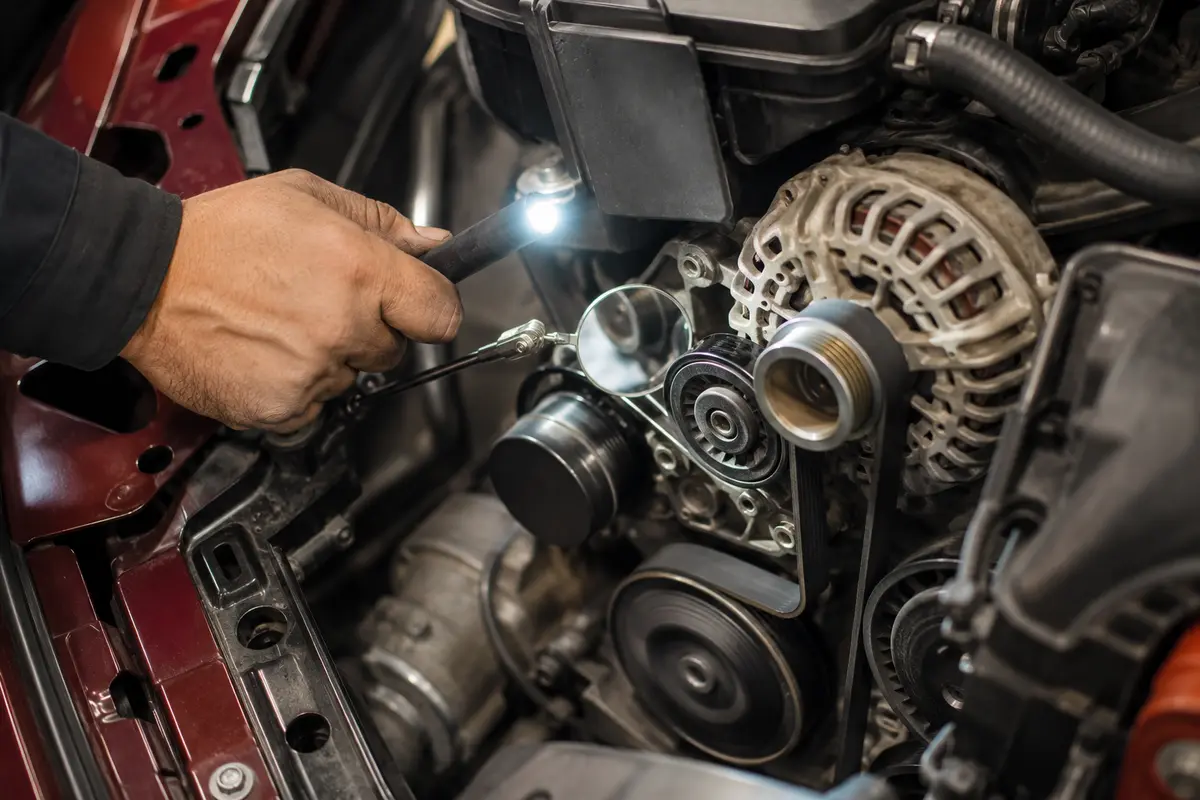
The drive must turn the unit smoothly and the electrical path must carry its output. A healthy alternator can still undercharge the battery when a belt slips or a connection heats. Routine belt inspection without a charging complaint remains with Audi Maintenance.
- Overrunning pulleyWhere fitted, it manages belt dynamics. Seizure or loss of freewheel action can create flutter, noise and tensioner movement.
- Belt and tensionerCondition, contamination, alignment and controlled tension matter. Replacement is based on inspection and the repair procedure, not automatically added to every alternator.
- Idlers and accessoriesA rough idler, compressor or other driven component can sound like an alternator bearing. Safe isolation prevents the wrong part being ordered.
- Positive cableCorrosion, loose connections or damaged junctions can lose voltage and create heat even when the generator itself produces correctly.
- Earth pathEngine, body and battery grounds need a load-based voltage-drop test. Visual cleanliness does not prove low resistance.
- Fuse protectionFuse and fusible-link designs vary. The repair must address the reason for damage as well as restore the protected path.
Parts decision
Five supply routes with different residual risk
Physical fit is not enough. Output, control, connector, mounting, pulley, cooling, supersession and warranty have to match the identified car.
Audi Genuine
Selected through VIN and current supersession. Usually the highest purchase-price route. Confirm whether it is new or official exchange and whether a refundable core charge applies.
Established manufacturer
Bosch, Valeo, Denso and HELLA have catalogued charging applications. A name is useful only when its current catalogue and exact part number match this vehicle.
Quality aftermarket
Can reduce cost when specifications, supplier identity and warranty are clear. An unknown white-label unit is not presented as equivalent to an established manufacturer.
Properly remanufactured
Ask who rebuilt it, which wear items were renewed, how regulator, rectifier and output were tested, whether the pulley is included and what the core and labour terms say.
Tested used
May suit some older conventional systems, but mileage and heat history remain uncertain. Supplier warranty and repeat-labour risk must be visible. It is not the default choice for a 48 V starter-generator.
Why access changes the fitted price
Transverse and longitudinal layouts place the unit differently. Four-cylinder access may be straightforward, while packaged V6 or V8 applications can involve undertrays, intakes, mounts or front-carrier access. Liquid cooling can add seals, bleeding and a leak check.
Include those steps only when the engine procedure requires them. A model-only price that ignores production year and supersession is unreliable.
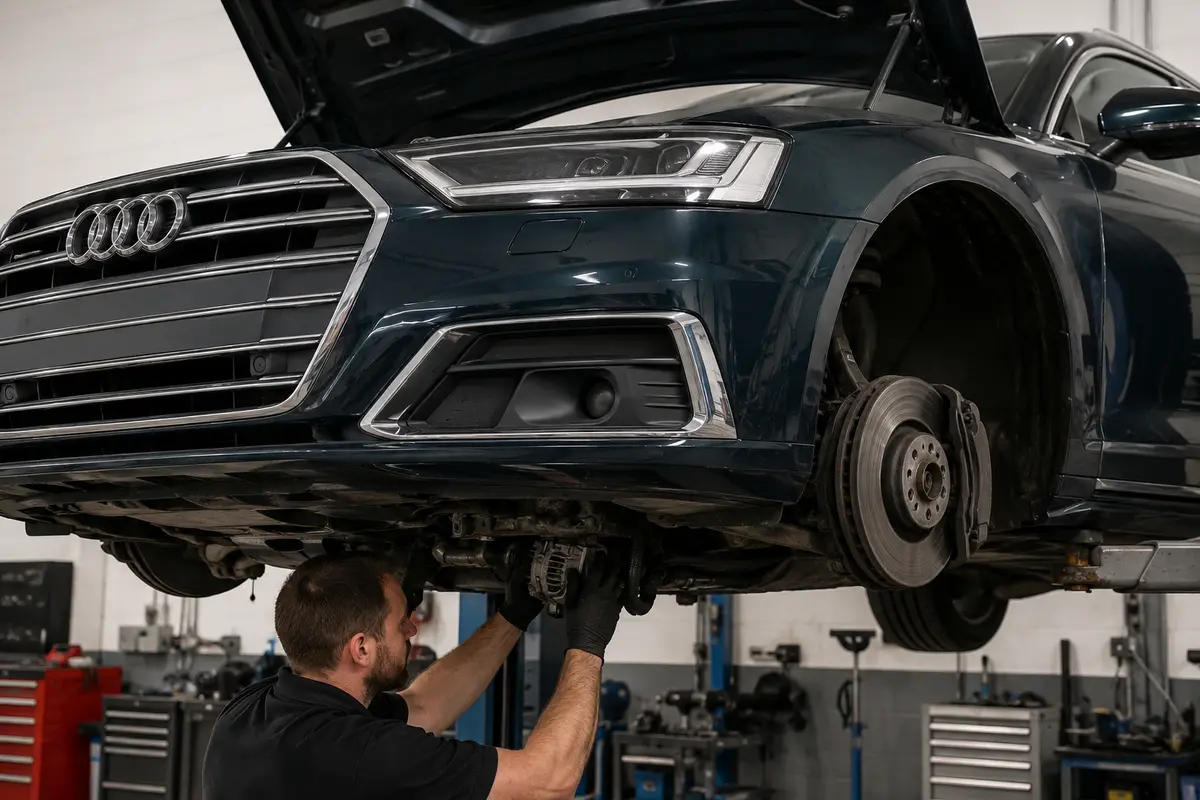
Architecture boundary
48-volt mild hybrid and e-tron are different jobs
Selected mild hybrids use a belt starter-generator with a 48 V battery, power conversion, communication and control. It can support recuperation, start-stop and restarting, unlike a conventional 12 V alternator.
Not every A6, A7, A8, Q7 or Q8 uses the same arrangement. Engine, market, date and equipment vary. Some newer systems add a powertrain generator, so the badge cannot set the parts list.
A battery-electric e-tron has no engine-driven alternator. Its high-voltage battery and DC-to-DC converter support 12 V. Supply faults belong to the appropriate EV and electrical diagnostic route.
- No public form asks the customer to touch 48 V equipment.
- No isolation, probing, jump-start or bypass procedure is published.
- Capability, procedure, software and parts must be confirmed.
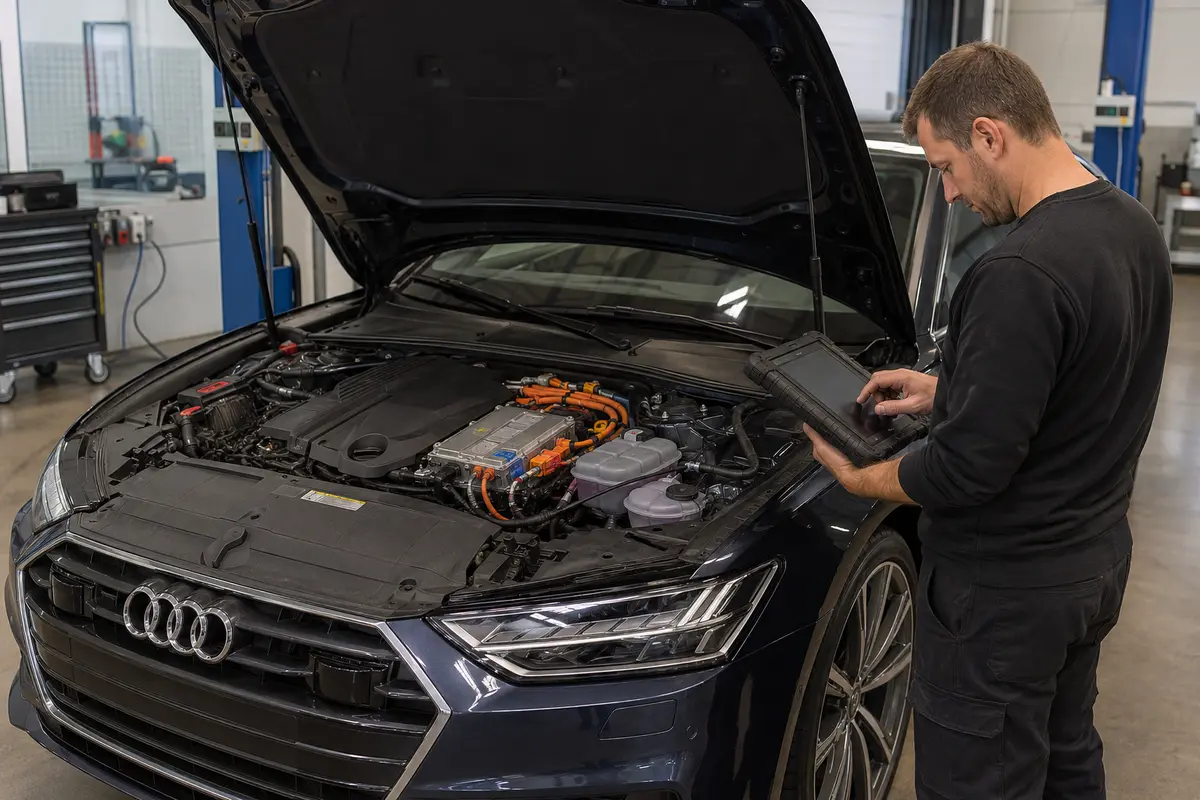
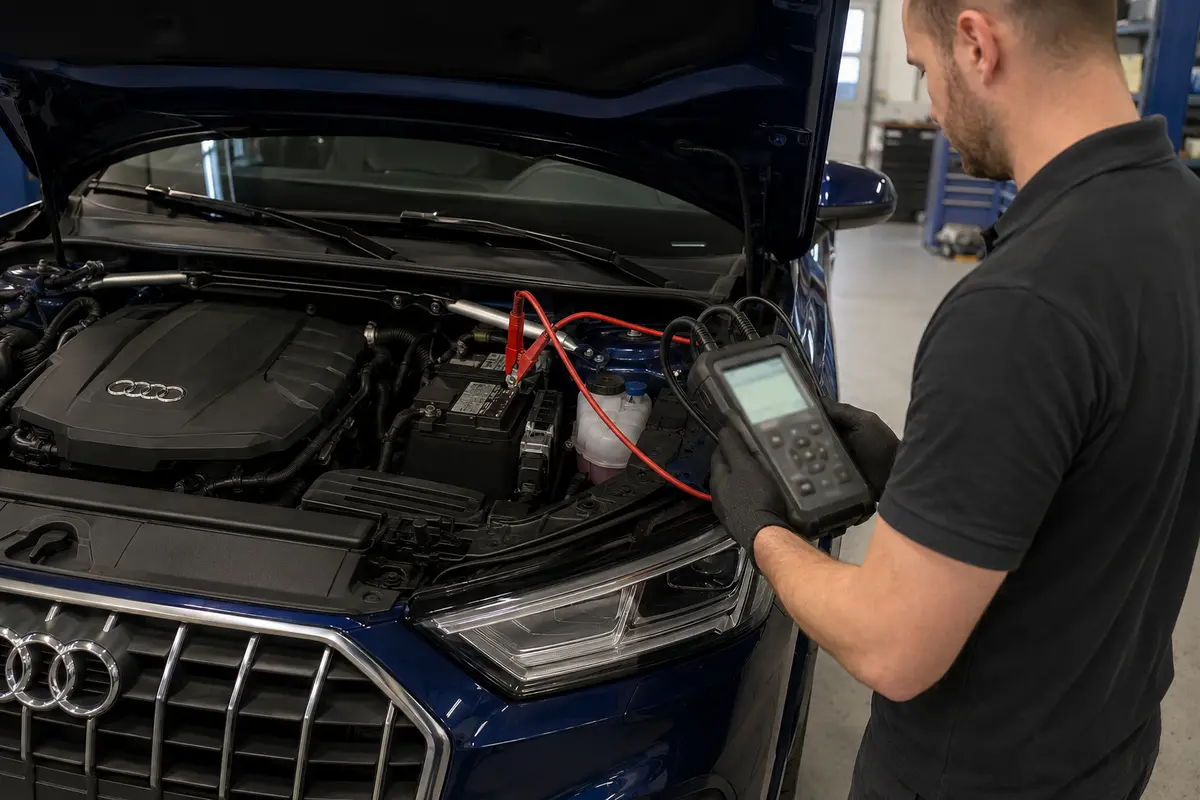
Tentative AED planning bands
What Audi alternator work can cost
These ranges help separate diagnostic, repair, conventional replacement and 48 V routes. They are not a quote for an unidentified vehicle.
Checked 2 September 2026 against visible UAE parts and service signals. Exact workshop labour, current stock, VIN, engine, access and supplier terms still require reconciliation before publication. The bands below exclude 5% VAT unless a written estimate states that VAT is included.
Pricing status under verification| Service route | Provisional range | System and part assumption | Included, excluded and variables |
|---|---|---|---|
| Initial battery and charging assessment | AED 150 to 350 | 12 V battery and conventional system. | Initial state, connections, belt and output context. Parts, recovery and VAT excluded. |
| Full scan and controlled-load diagnosis | AED 250 to 650 | 12 V conventional or smart charging. | Scan, command comparison and controlled load. Parts, charging and VAT excluded. |
| Voltage-drop and ripple testing | AED 250 to 600 | Conventional alternator and 12 V paths. | Positive, earth and suitable AC ripple tests. Repairs, removal and VAT excluded. |
| Battery charging and retest | AED 100 to 300 | Existing 12 V battery retained. | Controlled charge and retest. Replacement, registration, recovery and VAT excluded. |
| Parasitic-draw diagnostic route | AED 300 to 1,000 | Charging passes; battery empties parked. | Electrical Repair sleep-current diagnosis. Repairs and VAT excluded. |
| Charging cable, terminal or earth repair | AED 300 to 1,500 | Confirmed 12 V resistance or damage. | Local repair varies with access. Alternator, battery, harness and VAT excluded. |
| Fuse or fusible-link repair | AED 250 to 900 | Confirmed 12 V protection fault. | Part and normal access. Cause, harness, module and VAT excluded. |
| Auxiliary or serpentine belt replacement | AED 350 to 950 | Conventional drive; alternator retained. | Belt and standard fitting. Tensioner, idlers, pulley and VAT excluded. |
| Belt tensioner or idler replacement | AED 650 to 1,900 | Identified conventional auxiliary drive. | Component and labour. Belt, other pulleys, access and VAT itemised. |
| Overrunning alternator pulley | AED 650 to 1,600 | Separately serviceable conventional pulley. | Pulley and standard labour. Internals, belt, access and VAT excluded. |
| Voltage-regulator or brush-pack repair | AED 700 to 1,700 | Repairable existing conventional unit. | Targeted part and labour. Pulley, other damage, access and VAT vary. |
| Bearing, rectifier or diode repair | AED 800 to 2,000 | Repairable existing conventional unit. | Bench repair and test. Housing, windings, pulley, access and VAT vary. |
| Conventional alternator overhaul | AED 900 to 2,200 | Existing 12 V unit suitable for overhaul. | Defined internal work and output test. Access, pulley, belt and VAT itemised. |
| Tested used alternator fitted | AED 1,000 to 2,400 | Older 12 V system; exact used match. | Part and fitting. Test, pulley, warranty, repeat-labour risk and VAT stated. |
| Remanufactured or exchange alternator fitted | AED 1,500 to 3,500 | Conventional 12 V exchange route. | Unit and standard fitting. Rebuilder, pulley, core, warranty and VAT itemised. |
| Quality new aftermarket alternator fitted | AED 1,800 to 3,800 | New specified compatible 12 V unit. | Part and fitting. Brand, output, pulley, access and VAT documented. |
| Established manufacturer or OE-quality unit | AED 2,200 to 4,800 | Exact catalogued established-brand match. | Status, part and fitting. Core, pulley, access, fluids and VAT vary. |
| Audi Genuine conventional alternator fitted | AED 3,500 to 7,500+ | VIN-confirmed new or official exchange. | Unit and labour. Core, pulley, access, hardware, software and VAT confirmed. |
| Water-cooled or high-access alternator | AED 3,000 to 7,000 | Liquid-cooled or high-access 12 V unit. | Part and labour. Coolant, seals, hardware, pulley, belt and VAT listed. |
| Coolant, seals and one-time hardware | AED 250 to 1,000 extra | Only where the procedure requires them. | Specified fluids, seals and hardware. Not universal. VAT excluded. |
| 48V starter-generator diagnosis | AED 400 to 1,100 | Identified 48 V mild-hybrid system. | 12 V and 48 V context, scan and guided checks. Parts and VAT excluded. |
| 48V software or integration work | AED 500 to 1,500 | Confirmed 48 V software task. | Documented task and verification. Hardware, batteries, access and VAT excluded. |
| 48V belt starter-generator repair | AED 3,000 to 7,000 | Repair-supported unit after diagnosis. | Defined repair. Removal, coolant, software, belt, warranty and VAT vary. |
| 48V remanufactured or exchange unit fitted | AED 5,500 to 10,000 | VIN-matched supported exchange. | Unit and fitting. Core, cooling, software, belt, warranty and VAT written. |
| New OE-quality or Audi Genuine 48V route | AED 9,000 to 18,000+ | New exact-match 48 V unit. | Part and labour. Cooling, software, belt, related faults and VAT vary. |
| Conventional EFB battery redirect | AED 450 to 950 | Confirmed EFB battery becomes primary. | Battery route only. Capacity, registration, delivery and VAT confirmed separately. |
| AGM battery fitted and registered | AED 750 to 1,800 | AGM 12 V battery route. | Capacity, brand, fitting, registration, warranty and VAT stated separately. |
| Auxiliary battery route | AED 450 to 1,100 | Confirmed auxiliary 12 V battery. | Battery work, not alternator work. Access, type, registration and VAT vary. |
| Battery registration as a separate task | AED 150 to 350 | Registration confirmed necessary. | Registration only. Battery, charging diagnosis, other coding and VAT excluded. |
| DC-to-DC, module or network fault | After diagnosis | Generator not confirmed as cause. | Electrical Repair route. Module, wiring, software, high-voltage work and VAT quoted. |
| Dubai recovery | AED 250 to 800 | Vehicle cannot move safely. | Location, access and condition vary. Repair, diagnosis, parking and VAT excluded. |
Worked service examples
High-resistance connection with the alternator retained
Testing finds the generator responding but excessive voltage is lost across a loose or damaged charging connection. The band can include diagnosis and a local terminal, earth or cable repair. It changes with cable length, junction damage and access. No alternator is included.
Serviceable pulley or regulator fault
A conventional unit has a confirmed pulley or regulator fault and the design supports separate work. The estimate includes the identified repair and output verification. Belt condition, alternator removal time and additional internal damage can move the total.
Older Audi with an exchange or established-brand unit
The VIN and existing part confirm a conventional alternator. The range can include a properly remanufactured exchange or an established manufacturer unit with normal fitting. Output, pulley, core return and packaging explain why the model name alone is insufficient.
High-access or liquid-cooled conventional alternator
The route includes a matched unit and vehicle-specific access, with coolant, seals and one-time hardware where required. Front-carrier access, part tier, cooling connections and post-fit leak checks can change the band. Coding is not added unless the procedure requires it.
Mild-hybrid warning needs architecture diagnosis
A 48 V warning starts with 12 V and 48 V battery state, scan context, communication, software and requested starter-generator operation. Only then can the estimate distinguish software or integration work from repair or a unit route. A part can range from a targeted task to more than AED 18,000, which is why parts approval cannot follow the model badge or one fault code.
Written estimate
What the quote must identify
The estimate should be readable without decoding workshop shorthand. These items prevent a low starting price from becoming a different job at collection.
- Vehicle, engine and charging architecture assumed.
- Confirmed part number, output rating and current supersession.
- New, Audi Genuine, established brand, remanufactured or used status.
- Pulley supplied with the unit or transferred from the existing alternator.
- Belt, tensioner and idlers included or excluded.
- Fasteners, coolant, seals and bleeding included or excluded.
- Battery charging, battery replacement and registration included or excluded.
- Coding, software, updates or basic settings included only where required.
- Core charge, return deadline and condition terms.
- Vehicle attendance, workshop access or recovery.
- 5% VAT treatment and any external supplier charges.
- Parts and labour warranty boundaries plus residual battery or drain risk.
Output verification
Final testing follows the work performed
The handover is more than a clean dashboard at idle. The battery must be stable enough for valid testing, the mechanical drive must run correctly, and delivered output must respond to the vehicle request under an appropriate load.
- Record part number, output, pulley and connector.
- Check belt alignment and tensioner movement.
- Recheck positive and earth paths under load.
- Compare commanded and actual charging response.
- Assess ripple where appropriate.
- Fill, bleed and leak-check applicable cooling.
- Complete only required software or settings.
- Compare pre-repair and post-repair faults.
- Recheck battery and electrical warnings.
- Start, idle, load and road test as applicable.
- Repeat hot checks when heat caused the complaint.
- Explain warranty, core and remaining drain advice.
One idle-voltage reading or one clean scan cannot prove future charging reliability. The results are interpreted with the original fault conditions and the identified system.
Questions before approval
Audi alternator questions answered
How much does Audi alternator replacement cost in Dubai?
Tentative fitted conventional routes span about AED 1,000 to AED 7,500 or more. Engine, part tier, pulley, cooling, access, core terms and VAT decide the estimate.
Does a battery warning light mean the alternator has failed?
No. Battery, belt, pulley, cable, earth, fuse, control and mild-hybrid faults can show the same warning. Test the complete route before ordering a unit.
How can I tell whether the battery or alternator is faulty?
Test battery capacity and cranking behaviour beside charging command, current, cable voltage drop and belt condition. Symptoms alone cannot separate recharge failure from a parked drain.
Why did a new battery go flat again?
Possible causes include poor charging, a resistive connection, wrong battery specification, missing registration where required or a parked-current drain. A new alternator will not cure an unrelated drain.
Can an Audi alternator be repaired instead of replaced?
Sometimes. A serviceable conventional unit may accept regulator, brush, bearing, rectifier or diode work. Winding, housing or severe contamination damage may favour replacement.
Can the voltage regulator or pulley be replaced separately?
Only where the exact unit supports it. Pulley design and belt geometry must match, while a regulator repair also requires sound windings, rectifier, bearings and control.
What is an overrunning alternator pulley?
It manages rotational changes and belt vibration on some units. Failure can cause noise or tensioner flutter, but not every alternator uses a separately serviceable pulley.
Is a remanufactured alternator a sensible option?
It can be when the rebuilder, renewed parts, output test, pulley, core terms and warranty are documented. A cleaned used unit is not remanufactured.
What is the difference between a conventional alternator and a 48V starter-generator?
A 48 V unit can add recuperation, start-stop and restarting, with separate battery, conversion, communication and software. It is not a conventional alternator job.
Does every Audi A6, A7, A8, Q7 or Q8 use a 48V starter-generator?
No. Generation, engine, market, production date and equipment vary. Build data and scan identification select the architecture, not the model badge.
Can a parasitic drain look like alternator failure?
Yes. A sound charging system can be followed by abnormal current after shutdown. Diode leakage is one possibility, but broader sleep-current diagnosis belongs to Electrical Repair.
Can I drive with the red battery warning on?
The electrical reserve can run out. Stop for smoke, smell, belt damage, declining functions or a stop instruction. Otherwise limit driving and arrange prompt assessment.
Does alternator replacement require coding or battery registration?
Not universally. Scan and output verification still apply. Coding or settings follow the exact procedure, while battery registration is a separate battery task.
Why can smart charging voltage vary while driving?
Demand changes with battery state, temperature, load and strategy. Compare requested and actual behaviour under known conditions instead of using one universal voltage number.
Does an Audi e-tron have a conventional alternator?
No. A battery-electric Audi uses its high-voltage system and DC-to-DC converter to support 12 V, so it needs an EV electrical route.
What details are needed for an accurate estimate?
Send model, year, engine type, warning, starting state, timing, recent jump history, mileage, area and safe-to-move status. Share the full VIN only through a suitable private channel.
Start with the fault, not a part
Get the first charging-system route
Use the same request above to share the model, year, warning, starting state and safe-to-move status. Your entries remain in the builder during this page session and are not stored by the page.