
Display, gauge and network diagnosis
Audi instrument cluster repair in Dubai
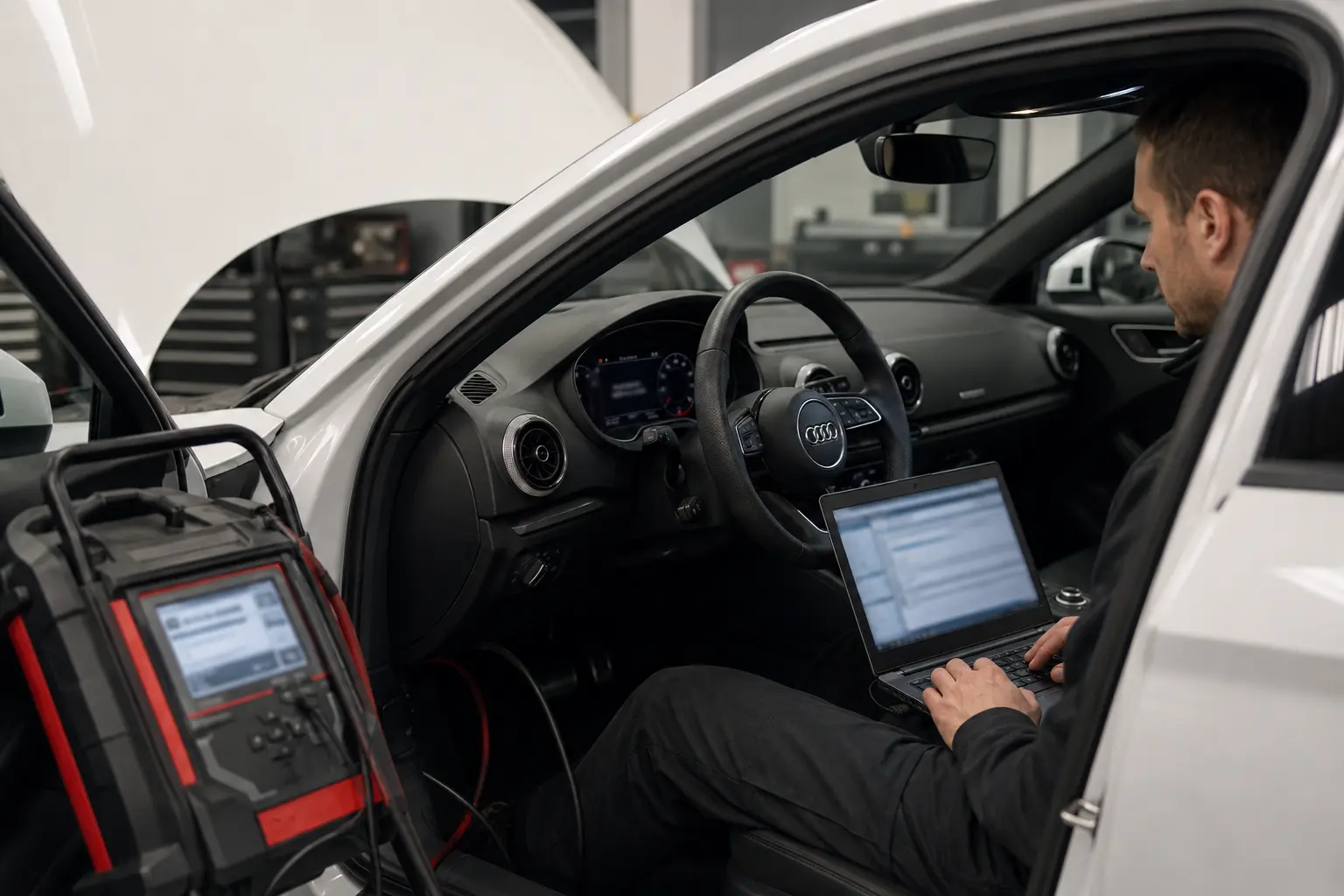
An Audi instrument cluster can often be repaired when pixels, illumination, gauges or internal power electronics fail. Replacement is not the automatic first step. We test the cluster, its power and ground, vehicle voltage and CAN communication first, then explain whether original-unit repair, wiring work or a correctly programmed replacement is the sensible route.
- Analogue and digital clusters
- Diagnosis before replacement
- Programming dependencies checked

The short answer
Start with the fault location
A blank screen does not always mean a failed cluster, and a warning light does not prove the cluster caused the vehicle fault. The cluster may be the display for information created elsewhere. Correct diagnosis separates an internal display or circuit fault from low battery voltage, a fuse, wiring, network communication, gateway, immobiliser or coding problem. If the failure is in the centre infotainment display or navigation interface rather than the driver cluster, use Audi MMI and navigation-screen repair.
If the original unit can be repaired reliably, keeping it can preserve the vehicle-specific identity and avoid some replacement dependencies. If the processor, board, housing or display is beyond a sensible repair, we identify the correct replacement path, part-number compatibility and programming requirements before parts are ordered.
WhatsApp enquiry builder
Send details that change the diagnosis
The complete message is shown before WhatsApp opens. Nothing is sent automatically.
Add photos of the complete cluster, warning lights and any scan report after WhatsApp opens.
Fault-location console
Which system owns the symptom
Similar dashboard symptoms can begin in different parts of the car. These routes explain what should be proved before a cluster is dismantled or replaced.
Display and pixels
Missing lines, dark zones, distorted graphics, flicker or temperature-sensitive operation can point to the LCD, connector, ribbon, driver circuit or internal supply. We still verify stable vehicle voltage before bench work.
Backlight and illumination
A dim section, colour change or illumination that reacts incorrectly may involve LEDs, a lighting driver, dimming request, ambient-light input or vehicle configuration. The symptom is tested in day and night modes.
Gauges and needles
A stationary, jumping or inaccurate needle can come from a stepper motor or internal drive circuit, but the cluster may simply be receiving implausible data from another control unit or sensor.
Warning indicators
The cluster displays engine, airbag, ABS, charging and temperature warnings. The responsible system must be scanned and tested. Clearing or masking the lamp is not a repair.
Power and ground
A fully blank or rebooting cluster may be affected by a fuse, terminal tension, voltage drop, poor earth, battery event or ignition-supply fault. Loaded circuit tests come before cluster condemnation.
CAN communication
No-communication faults may involve the cluster, gateway, wiring, another module pulling the network down or incorrect replacement configuration. Network topology and fault timing guide the next test.
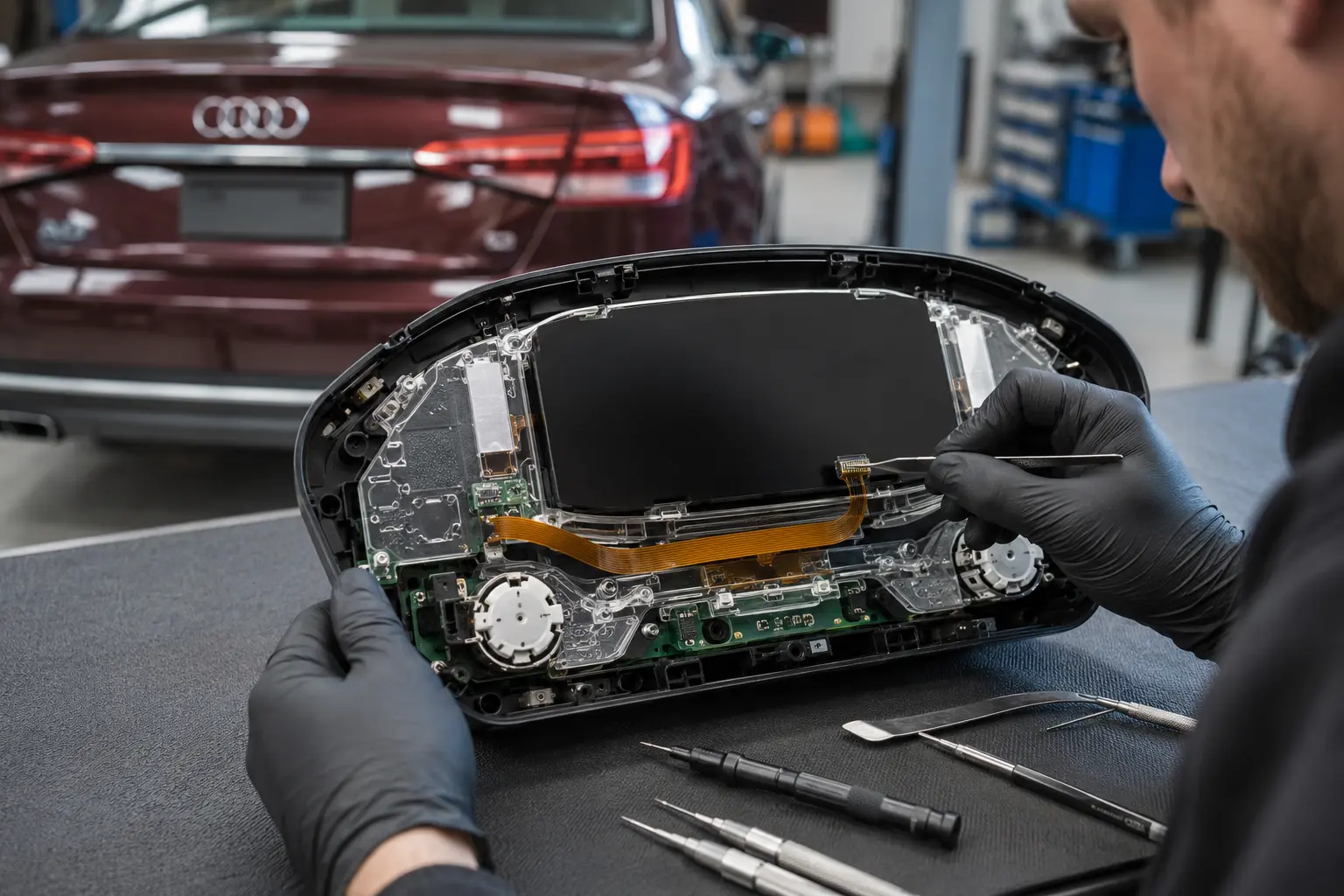
Internal cluster faults
Repair the cause inside the unit
When testing confirms an internal fault, the repair scope depends on the cluster generation and what has failed. Pixel lines, backlight zones, voltage regulation, solder joints, connectors, drive components and contamination are different jobs. A useful quotation therefore follows inspection rather than a single advertised price for every cluster.
We document the condition before opening, protect the casing and display surfaces, work with electrostatic precautions and test the original unit on stable power where the circuit allows it. A repaired cluster is then verified in the vehicle because bench operation alone cannot prove network communication, dimming, warning-lamp behaviour or gauge data.
- Original symptoms and scan data retained before disconnection
- Power, ground and battery condition checked under load
- Display, illumination and gauge functions tested separately
- Repair limits explained when contamination or board damage is extensive
Original unit or replacement
Choose the repair before buying parts
Repair the original cluster
This route is usually preferred when the unit communicates, its identity data is intact and the fault is limited to a repairable display, illumination, gauge or internal power section. Keeping the original unit may reduce compatibility and programming complications.
- Retains the vehicle-matched unit
- Can be more economical for contained faults
- Avoids gambling on unknown used-part history
- Still requires vehicle testing after repair
Repair may be unsuitable after severe water ingress, burnt multilayer-board damage, unavailable display parts, processor failure or previous poor repairs that make reliability uncertain.
Replace and programme
Replacement becomes reasonable when the original unit is missing, physically destroyed, internally irreparable or more expensive to recover than a suitable alternative. Connector shape alone never proves compatibility.
- Part number, suffix and hardware generation checked
- Used, remanufactured and new options compared honestly
- Component Protection and immobiliser dependencies identified
- Coding, adaptations and calibration included only when required
A used cluster may carry locked identity or mileage data and may not support a lawful, technically reliable adaptation route. We assess the label and donor information before it is presented as a saving.
Diagnosis before parts
Lookalike faults that waste money
A recent battery replacement, flat battery, jump start or alternator fault can create multiple low-voltage and communication codes. A fuse that looks intact can still have poor contact. Water around the plenum, windscreen, dashboard or wiring can affect connectors without visibly damaging the cluster. An aftermarket accessory can disturb ignition supply or the CAN network.
We begin with the symptom history, battery and charging condition, complete vehicle scan and cluster communication status. Power and ground are tested under load. Network faults are checked in context rather than by replacing the module named in a stored code. When the cluster communicates, output tests and live data can distinguish a display problem from information that never reached the cluster.
Broader wiring, battery drain and module-network problems belong to Audi electrical diagnosis and repair. Engine, airbag, ABS and other system warnings should be followed through their responsible control units, while the Audi warning-lights guide helps owners understand urgency.
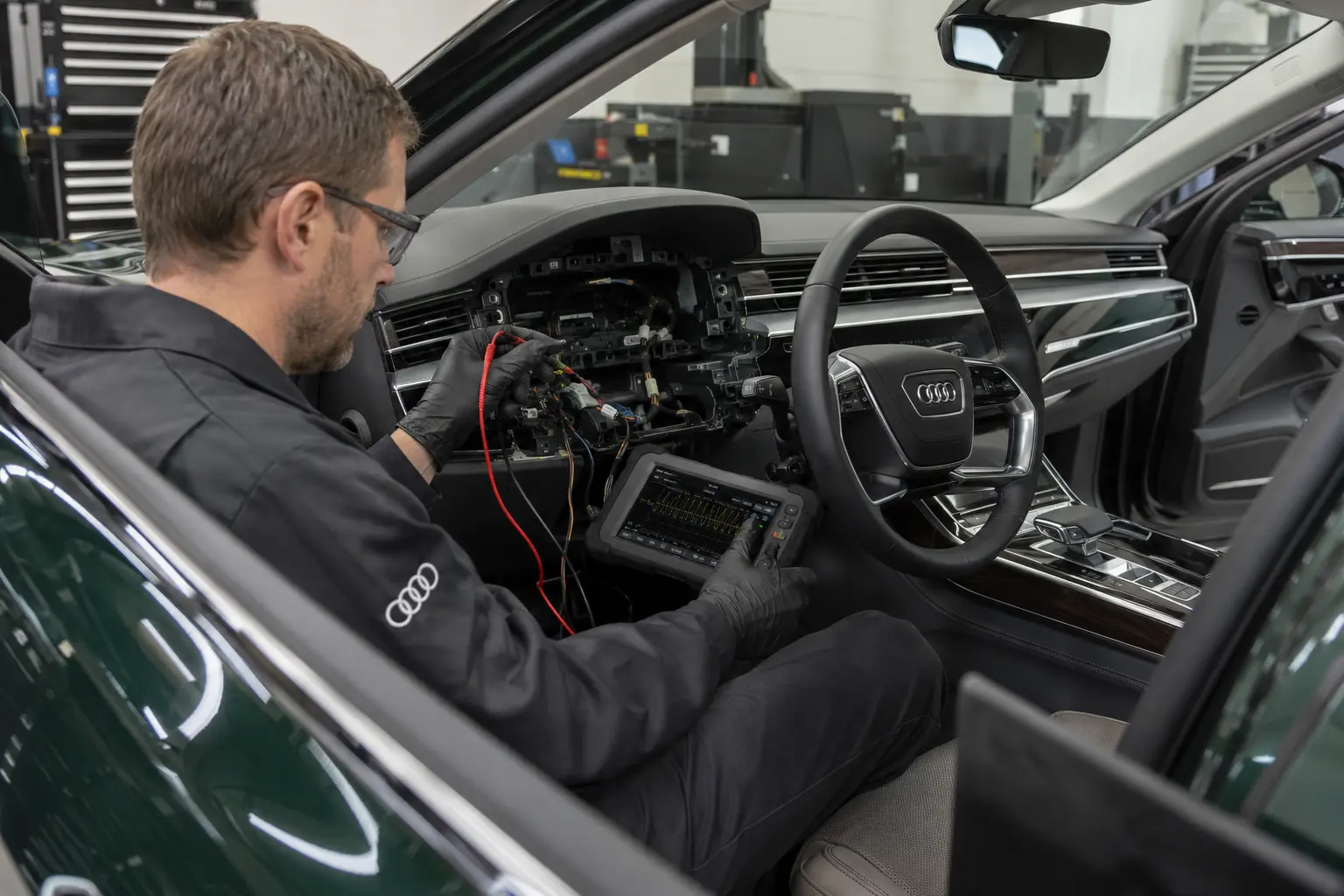
Programming dependency flow
What replacement may require
Not every repair needs programming. The requirement depends on what changed and how the vehicle identifies the cluster.
Identify the vehicle
Record VIN, model year, current cluster part number, hardware and software information, equipment and the exact fault.
Preserve readable data
Where lawful and technically supported, retain coding, adaptations and configuration from the original unit before it deteriorates further.
Check protection
Confirm immobiliser, Component Protection, mileage-data and online or security-related dependencies before fitting the replacement.
Commission and verify
Complete supported coding or matching, clear relevant faults, test every gauge and display, and verify warning-lamp and road-speed behaviour.
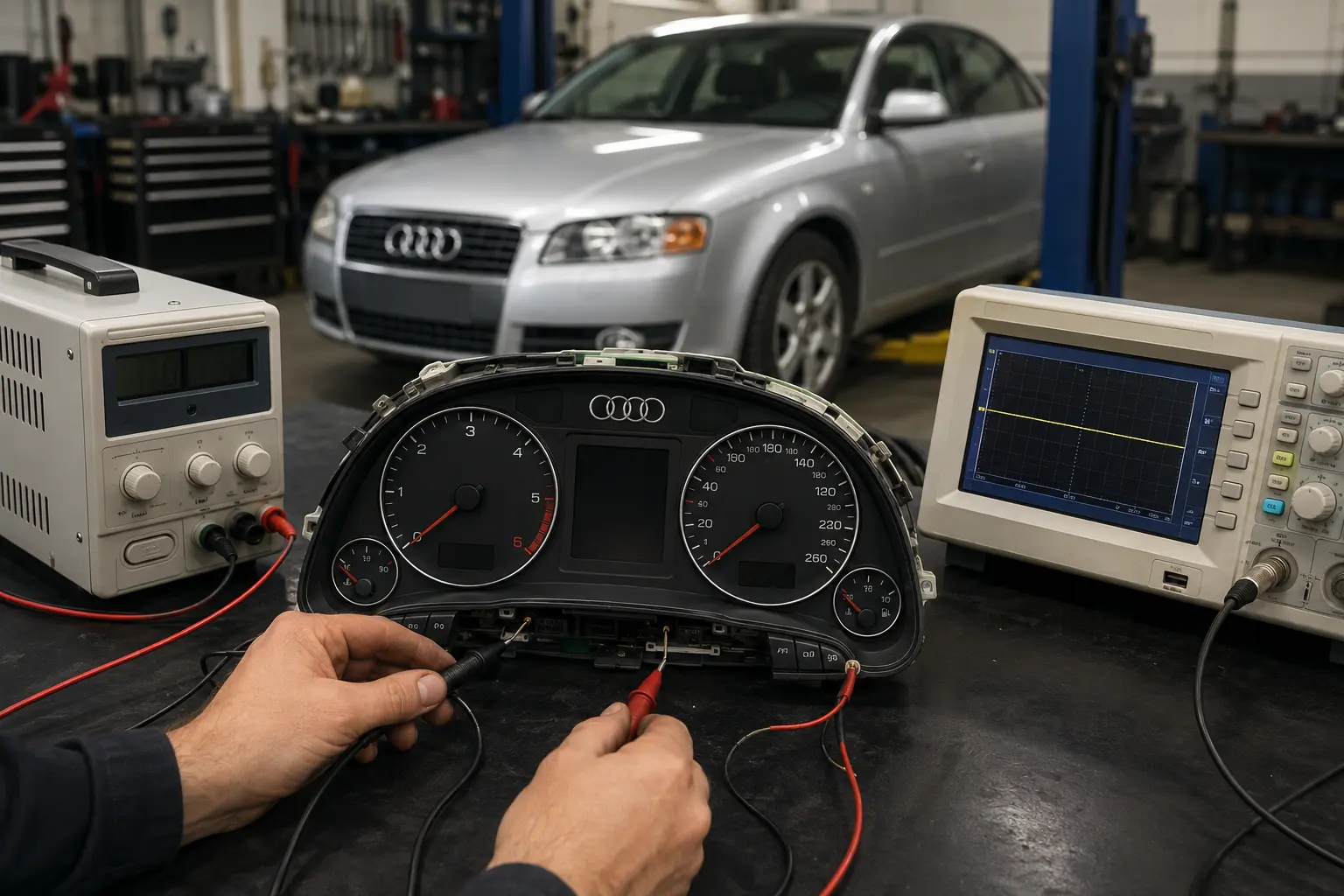
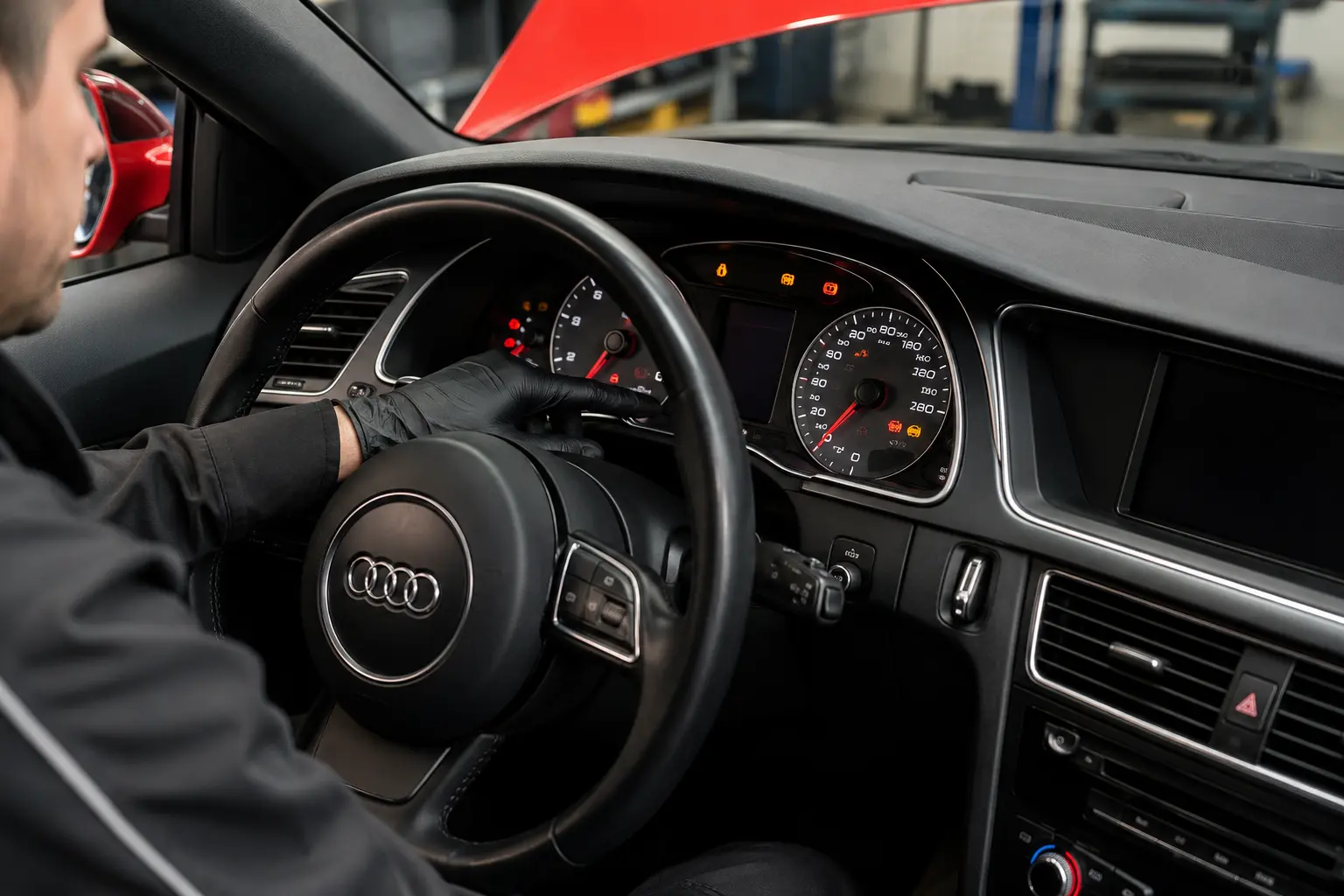
Tentative Dubai pricing
Cluster repair price ledger
These planning ranges are not quotations. They assume ordinary access and a confirmed scope. Unless a row says included, figures are before 5% UAE VAT. Vehicle generation, part number, display type, previous repair, water damage, parts source, coding access and whether the original unit communicates can change the total.
| Assessment or work | Tentative range | What the range assumes |
|---|---|---|
| Initial scan and symptom confirmation | AED 250–450 | Vehicle present, standard diagnostic access and one principal cluster concern |
| Battery, charging and supply check | AED 180–350 | Accessible 12-volt system, loaded voltage checks and no tracing beyond basic supply |
| Cluster power and ground diagnosis | AED 300–650 | Fuse, terminal, ground and voltage-drop testing around the cluster circuit |
| CAN communication diagnosis | AED 350–750 | Network scan, gateway context and limited waveform or resistance checks |
| Cluster removal and refit | AED 300–650 | Normal dashboard access with no broken trim or previous modification |
| Bench test of removed cluster | AED 300–600 | Stable power, communication or output checks possible for the unit generation |
| LCD pixel or line repair | AED 650–1,250 | Repairable display connection or replaceable display element |
| Backlight or illumination repair | AED 550–1,100 | Contained LED, driver or connection fault with viable parts |
| Analogue gauge drive repair | AED 750–1,400 | One or more repairable gauge motors or internal drive components |
| Internal power-supply repair | AED 700–1,500 | Repairable regulator, capacitor, solder or related board fault |
| Connector or terminal repair | AED 250–650 | Localised connector damage without an extensive loom replacement |
| Minor board repair | AED 850–1,800 | Contained component or track fault with recoverable board condition |
| Virtual Cockpit repair | AED 1,500–3,500 | Repairable display or board fault; major processor damage excluded |
| Used-cluster compatibility check | AED 250–450 | Readable labels and donor details supplied before purchase |
| Used or remanufactured cluster supply | AED 1,200–3,500 | Part only, subject to exact number, condition, return terms and availability |
| Coding or adaptation | AED 450–1,200 | Compatible unit and supported route; security or online work may differ |
| Component Protection or identity route | AED 600–1,600 | Eligible lawful supported process; availability confirmed case by case |
| New genuine cluster supply | AED 4,500–12,000+ | Part only; model, display specification and supersession create a wide range |
Example 1 Pixel repair
Diagnosis AED 300 + display repair AED 850 + removal and refit AED 350 = AED 1,500. VAT AED 75. Example total AED 1,575.
Example 2 Power fault
Diagnosis AED 350 + internal power repair AED 1,100 + removal and refit AED 450 = AED 1,900. VAT AED 95. Example total AED 1,995.
Example 3 Compatible used unit
Diagnosis AED 450 + used cluster AED 2,200 + coding AED 900 + removal and refit AED 500 = AED 4,050. VAT AED 202.50. Example total AED 4,252.50.
Example 4 New cluster replacement
Diagnosis AED 450 + new cluster AED 7,500 + programming AED 1,100 + removal and refit AED 550 = AED 9,600. VAT AED 480. Example total AED 10,080.
All four examples are hypothetical arithmetic examples, not customer jobs. A written estimate should identify diagnosis, labour, parts tier, programming, VAT treatment and exclusions for the exact vehicle.

Final testing and handover
Prove more than a bright screen
The repaired or replacement cluster is checked through an ignition cycle and a complete warning-lamp self-test. We verify illumination and dimming, display zones, menus, odometer visibility, gauges, indicators, audible alerts and steering-wheel or stalk controls that interact with the cluster. Relevant fault memories are rescanned.
When road testing is appropriate, vehicle speed, engine speed, temperature or energy data are compared with diagnostic values. Intermittent faults may require heat, cold or vibration observation and cannot always be guaranteed by a short visit. The handover states what was repaired, what was programmed, the parts route used and any remaining vehicle-system fault that the cluster only displays.
If another module is responsible, the customer receives a clear next route rather than a cluster replacement recommendation. You can also review the wider Audi repair services structure or use the contact and workshop page for directions.
Generation and estimate detail
What changes the repair choice
Instrument clusters evolved from analogue gauges with small information displays to high-resolution Virtual Cockpit units. The symptom may sound similar, but access, component availability, data dependencies and test methods can be very different.
Analogue and mixed clusters
Earlier and mixed clusters combine mechanical needles, warning lamps and one or more LCD areas. A dark centre display can exist while the gauges still work. A failed gauge motor can affect one needle without changing the data seen by the scan tool. Illumination may be divided into zones, so one dark area does not prove the complete cluster supply has failed.
Diagnosis compares what the control units report with what the driver sees. If live engine speed is correct but the tachometer remains still, the fault route differs from a vehicle that is not producing usable speed data. If the scan tool cannot communicate with the cluster, power, ground and network tests take priority over gauge repair.
Parts for some older units may be available only as recognised repair components or carefully verified donor sections. That can be a good repair when the original casing, board and identity remain serviceable, but availability and previous repair history must be confirmed before a fixed completion date is promised.
Virtual Cockpit and digital units
Digital clusters combine display hardware, graphics processing, internal memory, power regulation, vehicle communication and security-related identity. A black display can come from a display or internal power fault, but it can also follow unstable vehicle voltage, missing communication or a wider wake-up problem. A distorted image, coloured band or partial panel failure usually needs a different test from a complete no-power complaint.
A replacement screen panel does not automatically make the whole cluster repairable. Connector damage, liquid contamination, processor faults and unavailable matched components can change the decision. A complete replacement then creates part-number, software, protection, coding and data-handling questions that do not exist in a simple display repair.
Stable battery support matters during programming and some test routines. The final check includes cold and warm starts where practical, brightness changes, menu operation and a scan after the cluster has completed its normal sleep and wake cycle.
Written estimate boundaries
Know what the quotation includes
A useful cluster estimate identifies the diagnostic work already completed, whether the original unit is being repaired or replaced, the parts tier, removal and refit, bench work, coding or adaptation, VAT and final testing. It should also state whether the vehicle is expected to remain at the workshop while a removed unit is assessed.
Initial diagnosis is normally separate from unpredictable board reconstruction. If a unit has been opened before, has corrosion under several components or loses communication during testing, the workshop may need to stop and revise the scope. That is better than continuing with a repair that cannot be verified. When a replacement is proposed, the estimate should distinguish the part cost from compatibility checking and commissioning labour.
Customer-supplied used units can be assessed, but their condition, donor history and return terms remain outside workshop control. A lower purchase price can become expensive if the unit is incompatible or locked. Send the complete label before buying whenever possible.
Frequently asked questions
Audi cluster repair questions
Can a blank Audi instrument cluster be repaired?
Often, but the blank display must first be separated from a fuse, low voltage, power, ground or CAN communication fault. If the internal power supply, display or connection is repairable, the original cluster may be recoverable. Severe board damage or processor failure can make replacement more sensible.
Do missing pixels mean I need a complete cluster?
No. Missing lines, segments or unstable pixels can be limited to the display, ribbon, connector or driver circuit. The exact cluster generation and part availability decide whether a focused repair is reliable.
Why does my Audi cluster work only when cold or warm?
Temperature-sensitive solder joints, display connections, voltage regulators or internal components can behave intermittently. Battery voltage and external connections still need checking because supply resistance can also change with temperature and load.
Can a warning light be caused by the cluster?
The cluster can have an indicator or communication fault, but most warning lamps report a problem stored in another system. The engine, airbag, ABS, charging or steering controller should be diagnosed before the display is blamed.
Can you repair Audi Virtual Cockpit displays?
Repair is possible for selected display, backlight, power and board faults. Some processor, security, contamination or unavailable-component failures require a replacement route. Diagnosis and part-number identification come first.
Is repairing the original unit better than buying used?
It is often cleaner when the original identity data remains intact and the internal fault is contained. A used unit may have different hardware, software, protection or locked data. The best route depends on repairability, availability, cost and supported programming.
Will a used Audi cluster plug in and work?
Usually not reliably from connector fit alone. Part number, suffix, model year, equipment, immobiliser or Component Protection status, coding and mileage-data handling can matter. Compatibility should be checked before purchase.
Do you change mileage on an Audi cluster?
Mileage-data work is considered only for lawful repair or replacement with documented vehicle ownership and a supported technical route. The goal is accurate vehicle records, not concealment, rollback or alteration for resale.
Does cluster repair need coding?
Repairing the original cluster often requires no new coding when its identity and configuration remain intact. Replacement may need coding, adaptation, security matching, Component Protection handling or calibration, depending on the vehicle.
Can low battery voltage make the cluster reboot?
Yes. A weak battery, charging problem, voltage drop or jump-start event can cause reboots, blanking and multiple communication codes. Supply stability is checked before internal cluster work.
How long does Audi cluster repair take?
Basic diagnosis may be completed during an appointment, while removed-unit repair, parts sourcing and programming can take longer. Intermittent or water-damaged units need more test time. Timing is confirmed after the initial assessment.
Can water damage be repaired?
Minor contamination caught early may be cleanable and repairable. Corrosion under components, damaged multilayer tracks or contaminated displays can make the result uncertain. The water entry source must also be corrected.
Will you clear warning lights after the repair?
Relevant fault memories are cleared only after the cause is repaired and the vehicle permits it. Safety, emissions and system warnings are never hidden to make the dashboard appear normal.
What should I send before booking?
Send the Audi model and year, a clear photo or video of the symptom, when it happens, what changed before it started, any scan codes and the cluster part label if the unit has already been removed.
Plan the right first test
Tell us what the cluster is doing
Send the model, year, display type and a short video of the fault. We will confirm the first diagnostic route and explain when a firm repair or replacement quotation is possible.