
The oil warning returns soon after a top-up, yet there is no puddle under the car. Is your Audi burning oil, leaking it, or reporting the level incorrectly? The amount lost and the distance traveled matter more than how often you buy a bottle.
Why your Audi keeps needing oil
Repeated oil loss can come from an external leak, faulty crankcase ventilation, turbocharger oil leakage, or worn oil-control rings and valve seals. An incorrect level reading or service fill can also look like consumption. Check the level using your model’s instructions, record exact additions and mileage, and inspect for leaks before assuming the engine needs rebuilding.
Check the warning first
A red oil-pressure warning means stop safely and switch off the engine. Adding oil does not prove pressure is safe. An amber top-up message is different: follow its instructions and the owner’s manual.
Blue smoke is a useful clue, but its absence does not rule out oil loss. A sudden increase, strong burning smell, or repeated warning needs investigation.

How much Audi oil consumption is too much?
Some oil use can occur during normal engine operation. The allowed rate and test procedure must come from the owner information or current technical instructions for your engine. A number quoted for a different Audi, or for Volkswagen generally, is not a diagnosis of your car.
Frequency alone is misleading. One liter over 5,000 km is 0.2 L/1,000 km; the same liter over 500 km is 2.0 L/1,000 km. These are calculation examples, not acceptable-use limits. Smoke, a leak onto the exhaust, or low oil pressure matters regardless of the calculated rate.
Calculate oil use in liters per 1,000 km
A useful consumption record starts from a verified level on level ground, using the vehicle’s prescribed electronic or dipstick procedure. Record the odometer, oil temperature or waiting condition required by the manual, and every top-up. Use the same approved oil and do not round a partly used bottle into a full liter.
- Starting point
- Date, odometer, verified oil level, oil specification, and known refill quantity after service.
- Every top-up
- Odometer, exact amount added, warning message, driving pattern, and any smoke or smell.
- Vehicle context
- VIN, engine code, model year, service history, recent repairs, and known leaks.
- Inspection notes
- Undertray oil, driveway spots, tailpipe deposits, coolant condition, and crankcase symptoms.
Estimated oil use = liters added ÷ kilometers driven × 1,000. This only works when the ending level is restored to the same verified level as the start, with no oil change or unrecorded addition in between. If oil leaks externally, the result measures total oil loss, not just oil burned inside the engine.
| Illustrative top-up log | Distance | Calculated oil loss |
|---|---|---|
| 0.5 L added to restore the starting level | 2,000 km | 0.25 L/1,000 km |
| 1.0 L added to restore the starting level | 2,000 km | 0.5 L/1,000 km |
| 1.0 L added to restore the starting level | 500 km | 2.0 L/1,000 km |
Your log helps the workshop reproduce the complaint. It does not replace an Audi test procedure. Never delay a necessary top-up or continue driving with a warning simply to finish the distance.
Do not overfill. Excess oil can create its own crankcase, catalyst, particulate-filter, and seal problems. If the display is unclear, verify the approved measuring procedure before adding more.
Burning oil or an external oil leak?
External leakage
Oil can escape from covers, seals, the filter housing, cooler, sump, drain plug, turbo feed or return lines, timing covers, or vacuum-pump areas. An undertray may hold the oil and hide driveway spots.
Oil entering the intake
A crankcase ventilation fault can change pressure and pull excess oil mist into the intake. Turbocharger seal or drain problems can also place oil in the charge-air or exhaust path.
Internal consumption
Oil can pass piston rings, cylinder walls, valve guides, valve seals, or damaged internal components. The pattern may change during acceleration, long deceleration, cold start, or extended idling.
Coolant contamination is a separate concern. Oil in coolant, coolant in oil, unexplained coolant loss, or overheating needs a cooling-system and engine-integrity check rather than an oil top-up plan.
Blue smoke, burning smells, and oily intake pipes
| Observation | Possible cause | What still needs checking |
|---|---|---|
| Blue smoke after cold start | Oil entering cylinders while parked, valve-seal or guide path, turbo path, or pooled intake oil | Condensation and rich cold-start behavior can change exhaust appearance |
| Blue smoke under acceleration | Ring sealing, cylinder wear, turbo leakage, high crankcase pressure, or oil carryover | Fueling and boost faults can also create dark smoke or haze |
| Smoke after deceleration on a gasoline engine | Vacuum-related oil entry through valve guides, seals, or ventilation | The smoke pattern alone cannot identify the failed seal or component |
| Burning-oil smell without tailpipe smoke | External oil reaching a hot exhaust or turbo surface | Coolant, wiring, plastic, and other fluids can produce different hot smells |
| Oily intake or intercooler film | Normal mist, ventilation carryover, turbo leakage, or drain restriction | A light film can be normal; quantity and system behavior matter |
| Fouled spark plug or repeated misfire | Cylinder-specific oil entry, ignition fault, injector issue, or compression problem | The plug needs comparison with other cylinders and test data |
Common reasons an Audi consumes engine oil
- Incorrect level or specification. A wrong measuring routine, unsuitable approval, excessive viscosity change, or overfill can distort the complaint or create new problems.
- External gasket or seal leaks. The upper engine, filter and cooler areas, timing covers, sump, and turbo oil lines should be inspected clean and dry.
- Crankcase ventilation faults. A torn diaphragm, stuck valve, blocked passage, or pressure-control problem can affect idle, mixture, seals, and oil carryover.
- Turbocharger or drain faults. Shaft condition, housing leakage, drain restriction, boost behavior, and oil found in the intake or exhaust path must be considered together.
- Piston-ring and cylinder issues. Deposits, wear, damage, or sealing problems can increase consumption and may affect compression, leak-down, plug condition, and cylinder appearance.
- Valve guide or seal wear. The smoke pattern and borescope evidence may direct testing toward the cylinder head.
- Operating or maintenance history. Long service intervals, incorrect oil, overheating, sludge, repeated short trips, high load, or previous internal work can influence the repair path.
Why the engine code matters
An A3, A4, A5, A6, Q5, or Q7 can use several TFSI or TDI engines across different years and markets. Diagnose the fitted engine and revision instead of applying one internet fix to every Audi.
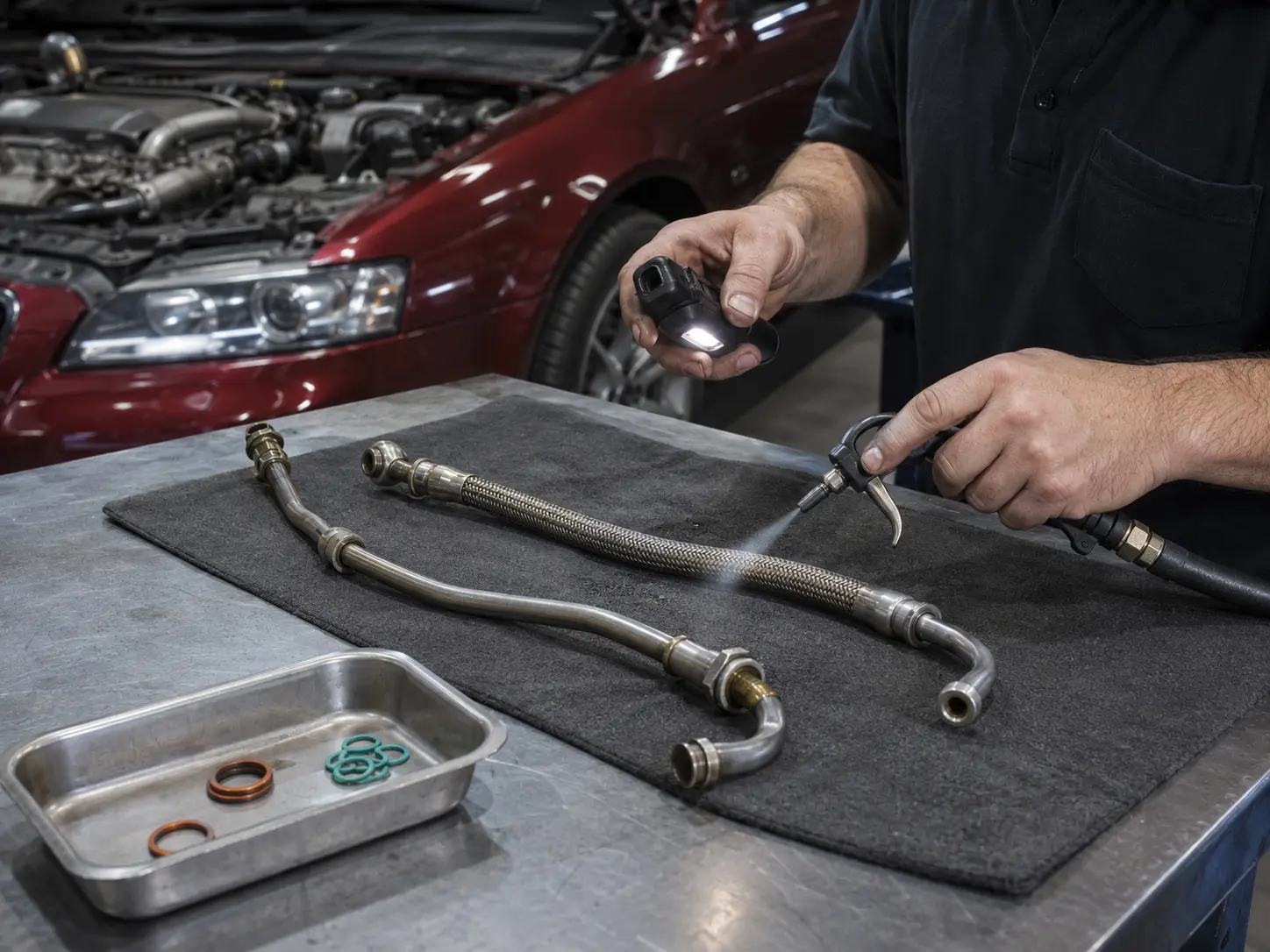
Check the oil drain before replacing the turbo
Turbo oil leakage can result from a restricted return line or abnormal crankcase pressure. Replacing the turbo alone may leave that cause in place.
The workshop checks the lines and ventilation system alongside the turbo. Oil in an intake pipe by itself does not prove that a new turbo is needed.
Documented oil-consumption issues on specific Audi engines
Audi has issued different technical bulletins for different engine families. The examples below are Audi of America documents, not a list of every affected car worldwide. A UAE or imported vehicle needs its engine code, source market, repair history, and current technical information checked.
| Engine and documented vehicles | What Audi documented | What it means for your car |
|---|---|---|
| 2.0 TFSI EA888 A4 2009–2011; A5 and A5 Cabriolet 2010–2011; Q5 2011 | Bulletin 2027731/5 addressed crankcase pressure, a pressure-regulating valve, front crankshaft seal, software, and consumption measurement. Its electronic measurement instructions specify CAEB. | Check whether the relevant work applies and has already been completed. The bulletin does not establish that every 2.0 TFSI needs pistons. |
| Supercharged 3.0 TFSI Selected 2009–2012 applications | Bulletin 2030197/9 describes pressure-related consumption and a revised pressure-regulating valve with applicable software and measurement steps. | Confirm the exact model and engine. Do not apply the older supercharged-engine procedure to every later turbocharged 3.0 TFSI. |
| Selected 4.0-liter models A8 2019–2021; S8, SQ7, and SQ8 2020–2023; RS 6 Avant and RS 7 2021–2023 | Bulletin 2071114/2 describes updated piston-ring geometry and requires confirmed excessive consumption, no visible leaks, and investigation before its internal repair procedure. | This is a different engine-specific issue. Model name alone is not enough to authorize pistons or an overhaul. |
These bulletins explain why a workshop checks more than the badge. They are not proof that your vehicle has the fault or confirmation of current warranty coverage. Later EA888 versions, diesel engines, and other Audi powertrains still require their own diagnosis.
Can you drive an Audi that is burning oil?
Stop safely and switch off the engine for a red oil-pressure warning, knocking, heavy smoke, overheating, or a large active leak. Arrange recovery if pressure or safe operation cannot be confirmed. If the level is below the safe range, do not continue driving with it low: follow the checking and top-up instructions or ask for assistance. A full oil level does not guarantee safe oil pressure.
If there is only a top-up message, the engine runs normally, and no stop-driving warning is present, use the approved oil in the amount directed and recheck as instructed. Keep a record and arrange an inspection if it happens repeatedly. Read the Audi oil-pressure warning guide if you are unsure which warning you have.
What the workshop checks before recommending engine work
Verify level, oil, and history
Confirm the measuring method, current approval and viscosity, service fill, top-up record, engine code, mileage, and previous repairs.
Clean and inspect for leaks
Check the upper engine, undertray, bellhousing area, filter and cooler, sump, turbo lines, and hot exhaust surfaces. Dye may help with an intermittent leak.
Scan and compare live data
Review mixture, boost, misfire, pressure, temperature, and emissions faults. A ventilation or air leak can leave useful fuel-trim evidence.
Test crankcase pressure
Assess ventilation operation and pressure behavior rather than replacing the PCV assembly from appearance alone.
Inspect turbo and intake paths
Check compressor and turbine evidence, shaft condition where accessible, oil quantity in charge pipes, and whether the oil return path is restricted.
Measure engine condition
Use compression, cylinder leak-down, plug inspection, borescope evidence, and oil-pressure testing when earlier checks point toward internal wear or damage.
Run a controlled consumption test
Start from a documented level and measure distance and additions consistently. Follow current technical information for the exact engine.

What a cylinder camera can tell you
A borescope helps inspect accessible piston and cylinder surfaces without dismantling the whole engine. Visible scoring or unusual deposits can guide further tests.
The image belongs alongside the oil-use record, leak checks and other measurements. One camera view is not enough to decide that an engine rebuild is necessary.
What happens during an Audi oil-consumption test?
A controlled test establishes how quickly the engine loses oil. It begins with the exact engine identified, leaks assessed, the required oil confirmed, and the level set by the prescribed procedure. The workshop should explain the starting mileage, oil measurement, return point, and what to do if a warning appears. Some procedures use diagnostic software; others depend on the prescribed physical measurement. Ask which procedure applies.
Before driving
Inspect the engine and undertray, verify that the oil-level display or dipstick reading is reliable, and correct any obvious external leak that would make an internal-consumption calculation meaningless. Record recent service work and whether the engine was overfilled or underfilled.
During the test
Follow the workshop’s written driving and return instructions. Some formal tests require returning for measurement before a top-up; that is different from keeping your own owner log. Contact the workshop if a warning appears. Do not continue with low oil or a pressure warning to preserve a test result. Record any necessary addition so the workshop can decide whether to restart the test.
At the final check
Repeat the level procedure under the same temperature, ground, and waiting conditions. Compare the measured use with current technical information for that engine and market. The result shows how much oil disappeared, but further testing may still be needed to show where it went.
A rate alone does not identify piston rings, valve seals, a turbocharger, or the crankcase ventilation system. Those decisions need physical evidence. A low rate also does not make an active leak onto the exhaust safe. The test result belongs beside the leak inspection, scan data, pressure checks, service history, and engine-condition measurements.
Why the oil-level display may change after a top-up
An electronic display may require a specific oil temperature, level ground, engine-off waiting period, ignition state, or hood cycle before it updates. A reading taken on a slope or immediately after switching off can differ from one taken through the prescribed procedure. Use the exact owner information for the vehicle.
Level and pressure are different. A normal electronic level does not override a red oil-pressure warning, mechanical noise, or visible active leak. Stop the engine when the warning instruction requires it.
If the level moves unexpectedly, check whether recent service work changed the fill quantity, whether the hood switch or level sensor has a fault, and whether the reading was taken before the prescribed settling conditions were met. Do not add a full bottle simply because the display has not refreshed.
A workshop can compare the electronic result with scan data, sensor status, service-fill records, and the engine-specific checking method. Establishing a reliable starting level prevents a sensor or procedure problem from being recorded as oil consumption.
Mistakes that lead to unnecessary oil-consumption repairs
When PCV, turbo, valve-seal, or piston repairs are needed
Leak repair
A localized seal, housing, line, or gasket can often be repaired without opening the engine. Access time and oil contamination of nearby belts, mounts, or wiring can change the scope.
Ventilation repair
A verified pressure-control or PCV fault may need a valve, diaphragm assembly, hoses, passages, or related seals. Adaptation and mixture checks should follow.
Turbo-system repair
A blocked oil return or abnormal crankcase pressure can cause leakage at the turbo without proving the turbo itself has failed. Repair the confirmed cause first. A damaged turbo may need an appropriate overhaul or replacement, with contamination and the oil supply checked as part of the job.
Internal engine repair
Valve-seal work, cylinder-head repair, piston and ring work, an engine overhaul, or a tested replacement engine should be compared using measured condition, downtime, warranty, and total fitted cost.
The fitted cost depends on the engine, access, parts, machining, fluids, and any damage found during inspection. A PCV repair and a piston job are very different bills. Ask whether the quote includes diagnosis, required seals and fluids, follow-up consumption checks, and written warranty terms. Compare specific repair options on the Audi engine repair service page.
Will thicker oil, an additive, or an engine flush stop the oil loss?
None should be treated as a diagnosis. Use an oil approval and viscosity permitted for the exact engine. A change that temporarily reduces top-ups does not show whether the cause was a leak, ventilation fault, or internal wear.
To reduce avoidable problems, follow the correct oil and service requirements, check levels between services, keep top-up records, and investigate overheating or new leaks promptly. Regular top-ups do not replace an oil and filter change.
Measure the oil loss and fix the cause
Check the warning, verify the level, and record how much oil is added over a known distance. Then separate external leaks, ventilation and turbo problems, and internal wear. A smoke pattern, oily pipe, or fault code on its own is not enough to choose an expensive repair.
Need the oil loss checked?
Our Al Quoz 4 workshop can investigate repeated top-ups and explain the next test. Start with your Audi’s year, mileage, and how much oil you have added. A service invoice or oil-use log helps if you have one.
Questions about Audi oil consumption
Is one liter of oil every 1,000 km normal?
Do not accept or reject that rate from the model badge alone. Verify the measurement, check for leaks, and compare a controlled result with current information for the exact engine. A sudden increase, smoke, or an active leak needs investigation even before a formal test is complete.
Can piston rings be a problem when compression is normal?
Yes. Compression tests do not directly test the oil-control rings’ oil-scraping function. Normal compression alone does not rule out an oil-control problem, and it does not identify the cause without other checks.
Why is my Audi burning oil without blue smoke?
Modern catalysts and operating conditions can make smoke intermittent or difficult to see. Measure use and inspect leaks, ventilation, turbo paths, plugs, and cylinders.
Can I keep topping up the oil?
Topping up can protect the engine while arranging diagnosis, but only within the correct level range and with the approved oil. It does not repair the cause.
Does a bad PCV valve cause oil consumption?
It can. Incorrect crankcase pressure may increase oil carryover or leakage, but the system should be tested because turbo and internal faults can look similar.
Will thicker oil stop an Audi from burning oil?
It may change consumption in some situations, but using a viscosity or approval not permitted for the engine can create other risks. Follow vehicle-specific technical information.
Does oil in the intercooler mean the turbo is bad?
Not by itself. A light film can come from normal ventilation mist. The amount, turbo condition, drain path, boost data, and crankcase pressure determine the next test.
How is an Audi oil-consumption test performed?
The workshop follows the current procedure for the identified engine, records the starting oil measurement and mileage, and specifies when to return. Ask what to do if a warning appears. An owner’s top-up log is useful, but it is not the same as a controlled diagnostic test.
When does oil consumption require an engine rebuild?
Only when testing supports internal wear or damage and smaller repair paths have been excluded. Compare overhaul and replacement using measured condition and total fitted cost.
Technical sources
- Audi owner’s manual portal for the vehicle’s oil-level procedure, permitted oil, and warning instructions.
- Audi bulletin 2027731/5 for the specified 2009–2011 2.0 TFSI applications.
- Audi bulletin 2030197/9 for selected supercharged 3.0 TFSI applications.
- Audi bulletin 2071114/2 for the specified 4.0-liter applications and piston-ring changes.
- Audi third-generation EA888 self-study program for engine design context. It is not a current repair manual.
- Garrett turbocharger oil-leakage guidance for pressure and drainage causes.
- Motorservice oil-control ring damage explanation for the oil-scraping function of the rings.
Bulletin dates and vehicle scope matter. The workshop must check current instructions and applicability before repair.