
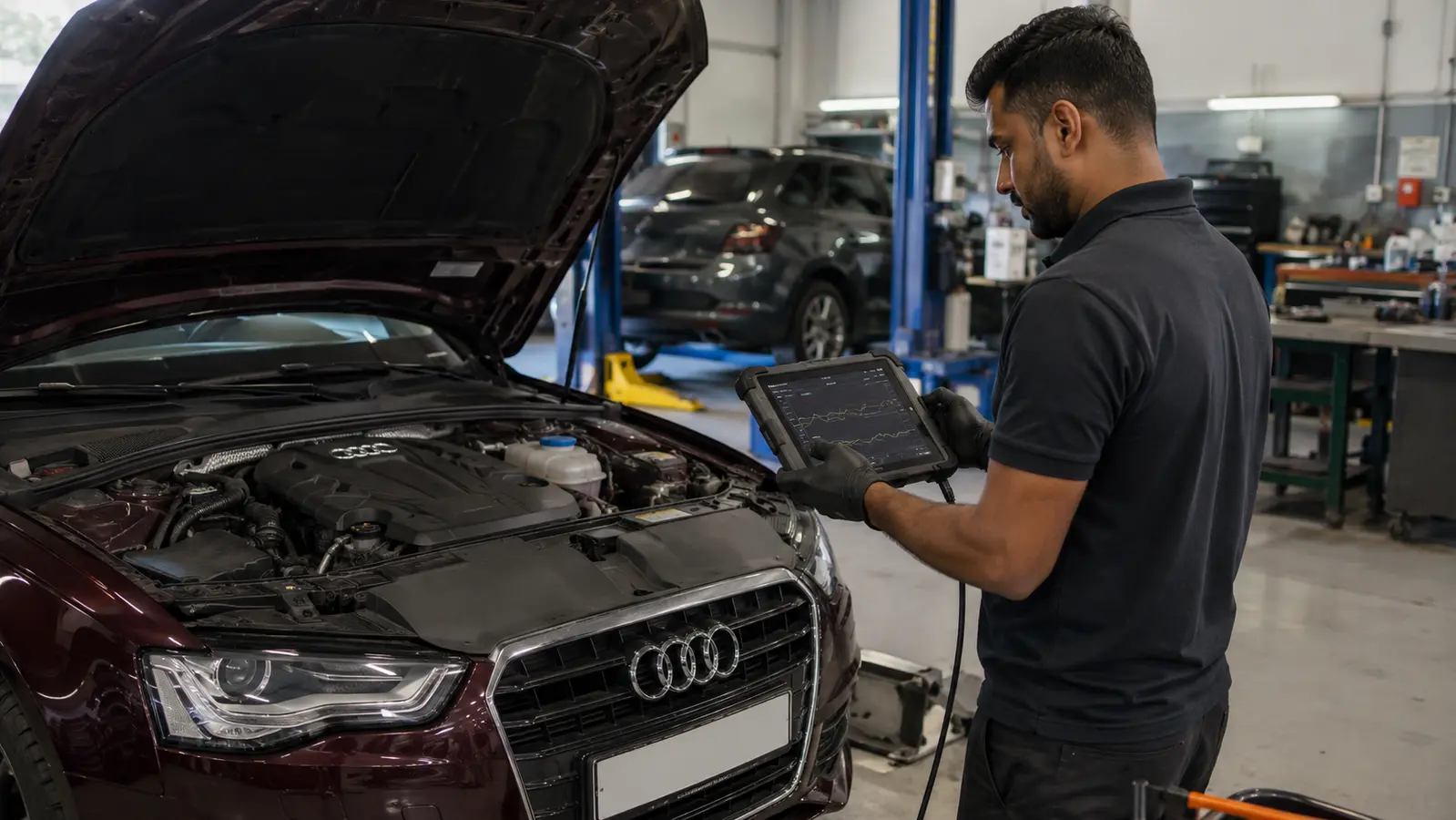
Low side · high side · electrical control
Audi Fuel Pump Replacement in Dubai
A useful fuel-pump quote starts by finding where delivery is being lost. We test low-pressure supply, high-pressure demand and electrical control under the condition that creates the fault, then recommend only the part the measurements support.
Long crank, no start, stalling, hesitation, reduced power, pump noise and pressure codes can share several causes. The next sensible step may be recovery, pressure testing, an electrical repair, a low-pressure pump, a high-pressure pump or another diagnostic route.
Immediate route
Choose safety before diagnosis
Stop and recover
Fuel smell, visible leakage, smoke or wet fuel means switch off, do not restart, avoid ignition sources and arrange recovery.
Do not keep restarting
If the engine cranks but will not start, avoid repeated extended attempts. They discharge the battery and can obscure the original fault with low-voltage errors.
Limit driving and ask
Repeated stalling or serious power loss is not a condition to test in traffic. Call to discuss whether inspection or recovery is appropriate.
Book prompt testing
A warning light with apparently normal running and no fuel smell needs timely testing. A remote conversation cannot promise that continued driving is safe.
The decision first
Test the pressure path before buying a pump
A weak in-tank pump, a starved high-pressure pump, a failed controller, voltage drop, a restricted filter, an implausible sensor, injector leakage and contaminated fuel can create overlapping symptoms. The quote becomes meaningful only when the workshop finds which part of delivery stops matching demand.
The first test should reproduce the complaint. A car that starts normally when cold but cranks for a long time when hot needs a hot-restart pressure and retention route. A car that loses power only under acceleration needs requested and actual pressure recorded while demand rises. A no-start needs cranking speed, supply, pressure build-up and authorisation checked together. One reading at idle is rarely enough.
This protects the customer from an expensive guess. If pressure is correct, the pump is not approved simply because a code or symptom mentions fuel delivery. The route continues through injectors, ignition, air, position signals or, where the evidence points there, mechanical engine diagnosis. The broader method is explained on the Audi diagnostics page; this page owns the fuel-pressure decision itself.
Which side failed, the test that supported it, the exact part and tier, what the installed figure includes, which uncertainties remain, and how the repaired system will be verified.
Supply to demand
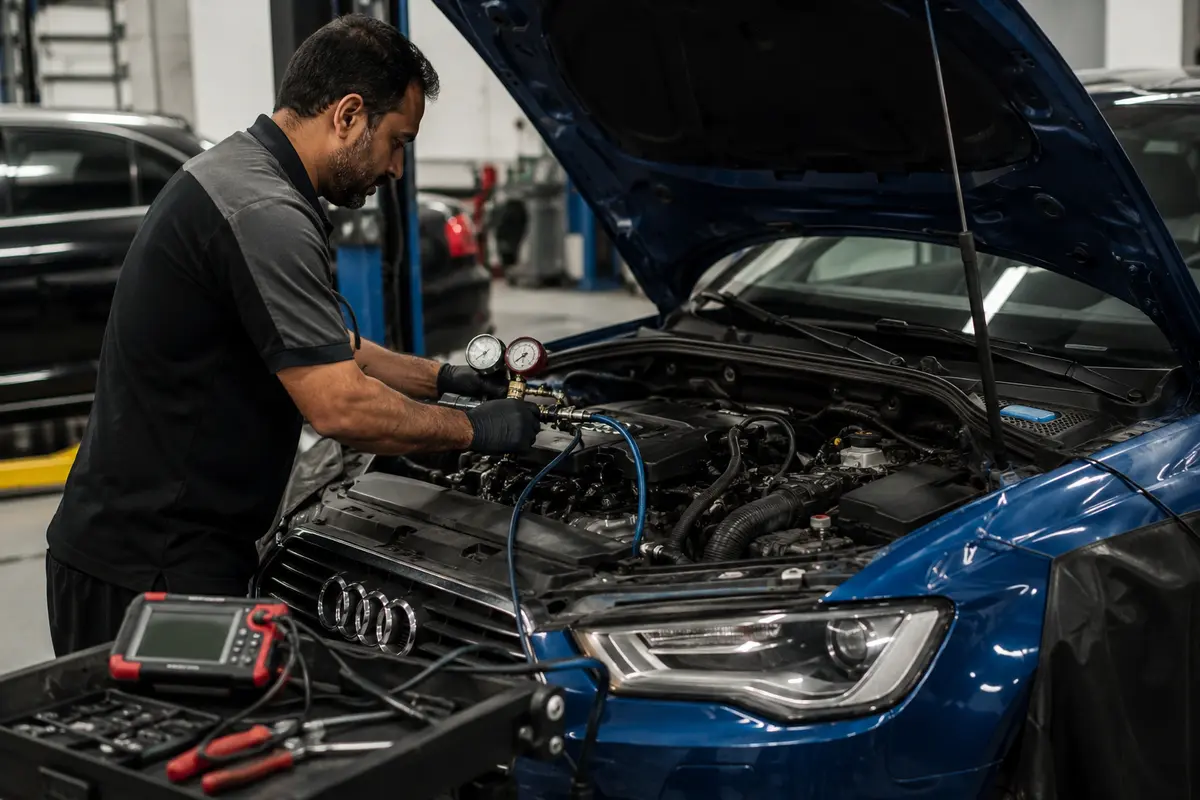
Low side and high side do different jobs
The exact system depends on VIN, engine code, model year and fuel type. The map shows a common direct-injection decision path, not a universal Audi layout or a pressure specification.
- Tank supplyPump, pickup and fuel quality
- Electrical controlController, command, voltage and ground
- Delivery pathFilter, strainer, lines and low-side sensing
- High-pressure pumpMechanical drive and metering where fitted
- Rail feedbackRequested pressure, actual pressure and sensor plausibility
- InjectorsDelivery, leakage and diesel return where applicable
Many FSI and TFSI petrol engines use an electric supply stage from the tank and an engine-driven high-pressure pump for direct injection. A controller, filter or delivery assembly can affect the supply. The rail, sensor, regulator or metering component and injectors affect the high-pressure result. Some petrol engines use different arrangements or combine port and direct injection, so component count and test points must be confirmed for the exact car.
TDI systems vary more widely across generations. A supply or lift stage may feed the high-pressure circuit, and common-rail versions separate pressure generation from injection through a high-pressure pump, rail, sensor and injectors. Older diesel architecture can be different. The label TDI does not justify assuming that every Audi diesel uses the same pump, return test or bleeding procedure.
Symptom to first test
What the complaint changes
No symptom below proves a pump. It selects the first useful evidence and the urgency of the next step.
| Customer symptom | What it may mean | Common lookalikes | First useful test | Urgency |
|---|---|---|---|---|
| Cranks but will not start | No low-side delivery, slow pressure build-up or inadequate rail pressure. | Weak battery, inadequate cranking speed, immobiliser, crank sensor or ignition fault. | Full relevant scan, cranking voltage and speed, then low and high pressure during cranking. | Stop repeated cranking and request diagnosis. |
| Long crank | Slow supply build-up, pressure loss after shutdown or a marginal high-pressure route. | Injector leakage, battery condition, engine-speed signal or cold-start strategy fault. | Record pressure build-up and retention in the cold or hot condition that creates the delay. | Book promptly. Ask before driving if worsening. |
| Difficult hot restart | Pressure retention, fuel-temperature influence, injector leakage or high-side control deviation. | Heat-affected crank or cam signal, starter speed and electrical connection faults. | Hot-soak restart trace with requested pressure, actual pressure, speed and retention. | Avoid repeated attempts. Arrange testing. |
| Starts then stalls | Supply interruption, pressure collapse or unstable control command. | Immobiliser authorisation, throttle or air-metering fault and voltage loss. | Pressure trace, pump command, voltage-drop result and fault status through the stall. | Do not keep driving in traffic. |
| Hesitation under load | Low-side flow cannot support demand or rail pressure cannot follow request. | Ignition misfire, boost leak, air fault or gearbox intervention. | Controlled load capture of requested and actual pressure, misfire data and pump command. | Limit load and book testing. |
| EPC or reduced power | Pressure deviation, sensor plausibility or control limitation. | Throttle, boost, ignition, wiring and many unrelated engine-control faults. | Preserve code status and freeze frame, then reproduce the recorded condition. | Call if power loss is severe or recurring. |
| Changed tank noise | Pump load, restriction, aeration or internal wear. | A normally audible pump, trim resonance or another rear-area component. | Command, current, pressure and delivery. Sound alone is not approval. | Prompt test if paired with starting or power symptoms. |
| Intermittent cut-out | Electrical interruption, controller heat fault, supply loss or pressure collapse. | Crank signal, main power, network, immobiliser or ignition interruption. | Capture pressure, voltage, command and engine-speed data through the event. | Do not continue normal traffic use. |
| Fuel smell or visible leak | Line, seal, flange, housing, injector connection or another fuel-path leak. | Tank-vent or EVAP vapour fault without visible liquid. | Switch off, recover and inspect the complete fuel path before restarting. | Stop and recover. |
Poor fuel economy on its own is weak evidence for a pump. Likewise, the absence of an audible prime does not prove failure. The pump may be controlled differently, the environment may mask the sound, or the electrical command may be missing.
Testing before replacement
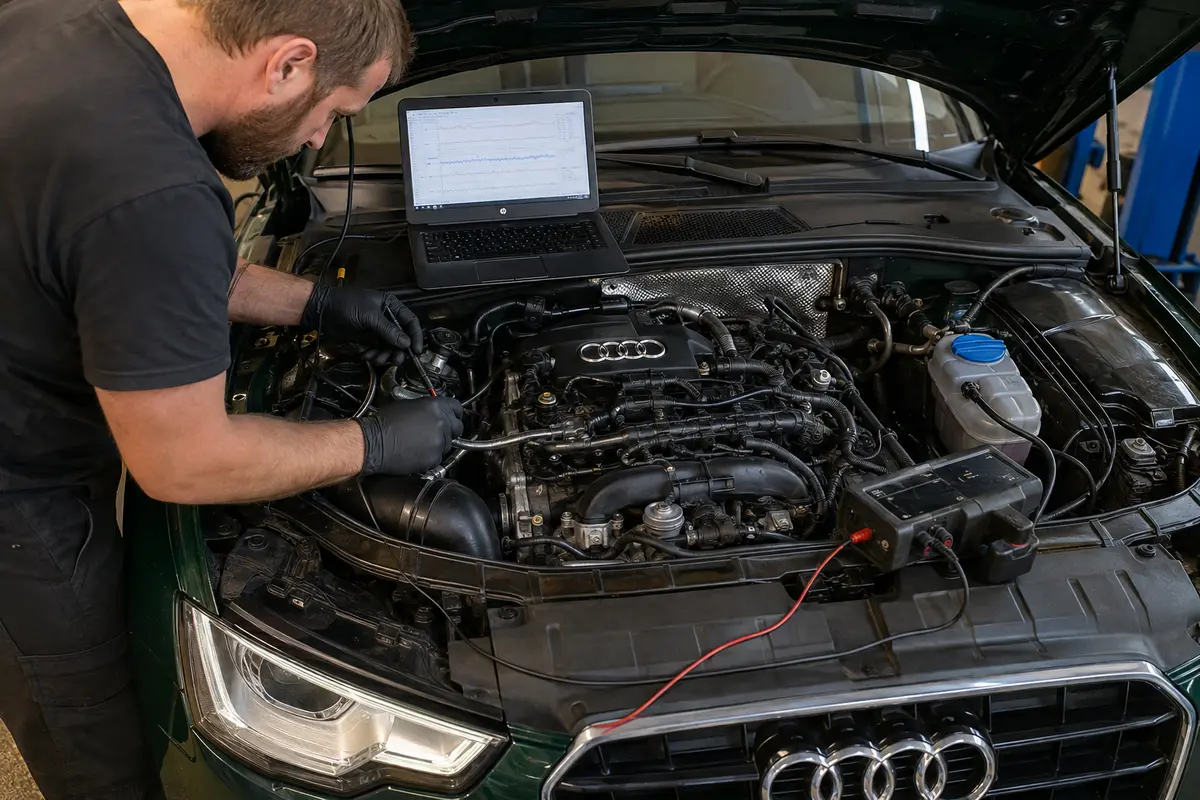
A numbered route from complaint to approval
Each stage removes a different wrong-pump risk. The process ends with a finding and options, not a parts order hidden inside a scan fee.
- Identify the exact vehicle
VIN, model, year, engine code and fuel type decide the architecture, safe procedure, part number and whether the car has one pump, more than one supply unit or a performance-specific arrangement.
- Record the real fault condition
Cold, hot, cranking, idle, low fuel level and acceleration are different test conditions. Recording when the symptom appears prevents an easy workshop-bay start from closing an intermittent complaint.
- Check for leakage and contamination clues
Fuel odour, visible wetness, recent refuelling, wrong-fuel risk, water, debris and recent repair work can change both the safety route and the estimate before pressure testing starts.
- Preserve scan and freeze-frame data
Fault status, occurrence count and operating conditions help rebuild the event. P0087, P0088, P0191, P2293, P310B and manufacturer-specific codes are examples of routes to verify for the exact vehicle. A code does not approve a pump.
- Stabilise the electrical baseline
Battery voltage and cranking condition are checked because low voltage can reduce pump output, slow pressure build-up and create misleading communication or sensor faults.
- Compare request with actual response
Requested and actual pressure are viewed during the condition that causes the complaint. The direction and timing of the deviation help separate a starved high side, a control problem, a bad signal and a pump that cannot meet demand.
- Measure the low-pressure circuit
The application-specific route may combine pressure, flow or volume, residual pressure, pump current, command, voltage drop and ground quality. The purpose is to decide whether the engine receives stable supply, not to chase one universal number.
- Measure the high-pressure circuit
Rail request, actual pressure, metering or regulator command, sensor plausibility, retention and applicable mechanical drive checks are considered together. A high-pressure pump cannot perform correctly if its supply is collapsing.
- Inspect fuel quality and restrictions
A serviceable filter, strainer, pickup, water, debris, stale fuel or misfuelling can starve or damage the system. Exact filter serviceability and intervals belong to the VIN-specific Audi maintenance route, not a universal rule.
- Exclude downstream pressure loss
Injector leakage, restriction and excessive diesel return can prevent the rail from reaching or retaining pressure. Replacing a pump without checking the downstream loss can leave the original symptom unchanged.
- Present findings before ordering parts
The estimate should name the failed side, supporting test, exact part, parts tier, included seals and work, remaining uncertainty and post-repair checks. Additional parts need a finding or an exact preventive requirement.
- Repeat the original condition
After the correct priming or bleeding route, required settings, leak inspection and rescan, the technician repeats the cold start, hot restart or controlled load condition that originally failed. Stable pressure closes the job more convincingly than a cleared fault memory.
Pump or surrounding fault
The measured outcome decides the repair
Electrical tests stay on this page only while they decide the fuel-pump route. If the fault expands into a larger wiring or module problem, the work moves to Audi electrical repair.
Consider the low-pressure pump motor or complete delivery module. Do not automatically sell the high-pressure pump.
Repair the connector, relay, fuse route, ground, wiring or controller as supported. A fuel pump cannot deliver correctly without the required electrical supply.
Continue high-pressure circuit diagnosis. The applicable route may involve the pump, its metering or regulating component, sensor, mechanical drive or injector loss. Do not automatically replace the in-tank pump.
Compare the signal with reference pressure and circuit checks. Scan data that cannot be trusted is not evidence for a pump.
Assess the filter, strainer, tank and fuel quality. A clean pump-only estimate is not the same job as draining, cleaning and repairing a contaminated system.
Define the exact-system contamination scope across pump, rail, lines and injectors. An isolated high-pressure pump swap may leave damaging material in the system.
Continue through injector, ignition, air, crank or cam signal, authorisation or mechanical diagnosis. Do not replace any pump to see whether the symptom changes.
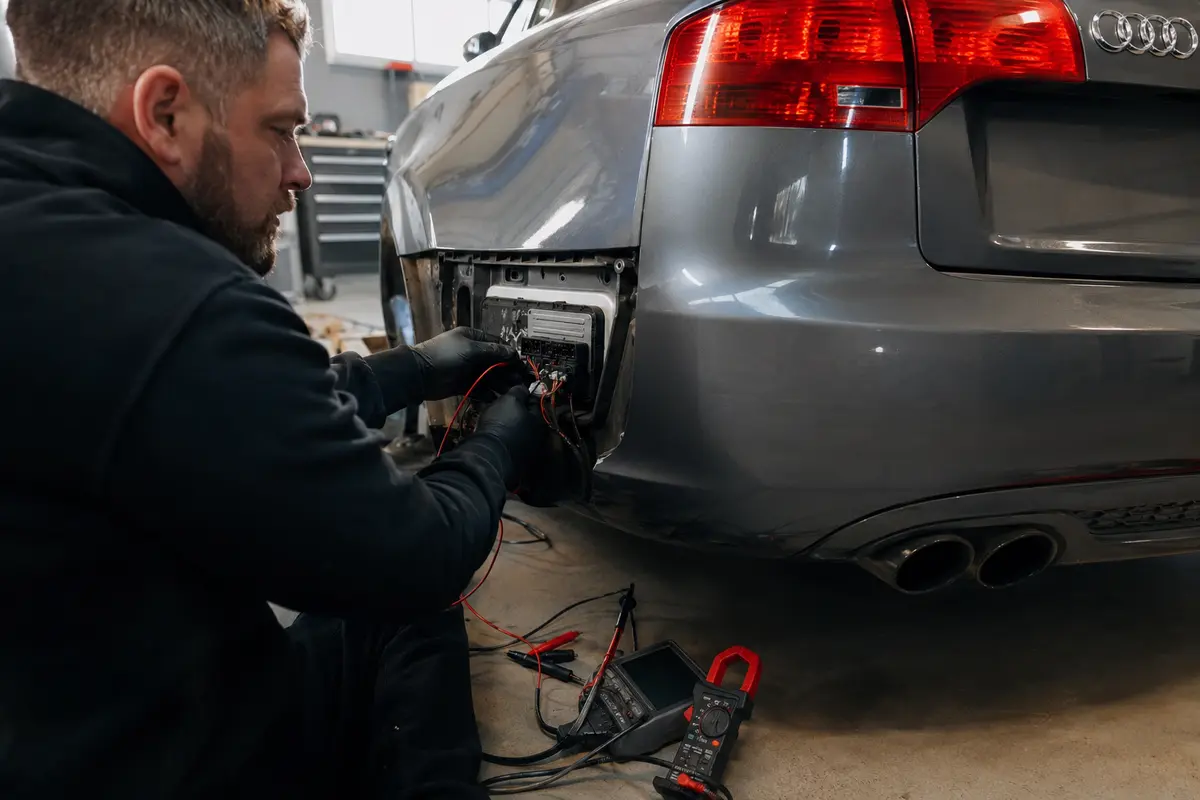
Tentative AED planning ledger
Installed costs only make sense with assumptions
These consumer planning ranges were checked on 2 September 2026 against current UAE parts listings and the workshop’s published VAT-inclusive estimate convention. They include 5% VAT. A VIN-linked written estimate overrides every webpage range.
Diagnosis rows are service prices. Replacement rows are installed ranges unless stated otherwise. Ordinary labour and verification are included only as described. Controller, coding, tank removal, extra lines, injectors and contamination work are not silently bundled.
| What is tested or repaired | Tentative range | Type and ordinary inclusions | What moves the figure |
|---|---|---|---|
| Initial scan, symptom review and relevant data check | AED 250 to 450 | DiagnosisLabour for intake, relevant scan, code status and data review. No parts or dismantling. | Number of affected systems, intermittent history, existing reports and whether the fault can be reproduced. |
| Low-pressure pressure, flow and current test | AED 350 to 700 | DiagnosisOrdinary test access and a defined low-side measurement route. No pump, filter or controller included. | Test-port availability, access, need for volume measurement, low-fuel condition and intermittent capture time. |
| Dynamic high-pressure requested-versus-actual test | AED 350 to 750 | DiagnosisData capture under a controlled applicable condition. No part or injector test included. | Road-test safety, load needed to reproduce the fault, fuel type and data channels required. |
| Combined low-side and high-side diagnosis | AED 500 to 950 | DiagnosisDefined supply, rail-demand and electrical correlation. No replacement parts. | Architecture, access, petrol or diesel route, reproduction time and need for retention testing. |
| Intermittent or hot-restart session | AED 450 to 900 | DiagnosisTime block for heat soak, restart capture and pressure retention review. | Waiting time, repeat cycles, symptom frequency and whether the car must cool fully between attempts. |
| Fuel-pump supply and voltage-drop test | AED 250 to 600 | DiagnosisCommand, supply, ground and circuit-drop checks. No wiring repair included. | Controller location, access, intermittent heating and circuit complexity. |
| Fuel sample and contamination inspection | AED 150 to 350 | DiagnosisSample inspection from an application-appropriate point. Tank draining and laboratory analysis excluded. | Safe sample access, fuel type, visible water or debris and wrong-fuel suspicion. |
| Fuse, relay, connector or minor circuit correction | AED 150 to 650 | RepairOrdinary labour and minor electrical materials. Pump and controller excluded. | Damage location, connector availability, terminal condition and confirmation time. |
| Larger fuel-pump wiring repair | AED 350 to 1,200 | RepairInstalled wiring route after the damage is traced. Module and pump excluded. | Harness access, corrosion extent, damaged length, heat damage and trim removal. |
| Fuel-pump control module replacement and setup | AED 900 to 2,500 | InstalledQuality application-specific module, ordinary labour and applicable setup. Pump excluded. | Audi Genuine or verified supplier tier, superseded part number, coding or adaptation need and access. |
| Fuel-pressure sensor or regulator route | AED 700 to 2,400 | InstalledVerified part, ordinary labour, seal where supplied and pressure recheck. Pump excluded. | Low or high side, part type, rail access, fuel type and whether the regulating component is separately serviceable. |
| What is replaced or serviced | Tentative range | Parts tier and ordinary inclusions | What moves the figure |
|---|---|---|---|
| Serviceable fuel filter or strainer | AED 450 to 1,200 | InstalledQuality application-specific part, ordinary labour, seal and leak check. Pump excluded. | External filter versus tank access, petrol or diesel, housing condition and line hardware. |
| Petrol low-pressure in-tank pump | AED 1,200 to 2,500 | Installed aftermarketReputable quality aftermarket motor or defined assembly, ordinary access, seal and verification. Controller excluded. | Motor only versus module, tank access, sender or flange condition, line fittings and exact fitment. |
| Petrol complete tank module | AED 2,200 to 5,500 | Installed OE or GenuineVerified OE-supplier or Audi Genuine module, ordinary labour, seal, priming and test. Controller excluded unless quoted. | VIN part number, Audi Genuine premium, sender and flange inclusion, tank removal and stock. |
| Petrol high-pressure pump | AED 1,800 to 4,200 | Installed OE supplierVerified OE-supplier pump, ordinary labour, supplied seal, priming, pressure check and rescan. | Engine family, mechanical drive inspection, required line or fitting and current verified supplier route. |
| Petrol high-pressure pump | AED 3,000 to 6,500 | Installed Audi GenuineAudi-branded VIN-selected part, ordinary labour, ordinary seal, priming and verification. | Part supersession, engine, stock, single-use line or fitting and Audi Genuine availability. |
| Twin-pump or high-output S and RS application | AED 5,000 to 12,000+ | Installed defined scopePrice assumes the written estimate names each proven component. No automatic pair replacement. | Number of pumps, high-output architecture, controller count, parts tier, access and calibration requirements. |
| Diesel supply or lift-pump route | AED 1,500 to 3,800 | InstalledQuality application-specific supply component, ordinary labour, applicable seal, bleeding and verification. | Tank or inline location, module scope, fuel-filter work, access and exact diesel architecture. |
| Diesel high-pressure pump without wider contamination | AED 4,500 to 10,000+ | Installed verified routeNew or traceable remanufactured pump where suitable, ordinary labour, bleeding and pressure confirmation. Injectors and rail excluded. | New versus remanufactured, core terms, pump family, metering component, lines, coding and contamination findings. |
| Tank draining and cleaning | AED 900 to 3,000 | ServiceDefined drain and clean route. New fuel, damaged components and disposal outside ordinary scope must be itemised. | Fuel quantity, tank removal, wrong fuel, debris, dual-tank layout and disposal requirements. |
| Injector testing as a set or defined batch | AED 600 to 1,600 | DiagnosisDefined petrol or diesel injector test batch. Removal, seals and replacement parts must be stated separately. | Injector count, in-car versus removed test, diesel return measurement and specialist bench route. |
| Petrol injector replacement per injector | AED 900 to 2,500 | Installed per injectorVerified part, ordinary share of labour, required seal and applicable setting. Pump excluded. | Direct or port injector, rail access, seal tooling, parts tier and whether several injectors share labour. |
| Diesel injector replacement per injector | AED 1,500 to 4,000+ | Installed per injectorVerified new or approved remanufactured injector, ordinary labour, seal and applicable coding. Pump excluded. | Injector type, new or remanufactured, removal difficulty, coding, return parts and contamination. |
| Broader contaminated petrol-system repair | AED 3,000 to 10,000+ | Installed defined scopeOnly the written estimate can define included tank, lines, pump, rail, filter and injectors. | Contaminant, time run, damaged component count, cleaning route, parts tier and fuel disposal. |
| Diesel common-rail contamination route | AED 10,000 to 30,000+ | System assessmentPotential pump, rail, lines, filter, tank and injector scope. The range is not a pump-only quote. | Metal spread, injector result, pump family, cleaning standard, new or remanufactured parts and vehicle value. |
| Standalone post-repair pressure and leak verification | AED 250 to 500 | VerificationDefined pressure recheck, visible leak inspection and relevant rescan. No corrective parts included. | Low or high side, cold or hot reproduction, road-test condition and access. |
Electrical fault without a pump
AED 500 to 1,050 including VATA combined diagnostic session finds excessive voltage drop at a connector, while pump command and output become normal after the circuit repair. The example combines testing with a minor connector correction and verification. It excludes a pump because the measurement no longer supports one.
Petrol pump route
AED 2,300 to 4,800 including VATTesting confirms either a complete in-tank module or a verified OE-supplier petrol high-pressure pump, with ordinary labour, ordinary seal, priming and pressure recheck. The written estimate must specify which component, the exact tier, whether a line or controller is additional, and why.
Diesel contamination assessment
AED 10,000 to 30,000+ including VATMetal is found in a common-rail high-pressure route. The figure becomes a system-planning range across tank, filter, pump, rail, lines and injector testing or replacement. It is not a fabricated customer job and does not approve every component before inspection.
Online UAE listings in September 2026 showed large part-only variation across generic aftermarket, verified-brand and application-specific modules. A low online part price is not an installed Audi estimate. Fitment, authenticity, shipping, return rights, seals, access, diagnosis and repeat-labour exposure still have to be resolved.
Parts route
Compare the exact component, not a vague quality label
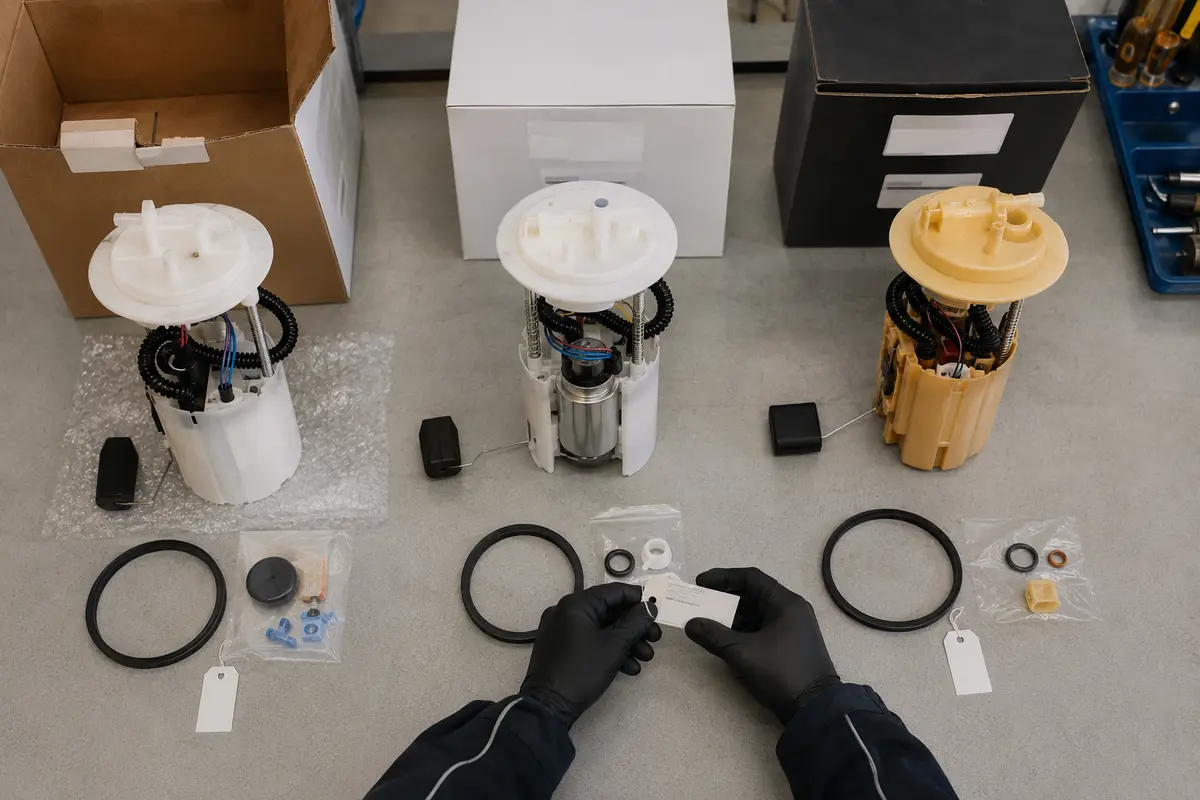
Audi Genuine
An Audi-branded part selected by VIN and current part number. It is usually the highest-cost route and gives the clearest Audi parts trail. Availability and supersession must be checked before a date or price is promised.
Verified OE supplier
This label is used only after the manufacturer and exact application are verified. Bosch, Continental or VDO, Pierburg, Delphi, Hitachi, Denso and TI Automotive appear across global fuel-system supply chains, but no single brand supplies every Audi pump and a marketplace listing does not prove authenticity.
Reputable aftermarket
The part needs exact fitment, a traceable source and written warranty terms. It should not be described as OEM, identical to original or dealer quality without evidence for that exact part.
Remanufactured
This can suit a specific high-pressure application when the remanufacturer provides traceable test results, clear core terms and a written warranty. It is not automatically suitable for every petrol or diesel pump.
Used
A used pump is a weak default because wear, storage, contamination and repeat labour are unknown. If accepted for an exceptional case, the source, test limitations, labour risk and warranty boundary should be recorded in writing before installation.
Petrol, diesel and electrified Audi models
Confirm the powertrain before choosing the test
A badge alone does not define the pump layout. VIN and engine code are part of diagnosis because they change the architecture, test points, parts and commissioning route.
FSI and TFSI petrol
Many direct-injection petrol engines use a low-pressure supply stage and an engine-driven high-pressure stage. Some use a different arrangement or combine port and direct injection. The workshop confirms the exact system before quoting a pump or universal pressure.
TDI diesel
Supply, high-pressure generation, rail control and injector return vary across diesel generations. Do not assume every TDI is common rail. Metallic debris or damaging contamination can widen a pump decision into a rail, line and injector assessment.
Plug-in hybrid
A plug-in hybrid Audi still has a combustion-engine fuel system, but access, inactive-engine periods, pressure strategy and parts require VIN confirmation. The fuel route is separated from high-voltage work and only accepted within the workshop’s confirmed capability.
Fully electric e-tron
A fully electric Audi without a combustion fuel system is outside this service. A no-start, reduced-power or warning concern on that vehicle needs the appropriate electric and electrical diagnostic route, not a fuel-pump booking.
When the fuel changes the job
Contamination is a system decision
A clean failed pump and a pump damaged by wrong fuel, water, debris or metal are not the same estimate. Replacing the obvious component may leave the cause or damaging material behind.
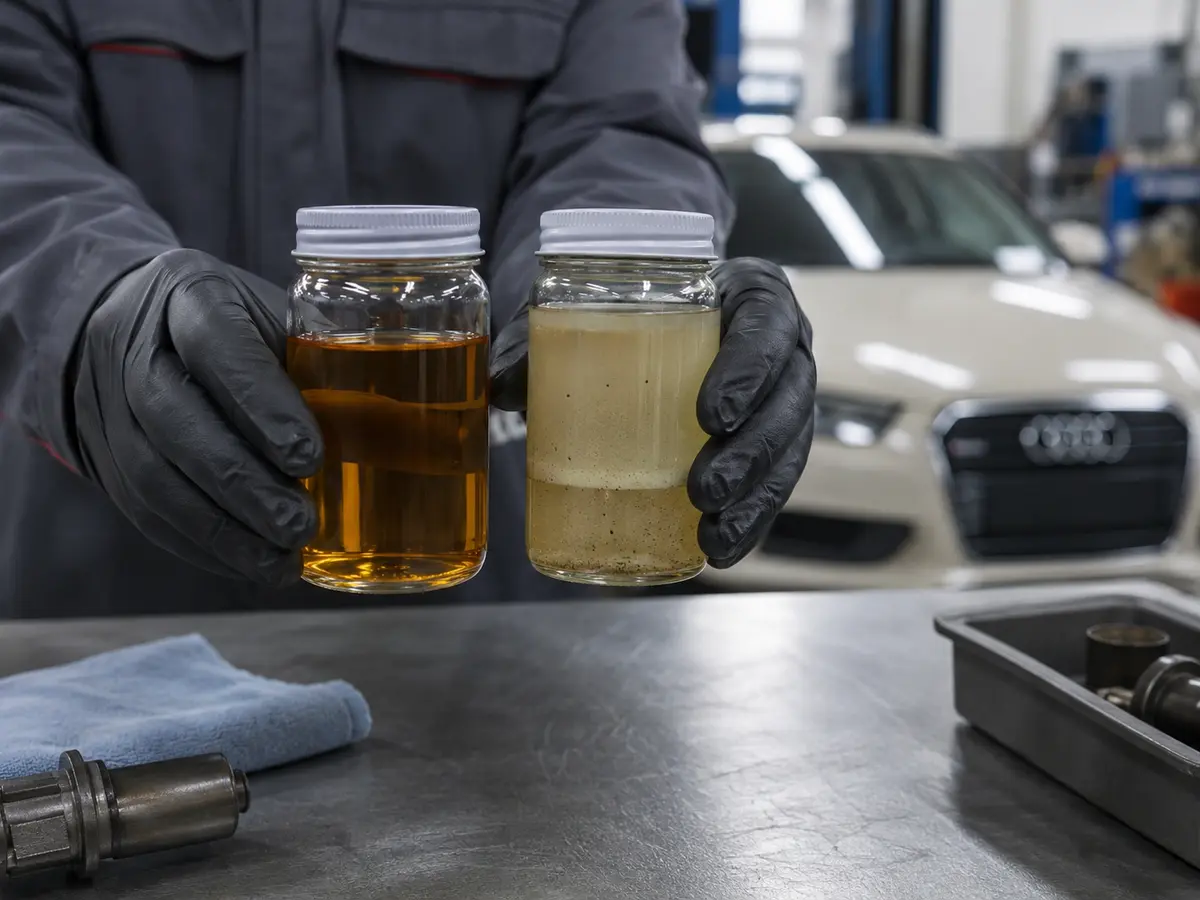
Water can disturb lubrication, corrosion protection and combustion. Debris may restrict a pickup, strainer, filter or metering component. Misfuelling changes the safe drain and cleaning route, especially if the engine has already been run. Stale or degraded fuel can also alter the diagnosis when a vehicle has been stored for a long period.
Diesel metallic debris is the most expensive boundary. The workshop needs to identify the exact pump family, where metal is present and whether the rail, lines and injectors have been affected. The customer should receive a written system scope rather than a pump-only number that quietly grows after work starts.
If wrong fuel is suspected and the engine has not been started, do not start it to check. Tell the workshop exactly what was added and how much.
A visible clean sample does not prove every internal part is clean, but water, debris or metal immediately changes the next inspection.
The estimate should distinguish draining and cleaning from new fuel, pump, filter, rail, line, injector and disposal costs.
Replacement and verification
The job closes with the original fault retested
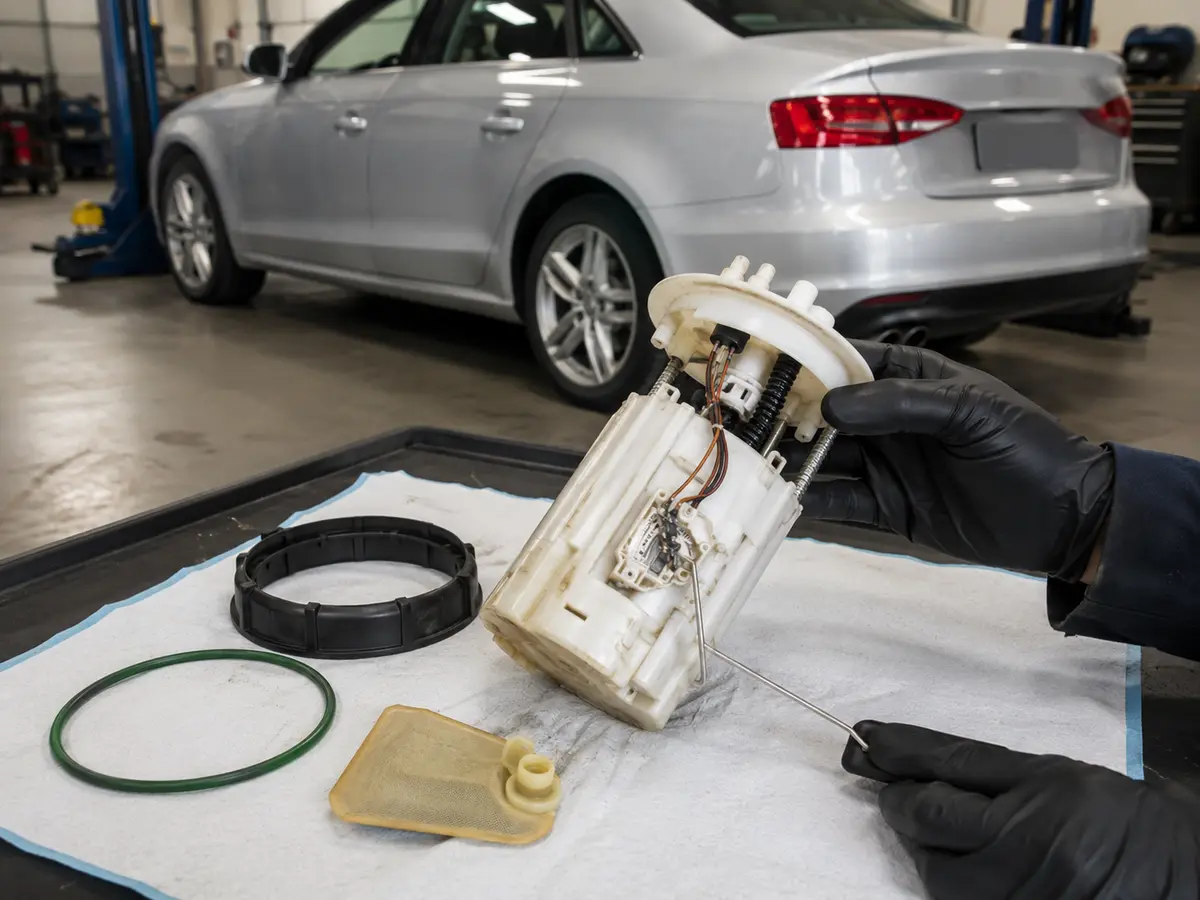
Once a pump or surrounding component is supported, the workshop confirms the current part number and safe procedure for the exact vehicle. The page does not publish DIY steps for opening, bypassing or probing a pressurised fuel system.
Access may be through the cabin, luggage area, underbody or tank removal route depending on the application. The system is made safe through the correct procedure, and seals, flanges, single-use lines or fittings are replaced when the application requires them. A pump motor is not silently substituted for a complete module, or vice versa.
After installation, the system uses the correct priming or bleeding procedure. Applicable basic settings, adaptation or coding are completed only where the vehicle requires them. The technician inspects for leaks, remeasures pressure, checks the cold or hot restart condition that mattered, conducts a safe controlled road test where needed and rescans the relevant systems.
Estimate and timing
Why one Audi takes longer or costs more
A responsible plan discusses time conditionally. It does not promise same-day completion before access, stock and contamination are known.
Vehicle and architecture
Model, VIN, engine, fuel type, one pump or twin-pump layout, low-side versus high-side fault and tank access determine the first labour and test route.
Part and availability
Pump motor, complete delivery module, Audi Genuine, verified OE supplier, reputable aftermarket, superseded numbers and special-order stock change both price and lead time.
Extra proven work
Controller, wiring, sensor, filter, line, injector, fuel draining, tank cleaning and contamination work are separate because each needs its own finding.
Commissioning
Petrol priming, diesel bleeding, coding, adaptation, basic settings, leak testing and restart or road-test verification vary with the exact application.
Intermittent diagnosis
A hot restart, low-fuel cut-out or load-only pressure drop may need the vehicle held through a temperature or operating cycle before the fault can be captured.
Planning language
A straightforward confirmed low-side module with stock available may be planned as a shorter visit. A diesel contamination route or special-order performance application can require staged testing, parts approval and more than one workshop period.
Before authorising
Ask for a defined fuel-system quote
The strongest commercial value is avoiding the wrong pump, naming the parts tier and agreeing the installed scope before parts are ordered.
Warranty language should be written for the exact brand and job. Do not assume that a parts warranty automatically covers diagnosis, removal, labour, contamination or a customer-supplied component.
The estimate should say low-pressure supply, high-pressure delivery, electrical control, sensor feedback, contamination or another route.
Ask for the measured evidence in plain language, such as correct command and voltage with low output, or rail pressure that cannot follow demand after supply is confirmed.
Record the part number, manufacturer, Audi Genuine or verified supplier status, new or remanufactured condition, source and fitment basis.
Confirm motor or module, sender, flange, seal, controller, filter, lines, fittings, mounting hardware, labour, priming, adaptation and post-repair checks.
Intermittent faults, inaccessible contamination, injector results, superseded parts and dismantling findings should be separated from the approved fixed scope.
Ask which inspection was used and whether the result changes the tank, line, rail or injector scope. This is particularly important before diesel high-pressure work.
Confirm brand, time or kilometre limit, labour coverage, diagnostic requirements, contamination exclusions, core terms and the treatment of customer-supplied, used or remanufactured parts.
The answer should include leak inspection, pressure remeasurement, the relevant cold or hot restart, safe road test where required and a relevant rescan.
Fuel pump questions
Answers before you approve the work
How can I tell whether the low-pressure or high-pressure pump is failing?
Symptoms overlap, so the distinction comes from measurements. The low side is checked for stable supply, command, current, voltage and delivery. The high side is checked by comparing requested and actual rail pressure after the supply side is known. The VIN and engine code determine the correct values and test points.
Does P0087 or another fuel-pressure code prove the pump is bad?
No. Low supply, a restricted path, sensor plausibility, regulator or metering faults, injector leakage, wiring and contaminated fuel can all affect pressure. The code’s exact definition and status must be checked for the vehicle, then the recorded condition has to be tested.
Can you test an Audi fuel pump before replacing it?
Yes. The applicable route can include pressure, flow or volume, command, current, voltage drop, ground quality, requested and actual rail pressure, retention, fuel quality and injector leakage. The correct combination depends on the system.
Can I drive with a suspected fuel-pump problem?
Do not drive with visible fuel, strong fuel smell, wet fuel, smoke, repeated stalling or severe power loss. Switch off and arrange recovery when leakage is suspected. For a warning with normal running and no smell, call for prompt testing because a webpage cannot confirm driving safety remotely.
What does Audi fuel-pump replacement cost in Dubai?
Tentative VAT-inclusive installed ranges on this page start around AED 1,200 to 2,500 for a quality aftermarket petrol low-pressure route, AED 1,800 to 4,200 for a verified OE-supplier petrol high-pressure route, and AED 4,500 to 10,000 or more for a diesel high-pressure pump without wider contamination. Diagnosis, exact parts tier, access and contamination can change the total.
Why can two Audi fuel-pump quotes differ so much?
One quote may be motor-only and another may include the complete module, sender, flange, seal, controller, new line, labour and verification. Audi Genuine, verified OE supplier and aftermarket parts also differ. Ask both workshops to name the failed side, part number, tier, inclusions, VAT and post-repair checks.
Is Audi Genuine, an OE-supplier part or aftermarket better?
The right choice depends on verified fitment, source, warranty, vehicle value and repeat-labour exposure. Audi Genuine gives the clearest Audi parts trail. A verified OE-supplier part can be a strong value route when the exact manufacturer and application are confirmed. Aftermarket should be traceable and should not be labelled OEM without proof.
Do you recommend a used fuel pump?
Not as the normal low-cost recommendation. Unknown wear, storage, contamination and repeat labour make a used pump a weak default. If an exceptional case uses one, its source, test limit, labour risk and written warranty boundary should be clear before fitting.
Is petrol high-pressure pump work different from diesel pump work?
Yes. Petrol direct injection and diesel high-pressure systems use different architectures, pressure strategies, components, lubrication conditions, contamination risks and commissioning procedures. The engine code and exact system are identified before a test or part is selected.
What happens if a diesel high-pressure pump produces metal debris?
The repair becomes a contamination assessment, not an isolated pump decision. The workshop checks where metal has travelled and defines the tank, filter, lines, pump, rail and injector scope. Replacing only the pump can leave damaging material behind.
Does a new pump need coding, basic settings or adaptation?
Some applications need a priming or bleeding routine, basic setting, adaptation, coding or controller setup; others do not. The workshop follows the VIN-specific procedure and lists any setup in the estimate instead of assuming that every pump needs coding.
How long do diagnosis and replacement take?
Initial defined testing may fit within one workshop session. A hot-restart or intermittent fault can require waiting for the correct condition. Replacement time then depends on tank access, engine layout, stock, contamination, required lines or seals and commissioning. The workshop should give a conditional plan after identification and testing rather than promise same-day work in advance.
What can imitate a failed fuel pump?
A weak battery, poor starter speed, fuse, relay, wiring, ground, controller, filter, sensor, regulator, metering valve, contaminated fuel, injector leakage, crank or cam sensor, ignition fault, immobiliser, air or boost fault, tank-vent problem and mechanical compression or timing concern can produce similar symptoms.
What checks close the job after replacement?
The applicable closeout includes correct priming or bleeding, required settings, visible leak inspection, pressure remeasurement, the relevant cold or hot restart, a safe road test where needed and a relevant rescan. The original fault condition should no longer be present.
Does a fuel smell mean the pump itself has failed?
No. A line, connection, injector, seal, flange, pump housing or tank-vent fault may be responsible. Fuel smell or visible wet fuel is a stop-and-recover issue because the complete fuel path needs inspection before restarting.
Can a plug-in hybrid Audi use this service?
Yes, when the concern belongs to its combustion-engine fuel system and the exact PHEV application is confirmed. High-voltage work is a separate capability and safety route. A fully electric Audi without a combustion fuel system does not use this service.
What information should I send for a more useful estimate?
Send the model, year, fuel type, engine size or code if known, main symptom, whether it cranks, whether it starts and keeps running, when the issue happens, any warning or code, fuel smell or leakage, recent refuelling or repair, driveable state and Dubai area. A VIN can narrow parts fitment after the first conversation.
Send the fault condition
Ask for the test route before the pump
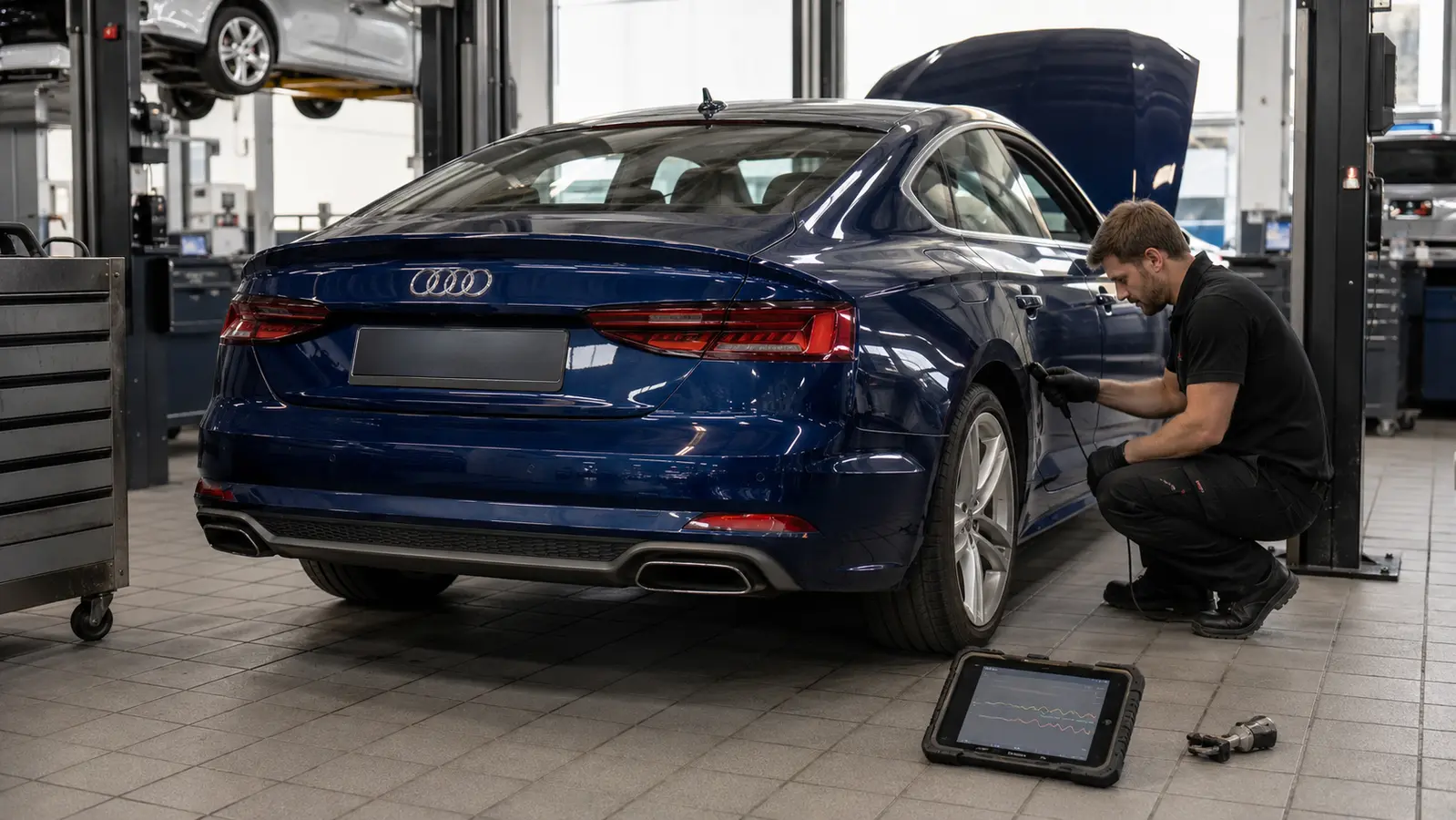
Use the original builder to send the model, fuel type, starting condition, warning, refuelling history and leak status. The workshop can then advise whether the next step is recovery, pressure testing, an electrical repair or a VIN-based pump estimate.