
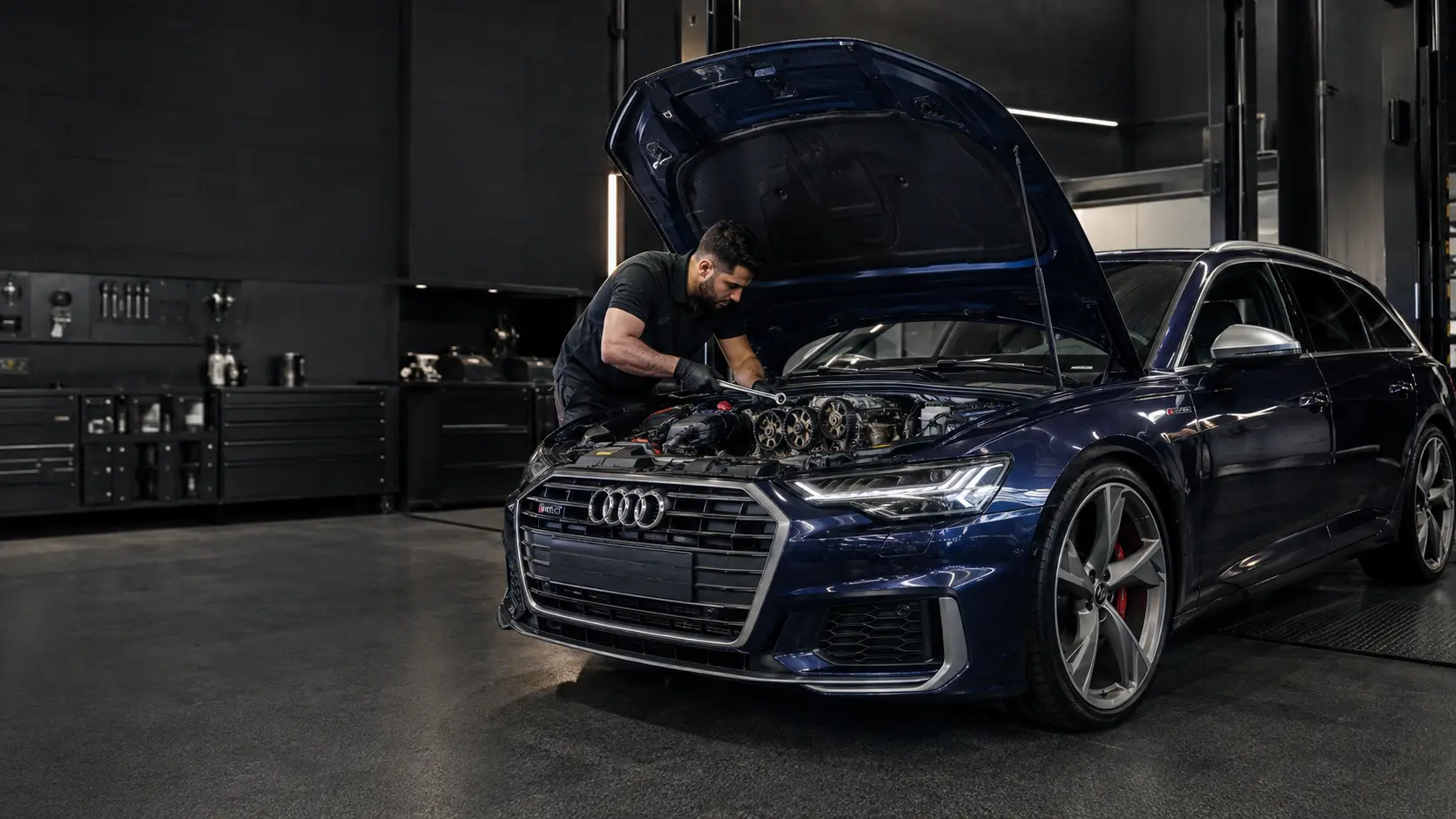
Audi Timing Belt Replacement in Dubai
Audi timing belt replacement should begin by confirming that the exact engine uses a belt, not a timing chain. The model badge alone is not enough. We use the VIN, engine code, production information and service evidence to identify the layout, then define a sensible scope for the belt, tensioner, idlers, water pump, seals, coolant and related access items.
Does this Audi actually have a timing belt?
Some Audi engines use a toothed timing belt, while others use one or more timing chains. A single model name can cover several engines across different years and markets. That is why an interval copied from a model list, a registration advert or another vehicle is not enough evidence for parts or scheduling.
The correct route begins with the VIN, engine code and available maintenance history. If the engine uses a belt, the next decision is whether the requested belt-only job makes sense or whether the tensioner, idlers, water pump and other access-dependent items should be included. If the engine uses a chain, the separate Audi timing-chain service owns that diagnosis and repair.
Confirm the engine before requesting a belt quote
VIN or engine code is the most useful first detail. Add mileage, service evidence and whether the request is preventive or prompted by a symptom. A final quote still depends on exact parts, access and inspection.
Five checks before a timing-belt scope is accepted
The route deliberately pauses before parts are selected. Each stage removes a common source of incorrect interval, kit or labour assumptions.
Decide whether the car needs immediate action or evidence first
A preventive enquiry, visible contamination, coolant leak and suspected belt failure are not the same job. The symptom changes whether the vehicle should be driven and what must be inspected.
No replacement record
Treat history as unknown until an invoice states the date, mileage and parts fitted. A sticker or seller statement can be useful context but may not define the full kit.
Verify before planningVisible cracking or fraying
A visible damaged edge, missing tooth or serious contamination warrants prompt assessment. The accessible view may not show the whole belt or every roller.
Avoid further runningOil on the belt area
Oil can attack belt materials and may indicate a camshaft, crankshaft or other seal leak. Replacing the belt without addressing the source can shorten the new kit’s life.
Source repair mattersCoolant leak near timing side
On layouts where the water pump is driven by or accessed with the timing belt, pump condition changes the job scope. Confirm the leak source before assuming the pump.
Cooling test firstNoise from behind the cover
A tensioner, idler, water pump or another nearby accessory can make noise. Do not run the engine repeatedly to demonstrate a severe or rapidly worsening sound.
Localise carefullyEngine stopped or will not start
If belt failure is possible, further cranking can worsen internal contact on an interference engine. Recovery and controlled inspection are safer than repeated start attempts.
Do not crank repeatedly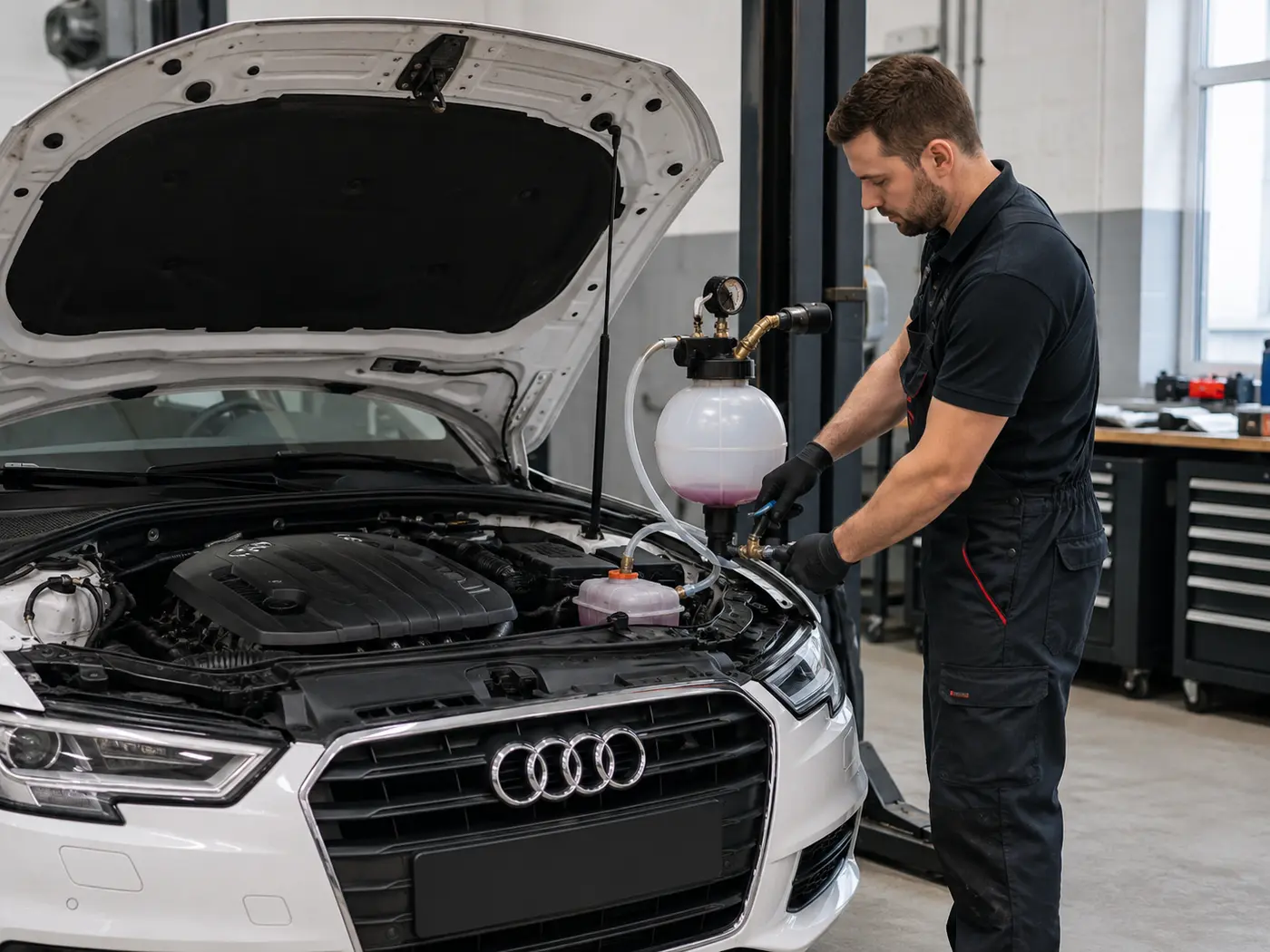
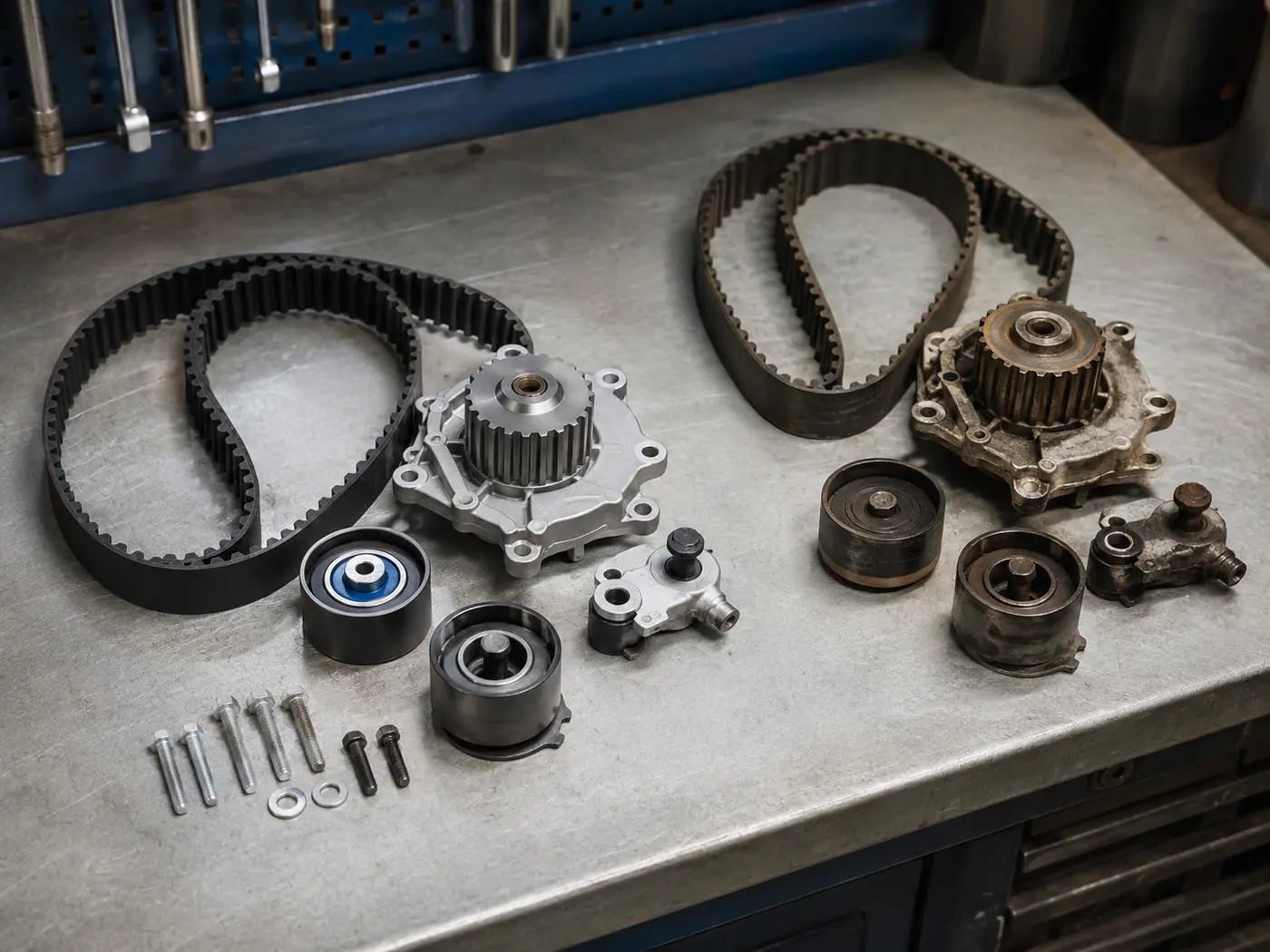
A complete kit addresses the parts that guide and tension the belt
The belt is only one element in the timing path. The tensioner sets or maintains the specified tension, while idler rollers guide the belt. Their bearings and mounting hardware age and operate for the same mileage as the belt. A seized roller or failed tensioner can damage a new belt even when its rubber is fresh.
The water pump belongs in the decision when it is driven by the timing belt or when most of the same labour exposes it. Some engines use a different pump arrangement, so “always replace the pump” is not a universal rule. Access, part quality, coolant condition and the exact engine layout determine whether combining the work is sensible.
One-time-use bolts, covers, seals, auxiliary belts and coolant may also appear in the estimate. The written scope should identify them instead of using “timing belt kit” as an undefined bundle.
- Toothed belt matched to engine code and production range.
- Tensioner and idlers with correct mounting hardware.
- Water pump only where layout and condition support it.
- Specified coolant when the circuit is opened.
- Seals or covers added only with evidence or access logic.
Replace now or inspect and verify first?
A documented due date and an unknown history lead to different evidence, but neither should be guessed. Symptoms can turn a planned service into a no-start safety decision.
Confirm the drive type
Establish belt versus chain from the exact engine. If it is a chain engine, stop this scope and route the concern correctly.
Review evidence
Compare current mileage and date with the applicable maintenance information and the contents of any previous invoice.
Inspect related condition
Check accessible belt condition, leaks, pump area, tensioner evidence, covers and auxiliary-belt interaction without claiming that a partial view guarantees remaining life.
Choose the scope
Define belt-only, complete kit, water-pump inclusion, seals and access items. State which findings could change the work after covers are removed.
What should be checked before the engine is locked and stripped
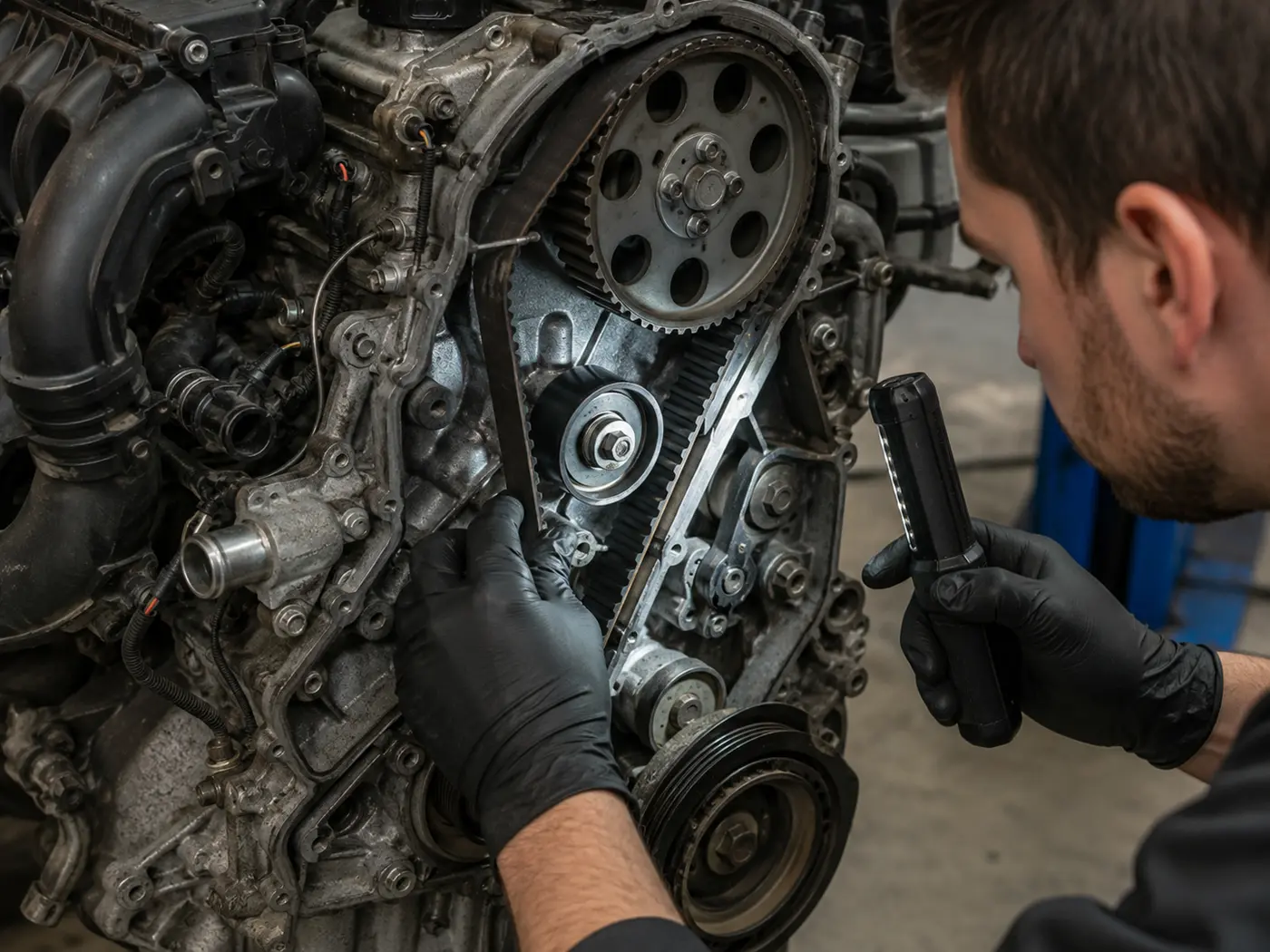
The booking is first classified as preventive maintenance, condition concern, coolant leak, noise or possible failure. That distinction changes whether the car can be started, whether recovery is appropriate and whether a compression or internal-damage assessment belongs before a belt kit is authorised.
Vehicle voltage, stored engine faults and current running behaviour can provide useful context, but fault codes do not measure belt condition. The technician inspects accessible leaks, covers, mountings, the auxiliary-belt area and the coolant circuit where relevant. An oil or coolant source should be identified closely enough to include the corrective work rather than contaminate the replacement parts.
If overheating or coolant loss led to the visit, a broader Audi cooling-system diagnosis may be needed. If abnormal compression, mechanical contact or internal engine damage is found after a suspected belt event, the work moves beyond routine belt replacement and into the engine repair route.
Four timing-belt service scopes
The cheapest line item can omit parts that share the same access or failure risk. The broadest kit can also waste money if it includes components the engine does not use.
Identification and inspection
For uncertain history, unclear engine type, a leak or a noise that needs evidence before parts.
- VIN and engine-code confirmation
- Relevant visual and diagnostic checks
- Written recommended scope
Belt-focused replacement
For a verified belt engine where tensioning components or pump have documented recent replacement and their condition supports a narrow scope.
- Defined belt and hardware
- Engine-specific locking procedure
- Post-installation checks
Complete belt kit
The common preventive route when belt, tensioner and idlers have shared age or the previous contents are unknown.
- Belt, tensioner and idlers
- Specified one-time hardware
- Clear conditional items
Kit plus water pump
Appropriate when the pump is driven by or efficiently accessed with the belt and the engine-specific plan supports replacement.
- Pump and seals
- Coolant drain and refill
- Leak and temperature verification
Belt-only request versus complete-kit planning
Compare the jobs by failure exposure and duplicated labour, then make the selected inclusions visible on the estimate.
| Route | Works best when | Main limitation | Verification needed |
|---|---|---|---|
| Inspection first | Drive type, history, leak source or symptom is still uncertain. | A partial visual view cannot certify long remaining life. | Engine identity, evidence record and defined next step. |
| Belt only | Related rollers and tensioner are recent, documented and suitable for reuse. | Older supporting parts can still fail and damage the belt. | Timing marks, tension and running checks. |
| Complete belt kit | Belt, tensioner and idlers have shared service age or history is incomplete. | Costs more than a belt-only line but reduces shared-age uncertainty. | Parts list, locking procedure and final checks. |
| Kit plus pump | Pump shares the timing drive or most of the same access, and replacement is supported. | Not every engine uses this layout; coolant work adds materials and checks. | Vacuum fill or bleed, leak check and stable temperature. |
Audi timing belt replacement cost in Dubai
These tentative planning ranges include 5% VAT and assume the engine has been correctly identified. Exact parts, access, one-time hardware, pump layout, seals, coolant and concealed damage can move the final quotation.
| Service scope | Tentative AED | What changes the range |
|---|---|---|
| VIN and engine-code identification check | AED 158–315 | Availability of vehicle records and physical identification access. |
| Timing-system inspection for uncertain history | AED 315–630 | Cover access and whether a leak or noise is being investigated. |
| Timing-side noise diagnosis | AED 420–945 | Need to separate tensioner, idler, pump and adjacent accessory noise. |
| Coolant pressure and leak-source check | AED 315–735 | Leak location, temperature behaviour and access. |
| Timing belt only, parts planning range | AED 420–1,260 | Engine, belt specification and parts tier. |
| Belt tensioner and idler set | AED 630–1,785 | Number of rollers, hardware and manufacturer. |
| Complete timing belt kit, parts | AED 1,260–2,940 | Engine layout, kit content and parts source. |
| Water pump and seal, parts | AED 525–1,680 | Pump design, material and engine application. |
| Specified engine coolant | AED 210–525 | System capacity and concentration. |
| Timing-belt labour, straightforward layout | AED 1,260–2,100 | Mount removal, cover access and locking procedure. |
| Timing-belt labour, access-heavy layout | AED 2,100–4,200 | Front-end service position, packaging and additional disassembly. |
| Auxiliary belt replacement during access | AED 315–945 | Belt path, tensioner condition and part specification. |
| Auxiliary tensioner or idler, if confirmed | AED 525–1,680 | Number of components and access. |
| Camshaft or crankshaft seal, accessible and confirmed | AED 420–1,260 | Leak source, fasteners and additional timing work. |
| One-time-use bolts and workshop materials | AED 158–630 | Engine procedure and quantity of specified hardware. |
| Post-installation scan and running verification | AED 210–525 | Required adaptations, road check and fault investigation if abnormal. |
Worked quote examples
The figures below show how belt-kit choice, service access and related coolant work can change a timing-belt total. Each calculation is illustrative and already includes 5% VAT.
Straightforward belt-kit route
Hypothetical confirmed belt engine with ordinary access and no coolant work.
- Inspection and identity
- AED 315
- Complete belt kit
- AED 1,470
- Installation labour
- AED 1,260
- Total
- AED 3,045
Kit and water-pump route
Hypothetical layout where the pump shares the service access.
- Complete belt kit
- AED 2,100
- Water pump
- AED 735
- Coolant
- AED 315
- Installation labour
- AED 1,575
- Total
- AED 4,725
Access-heavy engine route
Hypothetical application requiring additional front-end access and a confirmed seal leak.
- Kit and water pump
- AED 2,835
- Access-heavy labour
- AED 2,520
- Confirmed seal
- AED 525
- Coolant
- AED 315
- Total
- AED 6,195
Preventive complete-kit route
Hypothetical known belt engine with no previous replacement record.
- Engine identification
- AED 315
- Complete belt kit
- AED 1,890
- Installation labour
- AED 1,890
- Coolant top-up allowance
- AED 315
- Total
- AED 4,410
How an Audi timing belt is replaced
The exact procedure is engine-specific. The sequence below describes the decision and verification stages without pretending that every engine uses the same access or timing marks.
Confirm identity and scope
VIN, engine code, drive type and kit contents are checked before dismantling. The estimate names conditional seals, pump and access items.
Record baseline condition
Relevant running behaviour, fault memory, visible leaks and coolant level are recorded. A suspected failure is assessed without repeated cranking.
Create safe access
Covers, mountings, auxiliary drive or front-end parts are removed only as the specific engine procedure requires. Wiring, hoses and body edges are protected.
Set and lock the engine
The crankshaft and camshaft positions are set using the specified reference and suitable locking tools. Paint marks alone are not a substitute for the procedure.
Remove and inspect
The belt, tensioner and idlers are removed. Their wear, leakage, bearing feel and contamination are checked for evidence that should change the approved scope.
Install and tension
Matched parts and specified hardware are fitted in the required sequence. The belt path, direction where applicable and tensioner indication are verified.
Rotate and recheck
The engine is turned by hand through the required cycle, then timing references and tension are rechecked before covers are closed. Resistance or misalignment is investigated.
Restore fluids and access
If the coolant circuit was opened, it is filled with the specified coolant using the appropriate method. Removed mounts, covers and auxiliary components are refitted.
Start and verify
The engine is started only after pre-start checks. The technician checks for abnormal noise, leaks, stable temperature, stored faults and the complaint that led to the work.
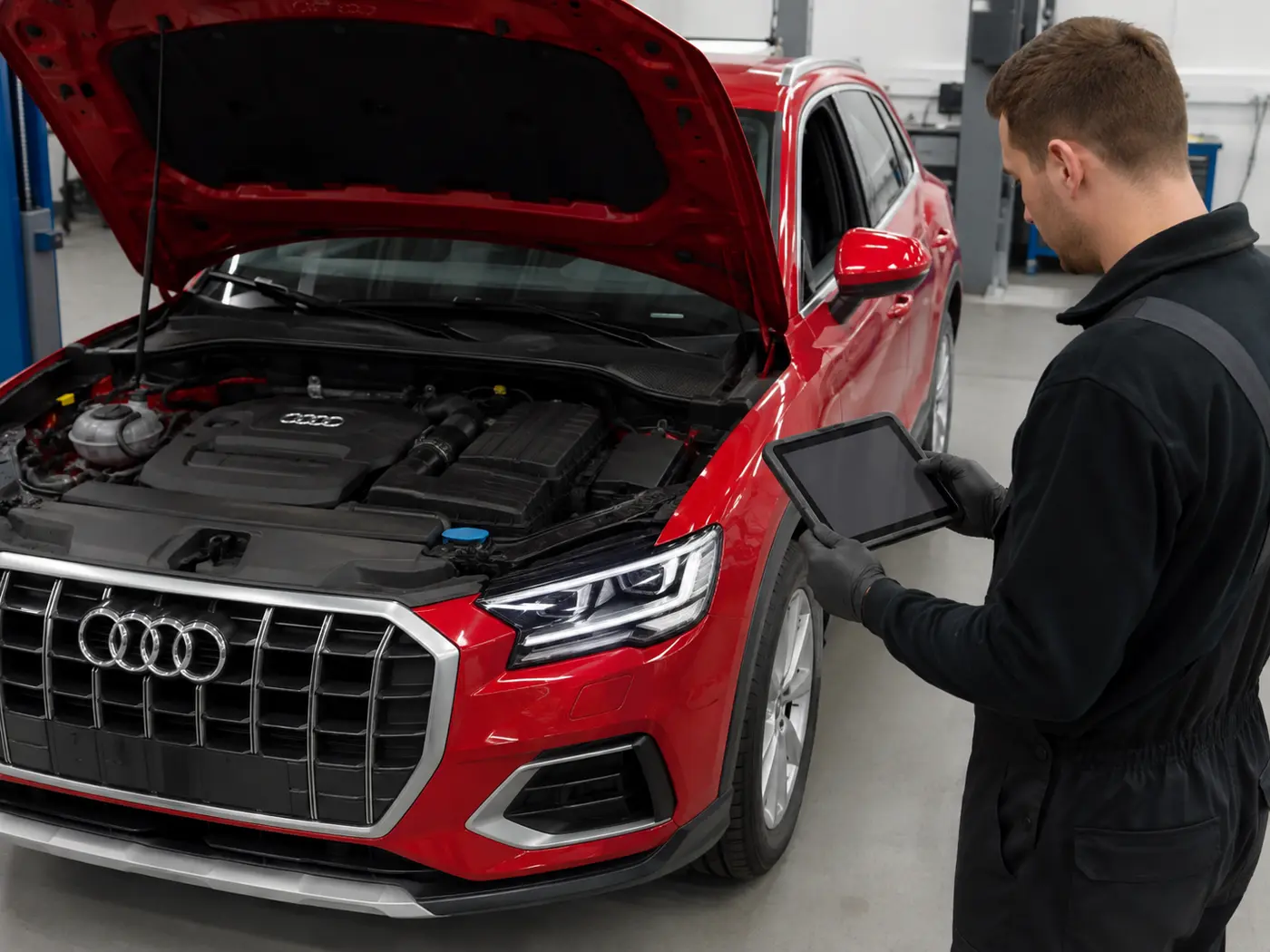
A timing belt kit should be defined line by line
“Timing belt kit” can mean a belt and tensioner, or a broader set with idlers, hardware and water pump. The estimate should list what is actually included and name the parts tier. New genuine, OEM-supplier and reputable aftermarket routes can differ in kit contents and warranty conditions. Compatibility must be checked against the engine, not a generic model list.
Tensioners and rollers matter because their bearings and control mechanisms can fail independently of the belt rubber. One-time fasteners matter when the engine procedure specifies replacement. The water pump needs its own logic: driven by the belt, reached through the same labour, leaking, noisy or otherwise due by the approved plan.
Coolant must match the vehicle specification and should not be mixed casually. If a seal is sweating but not leaking onto the belt, its inclusion is a judgment about evidence, access and duplicated labour. If oil is already contaminating the belt, correcting the source is part of protecting the new parts.
Verify timing, tension and sealing before handover
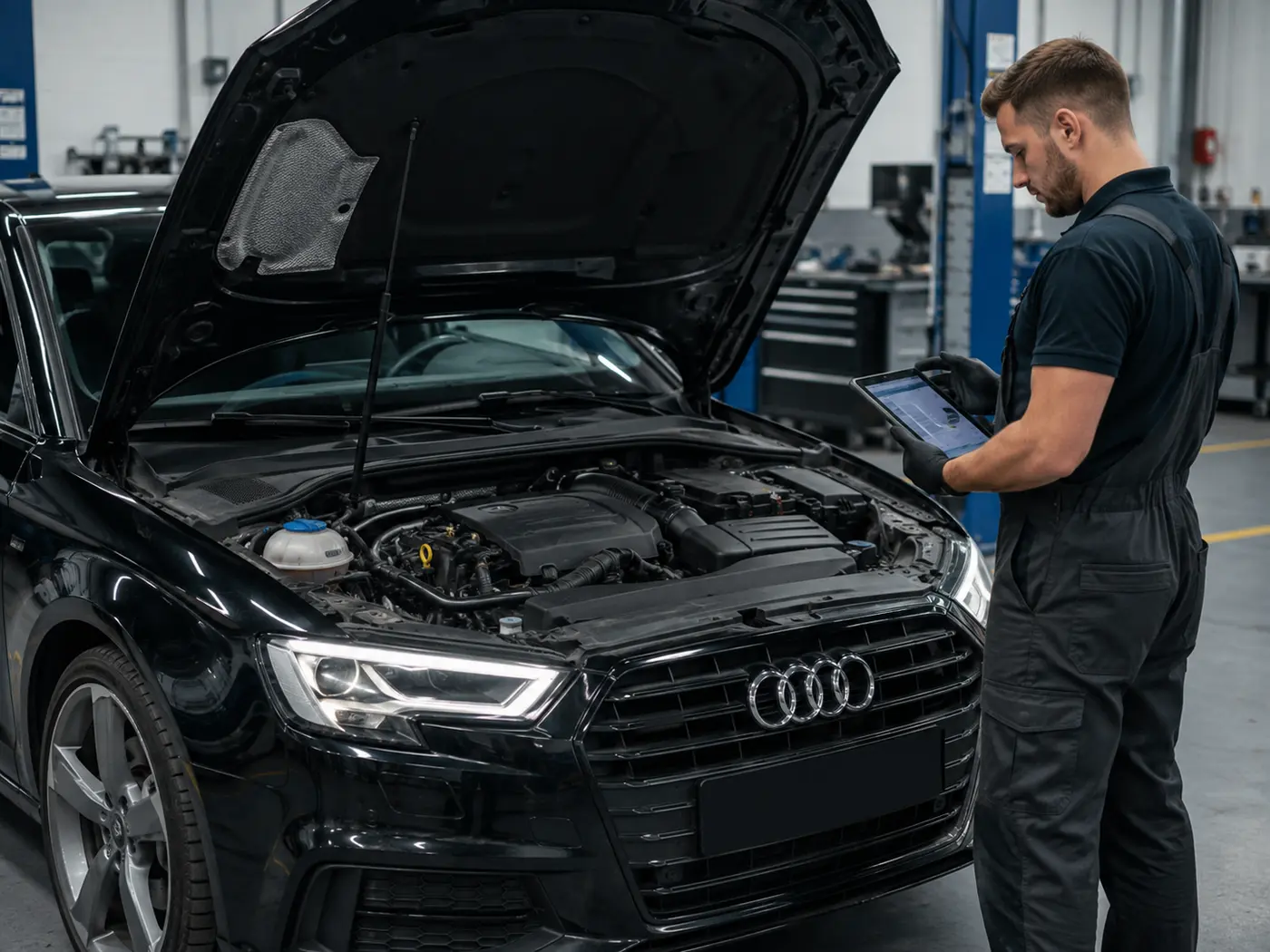
A quiet idle is only the start of verification. The final check should confirm the timing references, belt tension, running condition and every fluid circuit or access point disturbed during the job.
Audi timing belt replacement questions
Start with the engine code, belt-or-chain layout and service evidence. Those details determine whether timing-belt work is due and which parts belong in the job.
Does my Audi use a timing belt or a timing chain?
It depends on the exact engine, production date and market specification. The same model badge can cover different layouts. VIN and engine-code confirmation should come before interval advice, parts ordering or a quotation.
How often should an Audi timing belt be replaced?
There is no safe universal interval for every Audi. The applicable schedule depends on the exact engine and market information, while age, mileage, service evidence, contamination and condition affect the decision. Use verified vehicle-specific guidance.
Can you tell the timing-belt interval from the model year?
Not reliably. A model year can include several engines, and production changes or market specifications may differ. The VIN, engine code and applicable maintenance source are needed.
Should the water pump be replaced with the timing belt?
Often it is sensible when the pump is driven by the belt or most of the same labour exposes it. It is not universal. The exact layout, pump history, condition, coolant work and duplicated labour should be compared.
Is a belt-only replacement a good idea?
It can be appropriate when the supporting parts are recent, documented and suitable for reuse. If the tensioner and idlers share the belt’s age or their history is unknown, a complete kit usually gives a clearer risk and labour decision.
How much does Audi timing belt replacement cost in Dubai?
Tentative complete-job totals can range from a few thousand dirhams upward, depending on the engine, kit content, water pump, access, seals, coolant and parts tier. Diagnosis or inspection is separate when the drive type, leak or symptom is uncertain.
Can a timing belt be inspected to prove how long it will last?
No inspection can guarantee remaining life. An accessible view can reveal cracking, fraying, contamination, missing material or poor tension, but hidden tooth roots and internal cord condition may not be fully visible.
What happens if an Audi timing belt breaks?
On an interference engine, crankshaft and camshaft movement can lose synchronisation and valves may contact pistons. Damage can be extensive. Do not keep cranking an engine when belt failure is suspected.
Can I drive with a noisy timing belt area?
A serious, new or rapidly worsening noise should be assessed before further driving. A tensioner, idler, water pump or nearby auxiliary component may be involved. Continuing to run the engine can increase damage if the timing path is unstable.
Can oil or coolant damage a timing belt?
Yes. Contamination can affect belt material and tension, and it may signal a leaking seal or pump. The source should be identified and included in the repair plan instead of fitting a new belt into the same contamination.
Do timing belt fault codes exist?
Engine faults can appear when camshaft and crankshaft signals are implausible, but a code does not directly measure belt age or condition. Mechanical alignment, signal data and physical inspection must be interpreted together.
Why are timing locking tools necessary?
They hold or reference the crankshaft and camshaft in the specified positions while the belt and tension are set. The exact tools and procedure vary by engine. Paint marks alone do not control every movement or tolerance.
Is the auxiliary belt included?
Only when the written estimate says so. The auxiliary belt is separate from the timing belt, although it may be removed for access. Its condition, tensioner and idlers should be inspected and quoted clearly if replacement is recommended.
What records should I keep after replacement?
Keep the invoice showing date, mileage, engine or vehicle identity, parts fitted, coolant used and any seals or pump work. This is stronger evidence for future planning than a generic sticker that does not name the scope.
What should I send for an initial quotation?
Send the VIN, model, year, engine code if known, current mileage and any invoice for previous timing work. State whether the request is preventive or prompted by a leak, noise, warning or no-start event.
Confirm the engine before choosing a kit
Call with the VIN, engine details and timing-belt history, or use the enquiry builder to prepare the information. The first answer should establish belt versus chain and the parts that belong in the real scope.