

Audi mechatronic repair in Dubai
Audi mechatronic repair is appropriate only when testing confirms an electrical, hydraulic or control fault inside it. A gearbox warning or harsh shift alone is not proof. We identify the transmission, check voltage, wiring, oil, clutch behaviour, pressure and data, then compare repair, rebuild, replacement or a different route.
What an Audi mechatronic repair actually means
The mechatronic assembly combines electronic control with hydraulic pressure management. It selects and applies the requested gear through valves, solenoids and control logic. A repair may address a pressure leak, solenoid, sensor, circuit board, connector or housing issue. It should not become a convenient label for worn clutches, a damaged flywheel, internal gears, contaminated oil, weak battery voltage or a software adaptation problem. When the fault has not been localised to the mechatronic assembly, begin with the broader Audi gearbox diagnosis and repair route.
Send the details that change the diagnosis
The model, year, warning and exact driving symptom are more useful than a price request without vehicle details. The builder shows the full message before WhatsApp opens.
Add a stationary warning photo or safe symptom video after WhatsApp opens. Never film while driving.
Five systems can produce one gearbox complaint
The mechatronic unit sits in the middle of a chain. A sensible diagnosis checks the information entering it, the pressure it creates and the mechanical parts it commands.
What the car is doing narrows the first test
Timing, temperature and operating condition matter. Note whether the complaint happens cold, after traffic, only in reverse, during light throttle, during hard acceleration or after a battery event.
Gearbox warning or emergency mode
The transmission may hold one gear, restrict torque or display a malfunction message. We read transmission, engine, ABS and gateway faults together because the gearbox controller depends on information from other modules.
Scan the complete networkDelay selecting drive or reverse
A delay can follow weak hydraulic pressure, internal leakage, clutch adaptation, selector information, oil level or clutch wear. The delay duration and whether engagement arrives with a thump are useful diagnostic clues.
Pressure and adaptationHarsh or inconsistent shifts
A repeatable shift on one gear pair can point in a different direction from harsh shifting across the complete range. Road-test data helps separate control behaviour from mounts, driveline play and engine torque interruptions.
Observe the exact shiftJudder when moving away
Judder is often blamed on the mechatronic unit, but clutch condition, calibration, flywheel movement, contamination and mounts must be considered. Dry and wet clutch layouts behave differently.
Do not guess the unitLoss of drive when hot
Temperature-sensitive pressure loss, an electronic fault or oil-condition problem may only appear after the system warms. We reproduce the condition safely while logging pressure, temperature, speed and command values.
Temperature mattersNo communication with transmission
A dead controller is one possibility. Power, ground, CAN wiring, water entry, connector damage and gateway communication should be checked before condemning the control module inside the mechatronic assembly.
Electrical checks first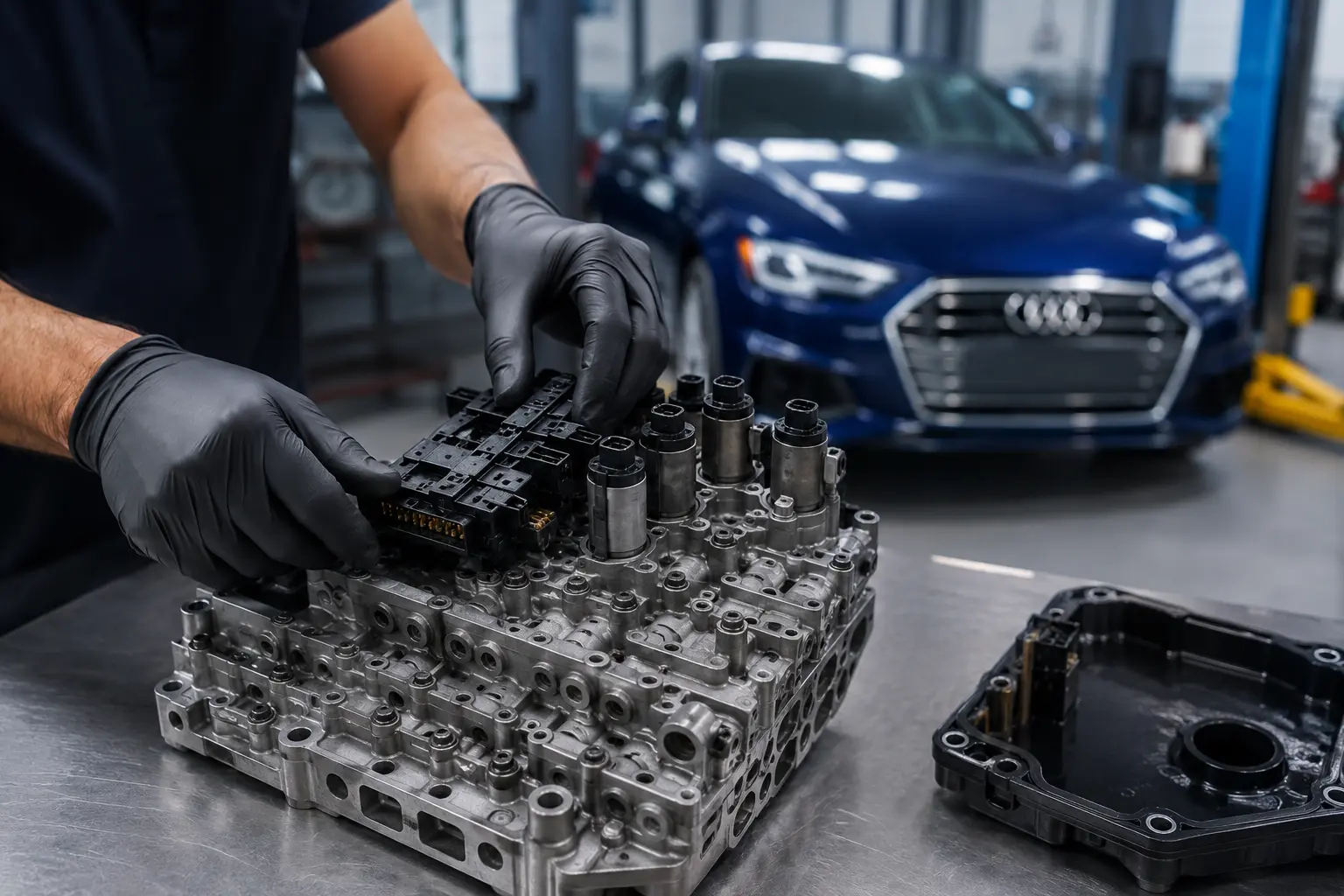
Hydraulics and electronics share one working environment
The valve body routes oil pressure to clutch and gear actuators. Solenoids meter pressure while sensors report position, speed and temperature. The controller combines those signals with engine and vehicle data to manage each shift.
A fault can be electrical, hydraulic or both. Contamination may affect valve movement, while heat can expose a circuit fault absent when cold. Testing determines whether repair stays local or requires a complete assembly route.
- Check the printed transmission and component identifiers.
- Record installed software and fault freeze-frame information.
- Inspect connectors, pins, wiring and signs of fluid migration.
- Compare requested values with actual values under controlled conditions.
A fault code starts the test; it does not finish it
The useful comparison is between what the controller requested, what the sensors reported and what the vehicle actually did.
| Observed complaint | Data or measurement to compare | Possible mechatronic route | Important lookalike |
|---|---|---|---|
| Slow drive engagement | Pressure build time, command state, clutch position, oil temperature | Pressure leak, valve or solenoid response | Worn clutch pack, incorrect oil level |
| Harsh 2–3 or 3–2 shift | Input/output speeds, clutch overlap, torque reduction request | Control valve, pressure regulation or learned-value issue | Engine torque interruption, mount or driveline play |
| Judder from standstill | Clutch slip, contact point, temperature and adaptation position | Adaptation or control inconsistency | Clutch wear, contamination or flywheel movement |
| Loss of drive when hot | Hydraulic pressure, oil temperature, current draw and selector state | Heat-sensitive electronic or hydraulic fault | Low oil, internal mechanical leak or clutch failure |
| Intermittent warning after start | Battery voltage history, terminal 15/30 supply, network faults | Controller supply or communication fault | Weak battery, ground or gateway issue |
| No reverse | Requested gear, selector position, actuator travel and pressure | Solenoid, valve or actuator-control fault | Selector mechanism or mechanical gear damage |
| Gear unavailable message | Gear-position plausibility, speed sensors, adaptation limits | Sensor or internal electronic route | Mechanical selector or clutch limit reached |
| Fluid around connector | Leak source, connector condition and harness contamination | Seal, sleeve, housing or internal migration repair | Leak from another gearbox joint above the area |
We need the right transmission identity before a price
S tronic is a family name, not one interchangeable gearbox. Audi applications use different layouts, clutch types, torque capacities, control units and oil requirements. The vehicle model alone may not settle the identity because powertrain, production date and market specification can change the installed unit.
We use the VIN, gearbox code, component number and scan identification together. That prevents a quotation for the wrong mechatronic variant and helps confirm whether coding, component protection, software, basic settings or adaptation will be required after installation.
- Wet-clutch systems use transmission fluid for clutch cooling and control.
- Dry-clutch systems separate the clutch friction surfaces from the hydraulic circuit.
- Longitudinal and transverse installations have different assemblies and access.
- Quattro configuration, engine torque and production revision can affect compatibility.

Six routes that can be mistaken for a failed mechatronic
These checks reduce the risk of paying for a unit that cannot correct the fault.
Unstable supply
Low starting voltage, a weak ground or charging fault can produce communication errors, implausible sensor readings and poor actuator behaviour. Voltage is checked under load, not from a resting reading alone.
Wear or adaptation limit
A clutch pack can judder, slip or reach its learned travel limit while the mechatronic unit still follows commands correctly. Clutch data and physical condition guide the next step.
Noise and vibration
A dual-mass flywheel or mount can create vibration, knock or take-up harshness. The symptom may feel like poor shift control but requires a mechanical inspection.
Wrong level or condition
The correct fluid, level procedure and temperature window matter. External leakage or contaminated oil can reduce pressure or alter valve response without an electronic failure.
Power or CAN interruption
Connector corrosion, pin tension, damaged wiring or a network issue can interrupt the controller. Continuity alone is not enough when the circuit fails only under load or movement.
Selectors, bearings or gears
Metal debris, grinding, abnormal shaft noise or failure confined to a mechanical ratio can point beyond the mechatronic unit. This belongs to the broader gearbox-repair route.
The route follows the confirmed failure and contamination risk
Compare part price with compatibility, internal condition, coding and the written warranty boundary.
Identify
Confirm the transmission code, mechatronic part number, software identity, clutch configuration and oil specification.
Reproduce
Capture the complaint safely and note the conditions that trigger it, including temperature, load, gear and time.
Measure
Compare supply voltage, wiring integrity, live data, pressure behaviour, clutch values and oil evidence.
Choose
Price only the route supported by the results, with inclusions, exclusions and follow-on risks stated.
Pressure behaviour explains what a code cannot
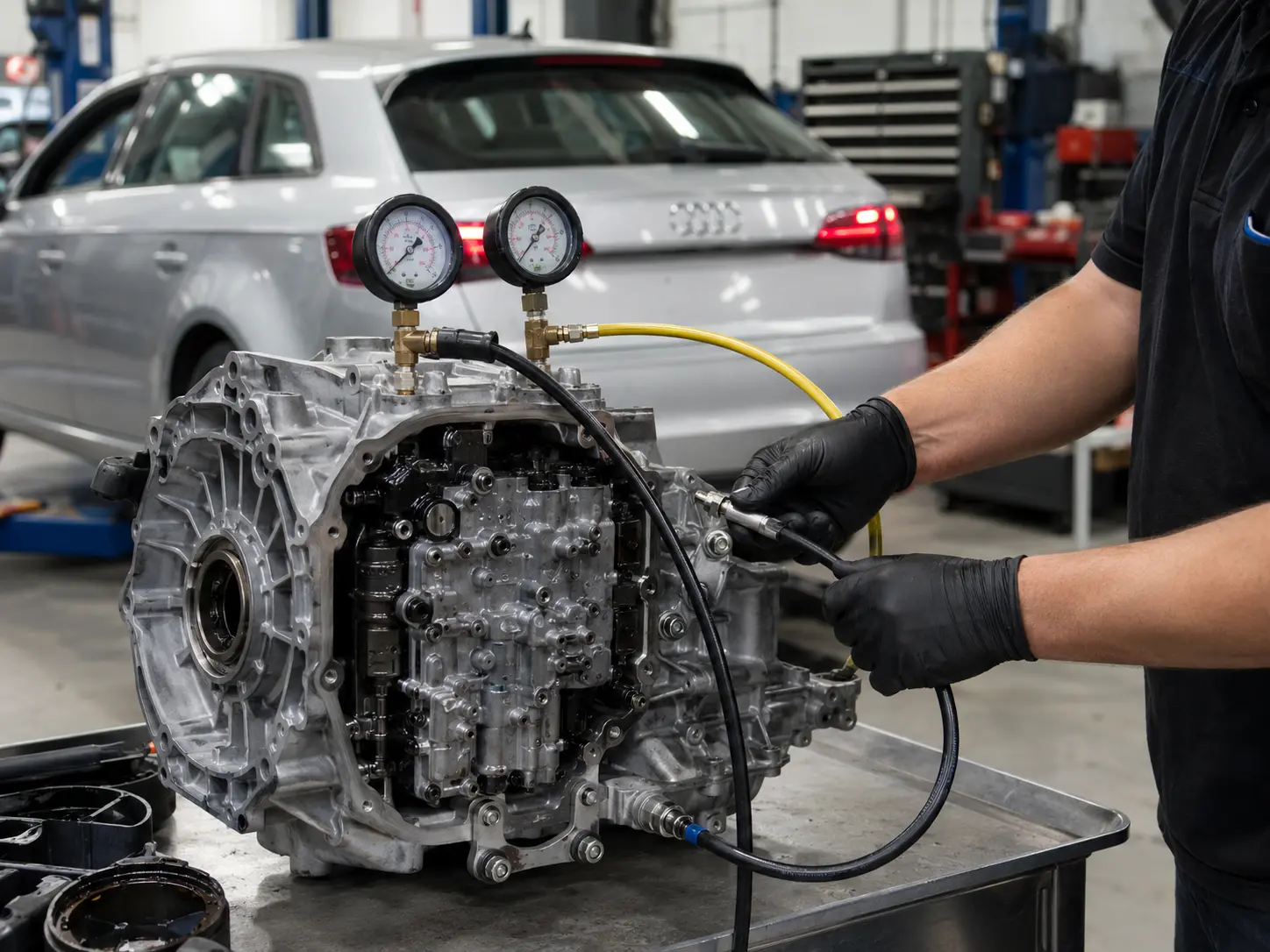
A controller may request pressure correctly while the measured response arrives slowly, falls away or oscillates. The next question is why. The cause could sit in a pump, accumulator, valve, solenoid, seal, worn bore or internal leak. Oil temperature can change the result, so a cold check may not reproduce a complaint that appears after traffic.
Where the transmission design and access allow, hydraulic testing is combined with scan data and electrical checks. The aim is to narrow the failed area before the assembly is opened or replaced. Dismantling is recommended only when the inspection path justifies it and the customer approves the next stage.
Four ways the estimate can move
The written estimate should name the part route, programming work, oil and filter scope, VAT treatment, testing and any item that remains conditional.
Targeted component repair
Suitable when the failed area is identifiable, repair access is practical and contamination or widespread damage does not undermine the result.
- Specific seal, sleeve, solenoid, sensor or circuit work
- Cleaning and controlled inspection
- Reassembly, oil procedure and basic settings as required
Rebuild the original unit
The original mechatronic is removed, assessed and rebuilt to the confirmed specification where a competent rebuild route and correct internal parts are available.
- Original identity retained where practical
- Wear items and failed areas addressed to agreed scope
- Commissioning and verification after refitting
Matched replacement
A new or supplier-rebuilt replacement may suit severe damage, an unrepairable controller or a unit that has already received poor-quality work.
- Part number and revision matching
- Coding, component protection or software where applicable
- Return-core conditions stated before approval
Non-mechatronic repair
The correct outcome may be battery, wiring, oil-service, clutch, flywheel, mount or internal gearbox work. We redirect the estimate rather than forcing the original assumption.
- Separate parts and labour scope
- No unit replacement without supporting evidence
- Route to Audi gearbox repair for internal mechanical work
Planning ranges before VIN and test results
These tentative Dubai planning bands include 5% VAT. Transmission identity, access, fluid, part source, software, core return and inspection findings can change the estimate.
| Inspection, part or repair route | Tentative AED | Typical inclusion and boundary |
|---|---|---|
| Initial symptom scan and road-test assessment | 315–525 | Network scan, complaint review and safe road test where the car can be driven; dismantling excluded. |
| Advanced transmission live-data session | 420–735 | Logged values under the fault condition; hydraulic hardware testing and removal excluded. |
| Battery, charging and supply-voltage checks | 210–420 | Load-related supply and ground checks; battery or alternator parts excluded. |
| Transmission wiring and connector inspection | 315–840 | Accessible harness, pins, supply and network checks; major loom removal excluded. |
| Oil level and visible-condition verification | 315–630 | Correct-temperature level procedure and accessible leak check; oil replacement excluded. |
| Pressure diagnosis where test access permits | 630–1,260 | Controlled pressure checks and data comparison; transmission removal excluded. |
| Basic settings or adaptation attempt | 420–840 | Performed only when preconditions and mechanical condition are suitable; no promise that adaptation cures a fault. |
| Software update or configuration work | 630–1,575 | Depends on installed control unit, access and supported software route. |
| External connector sleeve or seal repair | 735–1,470 | Accessible seal, labour and required top-up fluid; wider leakage or loom contamination excluded. |
| Targeted solenoid diagnosis and repair | 1,575–3,675 | One confirmed hydraulic-control route; final band depends on unit access and parts. |
| Internal sensor or electronic repair route | 1,890–4,725 | Bench assessment and identified internal repair; replacement controller excluded. |
| Valve-body cleaning and targeted service | 1,680–3,990 | For a suitable, repairable unit; worn bores or hard-part damage may change the route. |
| Accumulator or pressure-storage repair | 1,575–3,360 | Only for compatible designs and confirmed failure; housing damage excluded. |
| Mechatronic removal and refitting labour | 1,260–3,150 | Varies substantially by transmission layout and access; parts and fluids excluded. |
| Rebuild of original mechatronic unit | 4,200–8,925 | Indicative unit and labour route for repairable originals; exact internal scope follows strip inspection. |
| Supplier-rebuilt matched mechatronic unit | 6,300–12,600 | Correct revision required; core deposit, coding and fluid may be separate. |
| New matched mechatronic unit | 9,450–18,900 | Part availability and exact transmission identity dominate the price; installation extras stated separately. |
| Used mechatronic unit assessment | 2,625–6,825 | Used part only or initial route depending on source; compatibility, coding and condition risk remain. |
| Transmission oil and filter service | 945–2,100 | Correct specification and quantity for the fitted system; not a repair for confirmed hard faults. |
| Additional oil after mechatronic work | 420–1,260 | Depends on drained volume and specification; included only when stated in the estimate. |
| Clutch adaptation after related work | 420–840 | Basic settings and learning procedure where supported; worn clutch parts excluded. |
| Clutch pack route discovered during diagnosis | 4,725–11,550 | Separate non-mechatronic estimate; configuration, parts tier and flywheel condition alter the band. |
| Dual-mass flywheel route | 3,675–8,925 | Separate mechanical estimate when inspection confirms movement, noise or damage. |
| Internal gearbox inspection after debris | 2,100–5,250 | Removal or strip assessment may be needed; subsequent mechanical parts are not included. |
| Post-repair road test and final scan | Included–630 | Normally included in an approved repair; may be separate after customer-supplied or external work. |
| Recovery within Dubai | 210–630 | Depends on collection point, vehicle condition and recovery equipment; quoted before dispatch. |
How separate items build a total
These four examples are hypothetical and include 5% VAT. They are arithmetic illustrations, not records of customer jobs or promises for a particular Audi.
Electrical supply fault, no mechatronic repair
A voltage and connector route finds a poor ground and the mechatronic responds normally after repair.
- Diagnosis
- AED 420
- Ground repair
- AED 315
- Final scan
- AED 210
- Total
- AED 945
External seal and fluid correction
Inspection confirms leakage at an accessible connector sleeve with no harness contamination.
- Diagnosis
- AED 525
- Seal repair
- AED 945
- Fluid
- AED 525
- Final test
- AED 315
- Total
- AED 2,310
Original-unit rebuild route
The correct unit is repairable and the approved scope includes removal, rebuild, fluid and commissioning.
- Diagnosis
- AED 735
- Remove/refit
- AED 2,100
- Unit rebuild
- AED 5,775
- Oil and filter
- AED 1,365
- Commissioning
- AED 630
- Total
- AED 10,605
Matched replacement route
A damaged unit requires a matched supplier-rebuilt replacement with installation and configuration.
- Diagnosis
- AED 735
- Replacement unit
- AED 8,400
- Remove/refit
- AED 2,625
- Oil and filter
- AED 1,575
- Coding/adaptation
- AED 945
- Total
- AED 14,280
Clutch, flywheel and mechatronic are not one item
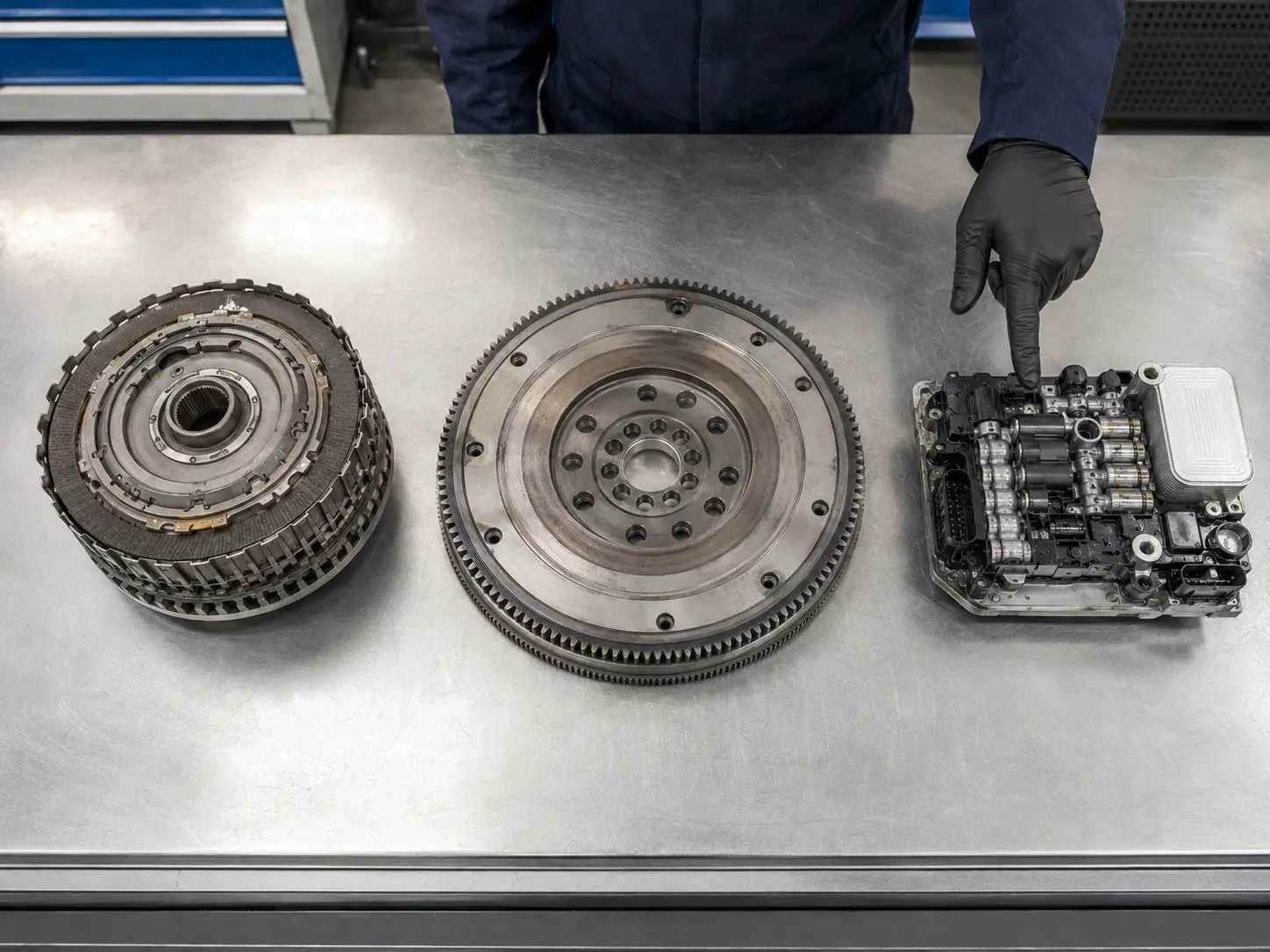
The clutch pack transfers engine torque. The flywheel manages torsional movement between the engine and transmission on applications that use one. The mechatronic assembly controls hydraulic and electronic shift functions. A symptom can involve more than one area, but the estimate should still separate them.
If clutch wear has driven adaptation to its limit, installing a control unit alone does not renew the friction material. If the flywheel has excessive movement, software cannot remove the mechanical play. If the mechatronic cannot build pressure, replacing a healthy clutch pack does not restore hydraulic control. The test results should show which relationship applies.
From complaint to controlled handover
The process preserves diagnostic information, controls approval and checks the result under the original fault conditions.
Record the operating complaint
We note the warning text, affected gears, temperature, road condition, recent battery or transmission work and whether the symptom is repeatable. This prevents a vague “gearbox problem” from becoming an equally vague parts quotation.
Identify the installed system
The VIN, transmission code, component identification, software information and wet or dry clutch configuration are recorded. Fluid and part decisions are tied to that identity.
Preserve codes and freeze-frame data
Codes are read before clearing. We check related engine, ABS, battery-energy and gateway information because the transmission may be reacting to another module or supply problem.
Inspect supply, wiring and oil evidence
Power, ground, connector condition, visible leakage and oil condition are checked within the agreed diagnostic scope. Metal debris or a major leak can redirect the job immediately.
Reproduce and measure
A controlled road test or workshop test compares requests with actual pressure, speeds, temperatures, clutch values and selector behaviour. Unsafe vehicles are not road tested.
Present repair routes
The estimate distinguishes targeted repair, rebuild, matched replacement and non-mechatronic work. It states parts tier, labour, fluids, VAT, programming, exclusions and conditional items.
Repair only after approval
Removal or opening may reveal wear that was not visible externally. If the agreed scope changes, work pauses for a revised explanation and approval.
Commission and verify
Oil level, basic settings, adaptations and software steps are completed where the system requires them. We then repeat the relevant scan and driving checks before handover.
Compare the complete fitted route
Compare compatibility, core conditions, software, oil and the repair-specific written warranty with the part price.
New matched unit
Usually the highest part cost and dependent on exact availability. Confirm the part number, supersession, installation items and commissioning work.
Rebuilt original
Can preserve the known vehicle unit when it is repairable. Ask what internal work is included and what evidence would make it unsuitable after opening.
Supplier-rebuilt exchange
Compatibility and supplier quality matter. Confirm the core-return deadline, deposit, covered components and whether prior coding can be transferred.
Used unit
Lower purchase cost can carry unknown wear and compatibility risk. Part number, revision, donor condition and software requirements need careful checking.
Customer-supplied parts can change labour, diagnostic and warranty boundaries. Read the site’s parts and warranty policy before choosing a supply route.
A wiring fault can imitate an internal controller failure
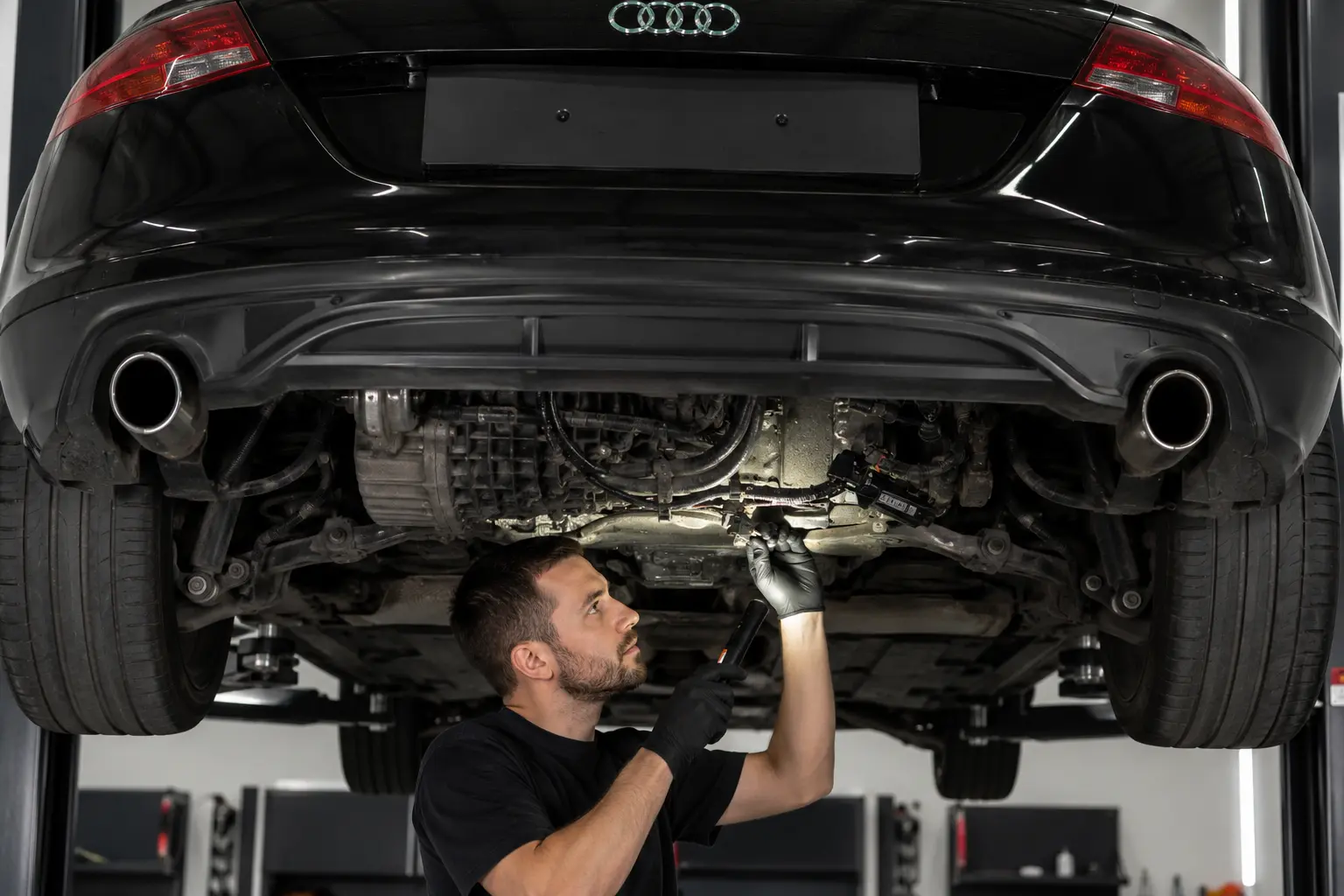
The transmission controller needs stable power, clean grounds and reliable CAN communication. A damaged pin, fluid migration, corrosion, harness movement or voltage drop can interrupt an otherwise serviceable unit. These faults may be intermittent and may only appear when hot or under vibration.
Testing follows the circuit under the condition that causes the complaint. A continuity reading with the vehicle switched off cannot prove the circuit remains healthy under load. Where the fault sits outside the transmission assembly, the job may move to the Audi electrical diagnosis and repair route instead.
The original symptom must be checked again
A cleared warning light is not enough. The repaired system needs correct fluid level, completed commissioning steps and a repeat check under relevant operating conditions.
Leak inspection, supply voltage, connector security and fault-memory review.
Required initialization, clutch values or selector learning for the installed system.
Safe verification of engagement, the affected shift, temperature and warning status.
Repair route, installed parts, fluid, observations and remaining recommendations.

Fluid condition changes the repair conversation
Correct fluid supports hydraulic control and lubrication. The specification and level procedure depend on the fitted transmission. Dark fluid alone proves little, but burning odour, heavy contamination, metal debris, water or a major level error can change the repair risk.
Mechanical debris may expose a repaired unit to the same contamination. The recommendation should say whether an oil service is support work or the findings justify wider gearbox inspection.

Audi mechatronic repair FAQs
What is an Audi mechatronic unit?
It is the electro-hydraulic control assembly used in relevant automatic and dual-clutch transmissions. It contains control electronics, sensors, hydraulic channels and solenoids that manage clutch and gear operation. The exact design depends on the transmission family.
Does a gearbox warning mean the mechatronic has failed?
No. The warning shows that the transmission controller detected a condition requiring attention. Voltage, wiring, sensor information, clutch wear, oil level, software and mechanical faults can produce similar warnings. Diagnosis should identify the cause before a unit is ordered.
Can an Audi mechatronic unit be repaired instead of replaced?
Sometimes. A targeted repair may be viable when the failed component or hydraulic area is identifiable and the unit is otherwise suitable. Severe contamination, housing damage, an unrepairable controller or poor prior work may make a rebuild or matched replacement more sensible.
How much does Audi mechatronic repair cost in Dubai?
Planning ranges on this page start with diagnosis around AED 315–1,260 and extend to several thousand dirhams for targeted work, rebuilds or replacement. Exact cost depends on the transmission code, failed area, access, parts route, oil, software and condition found after removal. Numeric ranges shown include 5% VAT.
Is S tronic the same as DSG?
S tronic is Audi’s name used for several dual-clutch transmission applications. DSG is a broader Volkswagen Group term. The labels do not make every unit interchangeable. Gearbox code, clutch type, orientation, torque rating and component number still need confirmation.
Can a weak battery cause mechatronic fault codes?
Low or unstable voltage can cause control-module communication and actuator problems. A battery or supply fault does not explain every gearbox code, but voltage history, load response, power and grounds should be checked when the fault pattern supports it.
Will adaptation fix a harsh shift?
Adaptation can be appropriate after specified repairs or when learned values need resetting within a healthy system. It does not repair worn clutches, hydraulic leakage, damaged wiring or mechanical faults. Preconditions and measured values should be checked first.
Can I keep driving with a mechatronic warning?
It depends on the symptom. Stop and seek advice if drive disappears, the vehicle selects neutral unexpectedly, there is a major leak, grinding, burning smell or severe impact. A stable warning with normal drive still deserves prompt diagnosis because the fault can become less predictable.
Do you need the VIN before quoting?
The VIN is strongly useful because model and year alone may not identify the exact transmission or mechatronic revision. A preliminary diagnostic range can be discussed from the symptoms, but a part or fitted-repair quotation needs confirmed component identity.
Does mechatronic replacement require coding?
Many replacement routes require some combination of coding, parameterization, component protection, software, basic settings or adaptation. The requirement depends on the vehicle, controller and replacement source. It should be stated in the estimate rather than assumed.
Is transmission oil included in the price?
Only when the written estimate says so. Fluid quantity and specification vary, and some removal procedures lose more oil than others. Ask whether oil, filter, seals, level setting and VAT are included in the quoted total.
Can clutch wear damage the mechatronic unit?
Clutch wear can push control and adaptation values toward their limits and change operating loads, but the relationship needs evidence. A worn clutch and a mechatronic fault can also exist independently. Both systems should be assessed before choosing parts.
Is a used mechatronic unit a sensible option?
It can reduce the initial parts cost, but condition, compatibility, software and warranty risks are higher. The correct part number and revision must be checked, and the estimate should include any coding, oil, seals, labour and the result if the used unit proves unsuitable.
What happens if metal is found in the transmission oil?
The amount and type of debris matter. Significant metal can indicate internal mechanical wear and may make a control-unit-only repair poor value. The next step may be a wider inspection under the Audi gearbox repair route.
What should I send on WhatsApp for a first assessment?
Send the model, year, VIN if available, exact warning text, when the symptom occurs and any recent battery or gearbox work. Add stationary photos of the warning and a short safe video if it helps. Do not record while driving.
Get an Audi mechatronic diagnosis before ordering a unit
Call with the model and symptom, or build a WhatsApp message that includes the details needed for the first assessment. We will explain the inspection route and what must be confirmed before a repair or replacement price becomes reliable.